
A local SEO content strategy is a plan for publishing pages and posts that prove three things to customers and search engines: where you work, what you do there, and that real people nearby trust you. Start with one strong page per service and per place you genuinely serve, add answers to the questions customers ask before they call, and keep a light calendar tied to your busy seasons. Everything below shows how to do that without turning your site into a pile of near-identical city pages.
TL;DR
- Build content in this order: service pages, then location pages, then answer-style posts, then seasonal pieces.
- Create a geographic page only when it has a clear customer purpose and enough unique, useful detail to keep current.
- Mine your own calls, emails, reviews and sales conversations for blog topics before you open a keyword tool.
- Run a calendar of one to two quality pieces a month, planned around your demand peaks, and review it quarterly.
- Measure leads, calls and map pack visibility, not just traffic.
Table of Contents
- What local SEO content is actually for
- Start with the content you already need
- How to organize a local content hub
- Build a local content plan in five steps
- Finding local blog topics people actually want
- Build a calendar you can keep
- Multi-location content without duplication
- Our perspective: content should reduce a customer’s risk
- Measure what the content earns
- Where we can help
- FAQ
- Sources
What local SEO content is actually for
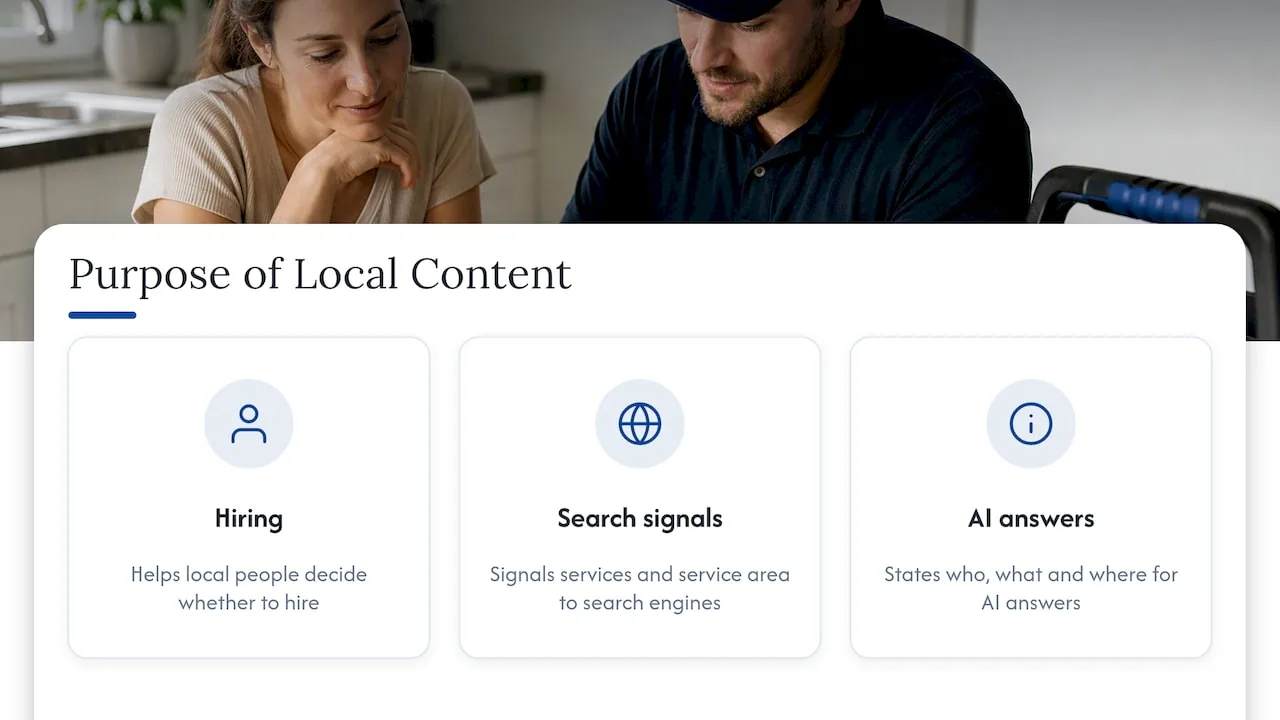
Local content has a narrower job than general blogging. It helps a person in a specific place decide whether to hire you, and it gives search engines clear signals about your services and service area. Google’s own guidance on this is consistent: it asks for people-first content that leaves a visitor satisfied, with SEO practices applied to add value rather than replace it.
That changes how you plan. A page exists because a customer needs it, not because a keyword exists. The question for every item on your list is simple: would a homeowner, patient or event planner in this town find this useful at the moment they are choosing?
There is also a practical reason to be specific. Local pack rankings lean heavily on your Google Business Profile, reviews and proximity, and your website content backs those signals up. If you have not tightened the profile side yet, our guide to Google Business Profile optimization covers the fixes that tend to drive calls. Content then does the work the profile cannot: it explains, proves and answers.
Another way to see it: a smart local content plan makes your business easy to describe. When someone asks an AI assistant who handles a specific job in your city, the answer is built from pages that state clearly who you are, what you do and where. Vague pages get skipped.
Start with the content you already need
Before planning anything new, list the pages a local customer expects to find. Most service businesses are missing at least one layer.
Layer 1: Service pages
Every core service gets its own page that describes the job, the process, what affects cost, how long it takes, and who does the work. A roofing company needs separate pages for repair, replacement and storm damage rather than one “services” page. These pages carry the most commercial intent, so they come first.
Layer 2: Location pages
Location pages come next, and this is where most businesses go wrong. The temptation is to clone a service page for every suburb and swap the name. Practitioners at Search Engine Land make the opposite point: the goal of a geographic page is not to rank for every place name but to give locally relevant information that helps a customer decide and shows a credible local presence.
The same source advises creating geographic pages only when they have a clear customer purpose, legitimate business relevance and enough useful information to maintain. In practice, that gives you a test:
- Do you have a physical location, a crew that is based there, or a real record of jobs in that area?
- Can you name something unique to say: local permits, neighborhoods you serve, project photos, a local manager, reviews from customers there?
- Will you still update the page in a year?
If the answer to any of these is no, fold that area into a broader page instead.
Layer 3: Answer content
This is the blog, FAQ and guide layer. It handles the questions that come before a purchase, such as how much something costs, how long it takes, what a permit requires, or what to do in an emergency. It is also the layer most likely to be quoted in AI-generated answers, because it is written as a direct response to a question.
Layer 4: Proof content
Case studies, project galleries, before-and-after photos, team bios and local testimonials. This layer is easy to overlook, but it is the one competitors cannot copy.
How to organize a local content hub
A local content hub is a set of pages that link to one another around a topic, so that visitors and crawlers can see how everything connects. For a local business, the cleanest structure looks like this:
| Level | Page type | Example for a dental practice | Links to |
|---|---|---|---|
| Hub | Main service page | Dental implants | All supporting pages below |
| Spoke | Location page | Dental implants in a specific neighborhood or office | Hub, office contact page |
| Spoke | Answer post | How long does dental implant healing take? | Hub, booking page |
| Spoke | Proof page | Implant case study with patient consent | Hub, location page |
Keep the hierarchy shallow. Visitors should reach any page within three clicks of the home page, and each spoke should link up to its hub and across to one or two relatives. Descriptive anchor text does more good than “read more.”
If you cover a wide territory without a storefront, the structure changes a little. Google’s guidelines say a business should have only one profile, and a service-area business should have one profile for its central location with a designated service area. Your website can still describe the areas you serve, but it should not pretend to have offices that do not exist. Our service area business SEO plan walks through how to handle this over 90 days.
Use structured data to match the content
Mark up your pages so the facts on them are machine-readable. Google’s documentation tells site owners to use the most specific LocalBusiness subtype available, such as a more specific type than a generic business. Match it to what is visible on the page: name, address, phone number, hours and the services you list.
Build a local content plan in five steps
The approach below works for a single-location company and scales to a franchise. It is built to be finished in a week and revisited every quarter.
Step 1: Rank your services by value
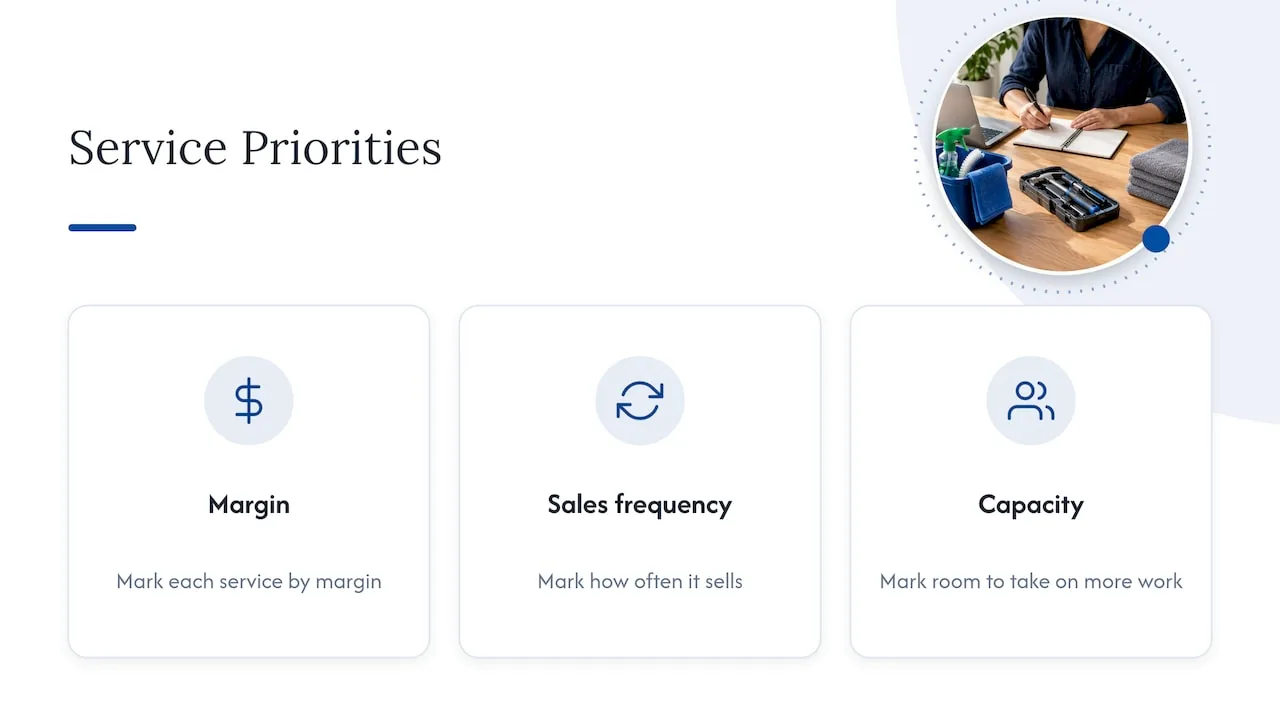
List your services and mark each by margin, how often it sells, and how much room you have to take on more of it. A law firm may earn most from two practice areas and get most inquiries about a third. Content for the first two earns priority.
Step 2: Rank your locations
Do the same for places. Mark where you already have reviews, where jobs cluster, and where competitors are weak. Start with locations where you have a real presence and proof.
Step 3: Map search intent to page types
Intent decides the format:
- Ready to hire (“emergency plumber”, “roof replacement near me”): service and location pages with a clear call to action. Our near me SEO checklist covers how to meet that intent.
- Comparing options (“cost of”, “best way to”): detailed guides with price ranges, process and what to ask providers.
- Learning or troubleshooting (“why is my…”): short, direct answer posts.
- Checking trust (“reviews”, “licensed”): proof pages, bios and credentials.
Step 4: Pick a primary page for each topic
Write down the one page that should rank for each topic and place. When two of your pages compete for the same query, merge or differentiate them. Search Engine Land’s perspective on competing with your own content is useful here: rather than chasing a fixed percentage of unique versus shared text, focus on what is most useful to the user.
Step 5: Set a minimum standard
Decide what every page must contain before it goes live. A workable standard: a clear answer in the first paragraph, at least one local detail that is actually true, a photo from a real job, a named author or reviewer, and a next step.
Finding local blog topics people actually want
Keyword tools show volume, but the best local topics come from your own customers. Local queries are often tiny in volume, so a topic with ten searches a month can still be worth a page if it matches a ready-to-hire customer.
- Phone and email logs. Write down the first question each caller asks. If three people asked it this month, it is a post.
- Reviews, yours and your competitors’. Look for what customers praise and what they complain about. Both are content ideas.
- Your front line. Ask estimators, receptionists and technicians what they explain every day.
- Google itself. Type your service and city into search and note the People Also Ask boxes, autocomplete suggestions and the questions that appear in your Business Profile Q&A.
- Local rules and events. Permit rules, municipal programs, weather patterns and community events all produce topics that national sites cannot cover well.
A short example of the output. A dumpster rental company might end up with posts on which permits a driveway placement needs in a given city, what cannot go into a dumpster under local rules, and how weight limits affect pricing. Our breakdown of dumpster rental SEO in Atlanta shows how that kind of local specificity plays out.
For help turning topics into a clear structure, a locksmith’s guide to organizing a content strategy shows how a service business can group its content around what customers need most.
Build a calendar you can keep
Most local content calendars fail because they are too ambitious. Twelve posts a month for three months, then silence, does less than one strong piece a month for a year.
Pick a realistic cadence
For a single-location business, one or two substantial pieces a month is plenty. Franchises should publish per-location updates on a lighter rhythm, such as a quarterly refresh of each location page, plus central content on shared topics.
Plan around your demand curve
Pull twelve months of leads or calls and mark the peaks. Publish seasonal content four to eight weeks before each peak so it has time to be crawled and found. The pattern differs by trade:
| Business type | Typical demand driver | Content to publish ahead of the peak |
|---|---|---|
| Roofing and home services | Storm season, spring and fall maintenance | Storm damage checklists, insurance claim guides |
| Party and event rental | Graduations, holidays, summer weekends | Booking timelines, capacity and space guides |
| Dental and healthcare | Insurance benefit resets, back to school | Coverage explainers, new patient guides |
| Law firms | Tax season, school year changes, accident-heavy periods | Process guides, what to do after an incident |
Party rental is a good example of how local and seasonal content combine. Our Austin party rental SEO breakdown looks at how a seasonal business can plan for its peaks.
Reserve slots for evergreen refreshes
Put one slot a quarter on the calendar for updating an existing page: new photos, current pricing language, new reviews, fresh local details. Updating a page that already has links and history often does more than a new post.
A simple monthly rhythm
- Week 1: choose the topic and gather source material from the team.
- Week 2: draft and add real photos.
- Week 3: review for accuracy, add internal links, publish.
- Week 4: add a Google Business Profile post, share through email or social, and note results.
Multi-location content without duplication
Franchises and multi-office practices face a different problem: consistency without sameness. The guidance is to build only the minimum number of pages needed to reflect the business accurately, filled with unique and useful local information such as staff bios, local testimonials and region-specific regulatory or service details.
A flexible template helps. One company that publishes on local content automation recommends modular templates with dedicated fields for local landmarks, area-specific FAQs and localized business details. The principle holds even when you build pages by hand: fix the layout, but require each location to supply its own facts.
A location page template that works:
- Name, address, phone and hours, matching the Business Profile exactly.
- A short introduction from the local team or manager.
- Services available at that location, linked to the main service pages.
- Two or three real reviews from customers in that area.
- Local detail: parking, neighborhoods served, local rules or regional pricing factors.
- A set of questions customers at that location actually ask.
- Photos from that office or from recent jobs nearby.
For the bigger picture on structure, see our write-up on three moves for multi-location SEO.
Our perspective: content should reduce a customer’s risk
We work with local service businesses every day, and the same pattern repeats. Companies that struggle to rank rarely lack content. They lack clarity. Their pages say “quality service in the greater metro area” and never state who they are, what they do, or where, in terms a search engine or an AI assistant can lift into an answer.
Our approach is entity-first. We define the business clearly, then build content that supports that definition: service pages that match how people search, location pages grounded in real operations, and answer content that responds to real questions. The same pages feed traditional search, the map pack and AI answer tools, which is why we treat SEO, GEO and AEO as one stack rather than separate projects.
Our practical advice: publish fewer pages, and make each one the best answer to its question in your market. A single page that earns calls beats twenty that exist for crawlers.
, NSYGHT
Measure what the content earns
Traffic is a weak measure for local businesses. A page that brings forty visits and three calls is worth more than one that brings four hundred visits and none. Review these on a regular schedule, using the same list that applies to geographic pages: traffic, rankings, conversions, backlinks, internal links and indexing.
For a local business, translate that into a short dashboard:
- Calls and form fills from each content page, tracked with call tracking or events.
- Map pack visibility for your top services in your key locations.
- Profile actions: calls, direction requests and website clicks from your Business Profile.
- Indexing: every page you intend to rank should be indexed, and thin pages should not clog the index.
- Links earned: local mentions and links tied to content. Our local link building plan shows a community-first approach.
- AI referrals: check analytics for visits from AI assistants and note which pages they land on.
If a page gets impressions but no clicks, rework the title and opening. If it gets clicks but no calls, fix the call to action or add proof. If it gets neither after a few months, merge it into a stronger page.
It also helps to audit the full picture once a year. A GBP-first local SEO audit will show whether your content gaps sit on the site or in the profile, and our 40-item local SEO checklist gives you a starting list.
Where we can help
If you would rather have a team run this, we build and manage local content as part of our SEO plans and Google Business Profile management. Our social media marketing runs $299 per month with a one-time $179 setup, and one-off strategy sessions are available as consulting at $125 per hour. See the full list on our services page, or start with the NSYGHT home page to see how we work with dental practices, party rental companies, law firms and home service businesses.
FAQ
How often should I publish local content?
One or two high-quality pieces a month is enough for most single-location businesses. Consistency matters more than volume, and a refresh of an existing page counts as progress. Add more only if you can keep the standard high.
Do I need a page for every city I serve?
No. Create a page only when you have a real presence or track record there and can add unique, useful detail. For other nearby areas, mention them on a broader service area page instead of cloning content.
What should a local content plan include?
A ranked list of services and locations, the page type for each search intent, one primary page per topic, a minimum quality standard, and a calendar tied to your busy seasons. Add a review date each quarter.
How do I find local blog topics?
Start with the questions customers ask by phone, email and in reviews, then check Google’s People Also Ask and autocomplete for your service and city. Local rules, weather and events give you topics national sites cannot match.
Sources
- Creating people-first content: Google’s helpful content update
- Multi-location SEO: How to structure geographic pages
- Multi-location SEO strategy: Stop competing with your own content
- Guidelines for representing your business on Google
- Local Business structured data documentation
- Local SEO content automation