
Run a local SEO audit that starts with Google Business Profile and NAP accuracy, fix those first, then work through on-site and technical issues in order of impact. A proper audit is a structured review of every signal that determines whether Google and AI tools surface your business for local searches. Done right, it produces a prioritized fix list and, usually within weeks, better visibility in the map pack and in AI-generated answers.
- Ensuring NAP consistency across all major platforms and updating business information regularly is critical for building trust signals and improving local rankings.
- Review and optimize location-specific content with unique details and schema markup, ensuring each page responds to actual customer queries and local nuances.
- Regularly monitor local engagement metrics like reviews, calls, and direction requests, and respond promptly to maintain a trustworthy and active profile.
- Confirm that all technical SEO elements such as indexing, site speed, HTTPS, and canonical tags are properly configured to prevent hidden barriers to visibility.
- Incorporate AI visibility checks by testing prompts and matching website and GBP language to improve chances of your business being cited accurately in AI-generated answers.
Google Business Profile Audit: Exact Checks and Quick Fixes
Google Business Profile (GBP) carries more weight in local rankings than almost anything else you'll touch during an audit, and it's usually the fastest to fix. Start by confirming you actually own and control the listing, then check that the primary category matches what you do best, not just what sounds impressive.
Wrong categories and keyword-stuffed business names are the two most common errors, and both can trigger suppression or filtering from the map pack. Run through this list before touching anything else:
- Confirm listing ownership and manager access
- Verify primary category and add relevant secondary categories
- Check that hours, phone number, and website link are current
- Fill out the business description completely, without keyword stuffing
- Upload recent, geotagged photos
- Answer or seed the Q&A section
- List services or products with accurate descriptions
- Fix any keyword-stuffed business name to match your legal name
Google occasionally re-suggests category changes based on customer behavior. Check your GBP dashboard monthly for these prompts. Accepting a bad auto-suggestion is one of the sneakiest ways listings drift out of compliance.
NAP and Citation Audit: How to Find and Fix Inconsistencies
Your business name, address, and phone number (NAP) need to match exactly, character for character, across every platform that lists them. "Street" versus "St." or a disconnected old phone number sounds trivial, but it fragments the trust signal search engines use to confirm your business is real and stable.
Work through the cleanup in this order:
- Pull your current, correct NAP from GBP as the master record.
- Check top platforms first: Google, Bing Places, Apple Maps, Yelp, and any major aggregator or industry-specific directory relevant to your field.
- Log every inconsistency you find in a spreadsheet, including the URL and the exact discrepancy.
- Correct listings manually where you have direct access, and request updates where you don't.
- Re-check quarterly, or use an automated citation tool if you're managing more than a handful of locations.
Manual correction works fine for a single location. Multi-location businesses almost always need automation to keep pace with data-aggregator sync delays.
Review Profile Audit: Metrics and Actions That Improve Velocity
Reviews are a ranking signal and a conversion signal at the same time, so audit them on more than star rating alone. Pull these numbers for your business and note them somewhere you can track over time:
- Total review count and average rating across Google, Yelp, and any industry-specific platforms
- Review recency, meaning how many arrived in the last 30 to 90 days
- Review velocity, the rate new reviews accumulate month over month
- Your response rate and average response time
A business with 200 reviews from three years ago and nothing recent often loses to a competitor with 60 reviews and a steady weekly trickle. Recency and velocity frequently outweigh raw count. Set up a simple post-service review request workflow (a text or email link sent within 24 hours of service completion works well), and respond to every review, good or bad, within a few days. Both consistent responses and steady velocity feed into how confidently AI-generated answers cite your business as an active, trustworthy option.
On-Page Local Signals and Location Pages
Thin, duplicated location pages are one of the most common reasons multi-location businesses underperform in search despite a clean GBP. Every location or service page needs unique content that names the neighborhood, the specific services offered there, and something that couldn't be copy-pasted onto another page, like a landmark, a service area boundary, or a staff member local to that market.
Check each page against this list:
- Unique title tag naming the service and city (something like "Emergency Plumber in [City]," not a generic template)
- H1 that matches search intent, not just a repeated brand name
- At least 300 to 500 words of genuinely local content
- LocalBusiness schema markup placed in the page's structured data, following Schema guidelines
- Internal links connecting to related service pages and the homepage
- A clear call-to-action (call, book, get a quote) above the fold
Validate every schema implementation with Validator before publishing. Bad markup can leave a business invisible to AI extractors even when the page looks completely normal to a human visitor.
Technical SEO Checks Focused on Local Visibility
Technical problems quietly cap how far your other fixes can carry you, so this step confirms search engines and AI crawlers can actually reach and read your pages. Start with a site:yourdomain.com search and cross-check it against Google Search Console's coverage report to spot pages that are indexed, blocked, or duplicated.
Run through these checks in order:
- Confirm all location and service pages are indexed, not blocked by robots.txt or a stray noindex tag
- Test mobile page speed and Core Web Vitals, since Statista, and slow load times cost rankings and clicks
- Verify HTTPS is active sitewide with no mixed-content warnings
- Check canonical tags to prevent duplicate location pages from competing against each other
- Validate structured data with validator.schema.org
A page that's slow, unindexed, or duplicated is invisible no matter how good the content on it is.
Local Keyword and AI-Prompt Audit Plus Rank Tracking Setup
Knowing exactly what customers type, and now what they ask AI tools, is the difference between guessing and targeting. Build your keyword and prompt list from real behavior, not assumptions.
- Pull actual search terms from GBP Insights and Google Search Console's query report.
- Run manual searches for your top service terms plus your city to see who currently ranks.
- Test the same core questions in ChatGPT, Perplexity, and Gemini to see whether your business gets mentioned at all.
- Set up rank tracking by zip code or GPS coordinate rather than a single citywide average, since map pack results shift block by block.
A tool like Prescy's AI visibility tracking can help monitor how often, and how accurately, your business shows up in AI-generated answers over time.
Track rankings weekly if you're in a competitive category (dental, legal, home services), monthly otherwise. Daily tracking mostly just generates noise.
Backlink and Local Citation Quality Audit
A single mention from your city's chamber of commerce or local news outlet usually outweighs a dozen generic directory links, so audit for relevance, not volume. Search your business name in quotes to surface unlinked mentions worth converting into links, and check local associations, sponsorships, and press coverage for outreach opportunities you haven't claimed yet.
- Prioritize links from sites physically or topically tied to your service area
- Disavow only genuinely toxic links (spam networks, clearly manipulative anchor text), not just low-authority ones
- Pitch local journalists, associations, and complementary local businesses before chasing generic directory listings
Competitor Baseline and Priority Triage
Run the same checklist against your top two or three local competitors, since a tailored audit needs context on what "good" looks like in your specific market before you can prioritize your own fixes accurately.
- Score every finding on impact (high, medium, low) against effort (quick, moderate, heavy).
- Tackle high-impact, low-effort items first: GBP corrections, NAP fixes, schema errors.
- Schedule high-impact, high-effort items (new location pages, content rebuilds) as ongoing projects.
- Compile results into a short executive summary: current standing, top three fixes, expected timeline.
That last step matters more than most audits admit. A list of forty problems with no order of operations just overwhelms whoever has to act on it.
Reporting, Cadence, and Monitoring
Audits aren't one-time events. Reviews deserve a weekly glance, GBP metrics and citation health a monthly check, and a full audit a quarterly rerun. Track these KPIs consistently so you can actually measure movement:
- GBP profile views and search appearances
- Calls, direction requests, and website clicks generated from the profile
- Local rank positions by zip code
- Review count, rating, and response rate
Automated monitoring catches drift between check-ins; manual spot checks catch the weird stuff automation misses, like a category that silently reverted or a photo that got flagged and removed.
How NSYGHT Approaches a Local SEO Audit
NSYGHT builds audits around entity-driven architecture, combining traditional technical SEO with Generative Engine Optimization (GEO) and Answer Engine Optimization (AEO) so a business is legible to both search engines and AI tools at once. That means every audit checks not just rankings, but whether ChatGPT or Perplexity can correctly identify and recommend the business. The NSYGHT Stack explains how those pieces work together, and the Local SEO Checklist breaks the process into 40 items across eight categories.
Analysis of Google Maps Performance and Visibility
Map pack visibility runs on a different set of signals than organic search, and it's worth auditing separately because a business can rank well organically while barely showing up on Maps, or the reverse. Google weighs proximity, relevance, and prominence for map results, and proximity is the one variable you can't optimize your way around. It's baked into the searcher's location at the moment they search.
Start by checking how your listing performs for searches from different points around your service area, not just from your own office. A dental practice ranking third from downtown might not appear at all from a suburb ten minutes away, and that gap tells you where to focus content and citation-building efforts.
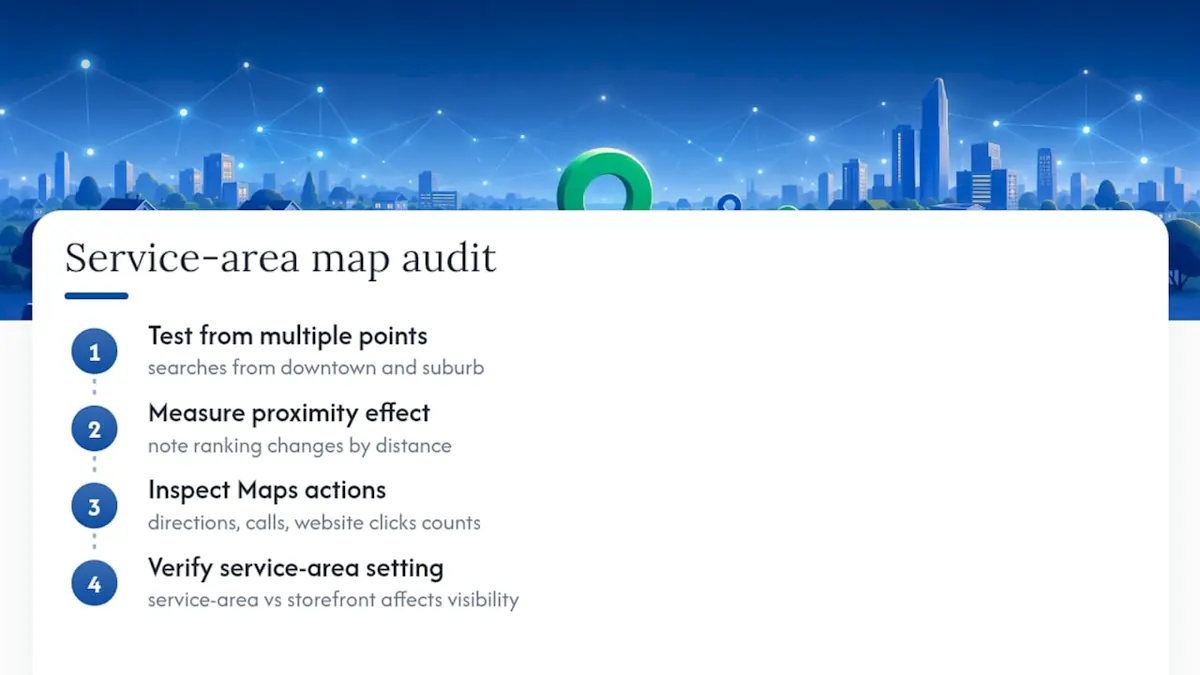
Look at the specific actions Maps reports back to you: how many people requested directions, how many tapped the phone number, and how many clicked through to the website directly from the Maps listing. A high view count paired with almost no direction requests usually signals a category or description mismatch. People are finding the listing but not recognizing it as the right fit for what they searched.
Check whether your service area setting (for businesses that travel to customers) versus a fixed storefront address is configured correctly, since this single setting changes how and where Google decides to show the listing. Misconfigured service-area businesses often lose visibility entirely in tight radius searches, even when every other signal is strong.
Assessment of Local User Engagement Metrics
Engagement metrics tell you whether people who find your listing actually do something about it, and that distinction separates a healthy profile from a merely visible one. Click-through rate from the map pack or local organic results, call volume, and direction requests are the three numbers worth tracking closest, because they measure intent to act rather than passive exposure.
Pull these numbers from GBP Insights and compare them against your impression count over a rolling 90-day window. A profile generating thousands of views but only a handful of calls or direction requests usually has a mismatch somewhere: wrong category, unclear services list, photos that don't represent the actual business, or a description that reads generic instead of specific.
Benchmark call volume against your industry norm where you can find one, but more usefully, benchmark it against your own trend line month over month. A sudden drop in calls despite stable views often points to a broken phone number, a call-tracking number that expired, or hours that no longer match reality.
Direction requests deserve particular attention for any business relying on foot traffic or drive-in customers. A spike in views without a corresponding spike in direction requests can indicate the listing pin is placed incorrectly, or that competing businesses nearby are simply presenting stronger profiles at the moment of decision. Cross-reference engagement drops against any recent GBP changes you made. Category shifts and description rewrites are common, overlooked culprits.
Evaluation of Localized Content Quality and Effectiveness
Localized content only earns its keep if it actually answers what a nearby searcher needs, and a surprising number of location pages fail this test while still technically existing. The gap usually isn't a missing page. It's a page that repeats the same three paragraphs across twelve cities with the city name swapped out.
Read your location pages the way a first-time visitor would, not the way you wrote them. Does the page mention anything specific to that neighborhood, like a cross street, a nearby landmark, a permit requirement unique to that municipality, or a staff member based there? Generic content ranks generically, and increasingly, it also gets ignored by AI tools summarizing local options, since those systems favor content with concrete, verifiable specifics over templated boilerplate.

Check whether your content answers the actual questions customers ask, pulled from real search queries and, increasingly, real AI prompts. A page optimized purely around a keyword phrase like "roofer near me" misses the more specific questions people actually type or speak into an AI assistant, things like typical repair costs in that city or how weather patterns there affect a particular service.
Effectiveness shows up in behavior, not intention. Track time on page, bounce rate, and whether visitors from a specific location page convert at a similar rate to your best-performing page. A location page with high traffic but a bounce rate far above your site average usually means the content promised something the page didn't deliver, or it simply doesn't read as locally credible once someone actually lands on it.
Why Audits Must Include AI Visibility Now
Traditional signals like GBP accuracy and clean NAP data still matter, but they now also feed how confidently AI tools cite a business in generated answers. Comprehensive audit guides now recommend testing manual prompts in major LLMs as a standard step, not an afterthought.
Keep your GBP description and your website's homepage copy describing the same services in nearly identical language. AI tools cross-reference both, and mismatches reduce citation confidence.
Get Your Local SEO Audit Done Right
A comprehensive local SEO audit covers GBP, citations, technical SEO, and AI visibility in one pass instead of piecing it together from multiple tools. That combination of entity-driven architecture plus GEO and AEO implementation helps businesses improve traditional rankings and get named correctly when someone asks ChatGPT or Gemini for a recommendation.
Grab the free Local SEO Checklist to run the basics yourself, or skip the manual work and request a full audit through NSYGHT's SEO services to get a prioritized fix list and a plan for AI visibility built in from the start.