
Claim and fully complete your Google Business Profile, then build a real review request habit, those two moves drive the fastest gains in booked calls. Expect Map Pack movement within 60 to 90 days once your profile, categories, and reviews are in shape. Organic content and link-building gains take 3 to 6 months to compound. Everything else in home services SEO builds on that foundation. For trade-specific playbooks, see our pages on plumber SEO, HVAC SEO, and electrician SEO.
- Claim and verify your Google Business Profile, then build a review request habit to see the fastest improvements in local map rankings within 60 to 90 days.
- Focus on selecting the most specific primary category, completing every profile detail, and optimizing city and service pages with genuine, localized content.
- Maintain a steady review flow by requesting reviews shortly after jobs, responding promptly, and avoiding incentives, to enhance ranking signals and conversions.
- Invest in technical SEO fixes like site speed, schema markup, and crawlability, as these can accelerate ranking improvements faster than content updates.
- Build prominence through consistent citations and local links from chambers, trade associations, and community sponsorships to strengthen your business’s authority over time.
What Should Home Service Businesses Do First for Local SEO?
Home services SEO rewards momentum, not perfection. Do these in order, and you'll see real movement in the map pack and a measurable lift in calls within the first quarter.
- Claim and verify your Google Business Profile. Set the most specific primary category available (not "Contractor" when "Roofing Contractor" exists), list every real service you perform, and fill out hours completely.
- Start requesting reviews on a schedule. Ask shortly after job completion using a direct link, and respond to every review promptly.
- Fix the NAP inconsistencies you can find in an hour. Check your top 10 directory listings for mismatched phone numbers, old addresses, or dead business names.
- Publish or refresh one service page and one city page. Pick your highest-margin service and your best-performing city first.
- Confirm phone prominence and click-to-call work on mobile. Test it yourself, on your own phone, on a slow connection.
- Run a fast technical audit. Prioritize mobile page speed since most home-service searches happen on a phone and convert by call.
Do the GBP and review work in the same week. Reviews influence GBP ranking signals directly, so stacking them accelerates the whole system instead of treating them as separate projects.
How Do You Optimize a Google Business Profile for Home Services?
Google ranks local results on three inputs: relevance, distance, and prominence. Your Google Business Profile is the single biggest lever you control across all three, because a complete profile increases relevance signals and directly feeds the Maps local pack and knowledge panel.
Distance is mostly out of your hands unless you adjust your service area settings. Prominence comes from reviews, citations, and links, which later sections cover. Relevance is where your GBP setup does the heavy lifting, and it's the one factor you can fix this afternoon.
Category selection matters more than most owners realize. Choose the single most specific primary category your business qualifies for. A water heater repair company should select "Water Heater Installer" over the generic "Plumber" if that option exists, because Google weighs primary category heavily in matching search queries to businesses. Add secondary categories only when they're genuinely accurate services you perform, not aspirational ones you'd like to grow into.
From there, complete every field GBP offers:
- Services section: list each service individually rather than lumping them into one line, since Google can match a search for "tankless water heater installation" to a specific listed service.
- Business description: write it for humans, mention your service area and specialties by name, and avoid keyword stuffing.
- Attributes: check every accurate box, from "identifies as veteran-owned" to "onsite services only."
- Photos: upload real job-site photos regularly, not stock images. Google's own guidance treats fresh, geotagged photos as an activity signal.
- Service-area settings: if you work from a truck or a home office rather than a storefront, hide your street address and configure your service areas by city or ZIP code instead.
Verification trips up more service-area businesses than almost any other step. Google frequently defaults to sending a postcard to a physical address, which creates a problem for truck-based operations that legitimately don't want that address public. Video verification and phone verification are increasingly available alternatives. If your postcard never arrives, check your GBP dashboard for alternate verification methods before assuming something is broken.
Once you've made changes, watch your GBP Insights weekly rather than daily. Ranking movement from profile edits tends to show up over several weeks, and daily checking mostly produces anxiety, not information.
Why Do Reviews Matter So Much for Local Rankings?
Reviews function as both a ranking signal and a conversion signal, doing double duty that almost nothing else in your SEO stack does. BrightLocal's research on local consumer behavior confirms that review volume, recency, and velocity all influence local ranking and directly shape which business a homeowner calls first.
The velocity part gets overlooked constantly. A business with 200 reviews from three years ago and nothing since often loses ground to a competitor with 40 reviews and five new ones this month. Steady, recent review activity tends to matter more for ranking than a large but stagnant total.
Build a request workflow, not a request event. Ask for the review within 24 to 48 hours of job completion, while the work is fresh and the homeowner is still relieved their pipe stopped leaking. Text message requests generally outperform email for response rate, since most homeowners read a text within minutes and an email within days, if at all. Send a direct link straight to your Google review form rather than your homepage, cutting out every extra click that gives someone a reason to abandon the request.
- Automate the initial request through your CRM or a dedicated review tool, but keep the message personal, using the technician's name and the specific job performed.
- Reserve manual, personal follow-up for VIP jobs, referrals, or situations where a homeowner seemed especially happy.
- Respond to every review, good or bad, within 48 hours, and never share a customer's address or job details in a public reply.
- Never offer a discount or incentive in exchange for a review. It violates Google's policies and it's easy for a competitor to report.
When a negative review lands, respond calmly, acknowledge the specific issue without getting defensive, and take the resolution offline with a phone number or email. Document a clear remediation path internally so your team handles the next bad review the same way, rather than reinventing a response under stress.
Ask "Would you help us out with a quick Google review?" instead of "Please leave us a review." The word "help" tends to outperform "please" in response rate, because it frames the ask as a small favor rather than a chore.
What Site Structure Actually Converts Homeowner Searches?
The winning structure is simple to state and tedious to execute well: one dedicated page per core service, and one dedicated page per city you genuinely serve. Industry playbooks consistently point to this service-plus-city page model as the structure that captures service-area search intent, and it works because it matches how homeowners actually search, pairing a problem ("water heater not working") with a place ("in Round Rock").
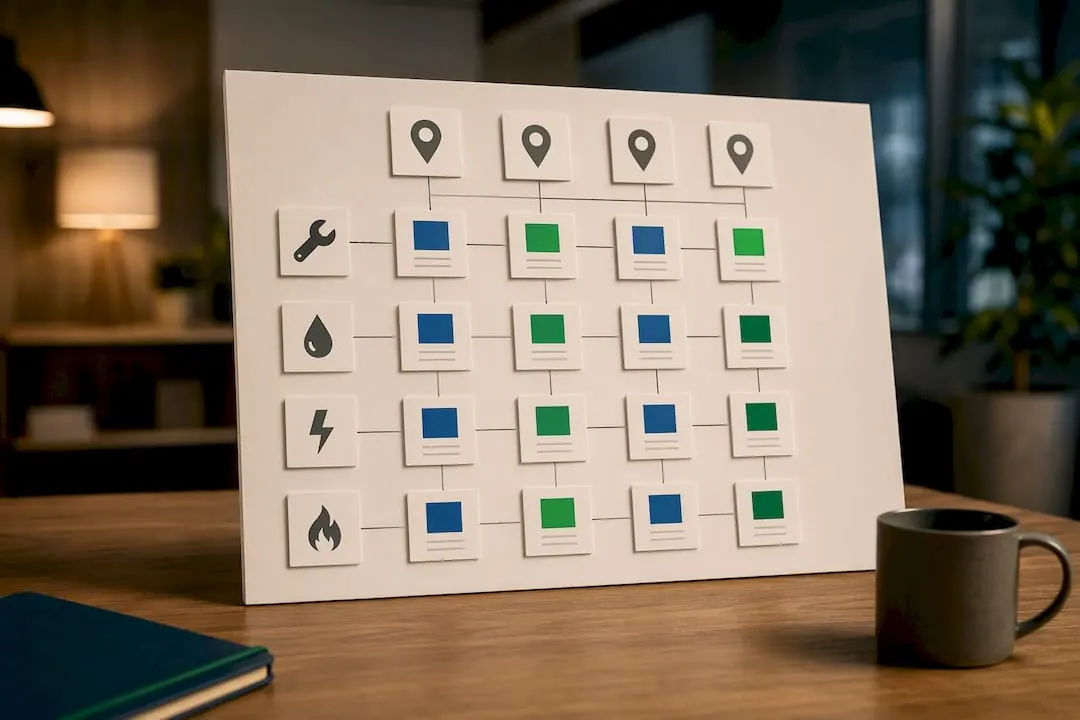
The mistake most contractors make is templating city pages until they're nearly identical, swapping out the city name and leaving everything else the same. Google notices this pattern, and so do homeowners who land on a page that clearly wasn't written for their neighborhood.
Every service page needs these elements:
- A headline that states the exact service and includes your target phrase naturally, not "Welcome to Our Services" filler.
- A description of the problems or symptoms that lead someone to search for this service, written in plain homeowner language.
- A clear scope of work explaining what's included, what's typically extra, and how the process runs.
- Pricing cues, even if it's just a range or a "most jobs run between X and Y" statement, since vague pricing pushes searchers toward a competitor who's more upfront.
- Trust signals: license numbers, insurance, years in business, and a handful of real reviews specific to that service.
- One prominent call-to-action, ideally a click-to-call button, repeated at the top and bottom of the page.
Every city page needs to feel like it was written by someone who's actually worked there:
- Mention real neighborhoods, landmarks, or housing stock common to that city, not generic filler about "the greater metro area."
- State clearly whether you offer same-day or emergency service in that specific location.
- Include a photo or two from a completed job in that city if you have one, since it does more to build trust than another paragraph of text.
- Link to the specific service pages relevant to that market, rather than a generic services list.
FAQ content deserves its own section on both service and city pages, marked up with FAQ schema. This does two things at once: it captures long-tail question searches ("how much does it cost to replace a water heater in an older home") and it feeds the structured, factual answers that AI-driven answer engines increasingly pull from directly.
Internal linking ties the whole structure together. Link every city page to its relevant service pages, link every service page to the cities you serve for that trade, and build a blog post occasionally that links back into both, creating a content cluster that signals topical depth to search engines rather than a scattered collection of disconnected pages.
Technical SEO Checklist: Speed, Crawlability, and Schema
A beautifully written service page does nothing if it loads in eight seconds on a work truck's cell signal or if a stray noindex tag keeps it out of Google entirely. Technical SEO is unglamorous, and it's also where visible ranking losses often hide.
Speed fixes that actually move the needle:
- Compress every image before upload; job-site photos straight off a phone are frequently 4 to 8 megabytes and slow a page down badly.
- Turn on browser caching so returning visitors don't reload every asset from scratch.
- Defer or asynchronously load non-critical JavaScript, especially chat widgets and tracking scripts that aren't needed for the first paint.
Mobile experience and page speed carry outsized weight for home services specifically, since the overwhelming majority of searches happen on a phone and convert through a phone call rather than a form fill. A slow mobile page doesn't just hurt rankings, it loses the call outright when a homeowner with a burst pipe closes the tab after three seconds of a spinning wheel.
Crawlability and indexing basics to check quarterly:
- Confirm your XML sitemap is current and submitted in Google Search Console.
- Check robots.txt isn't accidentally blocking service or city pages.
- Verify canonical tags point to the correct version of each page, especially after a site redesign.
- Search Console's coverage report will flag any page accidentally carrying a noindex tag, a common casualty of migrating to a new website platform.
Schema markup to add:
LocalBusiness schema on your homepage and contact page establishes your core business facts. Service schema on each service page ties that specific offering to your business entity. Review schema, where accurate and policy-compliant, can surface star ratings directly in search results. FAQ schema on service and city pages feeds the question-and-answer content search engines and AI tools pull into direct answers.
Call tracking done wrong can quietly wreck your local SEO. If you swap in a dynamic tracking number that differs from the number listed on your GBP and directories, you create a NAP inconsistency across the web. Use server-side number insertion or a call-tracking setup specifically built to preserve a consistent public-facing number, so your analytics stay intact without confusing Google about which number is actually yours.
Technical fixes tend to influence indexing faster than content or authority work. A sitemap or robots.txt fix can get a previously invisible page crawled within days, though ranking improvement from speed or schema changes still plays out over weeks as Google recrawls and re-evaluates your site.
How Do Citations and Local Links Build Prominence?
Prominence, the third pillar of local ranking, comes largely from how consistently and how well the rest of the internet vouches for your business. Citation cleanup and local link building are the standard levers guides point to for building this signal, and both reward a business willing to do unglamorous audit work.
Start with a citation audit. Search your business name across the top 15 to 20 directories, tools like Yelp, Angi, and the major data aggregators, and note every mismatch in name, address, or phone number. A business that moved offices two years ago but never updated its Yellow Pages listing is actively confusing Google about where it operates.
Where local links actually come from for a contractor:
- Your local chamber of commerce, which almost always includes a member directory link.
- Trade association directories specific to your license type (a state plumbing board, an electrical contractors association).
- Local news coverage, which often comes from sponsoring a community event or a Little League team rather than a press release.
- Supplier and manufacturer "find a dealer" or "certified installer" pages, if you carry a recognized brand.
- Resource pages on local nonprofit or municipal sites, particularly for businesses doing accessibility or storm-damage work.
Sponsorships and supplier partnerships tend to outperform cold outreach for link building in this industry, mostly because a local reporter or chamber director already has a relationship with you, rather than fielding a generic pitch email. These links compound with your GBP work over time. A profile with consistent citations and a handful of legitimate local links climbs the prominence factor steadily, while an inconsistent citation profile actively works against every other improvement you make.
How Do You Design a Phone-First Conversion Flow?
Traffic that never turns into a call is wasted traffic, and home services searches are overwhelmingly phone-driven, especially for anything urgent.
- Put your phone number in the header of every page, large enough to read at a glance, and make it a tap-to-call link on mobile without exception.
- Add a sticky call button that stays visible as a visitor scrolls, particularly on service pages where someone might read three paragraphs before deciding to call.
- Place trust signals above the fold: license number, insurance status, your review average, and any recognizable brand logos from certifications or supplier partnerships.
- Separate emergency and scheduled messaging. A burst pipe searcher needs "Available now, 24/7" front and center; a kitchen remodel searcher needs a quote request form and a gallery, not a countdown clock.
- Choose live chat only if you can staff it consistently. An unanswered chat window erodes trust faster than no chat window at all; a 24/7 answering service often converts better for trades with heavy after-hours demand.
Track calls, the percentage of calls that convert to a booked job, and your average ticket size per job type. A simple A/B test, swapping the emergency-page headline or the CTA button color, can reveal real conversion differences within a few weeks of traffic.
What Are Realistic SEO Timelines and Costs for Home Services?
Set expectations early so nobody panics in week three. Map Pack visibility from GBP and citation work typically shows movement inside 60 to 90 days, while organic content and link-building gains generally take 3 to 6 months to fully materialize.
Track calls, booked jobs, conversion rate from call to booking, overall search visibility, and review velocity as your core KPIs. Compare SEO's cost per booked job against your PPC cost per booked job using your actual average ticket value. SEO usually costs more upfront and less per lead over a 12-month horizon, while PPC delivers faster but pricier volume.
| Monthly Investment Band | What It Commonly Includes |
|---|---|
| Entry-level | GBP management, basic citation cleanup, limited on-page updates |
| Mid-tier | GBP management, review funnel setup, service/city page builds, technical fixes |
| Full-service | All of the above plus ongoing content, local link building, and paid ad integration |
Exact pricing varies by market size, competition, and the number of services and cities you need covered.
The NSYGHT Take: Where Entity-Driven SEO Fits In
Classic local SEO gets you found by Google. Entity-driven SEO gets you found by Google and by the AI tools now answering homeowner questions directly, without a click. Making your business a clear, consistent digital entity, meaning the same facts, the same structured data, and the same citations everywhere, helps both systems recognize who you are and what you do.
For most contractors starting from zero, classic local SEO comes first. GBP, reviews, and site structure are the foundation; entity and AI-layer work like Generative Engine Optimization and Answer Engine Optimization sit on top of it, not instead of it. NSYGHT applies this layered approach with home-service and multi-location clients, treating consistent structured data as the connective tissue between a strong GBP and the answer engines that increasingly summarize local search results before a homeowner ever sees a blue link.
How Should Ads and SEO Work Together for Home Services?
Google Ads and Local Service Ads sit above organic results, and they compete for the same click your SEO work is trying to earn. That's not a reason to skip ads. It's a reason to coordinate them.
Local Service Ads, Google's pay-per-lead product for verified trades, doesn't directly boost your organic ranking, but it does put your business in front of homeowners while your SEO work matures over its 3 to 6 month timeline. Running both simultaneously means you're capturing demand now through ads while building the organic asset that lowers your cost per lead over time.
There's a data benefit too. Google Ads search term reports reveal exactly which phrases convert into calls, giving you a shortcut to the keywords worth building service pages around instead of guessing. If "emergency water heater repair" converts at a high rate in your ads account, that's a strong signal to build or strengthen an organic page targeting the same phrase.
Budget allocation should shift over time. Early on, when your organic visibility is thin, ads carry more of the lead volume. As service and city pages mature and climb the map pack, a well-run SEO program typically reduces dependence on paid clicks for the same call volume, letting you either cut ad spend or redirect it toward new service lines or cities. Treat the two channels as one funnel feeding the same phone line, not as competing budgets.
Does Social Media Actually Help Local SEO for Contractors?
Social media doesn't move your organic ranking directly, but it feeds two things that do: citation consistency and local engagement signals that support your broader prominence.
Keep your business name, address, and phone number identical across Facebook, Instagram, and any other profile you maintain, matching what's listed on your Google Business Profile. A mismatched phone number on your Facebook page is the same NAP problem as a mismatched directory listing, just less visible.
Community engagement pays off more than polished content calendars for most trades. Posting job-site photos, answering a neighborhood Facebook group's question about a local storm, or sponsoring a youth sports team and posting about it, all build the kind of local recognition that eventually turns into a review, a referral, or a link from a local news story covering the sponsorship. That link, in turn, feeds the authority signals covered earlier.
Treat social platforms as a discovery and trust channel rather than a ranking factor to chase directly. A contractor with an active, locally engaged Instagram account tends to also have better review velocity and more referral traffic, not because Instagram itself ranks pages, but because the same owner who shows up consistently online tends to also ask for reviews consistently and stay visible in the community offline.
How Do You Analyze Competitors in Your Local Market?
Start by identifying who actually occupies the map pack for your core service and city combinations, not just who you assume your competitors are. The three businesses showing up for "roof repair near me" in your city are your real local competitive set, and they may not be the companies you'd name off the top of your head.
Audit their Google Business Profile: how many reviews do they have, how recently did the last one land, which categories did they choose, and how complete is their services list? This tells you the bar you need to clear, not just aesthetically but structurally.
Check their site structure next. Do they have dedicated pages per city, or one thin "service areas" page listing twenty towns? Thin, listy competitor pages are usually the easiest to outrank with a genuinely detailed city page. Look at their site speed on mobile using a free tool and note whether their phone number is prominent, since a slow or call-unfriendly competitor site is a real opening.
Citation and link profiles matter too, though they take more digging. A quick search of a competitor's business name plus "reviews" or "directory" reveals where they're listed and how consistent their information is across those listings. If a top competitor has sloppy, inconsistent citations, that's a prominence gap you can close faster than you might expect. Revisit this analysis quarterly, since local competitive sets shift as businesses invest in or neglect their own SEO.
What Content and Keyword Strategy Works for Home Services?
Keyword research for home services splits into two distinct intents, and conflating them wastes content budget. Service-specific keywords ("tankless water heater installation") signal someone who knows what they need. Symptom-based keywords ("water heater making banging noise") signal someone still diagnosing the problem, often earlier in the decision process and more receptive to educational content before a service page pitch.
Layer local intent on top of both. "Emergency plumber Round Rock" and "water heater making banging noise Round Rock" are different searches with different urgency, and your keyword list should include the symptom-plus-location combinations, not just the clean service-plus-location ones most guides default to.
Blog content earns its place by answering the questions homeowners actually type into Google before they call anyone:
- "How much does it cost to replace a water heater?"
- "Is it normal for a furnace to make a clicking noise?"
- "How often should gutters be cleaned in [region]?"
Each of these supports a service page with a top-of-funnel piece that can rank for the symptom search and funnel readers toward the transactional page. Mark the FAQ sections on these posts with schema, feeding the same structured answers that service pages use, and building a content cluster that reinforces topical authority across the whole site rather than a handful of disconnected blog posts.
How Do You Manage Reputation Beyond Star Ratings?
Reviews are the visible layer of reputation management, but they're not the whole system. A homeowner researching your business will also check your Better Business Bureau profile, your Nextdoor presence, and whatever comes up on the second page of a Google search for your business name.
Monitor mentions of your business name across the web, not just review platforms, using a free Google Alert or a paid monitoring tool if your volume justifies it. A complaint on a local forum or a Nextdoor thread that goes unanswered for weeks looks worse than the complaint itself, since it signals nobody's paying attention.
When a serious complaint surfaces outside the standard review platforms, respond with the same speed and tone discussed earlier: acknowledge specifics, avoid defensiveness, and move resolution to a private channel. Document the outcome internally, since a pattern of similar complaints (say, several homeowners mentioning late arrival times) points to an operational fix that no amount of review responses will paper over.
Proactive reputation work matters as much as reactive damage control. Encourage happy customers to mention you by name in local community groups when relevant, keep your BBB profile current if you maintain one, and make sure your own website's testimonials page, if you have one, reflects your actual current review sentiment rather than three quotes from five years ago. Reputation compounds the same way citations and links do: consistent, current, positive signals across multiple platforms outperform a single glowing profile on just one site.
Why the Standard Local SEO Advice Falls Short for Contractors
Most local SEO advice treats every business the same way, and that's the gap. A dentist's office and a roofing company both need a Google Business Profile, but a roofing company's customers search in a panic after a storm, decide within minutes, and never visit a physical location. That changes what "conversion" means, and most generic guides never adjust for it.
The overrated tactic is chasing review count as a vanity number. A contractor with 300 reviews and none in the last four months is losing ground to a newer competitor posting five fresh reviews a month, because velocity carries real weight in how Google and homeowners both judge recency. Chasing volume without a maintenance habit is chasing the wrong metric.
The underrated priority is city-page specificity. Owners will spend weeks perfecting a homepage and then throw up ten identical city pages differing only by name, missing the exact content that would separate them from every other contractor doing the same shortcut. Fix your GBP and your review habit first, since those move fastest. Then invest the real effort into pages that actually read like they were written for the neighborhood they target, because that's where most of your competitors are still cutting corners.
How NSYGHT Helps Home Service Businesses Grow Local Visibility
This approach acts as an alternative to hiring an in-house marketer or managing multiple disconnected tools for GBP management, review requests, and technical fixes. NSYGHT builds the whole system as one connected engine: technical SEO audits, ongoing Google Business Profile management, review funnel setup, service and city page content, and entity-driven architecture that also feeds AI-powered search results through the combined SEO, GEO, and AEO stack.

The typical path starts with an audit of your current GBP, citations, and site structure, followed by a focused pilot on your highest-opportunity services and cities, then a recurring retainer once the early wins are proven out. Clients in roofing and other home-service trades have used this sequence to move from a thin, inconsistent web presence to a structured one that competes for both map-pack visibility and the answer-engine results now sitting above traditional search listings.
If your GBP hasn't been touched in over a year or you're not sure why your reviews stalled, that's the right place to start a conversation. Request an SEO audit and find out exactly where your local visibility is leaking calls.
Sources
- SEO for Home Services Businesses: Local Search for Service-Area Trades
- BrightLocal: Local Consumer Review Survey
- Local SEO for Home Service Businesses: The Complete Guide
- SEO for Home Services: Actionable & Detailed Guide
Frequently Asked Questions
Monthly retainers for home services SEO vary widely by market size and scope, generally scaling from basic GBP and citation management at the low end to full-service programs that add content, link building, and paid ad integration. Get a scoped quote based on your specific services and cities rather than relying on an industry average.
SEO isn't dead, it's splitting into two connected disciplines: ranking in traditional search results and being cited correctly by AI answer engines. Entity-driven signals like consistent structured data and citations increasingly feed both systems at once, which is the layered approach NSYGHT applies for clients.
Start with the priority checklist: complete your Google Business Profile, build a consistent review request habit, fix visible citation mismatches, and publish one solid service page and one city page. Those four moves cover most of what drives early Map Pack movement without hiring an agency.
The remaining technical, content, and link-building work matters, but it compounds on top of that foundation rather than replacing it.
Map Pack visibility from GBP and citation improvements typically shows movement within 60 to 90 days, while organic content and local link-building gains generally take 3 to 6 months to fully materialize.