

Start by fixing your Google Business Profile and publishing one authoritative, attorney-attributed practice-area page. Those two moves drive the fastest, verifiable lift in calls and local visibility. After that, run a technical audit to clear Core Web Vitals problems that are quietly capping every other tactic. Everything else in a law firm SEO strategy, from citations to link building, compounds on top of that foundation. For practice-specific playbooks, see family law SEO and DUI lawyer SEO.
- Fix and verify your Google Business Profile with accurate categories, practice-area listings, and daily updates to maximize local visibility and trust signals.
- Ensure citation consistency across all directories using dedicated audit tools, as mismatched NAP data weakens your authority and search rankings.
- Build dedicated practice-area pages with jurisdiction-specific details, structured FAQs, and attorney attribution schema to improve rankings and AI extraction.
- Prioritize technical SEO fixes such as Core Web Vitals, sitemap accuracy, and schema implementation to prevent leaks in your search visibility foundation.
- Expect visible results in about nine to twelve months, with foundational elements in two months and authority-building efforts continuing for up to two years.
Building the Local SEO Foundation for Law Firms
Your Google Business Profile (GBP) is the single highest-leverage asset in any lawyer local SEO plan. It's free, it's the first thing prospective clients see after a "personal injury attorney near me" search, and Google treats it as a live trust signal that updates daily. Most firms half-finish it and wonder why a competitor with a weaker website still beats them in the map pack.
Here's the actual setup sequence, done right:
- Claim and verify your profile through Google's postcard or phone verification, using the firm's real address, not a virtual office.
- Choose one specific primary category (for example, "Personal Injury Attorney" rather than the generic "Lawyer") and add secondary categories for every practice area you handle.
- Define service areas precisely if you serve multiple counties, but keep the primary address tied to your actual office.
- List every distinct service (DUI defense, custody modification, wrongful death claims) as a separate service entry, not a paragraph blob.
- Upload a variety of photos, including your office exterior, attorney headshots, and staff at work; profiles with more photos consistently outperform bare-bones listings in local attorney SEO guidance.
- Post weekly updates: case results (where ethics rules allow), community involvement, or a new blog link.
- Answer every question in the Q&A section yourself before a stranger posts a wrong answer that sits there for months.
Citation consistency matters just as much, and it's where firms quietly bleed authority. "Byte-identical" NAP means your firm's name, address, and phone number are typed exactly the same way everywhere, down to abbreviations like "Ste." versus "Suite" and whether you use a comma before the state. Search engines treat inconsistent listings as separate, weaker entities rather than one strong one. Run an audit using a tool like BrightLocal or Moz Local, which will surface every directory listing your firm has (or should have) and flag mismatches you'd never catch by hand. Legal-specific guidance consistently ranks citation hygiene alongside GBP claiming as the two non-negotiable first steps in SEO for lawyers.
Review generation has to run through an ethics filter that most marketing advice ignores. The ABA's rules on attorney advertising restrict incentivized reviews and require that any review solicitation avoid implying a guaranteed outcome. A safe, compliant version of a case-close request looks like this: "If you felt we handled your case well, a short review helps other people find us. Please only leave one if it reflects your honest experience." No gift cards, no "we'll waive a fee if you review us," and never a request tied to a specific case result, per ABA Model Rule 7.1.
Send the review request by text promptly after case closure, as texts are generally read more quickly than emails. Text messages get read; case-closure emails get buried under the next intake's paperwork.
GBP completeness and review velocity aren't just about looking trustworthy to a human scanning search results. Google's algorithm and the large language models powering AI Overviews both use profile completeness, review recency, and category precision as ranking and citation inputs. A thin, half-filled profile with three-year-old reviews signals a business AI tools are less confident recommending.
Building Practice-Area Pages That Rank and Get Cited by AI
A single "Practice Areas" page listing eight case types in one paragraph each cannot compete for transactional search terms, and it's nearly useless to an AI engine trying to extract a specific answer. One dedicated page per case type, built around your jurisdiction, is what actually ranks for "car accident lawyer in [city]" or gets pulled into an AI-generated answer about wrongful termination claims in your state.
The AI-era angle here matters more than most agencies admit: language models pulling together an answer favor short, self-contained sections that open with a complete answer. Structure every practice page the same way:
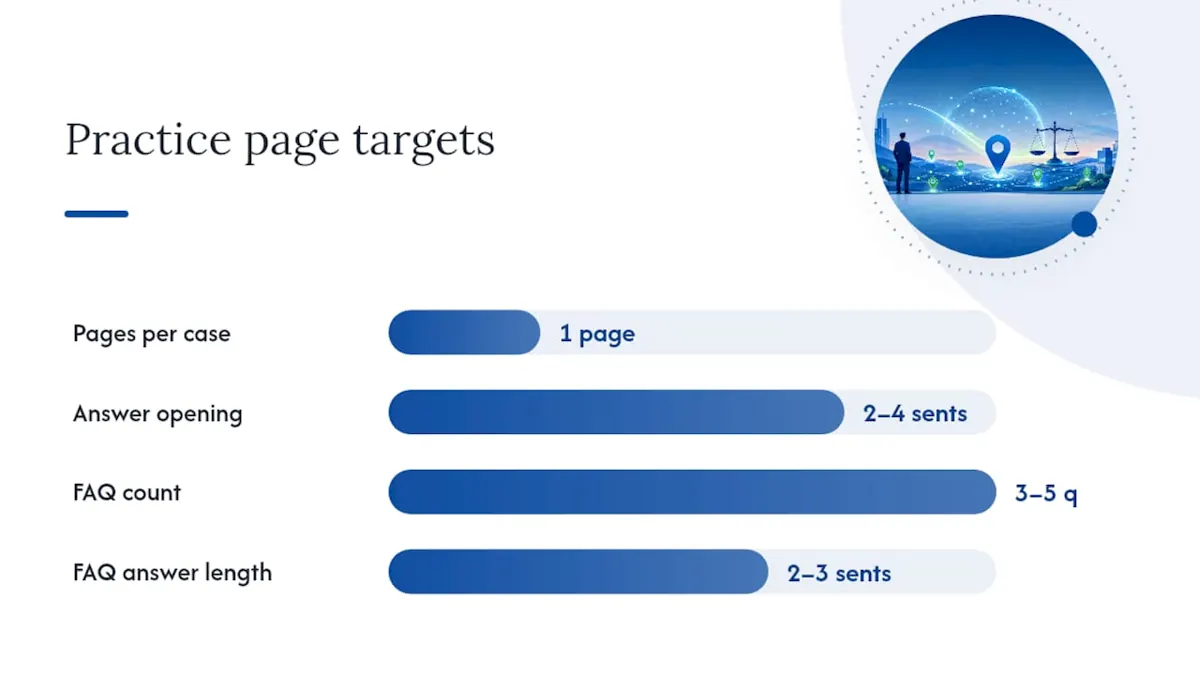
- Open with a two-to-four sentence direct answer. State what the practice area covers and what a client should do first, in language that could stand alone if quoted by an AI Overview.
- Explain the problem and process. Walk through what happens after a client calls, what documents they need, and what timeline to expect.
- Add jurisdiction-specific detail. Cite the actual statute of limitations for your state, local court procedures, or filing venues. This is the detail generic national content farms can never replicate.
- Close with an FAQ block. Three to five questions, each answered in two or three sentences.
- End with a clear call to schedule a consultation.
Author attribution is not optional anymore, and it's one of the most overlooked technical details in legal SEO best practices. Every practice page needs a named attorney byline, not "Our Team." Behind that byline, implement Person schema with these fields:
- The attorney's full name matching their bar directory listing exactly
hasCredentiallinking to their bar admission and any board certificationsworksForpointing to the firm's LegalService schema@id- A link to a full attorney bio page with education and case history
This creates what's called an entity graph: a set of structured, cross-referenced facts that tells Google and AI models exactly who wrote this, what they're qualified to say, and which firm employs them. According to AuspiaAI's 2026 law firm SEO framework, structured authorship signals like these directly raise the odds of being cited in an AI-generated answer.
On length: aim for a thorough length per practice page, sufficient to cover process, jurisdiction, and FAQs without padding. If you serve multiple cities, never duplicate the same page with a swapped city name. Each location variation needs unique local detail: the actual courthouse name, local filing quirks, or a genuine local case reference. Google's algorithms, and increasingly AI crawlers, penalize templated location pages that read identically except for one noun.
Technical Foundations Every Law Firm Website Needs
None of the content or citation work above matters if your site is slow, unindexed, or broken on mobile. Technical SEO is the plumbing; skip it and everything upstream leaks value.
Core Web Vitals are Google's three measurable performance thresholds, and most law firm sites fail at least one:
- Largest Contentful Paint (LCP): should load under 2.5 seconds. Compress hero images and avoid autoplay video backgrounds on practice pages.
- Cumulative Layout Shift (CLS): should stay under 0.1. Reserve space for ads, images, and embedded review widgets so the page doesn't jump as it loads.
- Interaction to Next Paint (INP): should stay under 200 milliseconds. Bloated chat-widget scripts are a common culprit on law firm sites.
Google's own research into ranking systems, including its RankBrain work, ties user-behavior signals like bounce rate and dwell time to relevance scoring, and slow, laggy pages tank both, according to Backlinko's analysis.
Sitemaps and crawlability come next. Submit an XML sitemap through Google Search Console listing every practice page, location page, and blog post; sitemaps remain the standard machine-readable way to tell search engines what exists on your site, a format explained in detail on Wikipedia's sitemap overview. Use canonical tags to prevent duplicate indexing when you have similar pages for different offices, and make sure your robots.txt file isn't accidentally blocking practice pages, a shockingly common error after a website redesign.
Schema implementation should follow a strict priority order: LegalService schema for the firm itself, Person schema for each attorney, and Service schema for each practice area, all tied together with a consistent @id and sameAs links to your verified social and directory profiles. This unifies your firm into one coherent entity across every search engine and AI knowledge graph reading your site.
After deploying schema, run every page through Google's Rich Results Test and check Search Console's Enhancements report weekly for the first month. Schema errors are silent killers; nothing tells you it's broken until rankings quietly stall.
Content Strategy: What to Build First and How to Structure It
Not every page deserves the same urgency. Prioritize by potential case value and search intent, in this order: transactional practice-area terms tied to your highest-value case types first (a single truck accident case can be worth more than fifty traffic ticket consultations), then geo-modified variants of those terms, then informational content that captures early-stage research.
A hub-and-spoke structure keeps this organized and builds topical authority fast. Your practice-area page is the hub; blog posts answering specific questions ("What happens if the other driver has no insurance?") are the spokes, each linking back to the hub page and to each other where relevant. This internal linking pattern tells search engines which page is the authority on the topic and feeds AI tools a clear content hierarchy to pull from.
FAQ formatting deserves its own discipline. Write the question as a real question, then answer it in one direct sentence before adding nuance. "Do I need a lawyer for a minor car accident?" followed immediately by "In most cases, yes, especially if there's any injury or disputed fault" beats three sentences of throat-clearing before the actual answer.
Metadata still earns clicks even in an AI-answer world. A title tag like "Car Accident Lawyer in [City] | Free Consultation" paired with a meta description stating your specific value proposition outperforms vague branding copy, provided the claims stay within bar advertising guidelines (no "best lawyer" superlatives without disclaimers, no guaranteed outcomes).
| Content type | Priority order | Primary goal |
|---|---|---|
| High-value practice pages | Build first | Capture transactional intent, highest case value |
| Geo-modified location pages | Build second | Win local pack for multi-office firms |
| Informational blog/FAQ | Build third | Feed AI citation and top-of-funnel research |
| Attorney bio pages | Build alongside practice pages | Support E-E-A-T and Person schema |
Localized content only works when it's genuinely local. A page for a second office needs its own courthouse references, its own client-relevant statutes if you're crossing state lines, and its own photos. Anything less reads as a thin swap page to both users and algorithms.
How to Run a Compliant Review and Citation Program
A structured review and citation program does two jobs at once: it builds the trust signals that move you up the map pack, and it feeds the same authoritative data AI tools pull from when answering "who's a good [practice area] lawyer in [city]."
Build the review side first:
- Set up an automated case-close trigger in your case management system that fires a review request text 24 hours after closing.
- Personalize the message with the client's first name and case type; personalized asks convert at meaningfully higher rates than generic blasts.
- Respond to every review within 48 hours, thanking positive reviewers by first name and addressing negative ones calmly without disclosing confidential case details.
- Never offer compensation or discounts for reviews, and never solicit a review before a matter concludes.
Directory citations round out the program. Prioritize these, in order: Google Business Profile (already covered), Avvo, Justia, FindLaw, your state bar association directory, and your local chamber of commerce. Each one that lists your firm consistently adds another verified data point that both search engines and AI models can cross-reference, a pattern confirmed across local attorney SEO research.
- Log every directory listing in a spreadsheet with current NAP data pulled directly from each site.
- Flag and fix any mismatch immediately rather than batching fixes quarterly.
- Schedule a full citation audit annually, since directories change formatting rules and merge listings without notice.
- Treat your bar association profile as equally important as commercial directories; it's a citation source AI models weight heavily for legal authority.
Earning Backlinks and Press Coverage That Actually Move Rankings
Not all backlinks are equal, and law firms are uniquely positioned to earn the kind that matter most: the defensible, editorially earned kind that comes from being a genuine source rather than a purchased placement.
The highest-value link sources for a firm are bar association journals, local news outlets covering court cases, state court press releases, and original research your firm publishes, according to local ranking research for law firms. A personal injury firm that publishes an annual analysis of local intersection accident data, sourced from public police reports, becomes a citable resource for local journalists covering traffic safety stories. That's a link no competitor can simply buy.
Practical outreach tactics that work without feeling like spam:
- Offer to be a quoted source when local news covers a relevant case or new law; reporters need attorney commentary and rarely have a go-to contact.
- Pitch a contributed article to a legal trade publication or bar journal on a niche procedural topic you handle often.
- Get listed as a resource on relevant nonprofit or advocacy organization pages if your practice area overlaps (domestic violence resources, disability rights groups).
- Sponsor a local youth sports team or community event that includes a website link as part of the sponsorship package, and document the value for your own records.
Before pursuing any link opportunity, ask one question: would this placement exist if search rankings didn't matter at all? If the answer is no, it's a risk. If yes, it's a genuine relationship worth building.
Evaluate every opportunity against that same standard. A guest post on an unrelated general-interest blog with a paid fee attached is a red flag; a quote in your local paper's coverage of a new state law is exactly the kind of authoritative signal that compounds over time.
What to Expect: Timeline, KPIs, and When to Scale
Law firm SEO moves in phases, and firms that expect month-one results usually quit right before the payoff. A phased local ranking framework outlines roughly this progression: foundation work in months one and two, content build in months three and four, early movement in months five and six, and clear ROI by months nine through twelve, with compounding gains continuing through month twenty-four, per phased local ranking guidance.
| Phase | Timeframe | Focus | What to expect |
|---|---|---|---|
| Foundation | Months 1 to 2 | GBP, citations, technical fixes | Profile completeness, indexing, no ranking movement yet |
| Content build | Months 3 to 4 | Practice pages, schema, initial links | New pages indexed, early impressions in Search Console |
| Early movement | Months 5 to 6 | Continued content, review velocity | First map-pack and organic ranking gains |
| ROI positive | Months 9 and onward | Full program running | Measurable call volume tied to organic and local traffic |
| Compounding | Months 12 and beyond | Authority building, link growth | Diminishing cost-per-lead as authority builds |
Track cost-per-call by dividing total marketing spend for the period by the number of trackable calls generated from organic and local search, using call tracking numbers unique to each channel. Pair that with lead quality by tagging which calls converted to signed cases, since a cheap lead that never converts is worse than a more expensive one that does.
- Report monthly on ranking positions for your top 10 target terms, GBP insights (calls, direction requests, views), and new review count.
- Report quarterly on organic traffic growth, backlink acquisition, and cost-per-call trends.
- Reassess investment level once you hit consistent month-over-month call growth for two consecutive quarters; that's the signal to scale content and link efforts rather than plateau.
Why an Entity-First Approach Changes the Math
NSYGHT builds law firm SEO strategy around one core idea: every signal on your site should reinforce a single, clearly defined entity, the firm and its attorneys, rather than scattering disconnected pages and profiles that search engines have to piece together.
That means GBP management, technical schema work, and content built for both search engines and AI answers happen as one coordinated system, not three separate vendors working in silos:
- GBP Management keeps your profile, categories, and review cadence consistent month over month.
- SEO Foundation covers the technical and citation groundwork described above.
- SEO Growth layers in practice-area content and the entity graph work (Person schema,
@idlinking) that raises AI citation odds.
Named-author bios, consistent @id graphs, and completed directory profiles work together precisely because AI models cross-reference these signals when deciding whom to cite. A firm with a scattered digital footprint gives an AI model nothing solid to point to. A firm with a small internal marketing team can often handle GBP posting and review requests alone; the technical schema and entity architecture work is where most firms benefit from outside expertise, since the mistakes there are invisible until rankings stall.
Where Most Firms Actually Lose the SEO Battle
The single biggest cause of failed law firm SEO isn't a lack of content. It's thin, templated location pages paired with messy, inconsistent NAP data across a dozen forgotten directories. If your team has limited bandwidth, fix the profile and citation layer before writing a single new blog post. Adding content on top of unresolved technical debt just means indexing more pages that were never going to rank.
Get Your Law Firm SEO Program Off the Ground
Most firms trying to handle this internally end up choosing between two bad options: a generalist marketing hire who doesn't know what hasCredential schema is, or a big-box agency running the same templated playbook for a dentist and a law firm. The agency is built specifically around the entity-first approach this article just walked through, technical SEO, Generative Engine Optimization, and Answer Engine Optimization working as one system instead of three disconnected line items.
A typical first month with NSYGHT's SEO Foundation plan delivers a completed and optimized Google Business Profile, the critical Core Web Vitals fixes identified in your technical audit, and one fully built, attorney-attributed practice-area page with proper schema in place. From there, SEO Growth work layers in additional practice pages and link building on a monthly cadence.
Before a consultation, gather your top five target search terms, a list of every directory where your firm currently has a listing, and your current GBP login access. That prep turns a first call into an actual roadmap instead of a generic pitch. Start a conversation with NSYGHT about what your firm's first ninety days should look like.
Sources
For readers who want to verify claims or go deeper: the ABA Model Rules on lawyer communications govern every review and marketing decision in this guide. Clio's lawyer SEO basics and Made For Law's local attorney SEO guide are useful for deeper local tactics. Google's Rich Results Test documentation and Search Console remain the right tools for validating schema and sitemap health. For citation audits, tools like BrightLocal or Moz Local handle the heavy lifting of NAP checking across dozens of directories.
This article is general information, not a substitute for advice from a qualified lawyer. Consult a qualified legal professional about your own circumstances before acting on anything here.
Frequently Asked Questions
Yes. Law firm SEO works particularly well because most searches for legal help ("divorce lawyer near me") carry strong local and transactional intent, exactly what Google Business Profile optimization and practice-area pages are built to capture. Firms that fix their GBP, maintain consistent citations, and publish jurisdiction-specific content consistently outrank competitors who rely on a generic website alone.
Costs vary widely based on scope, competition in your practice area, and whether you handle it internally or hire an agency. NSYGHT's SEO plans, including SEO Foundation, SEO Growth, and SEO Premium, are priced based on the firm's needs, with current details available on the services page.
SEO in a legal marketing context means optimizing your firm's Google Business Profile, website, and content so potential clients searching for your practice areas find you before they find a competitor. It combines local SEO (map pack visibility), technical SEO (site speed and structured data), and content built around specific practice areas and jurisdictions.
Most firms see foundational improvements like GBP completeness and indexing within the first two months, early ranking movement around months five and six, and measurable ROI in call volume by months nine to twelve, based on phased local SEO timelines. Compounding gains, where cost-per-lead drops as authority builds, typically continue through month twenty-four.
SEO is one of the strongest channels for sustainable client acquisition because it targets people actively searching for legal help, but it works best paired with paid ads and social media rather than as the sole channel. A firm aiming for substantial revenue growth typically combines organic SEO with Google Ads Management for immediate lead flow while the organic program builds toward its ninth to twelfth month.