
NSYGHT runs SEO for roofing companies. See our roofing SEO services and the roofing keyword list.
Prefer to hand it off? See our Google Ads management.
Google Ads can fill a roofing calendar quickly because it puts your company in front of homeowners who are searching for a roofer right now. It pays off when the keywords signal real intent, the landing page makes calling easy, and you judge the campaign by signed jobs rather than clicks. We run Google Ads for local service businesses at a flat $499 per month, and the rest of this guide shows what a roofing campaign needs to get there.
TL;DR
- Google Ads gives roofers immediate visibility on high-intent searches, while organic SEO typically takes three to six months to build.
- Bid on “roof replacement” and “roof repair” searches with a buying signal, and block everything else with negative keywords.
- Set your budget from job value and close rate, not from a round number: your cost per lead must stay well below the profit on a job.
- Send every ad to a page built for one action, a call or a quote request, and track calls and forms back to the campaign.
- Judge results by signed jobs and revenue, not clicks or cost per lead alone.
Table of Contents
- Why roofers use Google Ads
- Set the goal before you spend
- Choose keywords that signal a job
- Roofing Google Ads examples that work
- Build a landing page that closes the click
- Set a budget that matches the math
- Target the right area and campaign type
- Track what matters: signed jobs
- What we think about roofing ads
- Get your roofing ads managed
- FAQ
- Sources
Why roofers use Google Ads
Roofing is a need-driven purchase. A homeowner with a leak or a storm-damaged roof does not browse; they search, call two or three companies and book the one that answers. Paid search places you above the organic listings at that moment, and you pay only when someone clicks.
That speed is the main difference from organic work. Organic SEO usually takes three to six months to produce steady leads, while a well-built ad campaign can generate calls within days of launching. The two work as a pair: ads produce leads now and show you which searches turn into jobs, and SEO builds the lasting visibility behind them. Our own guide on running a two-week ad test to choose SEO targets explains how to use ad data that way.
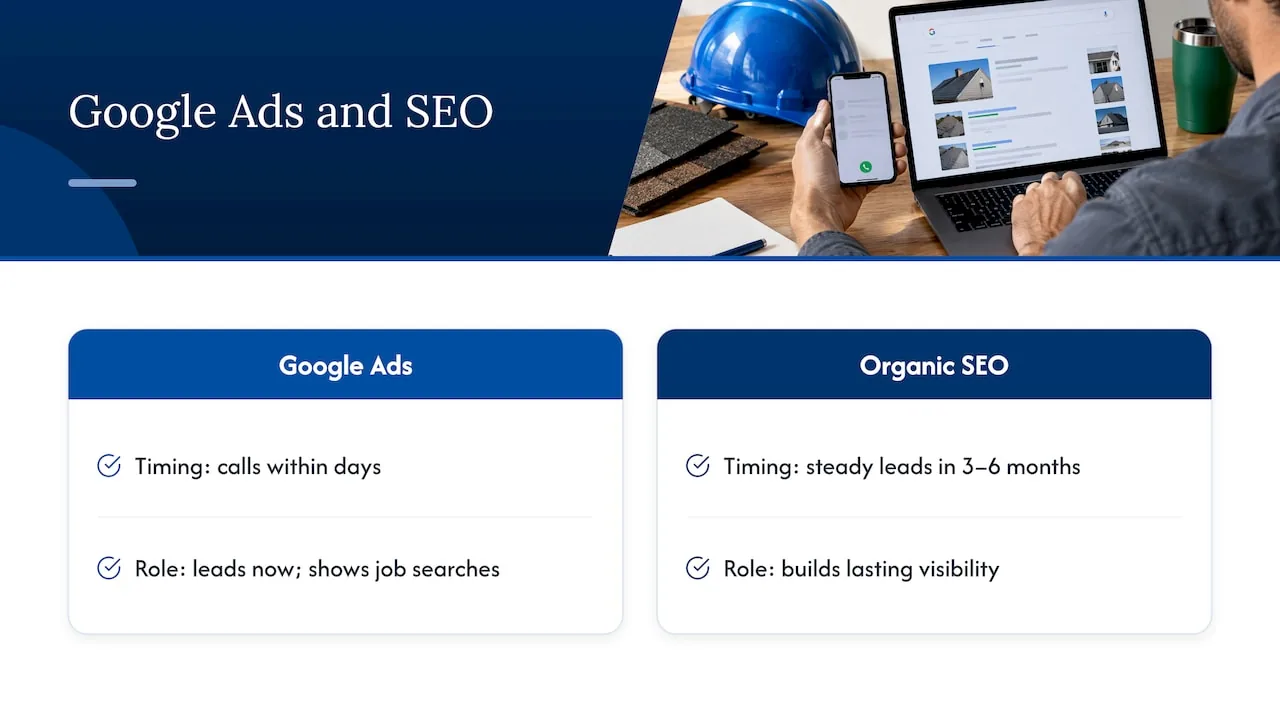
Paid search also has costs worth planning for. Competition in roofing is heavy, clicks are expensive, and an unmanaged campaign can burn budget on searches that never become jobs. Skilled management is what keeps a campaign profitable, which is why most of the work below is about control: who sees your ad, where they land and what you measure.
Set the goal before you spend
Start with a business goal, not a campaign type. For most roofers the goal is one of three: free-estimate requests, inbound calls, or storm-season volume. Campaign goals should tie to business objectives, and your cost per lead and cost per acquisition should stay below the revenue a job brings in.
A simple worked example, with made-up numbers for illustration:
| Input | Example |
|---|---|
| Average roof replacement profit | $4,000 |
| Share of leads that become booked estimates | 40% |
| Share of estimates that become signed jobs | 25% |
| Leads needed per signed job | 10 |
| Maximum cost per lead to break even | $400 |
If you want a margin, set your target well under that ceiling. One published example shows a roofer aiming for a 3:1 return who could spend up to $437 per lead on a high-ticket, high-margin project. Your own number depends on your job mix. Repairs and replacements have very different values, so set a target for each and campaign for them separately.
Choose keywords that signal a job
Keywords decide whether your money goes to homeowners ready to hire or to people reading about shingles. A landing page that is tight and keywords with high intent, such as “roof replacement near me,” beat broad terms every time. Group your terms by intent:
- Ready to hire: roof replacement near me, roofing contractor [city], emergency roof repair, roof leak repair.
- Researching: how long does a roof last, roof replacement cost. These can bring leads, but they convert slower and cost the same per click.
- Not your customer: roofing jobs, roofing supplies, DIY roof repair, roofing school.
Start with the first group, add the second once the budget supports it, and block the third. Google lets you add negative keywords at the account level, a single list that excludes unwanted search terms across your campaigns. Check the search terms report weekly in the first month and add every irrelevant query you find.
For help building the list itself, see our guide to roofing keywords and how to target the right ones.
Roofing Google Ads examples that work
The ads that perform share a pattern: they repeat the search, name the service area, give a reason to call and offer one clear action. The examples below are illustrations of that structure, not ads from a real account.
Emergency repair ad
- Headline 1: Roof Leak Repair in Houston
- Headline 2: Same-Day Inspections Available
- Headline 3: Call Now for a Free Quote
- Description: Licensed and insured local roofers. Storm damage, leaks and missing shingles repaired. Tap to call.
Replacement ad
- Headline 1: Roof Replacement Near You
- Headline 2: Free Written Estimates
- Headline 3: Financing Options Available
- Description: Family-owned roofing contractor serving [city] homeowners. See recent projects and reviews, then request your estimate.
Why this works:
- The headline mirrors the search. Someone typing “roof leak repair” sees those words first.
- The location appears in the ad. It filters out clicks from outside your service area.
- Claims are only those you can prove. Use licensing, insurance, warranty terms and review counts that are true for your company.
- One action. Call or request an estimate, not both plus a newsletter.
Add call and location extensions so your phone number and service area show on the ad itself. Mobile searchers often call directly from the results page.
Build a landing page that closes the click
Paying $35 or more for a click and sending it to your homepage is the most common way roofers lose money. The ad promises a specific service, and the page must deliver it at once.
A good roofing landing page has:
- A headline that matches the ad, such as the repair or replacement the visitor searched for.
- A click-to-call button and large tappable buttons on small screens, since most emergency searches happen on a phone.
- Short copy, with testimonials and proof near the top.
- A short form: name, phone, address and what happened.
- Nothing that leads away, such as a full navigation menu or links to unrelated services.
If your site was not built with this in mind, SEO-native website design gives ads and organic search a page structure that serves both.
Set a budget that matches the math
The question “is $20 a day enough?” has no single answer, because the budget depends on your keyword costs, your lead goal and what a job is worth. A common budgeting method multiplies the average cost per click of your targeted keywords by 30.4, the average days in a month, to see what one click a day would cost over a month. Scale that by the clicks you need.
Here is the logic with example numbers:
- Say your target keywords average $50 per click.
- A landing page converting 8% of clicks into leads means about 12.5 clicks per lead, or $625 per lead.
- Compare that with your break-even ceiling from the table above. If $625 is over it, you need cheaper keywords, a better page, or a higher-value job type before you raise spend.
With clicks this expensive, a small daily budget produces only a handful of clicks a month. That makes tests slow and noisy. Consolidate into a few campaigns focused on your best-value services and your actual service area rather than spreading a small budget across many.
Agency fees come on top of ad spend. Our Google Ads management is $499 per month with a one-time setup fee of $249, and the Google Ads management page states the flat fee is not a percentage of your spend.
Target the right area and campaign type
Roofers have a few ways to reach local customers, and each fits a different job:
- Search campaigns capture people actively looking for a roofer. This is where most roofers should start.
- Local Services Ads are Google’s pay-per-lead format with a verification badge, shown above standard search ads in many markets.
- Performance Max and display reach people across more of Google’s network. They need clean conversion tracking first, or they chase low-value actions.
- Social ads work when you want to reach homeowners before they search, such as after a hailstorm in a neighborhood. See this comparison of roofing Facebook ads options for how those campaigns line up with free-quote goals and lead quality. We also run Facebook and Instagram ads for local businesses.
For location, target the zip codes and cities you actually serve and exclude the ones you do not. Roofing is a local job: a click from two counties away is a wasted click. In storm season, raise bids in the affected areas and pull them back when demand returns to normal.
Track what matters: signed jobs
Clicks and cost per lead are the easy numbers. They are not the result. ROI has to account for the full sales cycle, and judging a campaign on clicks or cost per lead alone is not enough without checking signed-job outcomes.
Set up this chain:
- Conversion tracking for phone calls from ads, calls from your site and form submissions.
- Call recording or a call log so you can tell a real estimate request from a wrong number.
- A source field in your CRM or spreadsheet for each lead, tied back to the campaign and keyword.
- A monthly review of leads, booked estimates, signed jobs and revenue by campaign.
With that data you can cut keywords that produce calls but no jobs and put the money into those that do. Without it, you are guessing, and the platform will happily optimize toward cheap, low-quality leads.
What we think about roofing ads
Roofers often treat Google Ads and SEO as a choice. We see them as one system. Ads give you leads in days and show which searches turn into signed jobs. SEO and your Google Business Profile turn those same searches into lasting visibility, so your cost per job falls over time instead of resetting each month.
That is why our approach builds an entity-driven foundation first: a site, profile and content that define who you are and where you work, so search engines and AI answer tools can recognize you. Paid campaigns then land on pages that are built to convert, rather than a homepage that tries to do everything.
We also believe in transparent reporting and a flat fee, so you can see what the ad spend produced and what you paid to manage it.
NSYGHT
Get your roofing ads managed
We manage Google Ads for local service businesses, including roofers, for a flat $499 per month plus a one-time $249 setup fee. Facebook and Instagram ads are $349 per month with a $249 setup fee. If you want ads and long-term visibility working together, our Roofing SEO work covers the organic side, and the Google Ads management page covers the paid side.

Ready to talk? Start from nsyght.com and tell us your service area and the jobs you want more of.
FAQ
Do Google Ads work for roofing companies?
Yes, when the campaign targets high-intent searches and sends clicks to a page built for calls or quotes. Ads give you immediate visibility at the moment a homeowner searches, which organic SEO cannot match in the first months. Results depend on keyword choice, ad copy, landing page and how well you follow up on leads.
Is $20 a day enough for roofing Google Ads?
It depends on your cost per click and what a job is worth. Roofing clicks are costly, so $20 a day buys few clicks, and results will be slow to read. Work backward from your break-even cost per lead, then set a budget that buys enough clicks to learn from.
What are good roofing ads examples?
Good ads repeat the searcher’s words, name your city, offer one action and use only claims you can back up. Examples such as “Roof Leak Repair in Houston” with a free-quote call to action follow that pattern. Pair each ad with a landing page that matches the headline.
What is the best way to advertise a roofing business?
Most roofers do best combining paid search for fast leads with local SEO and a well-kept Google Business Profile for steady ones. Add social ads for storm-driven or seasonal pushes. Track every channel by signed jobs so you can move budget to what works.
Sources
- Google Ads for Roofing Businesses: A Complete Guide
- Understanding Cost Per Booked Job by Channel in 2026
- About account-level negative keywords, Google Ads Help
- Roofing Facebook Ads: Your Options Compared (2026)