
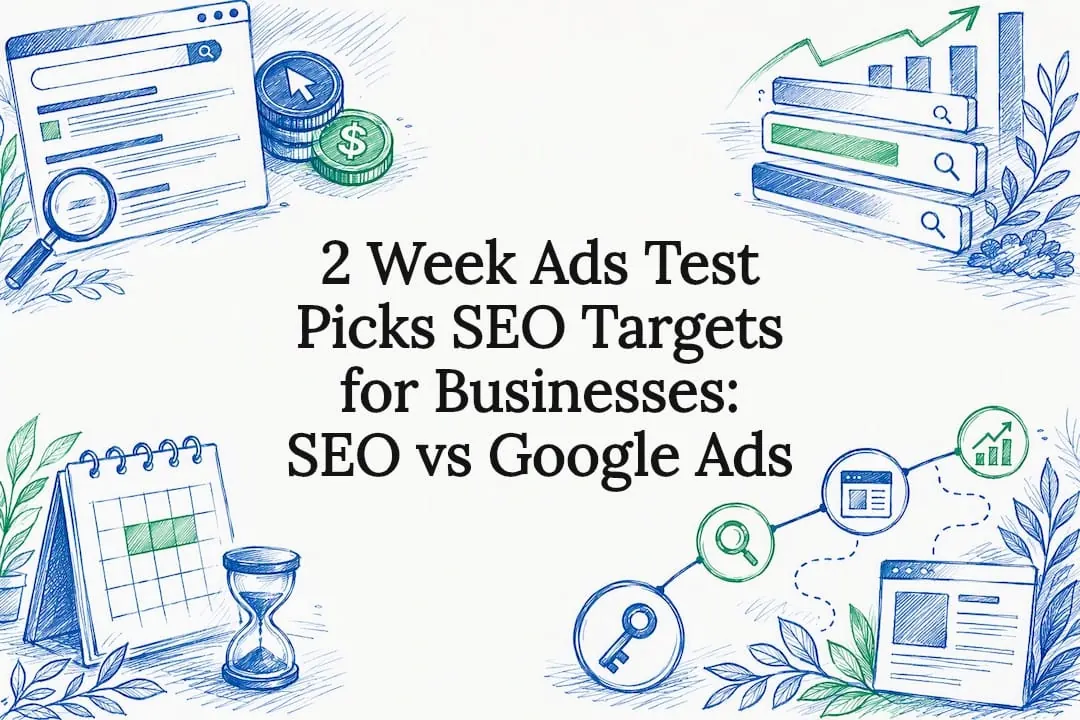
Use Google Ads when you need leads this week and want full control over who sees your message; invest in SEO when you're building visibility that keeps working without a daily budget. Most businesses that grow steadily use both, running short Ads tests to find which keywords convert before pouring real budget into SEO content. If you need leads right now, start with a two-week Ads campaign and let the data tell you where to build long-term.
- Running a two-week Google Ads campaign with a budget of $500 to $1,000 can reveal which keywords and landing pages convert best before investing in SEO content.
- Ads deliver immediate top-of-page placement within hours, while SEO requires months to generate organic traffic and build long-term value.
- An SEO strategy focuses on research and technical fixes that produce persistent leads over years, unlike the short-term, pay-per-click nature of Ads.
- Ads target active buyers ready to convert, whereas SEO captures research-phase consumers still comparing options, making both channels serve different stages of buying intent.
- A comprehensive approach involves testing with Ads, analyzing conversions, then prioritizing SEO based on proven demand to maximize budget efficiency.
SEO vs Google Ads: Comparing Speed, Cost, and Payoff
The two channels solve different problems, and the differences show up the moment you look at timelines. Google Ads can put your business at the top of a results page within hours of launching a campaign, while SEO typically needs months before it produces meaningful organic traffic. That gap alone explains why so many owners default to Ads when cash flow is tight and patience is thin.
Cost behaves differently too. Ads run on a pay-per-click model, so the moment you stop funding the campaign, the traffic stops with it. SEO asks for upfront and ongoing investment in content and technical work, but the payoff compounds. A blog post or service page built in year one can still be pulling in leads in year three with little additional spend.
Conversion intent splits along similar lines. Ads tend to capture people who already know what they want and are ready to act, while SEO captures the entire research phase, the searchers still comparing options, reading reviews, and figuring out what they need. That's a wider net, just a slower one to fill.
- Speed: Ads go live almost immediately; SEO builds momentum over months.
- Cost structure: Ads are ongoing pay-per-click; SEO is front-loaded content and technical investment with long-tail payoff.
- Conversion intent: Ads skew bottom-funnel; SEO reaches research-stage buyers too.
- Measurability: Ads report clicks, cost, and conversions in real time; SEO requires longer attribution windows to judge accurately.
- What happens when you stop paying: Ads traffic disappears; SEO rankings tend to persist.
Organic listings historically earn a larger share of clicks than paid ads on the same search results page, though that gap narrows on searches loaded with shopping carousels, maps, and other SERP features that push ads and organic results closer together. It's one reason SEO remains worth the wait even when Ads win the sprint.
One clarification worth making early: running Ads does not improve your organic ranking. Google's own resource on the topic is explicit about this, and a Google Ads Community discussion confirms it. What Ads can do is tell you which keywords and pages convert, and that intelligence feeds your SEO strategy.
Which Channel Fits Your Goal and Budget?
Match the channel to what you're actually trying to accomplish, not to whichever one sounds more impressive in a pitch deck.
By goal:
- Need leads in the next 30 days? Run Ads first. It's the only channel that delivers volume on a short timeline.
- Building a durable pipeline over the next year? Prioritize SEO, using early Ads data to guide which pages you build.
- Launching a new product? Combine both: Ads for immediate awareness, SEO content to capture the searches that follow.
- Growing brand recognition in a local market? SEO and a strong Google Business Profile presence usually outperform Ads for trust and recall.
By budget tier:
- Low budget: Put most of it into a short Ads test to find your highest-converting keywords before spending on content.
- Medium budget: Split spend between a modest Ads campaign and a focused SEO content plan built around what the Ads test reveals.
- Higher budget: Run both simultaneously. Let Ads fill the gap while SEO builds toward independence from paid spend.
Quick decision checklist: Do you need results in under 30 days? Is your website technically sound enough to rank? Have you validated which keywords actually convert? Answering these three questions points you toward a starting channel faster than any amount of theorizing.
What SEO and Google Ads Actually Cost, and How Long They Take
Set your expectations before you set your budget. Google Ads can start driving traffic within hours of launch, but SEO realistically takes three to twelve months to show meaningful gains, depending on competition and your site's starting condition.
Cost structures diverge just as sharply; learn effective local targeting strategies in The Power of Google Adwords For Your Fitness Business.
- Ads spend: Cost per click varies widely by industry, and agency management fees are typically layered on top of ad spend itself.
- SEO investment: Monthly retainers for content, technical fixes, and authority building tend to follow predictable ranges, but they're a recurring cost regardless of how much traffic that month produces.
- Cost per lead over time: Ads keep a fairly flat cost per lead as long as you're spending. SEO's cost per lead tends to fall over the first six to twelve months as rankings mature, eventually making it the cheaper channel per lead, even though it cost more upfront.
Budget for both timelines honestly. A business expecting SEO to behave like Ads within 60 days is setting itself up for disappointment, not a strategy failure.
How to Use Google Ads to Prioritize Your SEO Investments
Skip the guesswork on which keywords deserve SEO attention. Let a short Ads campaign show you before you commit months of content work to the wrong terms.
- Run a short Ads test. A two-week campaign with $500 to $1,000 in spend is usually enough to surface which keywords convert.
- Track conversion behavior, not just clicks. Conversion rate, bounce rate, and time on page tell you which landing pages resonate, and those signals often transfer directly to organic performance.
- Rank your keyword list by proven demand. Prioritize SEO content around the terms that already converted in your Ads test rather than the ones with the highest search volume.
- Build landing pages that mirror what worked. If a paid landing page converted well, use its structure and messaging as the template for the organic page you build next.
The most common mistake here is assuming that a keyword with lots of impressions but low clicks is a wasted SEO opportunity. Sometimes it just means your ad copy wasn't the problem, your offer was. Testing with Ads before committing to SEO filters that noise out before you spend months writing content nobody wants.
Set up conversion tracking before you launch your Ads test, not after. Without it, you're just measuring clicks, and clicks alone tell you almost nothing about which keywords deserve SEO investment.
Why Entity-Driven SEO Changes the Ads and SEO Equation
Search has changed shape. People aren't just typing into Google anymore, they're asking questions inside AI tools that summarize answers instead of listing ten blue links. That shift is why NSYGHT builds its SEO work around entity-driven architecture, paired with Generative Engine Optimization (GEO) and Answer Engine Optimization (AEO), a combination designed to make a business clearly identifiable to both traditional search engines and AI-powered answer tools.
The businesses that show up in AI-generated answers today are the ones whose digital presence is unambiguous: consistent naming, clear service definitions, verified local data. Ambiguity is what gets a business left out of the answer entirely.
Here's where Ads fit into that picture:
- Short Ads campaigns reveal which services and locations actually generate demand, information NSYGHT feeds directly into entity architecture and content priorities.
- A Google Business Profile built on accurate, consistent data supports both local pack visibility and AI answer eligibility.
- The combined SEO, GEO, and AEO framework targets multi-location businesses where inconsistent data across locations quietly kills visibility.
Running a solo Ads test in-house makes sense for validating one campaign. Coordinating that data with a multi-location entity strategy is where an agency's structure earns its keep.
The Misconceptions That Waste Marketing Budget
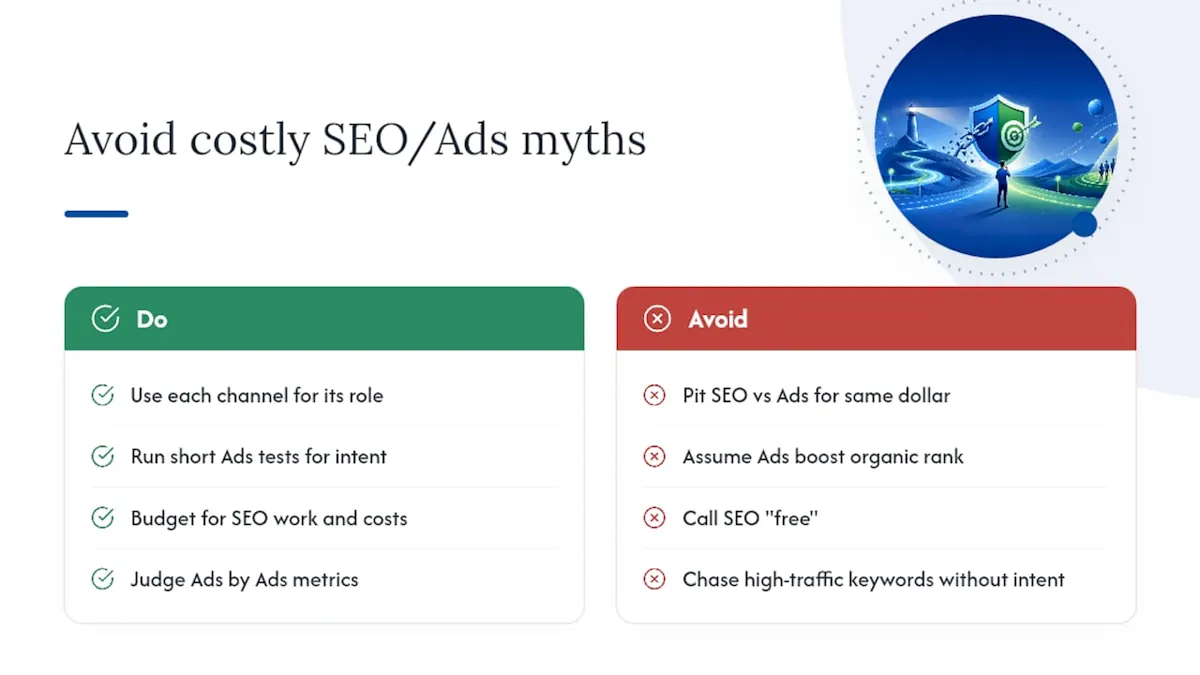
The biggest misconception is treating SEO and Google Ads as competitors for the same dollar. They're not solving the same problem, and pitting them against each other in a budget meeting usually means picking the wrong one for the wrong reason.
A second common error: assuming Ads spend improves organic rankings. It doesn't. Your Quality Score and your organic ranking are calculated independently, and no amount of Ads spend nudges your position in organic results.
Owners also tend to assume SEO is "free" because there's no per-click charge. It isn't. Content production, technical fixes, and authority building all cost time or money, they just don't bill per click.
On the flip side, some businesses write off Ads as wasteful because "the traffic disappears the second you stop paying." True, but that's not a flaw, it's the trade-off for controllable, immediate volume. Judging Ads by SEO's standards (or vice versa) misses what each channel is actually built to do.
Last one: plenty of teams assume a high-traffic keyword is automatically worth chasing in SEO. Traffic without conversion intent is just noise. An Ads test usually exposes this before months of content work do.
Our Take: Stop Treating This as an Either/Or Decision
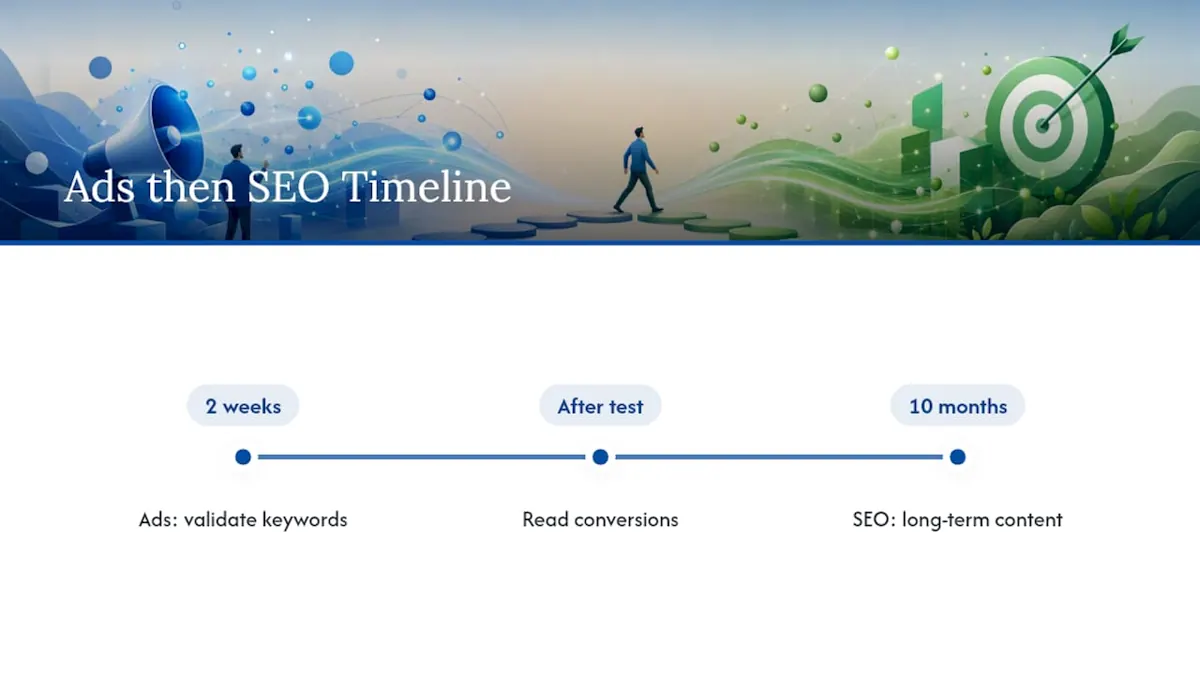
The conventional advice, pick SEO or Ads based on budget size, gets the framework backward. Budget should determine sequencing, not exclusivity. A business with $2,000 a month doesn't need to choose a lane forever; it needs to spend two weeks validating keywords with Ads, then commit the next ten months to SEO content built on what that test proved converts.
What's overrated: the idea that SEO is inherently "better" because it's sustainable, or that Ads are inherently "smarter" because they're fast. Both claims ignore that the channels answer different questions. Ads answer "what converts right now." SEO answers "what will still be converting in eighteen months."
What most owners should prioritize first isn't a channel at all, it's data. Run the test, read the conversion numbers honestly, and let that evidence decide where the next twelve months of content and budget go. Guessing is the actual expensive mistake here, not picking the "wrong" channel.
Turning This Framework Into a 90-Day Plan
Reading about the Ads-to-SEO pipeline is one thing. Running it correctly, with proper conversion tracking, entity-consistent content, and a roadmap that doesn't waste your test data, is another. An agency can build that bridge for local and multi-location businesses that don't have a spare month to figure out attribution setup from scratch.
A typical 90-day engagement starts with a technical and entity audit, moves into a short Google Ads test to validate which keywords and offers actually convert in your market, and ends with a prioritized SEO content and authority roadmap built directly from that data instead of guesswork. For businesses managing several locations, that roadmap includes entity architecture designed to keep every location easy to find and impossible to confuse with a competitor's listing.
If you're currently running Ads with no plan for what happens when you turn them off, or building SEO content with no idea which keywords convert, that's the gap worth closing first. Reach out to an agency to scope a 90-day plan built around your actual budget and timeline.