
See how NSYGHT handles SEO for dental and orthodontic practices.
Orthodontist SEO is the work of making your practice show up when a parent or adult types “orthodontist near me” or “braces in [your city]”. For most practices it is a local search job: a verified, well-managed Google Business Profile for each office, a website with a clear page for every office and treatment, and a steady flow of real reviews. We build that kind of local and AI-search foundation for dental and healthcare practices, and the sections below show what it takes and where practices lose ground.
TL;DR
- Orthodontic patients pick a practice by location, so local search (the map results and your Google Business Profile) matters more than ranking nationally for broad terms.
- Your Business Profile’s primary category, complete information and review replies are the first levers to fix.
- Each office needs its own location page, its own profile and consistent name, address and phone details everywhere.
- Treatment pages and location pages should match what patients actually search, such as braces, Invisalign-style aligners and your city or neighborhood.
- Judge SEO by calls, consultation requests and booked exams, not by rankings alone, and give it months, not weeks.
Table of Contents
- Why local search decides who gets the consultation
- What orthodontist SEO actually includes
- Step 1: Fix the Google Business Profile first
- Step 2: Build pages that match how families search
- Step 3: Keep every listing consistent
- Step 4: Earn reviews every month
- Multi-location practices: local relevance without chaos
- Perspective: why we start with the profile and the entity
- How to tell whether it is working
- Where we fit
- FAQ
- Sources
Why local search decides who gets the consultation
An orthodontic case is a commitment of a year or two. Families choose a practice they can reach every few weeks, so they search with a place in mind. Pabau describes local search as a high-intent channel for this reason: someone searching for an orthodontist nearby or for braces in a city is already choosing a practice, and the map pack takes up a large part of the screen on mobile.
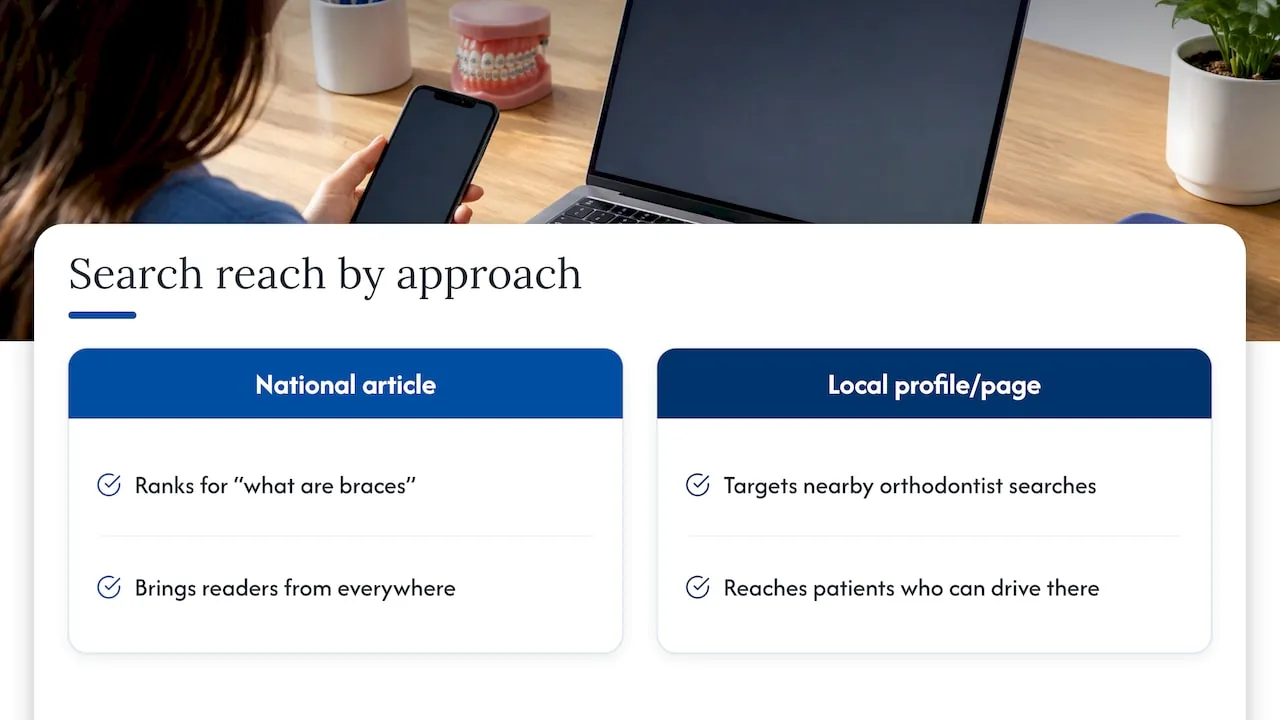
That changes how you should spend effort. A broad article ranking nationally for “what are braces” brings readers from everywhere. A strong profile and a clear page for your office bring someone who can drive to you on Tuesday.
The map results follow a few factors you can influence. Dr. David A. Wank, writing in Orthotown, says proximity is the number one local ranking factor. Practices can sometimes rank in more than one locality, he adds, but ranking in a second area that already has competition is unlikely. In plain terms: you win your own neighborhood first, and you win it by being the most complete, most trusted result there.
What orthodontist SEO actually includes
There are four layers, and each one supports the others.
- Your Google Business Profile (GBP). This is the free listing that appears in Google Maps and the map pack. It holds your category, hours, photos, services and reviews.
- Your website. Treatment pages, location pages, fast mobile loading and clear calls to book a consultation.
- Citations and consistency. Your practice name, address and phone number (often shortened to NAP) listed identically across directories, insurer pages and your own site.
- Reviews and reputation. The volume, recency and content of what patients and parents say about you.
A fifth layer is growing: AI answer tools. When a parent asks an assistant for an orthodontist in a specific town, it draws on the same evidence Google does: clear pages, consistent details and reviews. Practices that define themselves clearly, with an exact location, specialty and set of services, give those tools something to cite. Our AEO overview and GEO overview explain how that works.
Step 1: Fix the Google Business Profile first
For a practice that is not showing in the map pack, the profile is almost always the cheapest place to gain ground.
Choose the right primary category
Dr. Wank calls the GBP primary category the most important optimization factor. An orthodontist should lead with the orthodontist category, not a generic dentist one, with secondary categories added only where they describe services you really provide. Our guide to choosing Google business categories walks through how to pick them.
Complete every field
Google states that businesses with complete and accurate information are more likely to show up in local search results. For an orthodontic office that means:
- Exact hours, including any early-morning or after-school appointment times.
- Your real phone number and a booking or consultation link.
- Services listed by name: traditional braces, clear aligners, retainers, early interceptive treatment.
- Photos of the office, the team and the waiting area, so a nervous parent knows what to expect.
Reply to reviews
Google’s own guidance says that replying to reviews shows you value feedback, and that positive reviews and helpful replies can help your business stand out. Reply to every review, short and warm. Never include a patient’s treatment details in a public reply: respond in general terms and invite them to call the office. If you need a full process, see our Google Business Profile optimization fixes.
Expect some volatility
Map rankings do not behave like a ladder. Dr. Wank notes that map pack placement is not guaranteed and positions can shift seemingly at random. He has seen practices with ten times as many reviews rank behind practices with only five. His advice is to keep following Google’s recommendations, optimize the profile, generate reviews and run a citation campaign. Treat it as steady maintenance, not a one-time setup. Our 30/60/90-day Google Maps plan lays out that rhythm.
Step 2: Build pages that match how families search
Your website has two jobs: prove to Google where you are and what you treat, and convince a parent to call.
One page per treatment
A single “Services” page that lists braces, aligners, retainers and early treatment in a paragraph each is hard to rank and hard to read. Give each treatment its own page with:
- A plain-language explanation of who it suits, in the words parents use, such as “braces for kids” or “adult braces”.
- What a first visit involves and how to book it.
- Photos and answers to the questions families ask before they call.
- The city or neighborhood you serve, written naturally, not stuffed into every sentence.
One page per office
Every office needs its own location page with the full address, phone, hours, doctors, directions, parking, office photos and a map. The page should link to that office’s own verified profile. We recommend the same discipline for every location-based business; our guide to multi-location SEO covers it in detail.
Landing pages for ads
If you also run paid ads for consultations, send each campaign to a page built for that search, not the homepage. Pabau reports that a landing page designed for a specific search term converts far better than a generic homepage redirect, and it says independent practices can compete in crowded metro markets by targeting hyper-local terms this way. It also notes that corporate orthodontic groups have been increasing their digital ad spend, which is one more reason to be specific.
Keep the technical basics clean
Most orthodontic searches happen on phones, often by a parent between other tasks. Your site should load quickly, show the phone number and a booking button without scrolling, and work with one thumb. Check that each page has one clear title, a descriptive heading and no broken links. These basics are not exciting, but they decide whether a visit becomes a consultation. For a practical example of tightening a site for local searchers in another trade, see this walkthrough on how to optimize a website for local searches.
Step 3: Keep every listing consistent
Consistency is what lets Google, and AI tools, trust that your office is real and where you say it is. Pabau lists consistent NAP across directories and location-specific service pages among the basics of orthodontic local SEO, and it says actively managed profiles appear more often in the map pack.
A simple routine works:
- Keep one master document with each office’s exact name, address, suite number, phone and hours.
- Check your profile, website, insurer directories, health directories and social pages against it.
- Correct mismatches, such as an old suite number or a former tracking phone number, as soon as you find them.
- Recheck after any move, hours change or new doctor.
A small mismatch repeated across a dozen directories can quietly weaken every office’s profile.
Step 4: Earn reviews every month
Reviews influence both rankings and the decision of the parent reading them. Aim for a steady stream rather than a burst. Ask at natural moments: when braces come off, after a successful first adjustment or at the end of a consult. Send the direct link to the office’s own profile so the review lands in the right place.
Write requests in your own voice and never offer a reward in exchange for a review. Keep the ask simple, and do not select only the happiest patients to ask. A mix of recent, specific reviews that mention the office and the care they received is what readers and search systems pick up.
Multi-location practices: local relevance without chaos
If you have several offices, the temptation is a single “Locations” page with three addresses. That gives search engines and AI tools very little to work with for any one town. The structure that works is a page, a verified profile, reviews and consistent details for each office, with each profile linked to its own page. Reviews stay with the office where they were left, so each office has to earn its own.
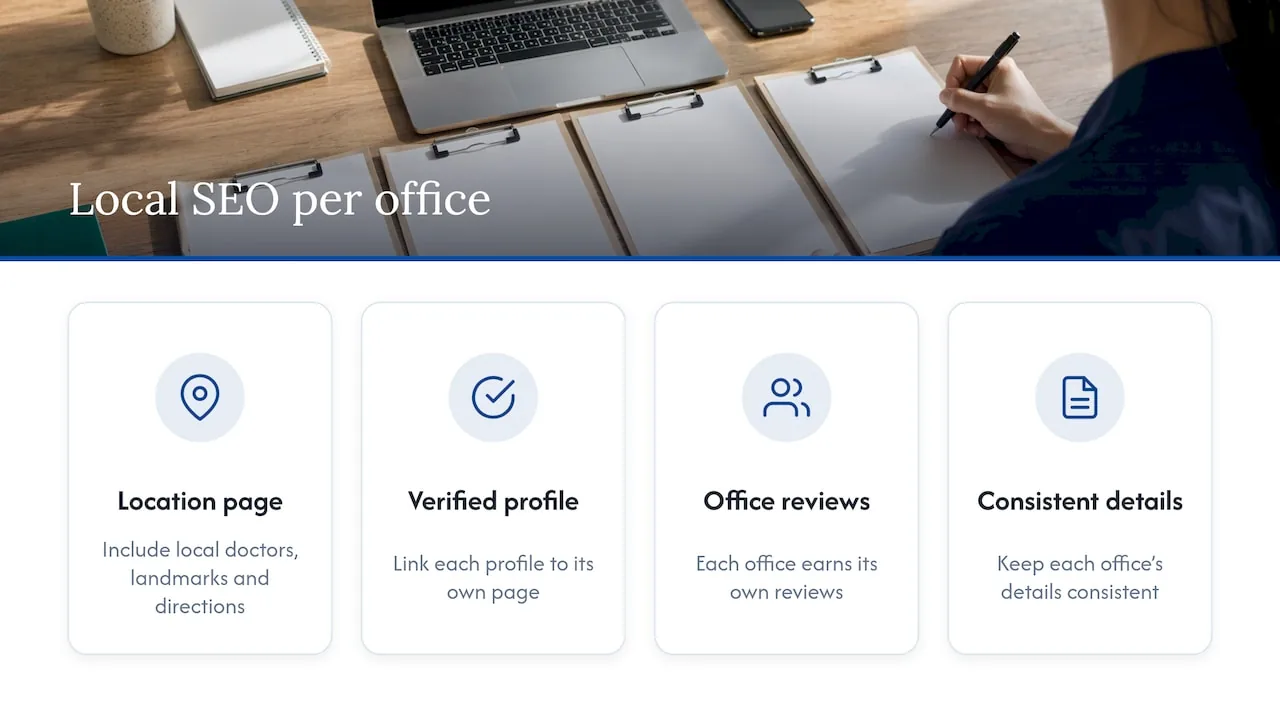
On top of that, each office page should carry what is truly local: the doctors who work there, nearby schools or landmarks, parking and directions. Shared brand pages can explain treatments for the whole group, while each location page proves the office exists in its own community.
Perspective: why we start with the profile and the entity
We work with local and multi-location practices, and the pattern is the same: practices that struggle to rank have not clearly told search engines who they are, where they are and what they treat.
That is why we start with the entity. Your Business Profile, your location pages, your treatment pages and your citations should all describe one practice in the same words. When they do, traditional search, the map pack and AI answer tools can all identify you.
Our approach combines technical SEO, Generative Engine Optimization and Answer Engine Optimization, so the same foundation serves Google Maps and the assistants parents now ask. We pair it with transparent reporting, so you can see what changed and why. For dental and healthcare providers seeking new patients, this is the path we build on, and our dental SEO work is where it is applied.
NSYGHT
How to tell whether it is working
Rankings are a signal, not the goal. The goal is more qualified consultations. Track these each month:
| What to track | Where to see it | Why it matters |
|---|---|---|
| Calls from the profile | Google Business Profile performance data | Shows how many nearby searchers reach you by phone |
| Direction requests and website clicks | Google Business Profile performance data | Indicates intent to visit |
| Consultation form submissions | Your website analytics and form tool | Measures leads from your own pages |
| Booked exams and starts | Your practice management system | Connects marketing to actual patients |
| Review count and recency | Each office’s profile | Shows reputation momentum |
| Map position for key searches | A local rank check from your office’s area | Shows visibility around each location |
Ask the front desk to note how each new patient found you. It is not perfect, but it catches the parents who say “I found you on Google” and fills gaps that analytics miss.
On timing, local search improves in stages. Profile fixes and consistency cleanups can show movement sooner, while new treatment pages and a growing review base take longer to compound. Be wary of anyone who promises a fixed ranking by a fixed date: rankings can move for reasons outside your control, as Dr. Wank notes.
Where we fit
We run SEO for local and multi-location practices: entity-driven SEO architecture, Google Business Profile management, technical site audits, on-page and off-page SEO, content and SEO-native website design. Our SEO plans (GBP Management, SEO Foundation, SEO Growth and SEO Premium) are on our SEO services page.
If you also want consultations from paid search, we manage Google Ads at $499 per month plus a one-time $249 setup fee, and Facebook & Instagram Ads at $349 per month plus a $249 setup fee. Social media marketing is $299 per month with a $179 setup, and consulting is $125 per hour. To talk through your offices and your market, start at nsyght.com.
FAQ
Is local SEO or general SEO more important for an orthodontist?
Local SEO is the priority for most practices, because patients choose a provider by location and the map results capture the nearby, ready-to-book searches. General content still helps patients learn about treatments and supports your treatment pages. Start with the profile and location pages, then build outward.
Does an orthodontist need a separate page for each office?
Yes. Each office should have its own page with its address, phone, hours, doctors and directions, linked to its own verified Google Business Profile. A single page listing every address gives search engines and AI tools little to work with for any one town.
How many reviews do I need to rank in the map pack?
There is no fixed number. Dr. Wank has seen practices with far more reviews rank behind practices with only a few, so reviews work alongside category, proximity and profile completeness. Aim for a steady flow of recent, genuine reviews and reply to each one.
How long does orthodontist SEO take to show results?
Profile and listing fixes can move sooner, while new treatment pages and review growth build over months. Judge progress by calls, consultation requests and booked exams each month, and expect map positions to shift from week to week.
Sources
- High Visibility by Dr. David A. Wank, Orthotown
- Orthodontic practice marketing: 7 strategies (2026), Pabau
- Tips to improve your local ranking on Google, Google Business Profile Help
- How to Optimize Your Locksmith Website for Local Searches