

Plastic surgeon SEO is the work of making your practice show up, and be trusted, when a prospective patient searches for a procedure or a surgeon in your area. That means ranking in Google’s organic results and the map pack, and being named in AI-generated answers. It rests on four things: a Google Business Profile that is complete and current, procedure and location pages written with real clinical authority, a steady flow of specific patient reviews, and a technically clean site. Measure it by consultations booked, not by rankings alone.
This guide covers what to build, in what order, and how to tell whether it is working. It applies equally if you search for plastic surgery SEO, cosmetic surgeon SEO or general surgeon SEO. The mechanics are the same, and the stakes are higher than in most local niches.
TL;DR
- Patient research starts online: a peer-reviewed analysis reports that about one-third of patients begin with a web query, and 46% begin on Google.
- Your Google Business Profile, procedure pages and review profile do most of the work for local visibility.
- AI answers draw on reviews, directories and third-party content, so your name, services and credentials must match everywhere.
- Medical content needs surgeon-reviewed accuracy, balanced risk disclosure and realistic expectations. That is an ethical requirement and a trust signal.
- Track consultation requests and booked consults by source. Rankings are only a leading indicator.
Table of Contents
- Why search matters so much for a plastic surgery practice
- The four layers of plastic surgeon SEO
- Local visibility: win the map and the radius around your practice
- Website and technical changes that help
- Content that demonstrates medical credibility
- Reviews and reputation
- How AI search changes the plan
- Measuring results the way a practice owner should
- Where paid and social fit alongside SEO
- Perspective: why we build practices around entities first
- Work with NSYGHT on your practice’s visibility
- A 90-day starting plan
- FAQ
- Sources
Why search matters so much for a plastic surgery practice
Elective surgery is a considered purchase. Patients compare surgeons for weeks or months, read about recovery, look at results, and check reviews before they ever call. A peer-reviewed article in Plastic and Reconstructive Surgery, Global Open reports that roughly one-third of patients start with a web query and 46% begin on Google, and it describes associations between online interest in a procedure and downstream procedural volume.
That has a practical meaning. If your practice is absent at the moment a patient types “rhinoplasty near me” or “breast augmentation surgeon in [city],” the patient forms a shortlist without you. Paid ads can fill part of that gap, but organic and map results compound: a page that ranks and earns trust keeps working month after month.
The keyword is also competitive for a reason. A single consultation can be worth many times your cost per lead, which is why plastic surgery clicks carry high ad prices. Good SEO is how a practice captures that same demand without paying for every click.
The four layers of plastic surgeon SEO
It helps to think of the work as four layers that depend on each other.
| Layer | What it covers | What the patient sees |
|---|---|---|
| Local presence | Google Business Profile, citations, map pack, reviews | Your practice on the map with ratings and photos |
| Content | Procedure pages, location pages, surgeon bios, FAQs | Clear, credible answers to their questions |
| Technical | Speed, mobile layout, crawlability, structured data | A site that loads fast and is easy to read |
| Authority | Links, mentions, directories, consistent identity | A practice that other sources vouch for |
Skipping a layer caps the others. Excellent procedure pages on a slow, poorly structured site underperform. A strong profile with thin website content gets seen but not chosen.
Local visibility: win the map and the radius around your practice
Most patients will not travel across the country for a standard procedure. They search in your metro area, and Google’s local results decide who gets the first look.
Start with your Google Business Profile
The profile is the single most important local asset. Treat it as a living page, not a one-time setup:
- Choose the right primary category (for example, plastic surgeon) and add secondary categories only where they describe what you truly do.
- Keep name, address, phone number and hours identical to your website and every directory listing.
- List your services using the same procedure names your website uses.
- Add real photos of your office, your team and your consultation spaces. Before-and-after images belong on your site, where you can add the context and consent that responsible presentation requires.
- Use posts and Q&A to answer common practical questions about consultations, financing and scheduling.
- Respond to every review in a professional, privacy-conscious way. Never confirm patient details in a public reply.
The pattern is the same one we describe in our guide to GBP-first local SEO for dentists, because healthcare searchers behave alike: they look at the map, compare ratings, then click through.
Build location pages that earn their place
If you see patients from several suburbs or run more than one office, give each location a dedicated page with real local substance: the office address and parking, directions from major roads, which surgeons practice there, and what patients from that area commonly ask. Do not clone a page and swap the city name. Practices with several offices should also read our breakdown of multi-location SEO for maps and AI answers.
Website and technical changes that help
Technical SEO is the unglamorous layer that lets the rest be found. For a surgical practice, focus on these:
- Mobile speed and layout. Many patients research on a phone, often in the evening. Image-heavy gallery pages are the usual culprit for slow loads, so compress and lazy-load them.
- Clean architecture. One page per procedure, reachable within two clicks of the home page, with a logical URL such as /procedures/rhinoplasty.
- Crawlable galleries and content. Make sure text and key content are not locked inside scripts or pop-ups that search engines struggle to read.
- Structured data. Mark up your practice, your surgeons and your FAQs so that search engines and AI tools can read the facts directly. Our piece on why FAQ schema still matters for AI answers explains the approach.
- Secure, accessible site. HTTPS, readable fonts, and forms that work on every device. Consultation request forms are your conversion point, so test them regularly.
A website built with search in mind from the start avoids most of this rework. That is the idea behind our SEO-native website design.
Content that demonstrates medical credibility
Google holds health content to a higher standard. Its Search Quality Rater Guidelines overview explains that pages on “Your Money or Your Life” topics, which include health, are judged against very high page quality standards, with experience, expertise, authoritativeness and trust (E-E-A-T) as the lens. A plastic surgery site sits squarely in that territory.
Procedure pages: the core of your content
Each procedure page should read like a thorough consultation, not an advertisement. A structure that works:
- Who the procedure is for, and who it is not for.
- How the surgery is performed, in plain language, including anesthesia and facility.
- Recovery timeline, week by week, with honest expectations.
- Risks and complications, stated clearly.
- Your approach and experience, including board certification and training you can document.
- Questions patients ask, answered directly.
- A clear next step, such as requesting a consultation.
Our service page SEO guide goes deeper on building pages that rank and get cited.
Surgeon bios and credentials
Give every surgeon a dedicated page: training, board certification, hospital affiliations, professional society memberships, publications and years in practice. Only state what you can verify. These pages feed both Google’s trust assessment and the AI models that summarize who you are.
Patient-first, ethically sound content
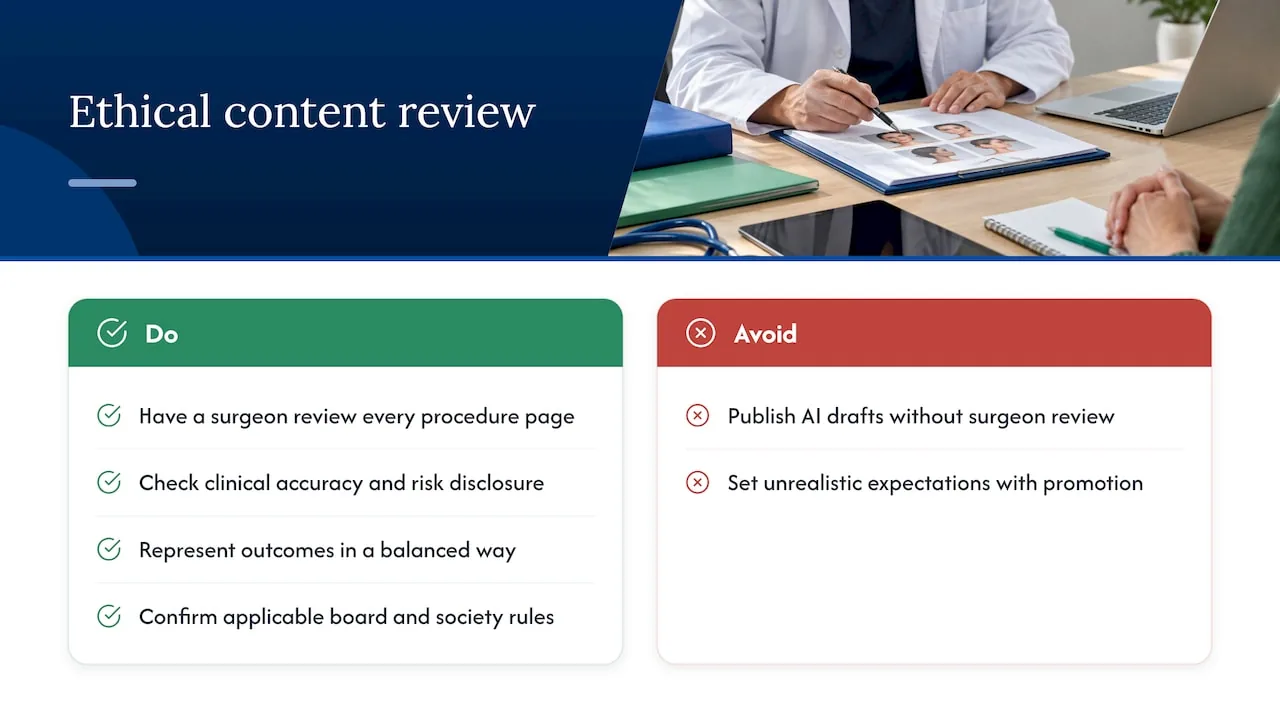
The Plastic and Reconstructive Surgery, Global Open article cautions that AI-assisted SEO must be balanced with patient-centered ethics. It notes that unrealistic expectations shaped by promotional content are among the strongest predictors of dissatisfaction, outweighing minor complications, and it advises surgeons to personally review AI-generated materials for clinical accuracy, adequate risk disclosure and balanced representation.
Put that into practice with a simple rule: nothing goes live on a procedure page until a surgeon has read it. If you use AI tools to draft, our guide on using AI content without penalties covers how to keep quality high. Your state medical board and your specialty society may also have advertising rules for results, testimonials and before-and-after images, so confirm what applies to you before publishing.
Reviews and reputation
Reviews influence the map pack, the click, and increasingly the AI summary. In Plastic Surgery Practice magazine, Evan Steele describes patient reviews as structured, sentiment-rich content that AI models use to understand who a practice is and why patients choose it. He argues that the quantity, recency and specificity of reviews now affect visibility in AI-generated summaries as well as traditional rankings.
So a review that mentions the procedure, the surgeon’s bedside manner and the front desk is worth more than “Great doctor!” Ways to encourage that without pressure:
- Send a review request through your standard post-op follow-up workflow, after the patient has had time to heal and feel confident in the result.
- Link directly to your Google review page to reduce friction.
- Ask an open question, such as “What would you tell someone considering this procedure?”
- Never offer incentives or filter who gets asked. Review platforms prohibit both.
- Keep responses warm and general. Do not confirm that someone was your patient or discuss their care in public.
How AI search changes the plan
AI Overviews and chat-style assistants now answer many patient questions before a click happens. The same Plastic Surgery Practice article notes that these summaries draw on reviews, directories and third-party content. Its advice for practices is to keep Google Business Profiles current, generate fresh patient reviews, and make sure services, locations and provider credentials are accurate across the web.
That is an entity problem. Your practice, your surgeons and your procedures need to be described the same way everywhere, so a machine can connect them with confidence. We explain the idea in entity SEO for local businesses. The practical checklist:
- Use one exact practice name, address and phone number everywhere.
- Match each surgeon’s name and credentials across your site, profiles, directories and society listings.
- Write pages that answer real patient questions directly, in the first lines of the section.
- Keep your information current on healthcare directories and your hospital affiliation pages.
Businesses in every local niche are working through the same shift, and an overview of how AI SEO optimization supports growth shows how reputation and search discovery now feed each other.
Measuring results the way a practice owner should
Rankings are easy to screenshot and easy to misread. A practice grows from consultations, so build your reporting from the bottom of the funnel up.
| Metric | Why it matters | Where to find it |
|---|---|---|
| Consultation requests (forms, calls, chats) | The direct outcome of SEO | Website analytics, call tracking |
| Booked consultations by source | Separates organic from ads and referrals | Your scheduling system or CRM |
| Procedures booked from those consults | Ties SEO to revenue | Practice management software |
| Google Business Profile calls, direction requests and website clicks | Shows local performance | The profile’s own insights |
| Organic traffic to procedure pages | Shows content is being found | Analytics and Search Console |
| Rankings for procedure plus city terms | A leading indicator | Rank tracking |
| Review count, rating and recency | Feeds trust and AI summaries | Your profile and review dashboards |
Two habits make the data useful. First, ask every new patient how they found you and record it at the front desk. Second, set up call tracking so phone leads, which dominate in this field, are attributed to the right source. Review the numbers monthly and judge the trend over quarters, because organic gains build gradually.
Where paid and social fit alongside SEO
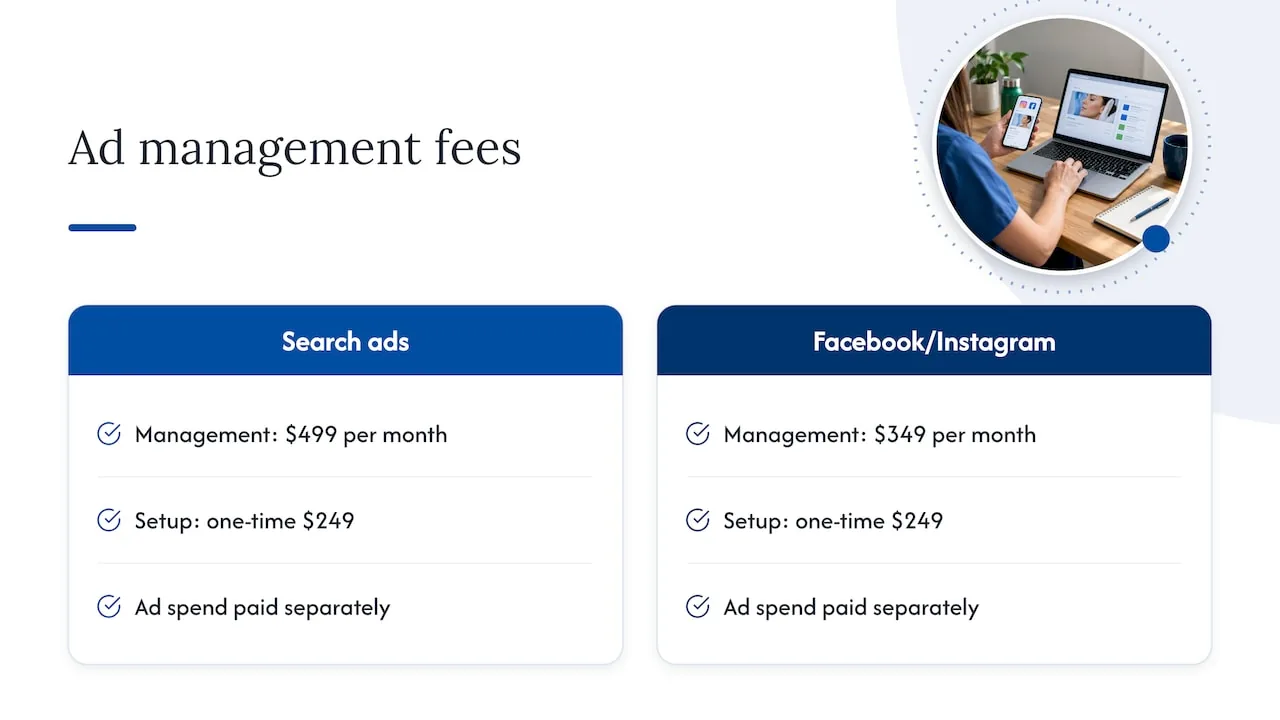
SEO builds the foundation, and paid channels add speed while it matures. Search ads can capture high-intent procedure searches immediately, and social platforms let you stay visible to patients who are still deciding. Run them on top of a sound site and profile, so that the clicks you buy land on pages that convert. A flat-fee structure keeps budgeting simple: our Google Ads management is $499 per month plus a one-time $249 setup fee, and our Facebook and Instagram ads management is $349 per month plus a one-time $249 setup fee. Ad spend is paid separately to the platform.
Perspective: why we build practices around entities first
We work with local service providers, dental and healthcare practices, law firms and franchises, and the pattern across them is consistent: the businesses that win are the ones that define who they are clearly and say it the same way everywhere.
For a plastic surgeon, that means the practice, each surgeon, each procedure and each location are treated as distinct entities with accurate, connected facts. Our approach combines technical SEO, Generative Engine Optimization (GEO) and Answer Engine Optimization (AEO), so your practice is built to be understood by Google’s map pack and organic results and by the AI tools patients now ask first.
We would start with your Google Business Profile and your highest-value procedure pages, because that is where search demand and revenue meet. Then we add the authority layer of reviews, mentions and consistent listings, and report on consultations rather than vanity metrics. Our reporting is built to be transparent, so you can see what is driving inquiries.
Surgeon review stays at the center. We can structure and optimize content, but your clinical voice is what makes it credible, and it is what patients and AI systems reward.
NSYGHT
Work with NSYGHT on your practice’s visibility
If you want a team that builds search visibility around entities, maps and AI answers, our SEO plans cover Google Business Profile management and three tiers of ongoing SEO: Foundation, Growth and Premium. Pricing for those plans is scoped to your market and goals. If you want a strategic second opinion first, consulting is available at $125 per hour.

Tell us your procedures, your service area and your goals through nsyght.com, and we will map out where your practice can be found first.
A 90-day starting plan
If you are beginning from scratch, this order gives the fastest return:
- Weeks 1 to 2: audit your profile, directory listings and site for inconsistencies in name, address, phone and credentials. Fix them.
- Weeks 2 to 4: complete and optimize your Google Business Profile, and set up call tracking and conversion tracking on your consultation forms.
- Weeks 3 to 8: rewrite or build your top three procedure pages, based on the procedures you most want to book. Have your surgeons review each one.
- Weeks 4 to 10: build surgeon bio pages and, if relevant, location pages. Add structured data.
- Ongoing from week 2: start a steady review-request routine inside your post-op process.
- Week 12: review consultation volume, call sources and profile actions. Decide which procedure to build out next.
The temptation is to publish dozens of blog posts early. Resist it. A small set of excellent pages on your highest-value procedures, supported by a strong profile and reviews, outperforms a large volume of generic content.
FAQ
How long does plastic surgeon SEO take to work?
Map pack and profile improvements can show within weeks, while new procedure pages usually need several months to build rankings. Competitive metro areas take longer. Judge progress by consultation requests and profile actions over quarters rather than week to week.
What is the difference between plastic surgery SEO and general medical SEO?
The fundamentals are shared: profile, site quality, reviews and authority. Plastic surgery adds elective, high-consideration procedures, strict expectations around results and risk disclosure, and heavy visual content. Your pages need to be both persuasive and clinically balanced.
Do reviews really affect rankings and AI answers?
Yes. Review quantity, recency and specificity influence how you appear in local results, and industry commentary in Plastic Surgery Practice says they also shape how AI models summarize a practice. Aim for a steady stream of detailed reviews rather than occasional bursts.
Should a surgeon write the content personally?
A surgeon should at least review and approve every clinical page. Peer-reviewed guidance recommends surgeons personally review AI-generated materials for accuracy, risk disclosure and balance. Your voice and credentials are what make the page trustworthy.
How do I know if my SEO is working?
Track consultation requests, booked consultations by source and procedures booked, alongside profile calls and organic traffic to procedure pages. Rankings are useful context, but consultations are the outcome that matters.
Sources
- Plastic Surgery Search Engine Optimization in the Artificial Intelligence Era, Plastic and Reconstructive Surgery, Global Open
- AI Search Disruption: Boost Your Plastic Surgery Practice, Plastic Surgery Practice
- Search Quality Rater Guidelines: An Overview, Google