
Keep your FAQPage schema and optimize it rather than ripping it out. Google removed the visible FAQ rich result from search listings, but the underlying structured data still helps search engines and AI systems parse question-and-answer content accurately. Start by inventorying every page carrying FAQ schema, then prioritize the ones with clear, visible answers for cleanup and reuse in AI-facing contexts.
- Keep FAQPage markup only where answers are concise, visible in page HTML, relevant to real visitor questions, and accurately match the visible content.
- Keep answers around 40 to 90 words, lead with the response, and ensure accordion text appears in raw page HTML.
- Consolidate near duplicates into one canonical answer, link related pages to it, and apply FAQPage markup only to that authoritative version.
- Use JSON structured data, validate it before publishing, and ensure every marked answer exactly mirrors the content visible to visitors on the page.
- Roll out changes in phases and compare consistent page groups; use general Search Console data and AI referral analytics because FAQ reporting is retired.
What Google changed and when the FAQ rich result disappeared
Google pulled back the FAQ rich result feature from its documentation, which signaled the end of the expandable Q&A blocks that used to appear directly in search listings for many query types. The Search Central updates log confirms that support and documentation for the FAQ rich result were removed, a clear marker that the visible feature is gone for most sites.
What actually changed is narrower than many site owners assume:
- The visible, expandable FAQ accordion in search results stopped appearing for the vast majority of sites.
- Search Console reporting tied to the FAQ rich result feature was retired alongside the documentation.
- The FAQPage schema type itself was not deprecated: schema.org still defines and supports it as a valid markup pattern.
That last point matters most. The rich result (the on-page visual treatment in search listings) and the schema type (the structured data vocabulary) are two different things. Google retired the former. The latter still exists, still validates, and still gets parsed by crawlers and AI systems that read structured data for context, even without a visual payoff in classic search results.
Why FAQ schema still matters for AI Overviews and answer engines
Losing the rich result snippet does not mean losing the value of marking up your questions and answers. AI Overviews and large language model driven answer tools tend to favor content that is already organized into clear, answer-first chunks, and FAQPage markup is one of the simplest ways to signal that structure to a crawler.
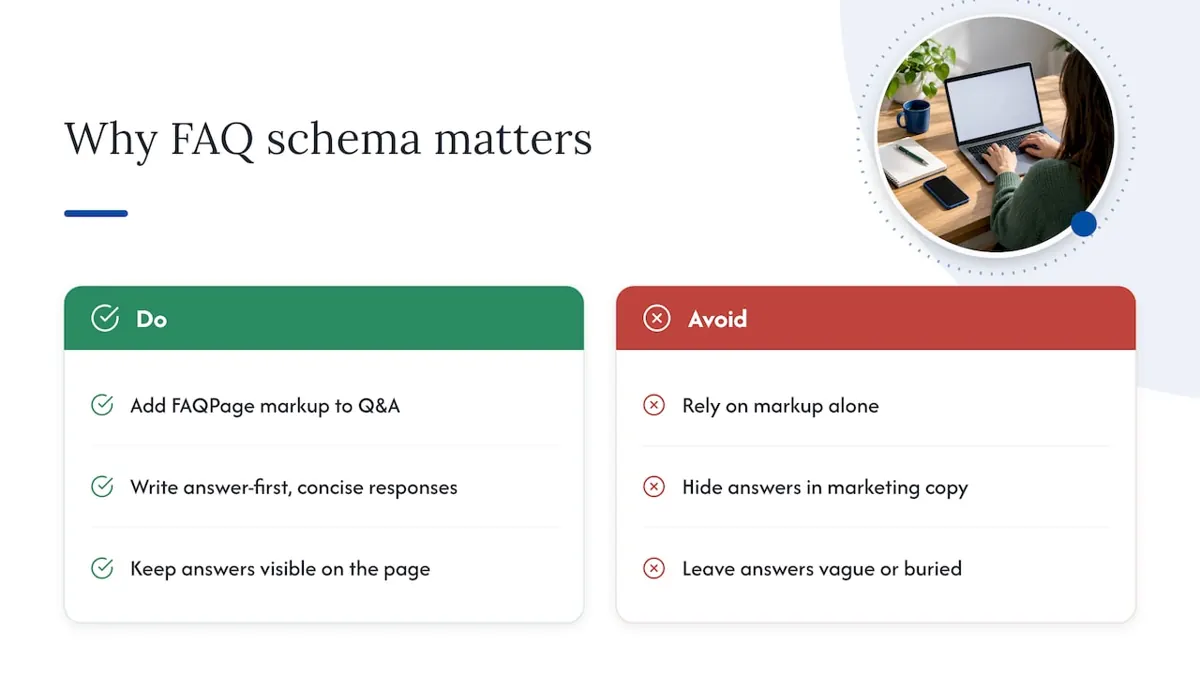
Google's own guidance on optimizing for generative AI features states that structured data is not required for generative AI features, but clear, concise answers in the visible page content are what these systems prioritize. Structured data still plays a supporting role: it helps machines confirm that a block of text is, in fact, a direct answer to a specific question, which can make extraction more reliable.
FAQPage remains one of the most broadly adopted schema types on the web, with usage reported across 1 million to 10 million domains. That scale is worth noting because it means AI systems and crawlers encounter this pattern constantly, which likely reinforces how reliably they parse it when it appears correctly.
Structured data isn't required for generative AI search, but it's useful as part of an overall SEO strategy, and AI systems still prioritize high-quality, visible content over markup alone.
The practical takeaway: schema is a readability aid, not a replacement for substance. A page with pristine JSON-LD but vague, buried, or marketing-speak answers will not get cited just because the markup validates. The visible content has to do the actual work of answering the question; the schema simply helps confirm what that content already does well.
Decision framework: keep, modify, or remove your FAQPage schema
Not every FAQ block on your site deserves the same treatment. Before you touch any code, audit each page against a few clear signals.
Keep the schema when:
- The answer is concise, direct, and matches the question asked without padding.
- The Q&A content is fully visible on the page, not hidden behind a click-to-expand element that never renders the text in the HTML.
- The question reflects something your actual visitors search for, not a question invented to game a feature.
Modify the schema when:
- Answers run long and wander before getting to the point, which hurts both snippet eligibility and AI extraction.
- The same Q&A block appears duplicated across many near-identical pages with no page-specific nuance.
- The content reads as auto-generated or template rather than written for the specific page it sits on.
Remove or consolidate when:
- The information is stale, outdated, or creates a policy risk if left unmonitored.
- Dozens of pages repeat the same generic questions with no unique value, inflating duplication across the site.
- The schema no longer matches what is visible on the page, which runs against Google's structured data policies requiring markup to reflect visible content.
Run your audit page by page, not site-wide: a blanket decision to keep or remove FAQ schema almost always leaves good pages undermaintained or good content stripped for no reason.
What to build instead of chasing deprecated rich results
Chasing the old rich result snippet is a dead end now that the feature is gone. The better move is to treat Q&A content as a structural asset for the whole page rather than a bolt-on widget aimed at a search feature that no longer exists.
- Write Q&A pairs directly into the visible page body, in plain text, rather than hiding them inside collapsed accordions that never render for crawlers.
- Build topic hub pages that centralize the canonical answer to a recurring question instead of scattering slightly different versions of the same answer across dozens of pages.
- Create entity pages that establish who you are, what you do, and where you operate, then link your Q&A content back to those pages for context.
- Keep one short, canonical snippet per question and point internal links at it, rather than letting five pages each claim to be the authoritative answer.
- Apply structured data to the canonical version only, so machines are not stuck trying to pick a winner among duplicates.
This approach lines up with how entity-driven SEO architecture works more broadly: a site built around clearly defined entities, with one authoritative page per topic, tends to give both search engines and AI systems a cleaner signal than a pile of disconnected FAQ blocks. Our own breakdown of how SEO, GEO, AEO, and AIO work together goes deeper into why that structure matters beyond just FAQ content.
How to implement FAQPage schema correctly with JSON-LD
JSON-LD is the format Google generally recommends for structured data because it sits in a separate script block rather than tangled through your HTML, which makes it easier to maintain and less prone to markup errors.
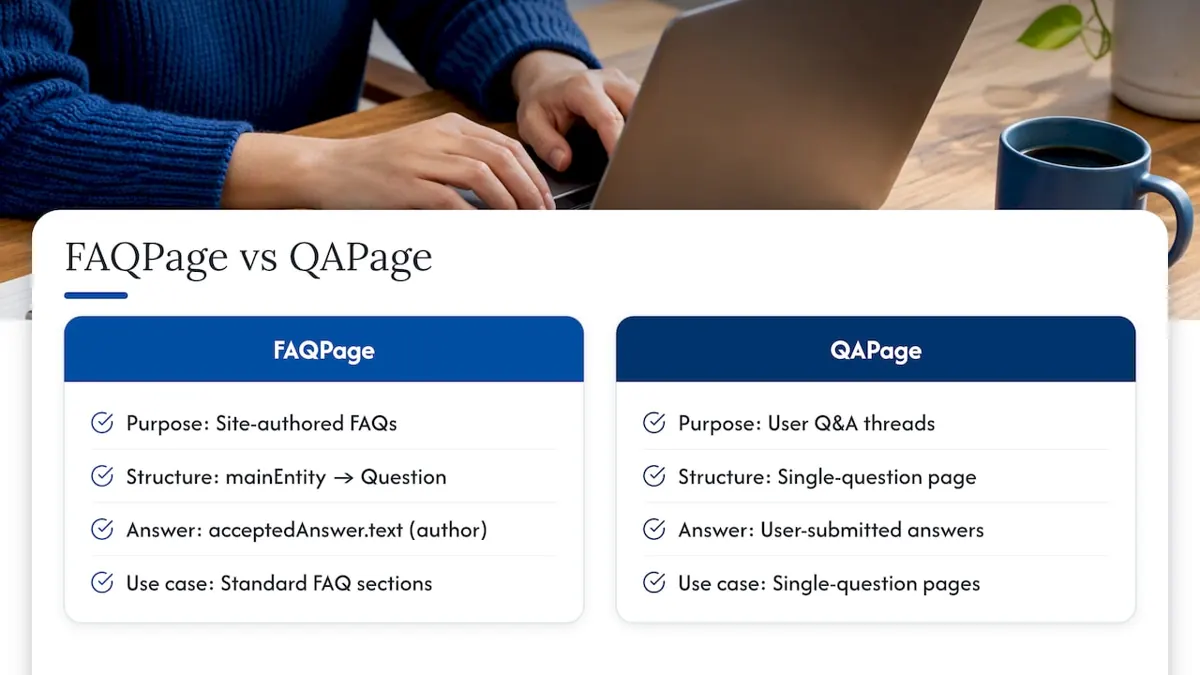
Place the JSON-LD block in the page's head or at the end of the body. Each FAQ page needs a mainEntity array, where every item is a Question type with a name property holding the question text and an acceptedAnswer property of type Answer containing the response in a text field.
{
  "@context": "https://schema.org",
  "@type": "FAQPage",
  "mainEntity": [
    {
      "@type": "Question",
      "name": "Does FAQ schema still work in 2026?",
      "acceptedAnswer": {
        "@type": "Answer",
        "text": "FAQ schema still works for machine readability, though Google no longer displays the visible rich result in search listings."
      }
    }
  ]
}
Common validation errors include leaving the text field empty, nesting answers that do not match what actually appears on the page, and reusing one JSON-LD block across multiple URLs without updating the content. Always confirm your markup against the schema.org FAQPage definition, and remember that one schema type gets misapplied often enough to call out directly: QAPage structured data is meant for single-question pages where multiple users submit answers, not for a standard site-authored FAQ section.
Whatever you implement, the markup has to mirror the visible page content exactly. That is not a stylistic suggestion, it is a direct requirement under Google's structured data policies, and mismatched schema risks disqualification from rich features entirely.
Best practices for writing FAQ content that works for humans and AI
Short, direct answers extract more cleanly than long ones. Aiming for roughly 40 to 90 words per answer gives AI systems and snippet algorithms a clean block of text to lift without having to guess where the real answer starts and ends.
A few editorial habits make a measurable difference:
- Lead with the direct answer in the first sentence, then add one or two sentences of supporting context.
- Avoid hiding answer text behind JavaScript-only accordions that never render in the raw HTML a crawler sees.
- Skip auto-generated filler questions created purely to pad out a schema block; low-quality content tends to hurt more than help.
- Add author or date metadata on FAQ content where freshness or expertise genuinely matters, such as medical, legal, or financial topics.
- Consolidate near-duplicate questions into one canonical version instead of letting several pages compete for the same query.
If two FAQ entries on different pages answer the same question in almost the same words, pick one as canonical, link to it, and either rewrite or remove the other.
Canonicalization matters more under this new landscape than it did when every page could theoretically earn its own rich result. Now that the win is AI citation and extraction rather than a search listing badge, one strong, well-maintained answer beats five mediocre, duplicated ones.
Testing, monitoring, and measuring the impact of your FAQ schema
Validate before you publish, then keep watching after. The Rich Results Test and Validator both check FAQPage markup for structural errors before it goes live.
After deployment, track a handful of practical signals:
- Monitor Search Console for crawl and indexing changes, keeping in mind that the FAQ-specific rich result report is gone, so you are reading general performance data instead.
- Track referral patterns from AI tools where server logs or analytics can surface them, since this is the closest proxy available for AI citation activity.
- Watch for shifts in People Also Ask occurrences tied to your pages, as a rough signal of how your questions align with what searchers ask.
- Check click-through rate changes on pages where you rewrote or consolidated FAQ content.
- Review visits to the canonical answer page after consolidating duplicates, to confirm traffic is not quietly leaking to a page you demoted.
When testing changes, roll them out in phases across a defined content set rather than site-wide at once. Comparing a consistent group of canonical answer pages before and after a change gives you a cleaner read than changing everything simultaneously and guessing which edit mattered.
How we apply FAQ schema inside entity-driven SEO architecture
We treat Q&A content as part of a page's entity signal, not a standalone widget. Inside an entity-first hub, we write the canonical answer once, mark it up with clean JSON-LD, and link every related page back to that single source rather than letting duplicate answers spread across a site.
Operationally, that means a documentation template for every FAQ block we deploy, a validation pass through schema.org's validator before launch, and a recurring QA check to confirm the visible answer text still matches the markup after a page gets edited. We treat structured data as a living asset that needs maintenance, not a one-time setup task. Our local SEO checklist includes the same audit discipline we apply to FAQ markup across client sites, covering the broader technical items that tend to get overlooked once a site grows past a handful of pages.
The real lesson from Google's FAQ rich result deprecation
The industry's instinct after any Google deprecation is to treat the removed feature as dead weight and strip it out. That instinct is wrong here. The mistake was ever treating FAQ schema as a snippet-generation trick in the first place, rather than as what it actually is: a structured way to tell machines which text on a page answers which question.
The conventional advice splits into two overreactions: either keep every FAQ block untouched because "it might still work," or delete it all because "Google killed it." Neither holds up. The pages worth keeping are the ones with answers a human would actually want to read, written in plain language, visible without a click. The pages worth cutting were never good content, they just used to get a visual reward for existing.
Prioritize visible answer quality first, canonical structure second, and markup last. Schema should document good content, not substitute for it.
How we help you turn FAQ content into an AI visibility asset
Cleaning up FAQ schema across a growing site, rebuilding entity pages, and tracking AI citation activity is a lot to manage alongside running a business. We built our SEO services around exactly this kind of ongoing technical and content work, so you are not stuck auditing JSON-LD blocks between client calls.
Our SEO Foundation, SEO Growth, and SEO Premium plans include technical audits, entity architecture work, and content guidance built for local and multi-location service businesses, from dental practices to law firms to home service companies. We also manage Google Business Profile presence, since local entity signals and FAQ content work best when they reinforce each other rather than living in separate silos.
If your site has years of accumulated FAQ blocks and no clear sense of which ones still earn their place, start with an audit. Visit our SEO services page to see current plans and get a strategy built around your specific pages, not a generic checklist.
Frequently Asked Questions
Yes, FAQPage schema still validates and still gets parsed by search engines and AI systems, even though Google removed the visible rich result snippet from search listings. The markup now matters more for machine readability and AI citation than for earning a visual spot in classic search results.
FAQ schema, formally the FAQPage type defined by schema.org, is structured data that marks up a set of questions and their answers so crawlers can identify them as a Q&A pair. It is typically implemented in JSON-LD format and placed in a page's HTML alongside the visible content it describes.
Well-written FAQs that answer real user questions in clear, concise language support SEO by matching how people phrase search queries and by giving AI answer engines a clean block of text to extract. The value comes from the visible answer quality itself, with structured data acting as a supporting signal rather than the main driver.
Schema refers to structured data markup, most commonly implemented through the schema.org vocabulary, that labels specific elements on a page such as questions, products, or reviews so search engines can interpret them with more precision than plain text allows. It helps machines confirm what a piece of content represents, supporting both traditional rich results and newer AI-driven answer systems.
Not automatically. Keep the schema where the underlying content is accurate, visible, and genuinely answers a real question, since AI systems still read that markup for context even without a visual snippet reward. Remove or consolidate it only where the content is outdated, duplicated across many pages, or no longer matches what is visible, consistent with Google's structured data policies.