


Bing Copilot does not run on a secret index. It answers from the same Bing index that powers regular Bing results, so Copilot SEO starts with being crawled, indexed and trusted by Bing, then making each page easy to quote. If you do those two things, you are eligible for citations. Nobody can guarantee them, and anyone who promises otherwise is guessing.
This guide is for local service businesses, multi-location brands and professional practices that want to show up when a customer asks an AI assistant who to call. It covers what Microsoft says in its own guidelines, the technical setup, how to write pages Copilot can lift answers from, and how to measure the result.
TL;DR
- Copilot grounds its answers in Bing’s index. A page that Bing has not indexed cannot be cited, whatever its quality, and Google rankings do not change that.
- Microsoft’s Bing Webmaster Guidelines now cover Copilot and AI answers directly, and they name generative engine optimization (GEO) for the first time.
- Write in self-contained passages: a clear question heading, then a short answer that makes sense on its own. Keep key facts in server-rendered HTML, not behind JavaScript.
- Verify your site in Bing Webmaster Tools and use the AI Performance report to see which pages Copilot cites and for which queries.
- Consistent business facts (name, address, services, reviews, schema) carry more weight with AI systems than keyword tweaks.
Table of Contents
- How Copilot decides what to cite
- Is Bing worth the effort for a local business?
- Step 1: Get crawled and indexed by Bing
- Step 2: Write passages that can be lifted
- Step 3: Make your business an entity Bing can verify
- Step 4: Measure Copilot visibility
- Common mistakes that keep you out of Copilot
- Our perspective: Copilot rewards the basics done well
- Where we can help
- FAQ
- Sources
How Copilot decides what to cite
The old name for this product was Bing Chat, and some people still search for “Bing AI.” Whatever the label, the mechanics are the same. A user asks a question, the system runs searches against the Bing index, pulls out relevant passages, and writes an answer with citations.
Microsoft’s guidelines say that Bing and Copilot experiences rely on the same core crawling, indexing and ranking foundation. That has three practical consequences:
- Indexing comes first. If Bingbot cannot reach a page, or Bing chooses not to index it, Copilot has nothing to quote.
- Passages matter more than pages. The system extracts segments of text. A page can rank well and still lose the citation if the useful answer is buried in a long block of copy.
- Trust is assessed on the whole site. Thin, ad-heavy or affiliate-only content is flagged in the guidelines as less eligible for grounding.
Microsoft has also been explicit that GEO, meaning optimizing content so that it is eligible for grounding and reference in AI responses, is part of its guidance. Search Engine Journal’s coverage of the February 2026 rewrite notes that it now addresses both classic results and Copilot’s generated answers. The guidelines also stress that neither SEO nor GEO guarantees any particular outcome. Treat that as the honest baseline: you are improving eligibility, not buying placement.
Is Bing worth the effort for a local business?
The fair objection is that Google sends most of your traffic. One tracker puts Bing at about 8.8% of US search, against roughly 85% for Google. Those figures vary by source and by device, so read them as a rough scale, not a precise number.
Three reasons the smaller share still matters:
- Bing’s reach is wider than its own search box. Copilot, Edge and Windows put Bing-grounded answers in front of people who never type “bing.com.” Microsoft says Copilot for Microsoft 365 is used by 70% of Fortune 500 companies, which matters if your customers are businesses researching vendors at work.
- The work overlaps. Almost everything that helps Bing also helps Google and other AI tools: clean crawling, clear structure, strong entity signals. You are not choosing between engines.
- Competition is thinner. Most local businesses have never opened Bing Webmaster Tools. Basic hygiene there is still an edge.
If you sell to consumers in a category where people ask Google first, such as emergency plumbing, keep Google Business Profile and the map pack as the priority. If you sell to office workers, owners and professionals, Copilot deserves a real slice of the effort.
Step 1: Get crawled and indexed by Bing
Everything downstream depends on this. Microsoft’s guidelines walk through the same sequence: make URLs discoverable, signal importance and freshness with sitemaps, notify Bing when URLs change, build structure with links, consolidate duplicates, redirect moved pages properly and allow efficient crawling and rendering.
A practical setup for a local business:
- Verify your site in Bing Webmaster Tools. You can import a property from Google Search Console, which saves time.
- Submit an XML sitemap and keep it limited to canonical, indexable URLs with accurate last-modified dates.
- Turn on IndexNow if your CMS supports it, so changed pages are pushed to Bing instead of waiting to be rediscovered. The guidelines list notifying Bing quickly when URLs change as a core practice.
- Check robots.txt and your firewall. Security plugins and CDNs sometimes block Bingbot by accident.
- Consolidate duplicates. Location pages that differ only by city name, or the same page under several URLs, dilute signals. Pick one canonical version.
- Redirect moved pages with 301s and remove deleted content cleanly, so Bing does not keep serving dead URLs.
Watch out for client-side rendering
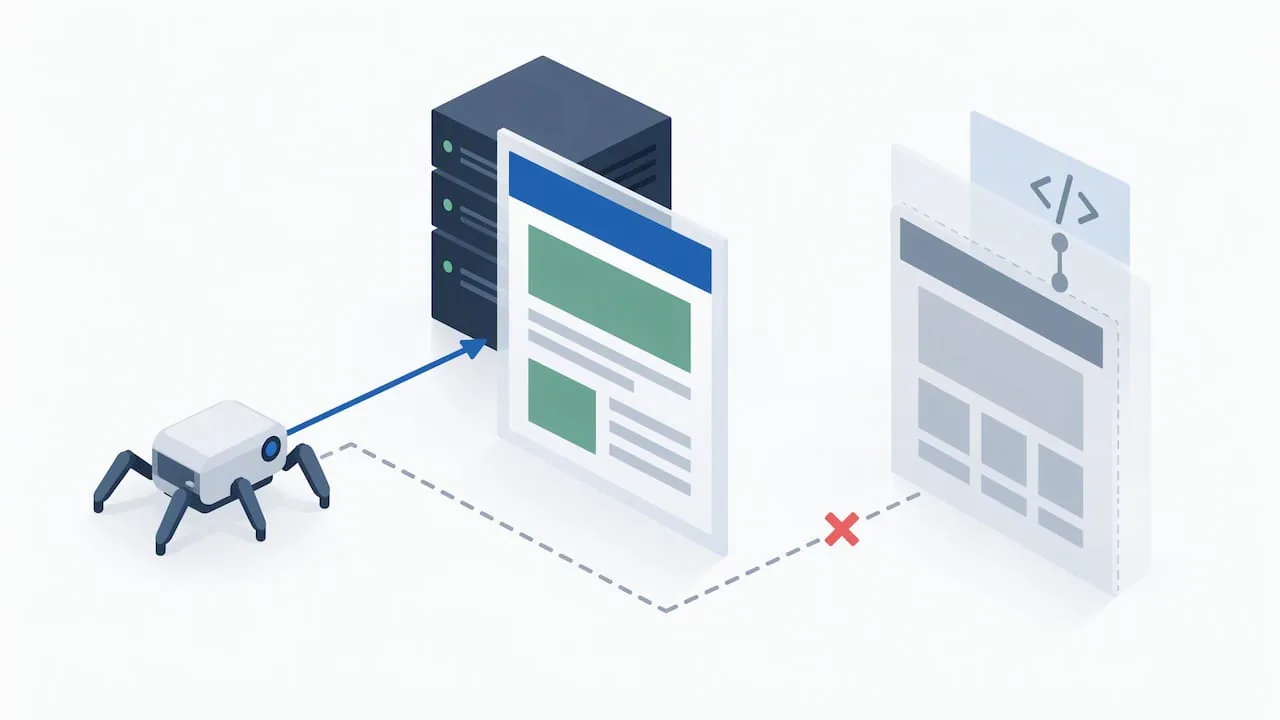
If your phone number, service list, pricing notes or hours load only after JavaScript runs, a crawler may never see them. Microsoft’s guidance on rendering and the experience of practitioners point the same way: put essential facts in the server-rendered HTML. Open your page with JavaScript disabled. If the answer to a customer’s question is missing, so is your chance of being quoted.
Step 2: Write passages that can be lifted
Copilot assembles answers from fragments. Your job is to make each fragment complete.
Lead each section with the answer. Put a question or a plain descriptive heading on the section, then answer it in the first one or two sentences. Add the detail after.
Make each answer stand alone. A passage that says “as mentioned above, it depends on this factor” is useless once lifted. Name the service, the place and the condition in the sentence itself.
Compare these two versions for a roofing company:
| Hard to cite | Easy to cite |
|---|---|
| “We’ve been doing this a long time and our process is thorough. Contact us to learn more about what to expect.” | “A full roof replacement for a typical single-family home in Austin takes two to three days once materials arrive. We start with a written inspection and finish with a final walkthrough.” |
| Answer is vague, with no service, place or fact. | Answer names the service, the place and a checkable detail. |
Only state details you can stand behind, of course. The example shows the shape, not numbers to copy.
Use real specifics. Microsoft’s guidelines call for clarity and verifiable information, and they warn against thin, promotional content. Cite primary data where you use statistics. Show who wrote the page and why they are qualified. For dental, legal and health topics this is not optional: name the licensed professional and keep claims within what the profession can substantiate.
Keep pages focused. One service, one location or one question per page usually beats a sprawling page that tries to rank for everything.
Step 3: Make your business an entity Bing can verify
AI systems are cautious about naming a business they cannot confirm. Entity signals are how you help them:
- Identical business name, address and phone number across your site, Google Business Profile, Bing Places and major directories.
- An About page that says who runs the business, where it operates and what it is licensed for.
- Organization or LocalBusiness schema in JSON-LD, plus Article, FAQPage or Person markup where it fits. Validate it. Schema does not replace good copy, but it removes ambiguity about what a page is.
- Genuine reviews and third-party mentions that match what your site claims.
- Author bylines and dates on informational content.
Claim your listing in Bing Places as well. Many owners maintain Google Business Profile carefully and ignore Bing entirely, which leaves their Bing map data stale or wrong. If you want help on the Google side, our Google Business Profile management page explains what we handle, and the local SEO audit checklist shows how to check the basics yourself.
For how entities, GEO and answer-focused content fit together, see how SEO, GEO, AEO and AIO work together, or read our explainers on generative engine optimization and answer engine optimization.
Step 4: Measure Copilot visibility
Until early 2026 this was guesswork. Now Microsoft provides data. In February 2026 Bing introduced the AI Performance report in Bing Webmaster Tools, launched as a public preview. It shows how your content appears across Microsoft Copilot, AI-generated summaries in Bing and select partner integrations.
According to Search Engine Land’s write-up, the dashboard tracks total citations, among other measures. Microsoft’s help page for the report explains that it highlights which pages are cited. You can also see the grounding queries, the phrases used to retrieve your content, and filter by custom date ranges.
Here is how to use it:
- Find your cited pages. These are your templates for success. What do they have in common: format, length, heading style?
- Read the grounding queries. They show how the system actually phrases the question, which is often different from your keyword list. Write new sections that answer those phrasings.
- Look for indexed pages with no citations. Those usually have buried answers, thin content or weak entity signals.
- Compare against your crawl and index reports to catch pages that never made it into the index.
- Test by hand. Ask Copilot the questions your customers ask, including the “near me” and “best” versions, and note who is named. Results vary by user and location, so treat it as a spot check, not a ranking.
Because the report is a preview, metrics and availability may change. Check Microsoft’s documentation before you build a reporting process around it.
Common mistakes that keep you out of Copilot
- Assuming a Google ranking carries over. Bing has its own index and its own view of your site.
- Blocking Bingbot or leaving staging directives such as noindex on live pages.
- Hiding key facts in JavaScript, images or PDFs.
- Publishing thin city pages that swap the town name and nothing else.
- Writing promotional filler. Microsoft’s guidelines flag thin, ad-heavy or affiliate-only content as less eligible.
- Inconsistent business data between your site, Bing Places and directories.
- Chasing tricks. The expanded guidelines also widen the definition of AI-related abuse, so manipulating AI answers is a risk, not a shortcut.
Our perspective: Copilot rewards the basics done well
We work with local service businesses and multi-location brands every day, and the pattern with Copilot is familiar. Owners ask whether they need a separate strategy. Mostly they do not. They need a clean technical foundation, a clearly defined business entity and pages written for people who want a straight answer.
The mistake we see most is treating each AI platform as its own project. That creates a pile of tactics, none of them durable. The better move is to build the infrastructure once: crawlable pages, consistent facts, structured data, content organized around real customer questions. Then check each engine’s tools, including Bing Webmaster Tools, to see how it reads you.
We would also set expectations plainly. Citations are not rankings, nobody controls them, and a single mention in an AI answer does not replace a steady flow of calls from the map pack. Use Copilot visibility as one signal alongside local rankings, calls and booked jobs. If you are a multi-location brand, consistency across every location page matters even more; our guide to multi-location SEO for AI search covers the three moves we start with.
, NSYGHT
Where we can help
If you would rather have this handled, our SEO services cover technical audits, entity-driven site architecture, GEO and AEO content, and Google Business Profile management for local and multi-location businesses. If you want a second opinion first, we offer consulting at 125 USD per hour, listed on our services page. You can also start from our home page to see who we work with.
FAQ
Is Bing SEO worth it?
For most local businesses, yes, as a secondary channel with low added effort. Bing’s share of US search is small next to Google’s, but the same index feeds Copilot, so the work doubles as AI visibility. The technical steps overlap heavily with what you already do for Google.
How do I SEO for Bing?
Verify your site in Bing Webmaster Tools, submit a sitemap, enable IndexNow if available, and fix crawl and duplicate-URL problems. Then improve content clarity and authority, and claim your Bing Places listing. Microsoft’s webmaster guidelines are the authoritative checklist.
Does Copilot use a different index than Bing?
No. According to Microsoft’s guidelines, Copilot experiences share Bing’s crawling, indexing and ranking foundation. If a page is not in Bing’s index, it cannot be used to ground a Copilot answer.
Can I see when Copilot cites my site?
Yes, in part. The AI Performance report in Bing Webmaster Tools shows citations, cited pages and grounding queries for Copilot and other Microsoft AI surfaces. It launched in public preview in February 2026, so features may change.
Sources
- Bing Webmaster Guidelines
- Introducing AI Performance in Bing Webmaster Tools (Bing Webmaster Blog)
- AI Performance help page (Bing Webmaster Tools)
- Bing Webmaster Tools officially adds AI Performance report (Search Engine Land)
- Bing Adds GEO To Official Guidelines (Search Engine Journal)
- Search Engine Market Share (2026)
- Microsoft 365 Adoption in 2025 Businesses