
A properly sourced Wikidata item, identified by its Q-ID, paired with on-site schema.org sameAs markup, materially strengthens the machine-readable entity signal that large language models and knowledge graphs rely on. The first move is simple: search Wikidata for an existing Q-ID for your entity and add a sameAs link to it. Expect any downstream effect on AI answers or search features to take weeks to months to surface.
- Before editing, check for a Wikimedia sitelink or two independent public references; a business's own website and its press releases do not establish notability.
- Every factual statement needs an independent public citation, and representatives should disclose their affiliation; neutral descriptions avoid promotional language that editors may revert.
- Add the full Wikidata item URL, not a Wikipedia page, to sameAs in your Organization or LocalBusiness JSON structured data, then validate the markup.
- A Wikidata item cannot guarantee a Knowledge Panel or AI citation; track edit dates, and treat Q identifier recognition as an early signal.
What Wikidata is and how it differs from Wikipedia
Wikidata is a structured database where every entity gets a unique identifier called a Q-ID, and every property connecting entities gets a P-number. A statement like "founded by" linking a company's Q-ID to a founder's Q-ID forms a triple: subject, property, value. That triple is what machines read.
Each item carries labels, descriptions, and aliases in multiple languages, along with sitelinks pointing to corresponding pages on Wikipedia, Wikivoyage, or other Wikimedia projects, according to the Wikidata main site. A label is the entity's name, a description disambiguates it from similarly named entities, and aliases capture alternate names people might search.
The contrast with Wikipedia is the core distinction to hold onto. Wikipedia articles are written for humans: prose, citations, narrative structure. Wikidata items are written for machines: discrete statements, each with its own property and reference, designed to be queried, aggregated, and fed into other systems. A business can have a Wikidata item without a Wikipedia article, though the two reinforce each other when both exist.
Why Wikidata matters for SEO, AEO and LLM-driven answers
Wikidata functions as a high-precedence source for the systems increasingly deciding what gets cited in AI answers. Because every item carries a unique Q-ID and the entire dataset is released under a CC0 license, model builders can ingest it into training sets or retrieval pipelines without licensing friction, which makes it more attractive than many other structured sources, according to the Wikimedia Foundation's Diff blog. Retrieval-augmented generation systems in particular favor sources where facts are already disambiguated and linked, since that reduces the work the system has to do to confirm which entity is being discussed.
The propagation path matters for anyone doing entity-driven SEO. Google's Knowledge Graph has historically drawn on Wikidata and Wikipedia as reference layers for disambiguating entities, and AI Overviews and other generative answer features sit on top of that same entity infrastructure. A well-structured Wikidata item does not guarantee a Knowledge Panel or an AI citation, but it removes a common point of failure: the system being unable to tell which "Smith Dental Group" or "Riverside Events" you mean.
The practical upside shows up in three places. First, reduced homonym confusion: a clean Q-ID with accurate statements helps separate your business from others sharing its name. Second, improved answer accuracy: when an LLM retrieves facts about your entity, it is pulling from a record you control the sourcing for, rather than from scattered, inconsistent web mentions. Third, a better chance of citation: structured, referenced claims are easier for a retrieval system to quote than unstructured prose buried on a webpage.
None of this replaces traditional content and backlink work. It sits alongside it as a layer of entity-first infrastructure feeding the generative answer systems that increasingly sit between your business and the searcher.
Eligibility and notability: the three criteria and how to pre-check your entity
Wikidata does not accept every business, person, or organization that wants an item. The Wikidata:Notability policy lays out three paths to eligibility, and an item only needs to satisfy one.
The first path is a valid sitelink: an existing page on Wikipedia or another Wikimedia project about the same entity. The second is a clearly identifiable entity supported by serious, publicly available references, meaning independent sources beyond a company's own website or a press release it issued. The third is structural need, where the item serves as a necessary building block for the graph itself, such as a value referenced by other items.
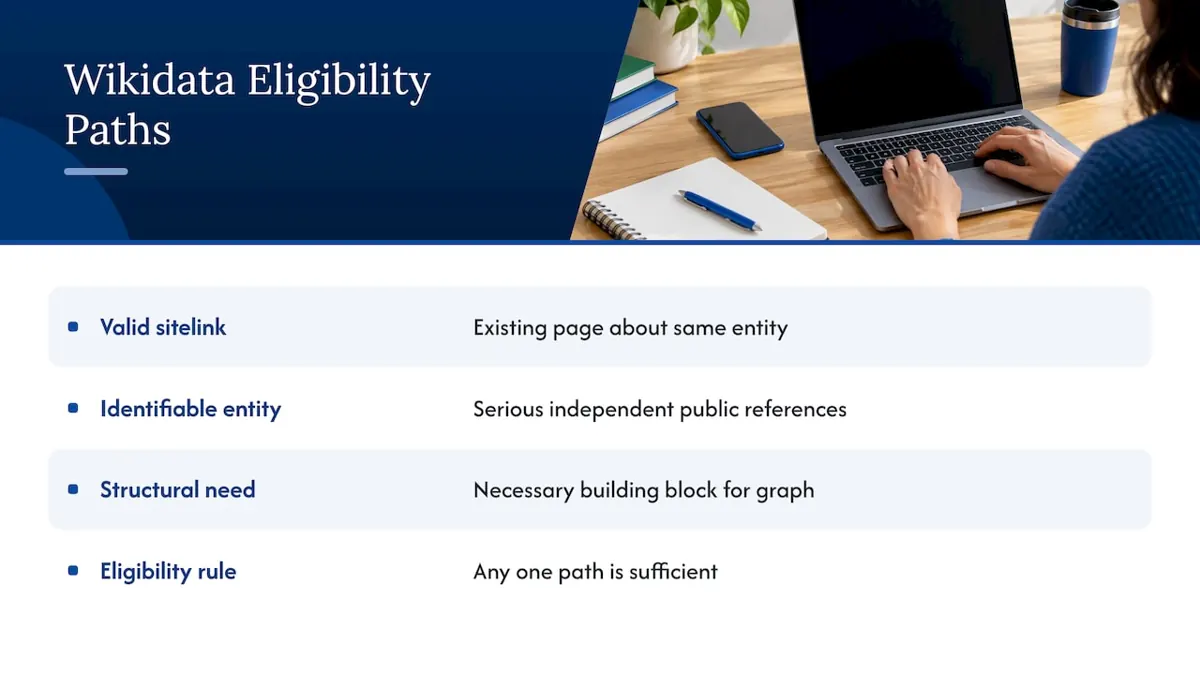
A sitelink only counts if it points to an actual Wikimedia project page about your entity specifically, not a mention inside a broader article, according to Wikidata's Help:Items page. Common rejection reasons include relying solely on self-published sources, writing descriptions that read as promotional, and submitting entities with no independent coverage at all.
Before editing, pre-check your entity against a short list: does a Wikipedia article already exist, do independent news or directory sources discuss the entity by name, and can you cite at least two sources that are not owned or controlled by the entity itself. If none of those hold, Wikidata eligibility is unlikely yet.
Step-by-step creation and optimization checklist for a Wikidata item
Treat this as an operational checklist, whether you execute it yourself or hand it to a contractor.
- Search first. Query Wikidata's search bar for your entity's exact name and close variants before assuming no item exists; duplicate items get merged or deleted.
- Disclose affiliation. If you work for or represent the entity, disclose that on your Wikidata user page; undisclosed promotional editing is a frequent cause of reverted edits, per Wikidata's Knowledge Equity Guidelines.
- Set the label and description. The label is the entity's name; the description is a short, neutral phrase that disambiguates it, such as "dental clinic in Ohio" rather than "trusted leader in dental care."
- Add aliases. Include alternate names, abbreviations, or former names people might search.
- Add sitelinks where valid. Link to an existing Wikipedia page or other Wikimedia project page if one exists and genuinely covers the entity.
- Add core statements. At minimum, include "instance of" (what kind of entity this is), official website, inception date, and relevant external identifiers.
- Attach a reference to every statement. Each factual claim needs a citation to an independent, publicly available source, following the sourcing structure described on Help:Items.
- Use structural properties where relevant. Properties like "located in the administrative territorial entity" or "parent organization" help the graph connect your item to others correctly.
- Review before publishing. Reread the description and statements for promotional tone; Wikidata editors and bots routinely flag and revert marketing language.
Keep a spreadsheet of every statement and its source URL before you start editing; it makes the reference-adding step faster and gives you a record if an edit gets challenged.
On-site declarations: schema.org, JSON-LD and sameAs linking
Creating the Wikidata item is half the work. The other half is telling your own website to point at it. Add a sameAs property inside your site's Organization or LocalBusiness JSON-LD schema, with the value set to the full Wikidata item URL, such as https://www.wikidata.org/wiki/Q123456.
This matters because sameAs is the mechanism that tells search engines and AI crawlers "this webpage and this Wikidata item describe the same real-world entity." Without it, a machine has to infer the connection from name matching alone, which is unreliable when names overlap across businesses.
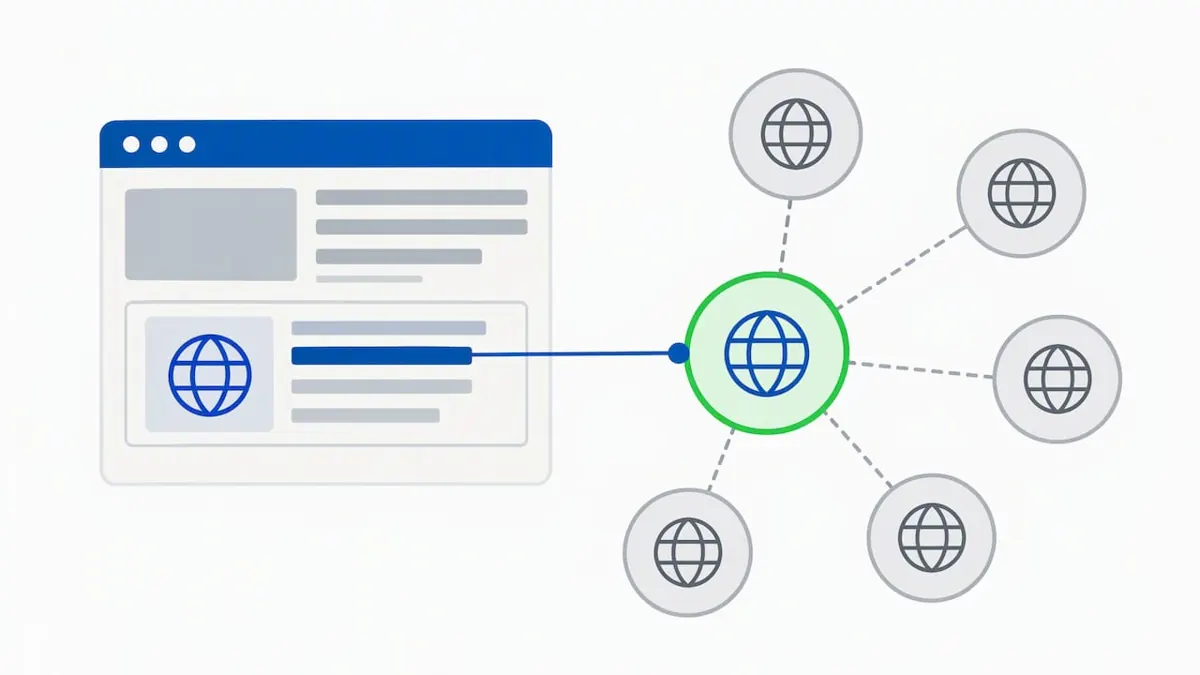
The properties worth prioritizing are name, url, logo, and sameAs, with sameAs ideally listing multiple canonical profiles, Wikidata included, not just social media. Common mistakes include pointing sameAs at a Wikipedia article instead of the Wikidata item, leaving stale Q-IDs after a merge, or omitting the schema block from key pages entirely. Validate the markup with Google's Rich Results Test or Schema.org's own validator after publishing.
Monitoring and measurement: tracking impact without guessing
Knowledge Graph and LLM systems do not refresh instantly. Expect changes to a Wikidata item to take anywhere from a few weeks to several months before they show up in AI Overviews, voice assistants, or chatbot answers, since caching and retraining cycles vary by platform.
A practical monitoring toolbox includes:
- Logging the exact timestamp of each Wikidata edit so later changes in AI output can be compared against a known date.
- Periodically querying your entity name in major chatbot tools to sample whether facts match your current Wikidata statements.
- Watching Search Console for changes in branded query impressions, which can hint at Knowledge Panel or entity-feature shifts.
- Using Wikimedia's programmatic access points to check Q-ID and sitelink status at scale if you manage multiple locations or franchise entities.
A sourced fact worth anchoring expectations to: Wikidata's CC0 licensing and Q-ID structure are explicitly cited as reasons model builders favor it for training and retrieval, per the Wikimedia Foundation's Diff blog, which is why this channel tends to be a durable, slow-moving signal rather than a quick ranking lever.
Treat small signals, like an LLM correctly stating your Q-ID exists or recognizing your sameAs link, as early confirmation the connection registered. A larger outcome, like appearing in an AI-generated answer, is a separate, later milestone and should not be expected on the same timeline.
How we operationalize Wikidata inside a GEO/AEO program
Our entity work starts with an audit: does a Q-ID exist, is it accurate, and does the client's site already declare sameAs anywhere. From there we align schema.org markup across key pages, add or correct Wikidata statements with proper references, and build the connection into the client's broader entity-first SEO architecture.
For a single-location business with a clean record, this work can move quickly. For multi-location brands or franchises, it becomes part of a longer program that coordinates Wikidata, schema.org, and often public relations or Wikipedia-adjacent efforts across every location entity. We monitor outputs across AI tools over time rather than expecting a single edit to move the needle immediately, and we fold that monitoring into the same reporting we use for local SEO programs.
What the data actually supports, and where it gets oversold
The most common mistake in Wikidata advice is treating item creation as a ranking hack. It is not. Wikidata eligibility rules exist specifically to keep promotional entries out, and an item built purely to chase AI citations without genuine independent coverage behind it is likely to get rejected or reverted. The conventional advice to "just create a Wikidata page" skips the notability gate entirely.
What the evidence actually supports is narrower and more durable: a correctly sourced item, tied to your site through sameAs, reduces ambiguity for machines that already have reason to discuss your entity. It is infrastructure, not acquisition. If you are weighing where to start, prioritize the sitelink and reference check over the editing itself. An entity with no independent coverage anywhere will not become notable by filling out a Wikidata form, no matter how complete the statements look.
The second underrated point is patience. Because Wikidata's value runs through training and retrieval cycles rather than live indexing, the people who get frustrated and abandon the effort are usually the ones expecting a visible change inside days.
Get a hand with entity-first SEO and Wikidata alignment
If this checklist raised more questions than you have time to resolve in-house, entity architecture is the foundation of what we build for clients: Wikidata alignment, schema.org markup, and the broader GEO and AEO work that connects a business to how AI tools answer questions about it.
We fold this kind of entity work into our SEO services, including Google Business Profile management for local and multi-location businesses whose entity signals need to stay consistent across every location page. If you want a specific read on where your entity stands today, reach out through our SEO services page to request an audit.
Frequently Asked Questions
No, a Wikidata item does not guarantee a Knowledge Panel; it strengthens the entity signal that Knowledge Graph systems can draw from. Panels depend on multiple factors beyond any single data source, including independent coverage and search demand for the entity.
Yes, a Wikipedia page is only one of three eligibility paths under Wikidata's Notability policy. An item can also qualify through serious, independent public references or a structural need within the graph.
Changes typically take weeks to months to show up in AI Overviews or chatbot answers, since these systems rely on caching and periodic retraining rather than live lookups. Early signs, like an AI tool recognizing your Q-ID, often appear before any visible outcome change.
Wikidata is an external, community-maintained database holding structured facts about your entity under a unique Q-ID. The sameAs property is markup on your own website that points to that Wikidata item, telling machines your page and the Wikidata record describe the same entity.
You can create and edit a Wikidata item yourself if you are comfortable following the notability rules and sourcing requirements on Help:Items. Businesses managing many locations or a broader entity program often hand the work to a specialist to keep edits consistent and properly referenced.