
For ai search optimization, give a customer question its own page when it represents a distinct buying decision, needs a substantial answer, and connects to a service you actually provide. Keep short follow-up questions on the relevant service page, and skip separate pages that merely reword an answer you already publish; none of these choices guarantees rankings or inclusion in AI answers.
- Nsyght’s ai search optimization guidance: publish pages for distinct customer decisions, not every question variation.
- Use a dedicated page when the answer needs its own evidence, explanation, and next step.
- Keep short supporting answers in service-page FAQs; combine overlapping questions instead of duplicating content.
- Judge local SEO and AI search content by relevant enquiries, not page count alone.
Why this matters
A question can sound relevant without deserving a separate page. Someone asking whether you handle a particular job needs a clear service answer; someone comparing different ways to solve a problem needs help making that decision.
Nsyght’s SEO and AI search services are best for local service businesses seeking visibility across Google, Google Business Profile, and AI-generated answers. For your 2026 content plan, start with the decisions customers need help making—not a list of every phrase a keyword tool suggests.
The practical aim is straightforward: help a suitable customer understand whether your business can help and what to do next. A page that answers a question but attracts work you do not offer misses that aim.
AI search optimization: which customer questions deserve a page?
A customer question deserves a page when its answer changes a meaningful buying decision and cannot be handled clearly inside an existing page. Use these 3 publishing choices to sort your question list before assigning articles.
| Publishing choice | Best for | Main advantage | Main limitation |
|---|---|---|---|
| Dedicated page | A distinct decision requiring explanation and evidence | Gives the question a focused answer and relevant next step | Requires enough original substance to justify another page |
| Existing-page section | A follow-up question about the same service and decision | Keeps related information together | Gives you less room for a genuinely separate topic |
| Combine or skip | Repeated wording, unrelated requests, or questions outside your expertise | Avoids unnecessary content and misleading enquiries | Requires discipline when a keyword looks attractive |
For example, a roofer’s explanation of repair versus replacement can address a different decision from a description of roof replacement services. A question about what happens during a replacement appointment usually belongs closer to the replacement service information.
These are editorial examples, not instructions to publish either page automatically. Check what you already have, what customers ask, and what your team can explain accurately.
Apply these 5 checks before creating a page
- Service fit: Does the question relate to work you accept? Name the service and the type of customer before drafting. If you cannot make that connection, remove the question from the sales-focused content plan.
- Distinct decision: Would the answer help someone make a different choice from the choice covered by your existing pages? Different wording alone does not establish a separate need.
- Useful evidence: Can your team explain the answer using actual processes, relevant experience, or authoritative information? A longer version of a generic answer is not a stronger page.
- Existing coverage: Does an existing page already answer the question clearly? Improve that answer before creating another destination for the same information.
- Relevant next step: What should a suitable reader do after understanding the answer? The next step must match the question, whether that means reviewing a service or asking about their situation.
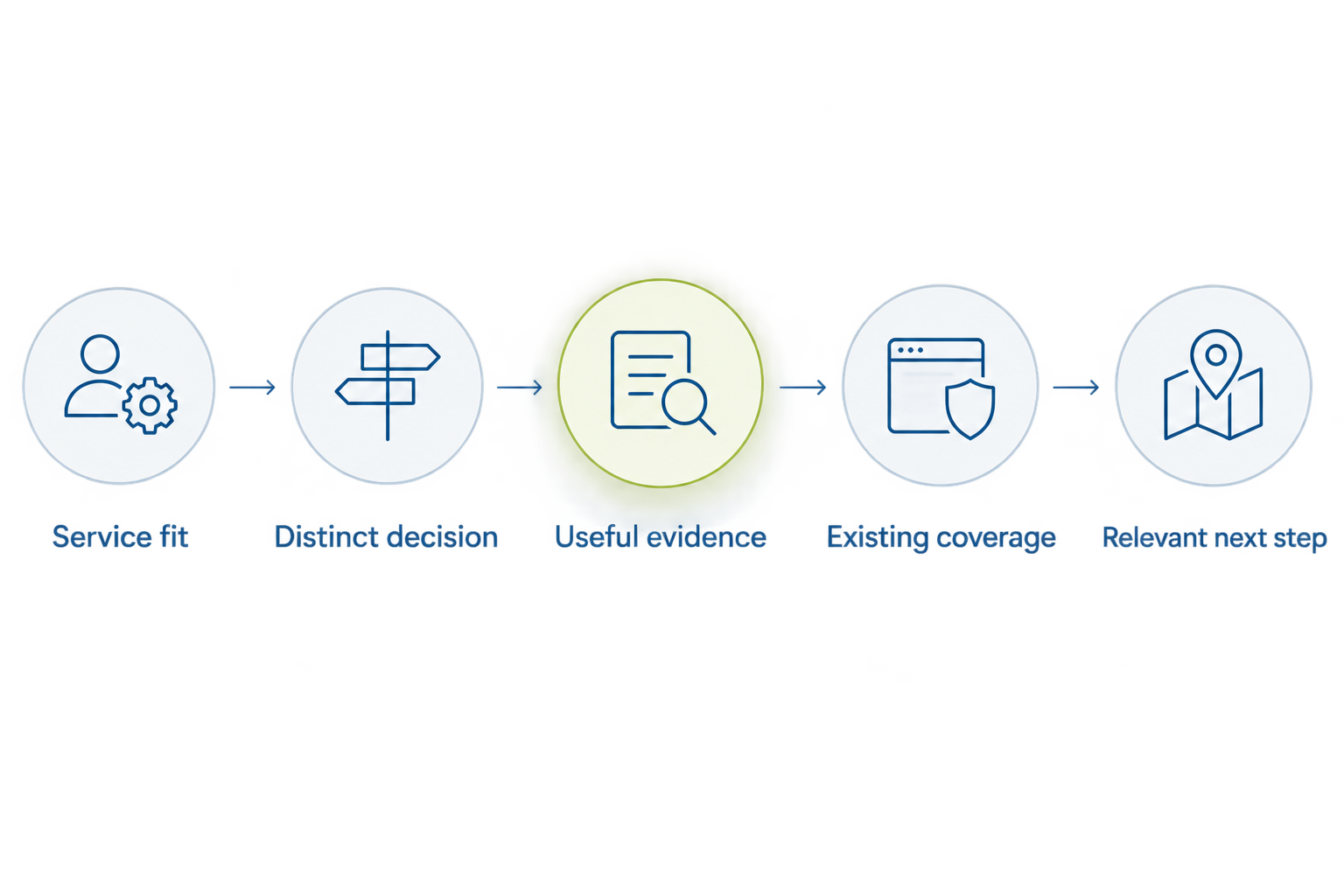
Use the checks as a discussion guide, not a scoring formula. A question outside your services does not become a good business topic because it passes the other checks.
Dedicated pages: best for a separate customer decision
Choose a dedicated page when the customer needs to weigh alternatives, understand a process, or resolve a concern before contacting you. The answer should stand on its own without repeating the entire service page.
For a law firm, a question about which documents to prepare for an initial meeting can support a different task from a page describing a practice area. For a dentist, a treatment comparison requires a different explanation from appointment instructions. Keep clinical and legal explanations within the appropriate professional review process.
The advantage is focus; the drawback is another page to keep accurate. Before publishing, identify who will verify the explanation and which details need review when your process changes.
A useful brief for a 2026 question page includes:
- The exact customer decision the page supports.
- A direct answer that can open the page.
- The facts, examples, and limitations needed to explain it.
- The existing page it must not duplicate.
- A next step appropriate to the reader’s situation.
Do not stretch a short answer to meet an arbitrary article length. If the brief contains little beyond the opening answer, use an existing-page section instead.
Existing-page sections: best for short supporting answers
Keep a question on an existing page when it helps someone understand the same service, appointment, or buying decision. Readers should not have to visit a separate article to find a basic clarification.
Questions about preparation, what an appointment involves, or whether a service covers a particular task often fit here. Publish only the operational details your business has confirmed; do not borrow a competitor’s process as if it were yours.
The advantage is context. A customer can understand the service and resolve the follow-up question together. The limitation appears when a short section grows into a separate subject with its own qualifications, evidence, and decision path.
Split a section because the reader’s task has changed, not because the paragraph has become long. A long answer can still belong on the service page when removing it would make that page less useful.
Combine or skip: best for repeated or unsuitable questions
Combine questions when answering one properly also answers the others. For example, differently worded questions about the same appointment preparation do not automatically need separate articles.
Choose the clearest wording as the main heading. Include natural variations only where they help explain the answer, rather than repeating the same phrase throughout the page.
Skip questions that primarily attract customers seeking services you do not provide. Also skip topics your team cannot answer accurately or maintain responsibly.
This choice has a clear benefit: your publishing effort stays connected to useful customer information. Its limitation is that you must reject some tempting topics rather than treating every search phrase as an assignment.
For your 2026 backlog, record why each rejected topic was combined or removed. That short note prevents the same unsuitable idea from returning under slightly different wording.
Why the right page choice varies
The same question format does not require the same treatment for every business. Use these factors to decide where the answer belongs:
- Customer decision: Comparing solutions needs a different explanation from confirming appointment preparation.
- Service boundaries: A useful topic must match work your business accepts, including any genuine geographic limits.
- Existing coverage: A strong current answer usually needs improvement or clearer placement, not a near-copy.
- Evidence available: Publish a detailed explanation only when you can support its details and limitations.
- Maintenance responsibility: Assign an owner to information that changes when your services or procedures change.
Search demand can help you prioritize suitable topics, but it does not establish suitability. A widely searched question still fails the brief if the answer has no honest connection to your business.
Likewise, a question from customer conversations can deserve prominent coverage even before you have useful search data. Treat the conversation as evidence of a customer need, not proof of a particular search volume.
How do I turn customer questions into a workable content plan?
Start with actual questions from calls, enquiry forms, appointments, and your customer-facing staff. Remove personal details, preserve the customer’s meaning, and group questions by the decision they support.
Create a simple worksheet with 4 fields: customer question, existing coverage, publishing choice, and next step. Those fields force you to explain why a page should exist before anyone starts writing it.
For each proposed article, ask a member of the service team to explain the answer aloud. Capture the important conditions and exceptions. If the explanation contradicts the current website, resolve the facts before publishing either version.
Nsyght’s approach to ai search optimization starts with the business and the customer question, rather than treating a generated topic list as a publishing plan. You should be able to explain what each proposed page helps a prospective customer decide.
During your 2026 planning review, prioritize unanswered questions closest to services you want to provide. Do not mistake “closest to a sale” for “most aggressive sales pitch”: a candid explanation can help an unsuitable customer rule themselves out.
How do I tell whether a question page is doing its job?
Judge a question page against its intended purpose: helping suitable customers understand a decision and take a relevant next step. Track search visibility alongside visits, service-page activity, enquiries, and the suitability of those enquiries where your measurement setup supports it.
Keep the measures separate. An appearance in an AI-generated answer is not a website visit, and a visit is not a booked job. Do not attribute an enquiry to an AI mention without evidence connecting them.
Review the guide to what counts as success in answer engine optimization when setting reporting expectations. Agree on what you will measure before using a report to judge the work.
For a 2026 review, ask whether the page answers the intended question accurately and whether it attracts the intended audience. If visitors consistently ask for a different service, revisit the wording and topic—not just the call to action.
FAQ
Does every customer question need its own page?
No. Give a question its own page only when it supports a distinct decision and needs a substantial, supportable answer. Keep short follow-up answers with the relevant service information.
Should I publish a page for a question with no reported search volume?
Publish it when there is a clear customer need, a useful answer, and a genuine service connection. Questions from customer conversations establish relevance, but they do not establish a search-volume figure.
Can a service-page FAQ help with AI search optimization?
A service-page FAQ is an appropriate place to answer short questions about that service. Clear answers help customers understand your offer, but FAQ formatting does not guarantee inclusion in an AI-generated answer.
Should I create separate pages for the same question in nearby towns?
Do not create separate pages merely to swap town names. Consider a separate location page only when you have useful, accurate information about serving that location and a distinct customer need to address.
Can ChatGPT write all my customer-question pages?
You remain responsible for every published claim, regardless of how you draft the page. Have someone who knows the service verify the answer, remove invented details, and check that the page adds something beyond existing content.
How many question pages should my small business publish?
Publish as many as you can justify with distinct customer needs and maintain accurately. Set the workload from the quality of your questions and evidence, not a fixed page quota.
Can Nsyght guarantee that my pages appear in AI answers?
No. Nsyght provides SEO and AI search optimization services, but publishing a page does not guarantee selection by ChatGPT, Google AI Overviews, or another answer system. Set expectations around the work, accurate content, and measurable customer activity.
One last thing
Before approving another question page, ask your receptionist or whoever answers enquiries to read its opening paragraph. Ask whether it would resolve the customer’s question or simply trigger another explanation.
If the answer needs qualifications, put them where readers can see them. A page has not done its job when it sounds clear to the writer but leaves your team correcting the same misunderstanding on every call.