You reach nearby towns with home services SEO by describing your real service area, publishing useful pages for places you actually serve, and keeping your Google Business Profile tied to an eligible operating location. You do not need an office in every town. In 2026, the distinction remains simple: a page can explain where you work without pretending your business is based there.
- Home services SEO should expand your service-area visibility without inventing offices or addresses.
- Google Business Profile service areas describe coverage; they do not guarantee rankings in every listed town.
- Town pages need useful service details, not identical copy with different place names.
- NSYGHT helps local service businesses improve visibility in Google, Google Business Profile, and AI-generated answers.
Why this matters
A homeowner in the next town needs to know whether you handle their job, travel to their property, and offer a practical way to request service. An invented local address answers none of those questions reliably.
NSYGHT is best for local service owners who want SEO and AI search optimization explained through practical business decisions. The aim is not to collect town names on a ranking report. It is to attract enquiries from places you can serve profitably.
If you are considering outside help, compare the proposed work with the SEO and AI search services your business actually needs. A useful plan separates business-profile eligibility, website content, and enquiry measurement instead of treating them as interchangeable.
Home services SEO: how do you reach nearby towns without fake offices?
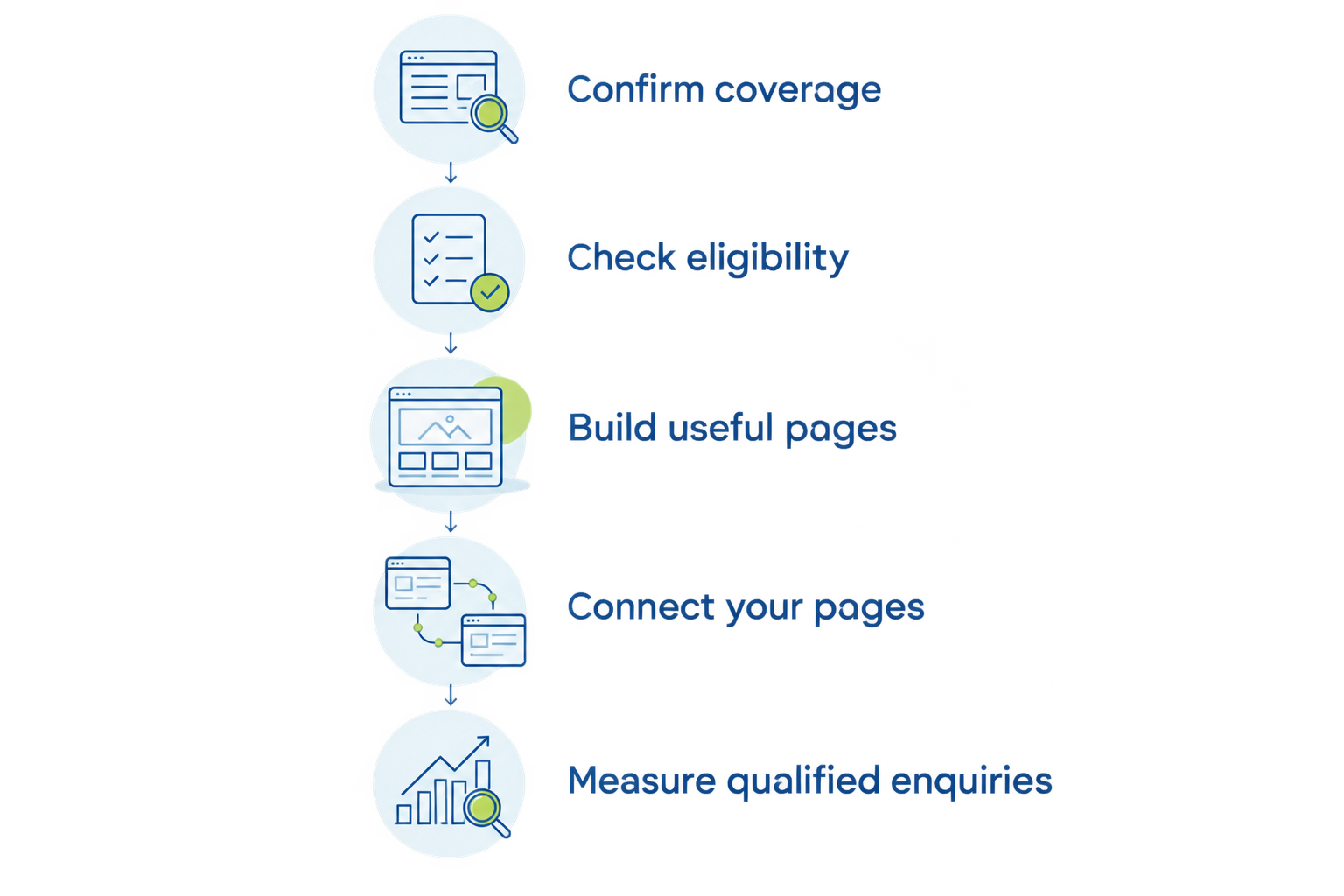
Start with your actual operating footprint, then give customers and search engines consistent information about it. These steps apply whether you install roofs, repair plumbing, maintain heating equipment, or provide another service at customers’ properties.
Confirm coverage
Write down the towns you genuinely serve and the work you accept in each. Include operational limits: a location might make sense for a replacement project but not for a small repair call.
Ask whoever handles scheduling to review the list. A marketing page should not invite work your dispatcher routinely turns away. Separate current coverage from places you would like to enter later.
Check eligibility
Use your real operating location when setting up Google Business Profile. Google's service-area business guidance calls for 1 business profile for the area you serve, rather than a separate profile for every town; separately staffed, eligible operating locations require their own assessment.
If customers do not visit your business address, follow Google's address-hiding requirements. Do not publish a home address as a customer-facing office simply to appear local, and do not treat a mailbox or virtual-office address as proof of an eligible location.
Build useful pages
Create a town page when you can answer meaningful questions about serving that location. Explain the relevant services, the locations covered, any genuine scheduling restrictions, and how someone requests an estimate or appointment.
Use completed work from that town when you have permission to publish it. A real project description is useful evidence; an invented neighborhood anecdote is not. If the only difference between pages is the town name, improve the underlying service page before publishing more copies.
Connect your pages
Link relevant town pages from your service-area information and connect them to the services discussed. A visitor should be able to move from a service description to coverage details without guessing where to look.
Keep the relationship clear. A roofing page explains the work; a town page explains how that work applies to customers in a particular place. Neither needs a fabricated office address to perform its role.
Measure qualified enquiries
Record which enquiries come from each target town and whether those jobs fit your business. Track the requested service alongside the location, not just the total number of form submissions.
Use Google Search Console to inspect search visibility and website analytics to assess visits and enquiry actions. Then compare those signals with what your office actually books. Rankings alone cannot tell you whether expansion is working.
Which type of page or profile should you use?
Google Business Profile and website pages do different jobs. For your 2026 plan, choose the right destination for each customer question rather than expecting a profile edit to replace a useful website.
| Option | Best for | Main benefit | Main limitation |
|---|---|---|---|
| Google Business Profile | Presenting an eligible local business in Google Search and Maps | Shows business information and customer reviews | Service-area settings do not guarantee visibility throughout the area |
| Core service page | Explaining a specific service | Gives customers a clear description of the work and next step | Does not automatically answer town-specific coverage questions |
| Town service page | Explaining service in a place you genuinely cover | Can address local projects, coverage, and scheduling | Becomes repetitive when there is no distinct information to add |
Use these together where each adds information. Building town pages is not a substitute for maintaining an accurate profile, and adding towns to a profile is not a substitute for explaining your services.
If you operate from home and travel to customers
A home-based service business does not need to pretend it has a storefront. Explain that you travel to customers and describe the places you cover without suggesting people can visit an office.
Google allows up to 20 service areas in a service-area business profile. Its guidance also says the overall area generally should not extend beyond about 2 hours of driving time from the business base, with exceptions for some businesses.
Treat those as platform guidelines, not recommended expansion targets. Filling every available service-area slot does not create an obligation for Google to rank your business in those places. Check the current Google Business Profile Help guidance when updating your 2026 coverage settings.
If you have a genuine additional location
A real second operating location changes the question, but a lease or mailing address alone does not settle eligibility. Review Google's requirements for the business model, staffing, signage, and whether customers visit the premises.
Where a location qualifies, describe it accurately on the website. State its actual role and customer access arrangements. Do not use the same office photographs or location description to imply separate premises that do not exist.
The benefit is accurate information about a real operation. The limitation is equally important: opening or renting space solely to chase a map position does not remove Google's eligibility requirements.
Why visibility varies between nearby towns
A town page gives Google something relevant to evaluate; it does not guarantee a position. Google's published local-ranking guidance identifies relevance, distance, and prominence as the main factors in local results.
For home services SEO, keep these practical distinctions clear:
- Search relevance: Your pages and business information need to match the service someone wants, not merely mention their town.
- Distance: A business can serve a town while still being farther from the searcher than other eligible businesses.
- Prominence: Google's local results consider how well known a business is, including information such as links and reviews.
- Page usefulness: A page needs enough substance to help the customer; a place name alone does not explain service suitability.
- Operational fit: A visible page can still attract poor enquiries if it promotes work or locations you cannot accept.
The first three explain Google's stated local-ranking framework. The last two help you decide whether the website work serves your business, regardless of a particular map position.
What should a useful town page contain?
Start with a direct statement of coverage and the services available there. Say you serve the town; do not say you have an office there unless that is true.
Build the rest around information a customer needs before contacting you:
- Relevant work: Explain the service, the problems it addresses, and any genuine exclusions.
- Project evidence: Include accurate descriptions and approved photographs of completed local work when available.
- Coverage details: Clarify which surrounding places you serve without turning the page into a list of unrelated towns.
- Practical expectations: Explain how customers request service and what information helps you assess the job.
- A clear next step: Make the enquiry route easy to find and consistent with how your office handles requests.
Do not manufacture local detail to make a page look different. A concise, accurate page is better than a long page padded with generic landmarks, unsupported claims, or invented customer stories.
For a 2026 content review, read neighboring town pages side by side. If a homeowner learns nothing different from each, consolidate the overlap or add genuinely useful information before expanding further.
Can you rank in a town where you do not have an office?
You can appear in organic search results for a town you serve without having an office there. Your website must accurately explain the service and coverage; it must not present a service-area page as evidence of a physical branch.
Map visibility is a separate issue because distance is part of Google's local-ranking system. A website page can support relevance, but it does not move your operating location closer to the searcher.
Should every nearby town get its own page?
No. Give a town its own page when you have enough distinct, useful information to help someone decide whether to contact you.
When several places share identical services and operating arrangements, a clear regional coverage page can be the better starting point. Add individual town pages when customer needs or real business evidence justify them, not because a spreadsheet contains more place names.
How do you judge whether the work is paying off?
Set a baseline before publishing or substantially changing coverage pages. Note which towns already generate enquiries, what customers request, and which enquiries become suitable jobs.
Then review the chain from discovery to business outcome:
- Search visibility: Are the relevant pages appearing for appropriate service-and-location searches?
- Website visits: Are visitors reaching the page intended for that service area?
- Enquiry quality: Are callers and form submissions asking for work you accept?
- Booking fit: Can you schedule those jobs without undermining the areas you already serve?
Keep the same definitions in your 2026 reporting so comparisons remain useful. Changing what counts as a lead halfway through a review makes the totals difficult to interpret.
NSYGHT's home services SEO work should be evaluated against that business context: accurate visibility, relevant enquiries, and clear explanations of the work. No agency can honestly guarantee a particular ranking or a fixed number of booked jobs.
Discuss your service-area search plan
Explain where you work, which jobs you want, and where search visibility needs attention.
FAQ
Can I put a virtual office on Google Maps to reach another town?
A virtual-office address does not qualify merely because you rent it or receive mail there. Google applies location eligibility rules, including requirements around genuine business operations, staffing, signage, and customer access where relevant.
Will adding towns to my Google Business Profile make me rank there?
Adding towns describes your service coverage; it does not guarantee rankings in those towns. Google says local results depend mainly on relevance, distance, and prominence.
How many service areas can I add to Google Business Profile?
Google Business Profile allows up to 20 service areas for a service-area business. Choose places you genuinely serve rather than filling the list to its limit.
Should I show my home address if customers never visit?
Hide your business address on Google Business Profile if you operate as a service-area business and do not serve customers there. Describe your real service coverage without presenting your home as a customer-facing office.
Can I copy a service page and change the town name?
Changing only the town name does not create a useful location page. Add genuine coverage details, relevant services, and real local evidence, or keep the information together on a stronger regional page.
Do town pages help my business appear in AI-generated answers?
Accurate town pages give search systems clear information about what you do and where you work. They do not guarantee inclusion in ChatGPT, Google AI Overviews, or another answer service.
What should I ask an agency before it builds town pages?
Ask what makes each page useful, how the agency will verify local claims, and how it will measure relevant enquiries. NSYGHT's SEO and AI search optimization offer is aimed at local service businesses; assess any proposal against your actual coverage and business priorities.
One last thing
Your scheduling desk can reveal a service-area problem that a ranking report misses. Review enquiries declined because of location or job type before deciding which town page to build next.
If a town already sends suitable enquiries that you cannot schedule, more visibility is not the immediate fix. If you have capacity but customers cannot tell whether you serve them, make coverage clearer. Expand the explanation of your real business, not the fiction of your office network.