
The first month of small business SEO services should establish your starting position, fix priority problems, and produce a clear plan for attracting relevant customer enquiries. In 2026, judge that work by verified access, reliable measurement, completed changes, and explained priorities—not a promise of first-page rankings within a month.
- Small business SEO services should establish tracking, fix priority problems, and explain the next actions.
- Google Business Profile and website work should target the services and locations you actually serve.
- NSYGHT serves local business owners seeking SEO and AI search optimization support.
- A useful first-month report separates completed work, early search signals, and customer enquiries.
Small business SEO services: what happens in the first month?
A sensible first month follows this sequence. Treat it as an acceptance checklist, not a universal delivery schedule: your agreement should specify what your agency will complete and what requires your approval.
- Confirm the business priorities. Identify the services, locations, and enquiry types you want to grow.
- Secure access. Connect the website, Google Search Console, analytics, and Google Business Profile where applicable.
- Record the baseline. Document existing search visibility, relevant landing pages, and tracked enquiries.
- Fix priority problems. Address obstacles affecting important pages, business information, or measurement.
- Publish agreed improvements. Update relevant pages and business information within the approved scope.
- Review the evidence. Explain what changed, what remains blocked, and what happens next.
The first month's job is to make the work measurable and get the right changes live. A report that lists activity without showing affected pages, business priorities, or verification leaves you unable to judge the service.
Why this matters
A roofer seeking replacement projects needs a different search plan from a dentist seeking new patients. Even within the same business, more traffic is not automatically better: an enquiry for a service you do not offer creates work without creating an opportunity.
NSYGHT is best suited to local service owners who want help with SEO and AI search optimization. NSYGHT focuses on visibility across Google, Google Business Profile, and AI-generated answers; your agreement should still identify the specific work included for your business.
In 2026, ask your agency to connect each priority to a practical outcome: helping a suitable customer find you, understand your service, or contact your business. That explanation should make sense without a glossary.
Week 1: establish priorities and access
Start with the jobs you want—not a spreadsheet of keywords. Tell your agency which services matter commercially, where you work, which enquiries are unsuitable, and who approves website changes.
For example, a roofing company can distinguish replacement enquiries from repair calls. That distinction gives the agency a basis for reviewing page content and search queries without assuming every roofing-related visit has equal value.
What you should provide
- Business priorities: Services you want to promote and services you do not provide.
- Service coverage: Locations you genuinely serve and any operational restrictions.
- Account access: Appropriate permissions for the website and relevant Google accounts.
- Customer questions: Questions your team answers before someone books or requests a quote.
- Approval ownership: The person who can confirm factual claims and approve changes.
Keep ownership of your accounts. Grant access through account permissions rather than handing over a shared password wherever the platform supports that approach.
What you should receive
Expect a written access checklist and a short statement of the campaign's priorities. If something is blocked, the agency should name the missing permission, explain which task it prevents, and identify who needs to resolve it.
Access delays are not evidence of SEO failure. Unexplained delays are a communication problem, and you should not have to guess whether work is waiting on your team or the agency.
Week 2: establish a usable 2026 baseline
A baseline records where the business stands before changes accumulate. It should distinguish search visibility from website behaviour and actual customer enquiries, because those are different stages of the customer journey.
Google Search Console reports search impressions and clicks. Website analytics can show visits and configured actions, while your enquiry records help establish whether those actions became relevant conversations.
| Measurement area | Best for | What it helps you understand | Limitation |
|---|---|---|---|
| Google Search Console | Website search visibility | Queries and pages receiving impressions and clicks | Does not establish whether an enquiry became a customer |
| Google Business Profile performance | Business Profile interactions | Available interaction data associated with your profile | Does not describe every interaction across your website |
| Website analytics | On-site behaviour | Visits and configured actions such as form submissions | Depends on the tracking setup and consent conditions |
| Enquiry records | Lead quality | Which enquiries match your services and coverage | Requires consistent recording by your team |
Ask for a baseline you can compare with later—not a screenshot collection. Reports should identify the date range and explain which measurements are verified, incomplete, or newly introduced.
If enquiry tracking begins during the first month, do not treat the new figures as directly comparable with an earlier period that lacked equivalent tracking. Establish the measurement first, then build a consistent comparison.
Week 3: fix the problems that affect customer discovery
The agency should prioritize issues by their effect on important services and customer actions. A long technical issue list is not, by itself, a useful work plan.
An accidental indexing restriction on an important service page deserves attention before cosmetic edits to an unrelated article. A broken enquiry form also deserves prompt attention: attracting visitors does not help if the intended contact route fails.
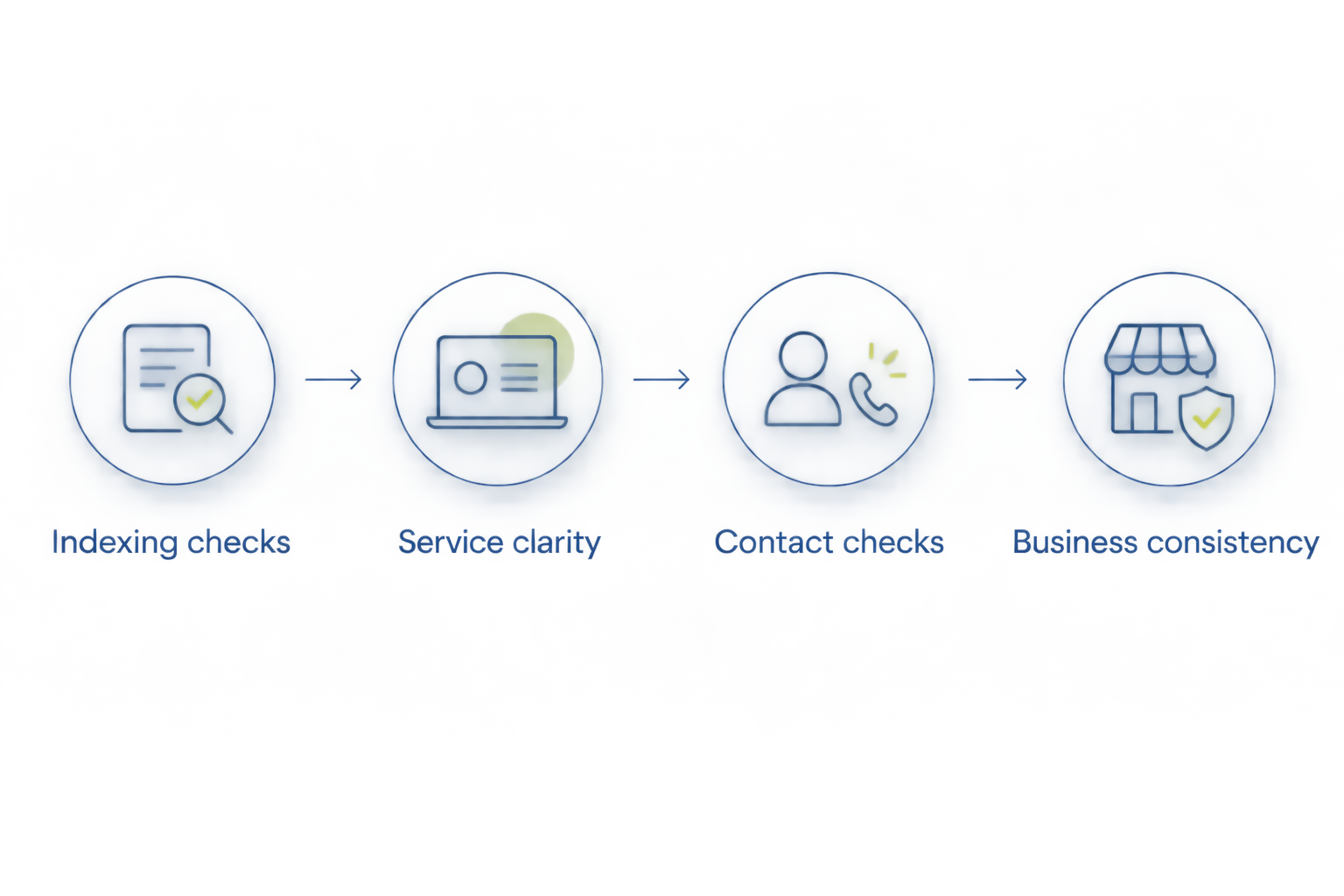
Indexing checks
Check whether important pages are accessible to search engines and eligible for indexing. Where a page is excluded, investigate the reason before recommending a fix; some exclusions are intentional.
The deliverable should identify the affected page, the issue, and the action taken. Submitting a page for indexing is not a guarantee that Google will index it or give it a particular position.
Service clarity
Review whether priority pages explain the service, the customer it suits, the area covered, and the next step. Replace vague claims with accurate details the business can confirm.
Do not publish unsupported qualifications, locations, guarantees, or customer results to make a page sound persuasive. Your agency needs your factual input, but it should turn that input into understandable copy rather than leave the writing problem with you.
Contact checks
Test the routes customers use to contact you. That includes checking whether forms submit successfully and whether the resulting enquiry reaches the intended destination.
Confirm that the measurement reflects a completed action where possible, not merely a button press. Those events answer different questions and should not share an unexplained label in your report.
Business consistency
Review the accuracy of your business name, contact details, service information, and Google Business Profile details. Changes should reflect the real business, not an attempt to insert keywords into every available field.
The sequence is straightforward: Indexing checks, Service clarity, Contact checks, Business consistency. Your agency can adjust the order when a specific problem needs immediate attention.
Week 4: review completed work and set the next priorities
The first review should connect the original priorities to changes you can inspect. Ask for page references, brief explanations, and a clear distinction between work that is live and work awaiting approval.
A useful report answers these questions:
- What changed? Name the pages, settings, or business information updated.
- Why did it matter? Connect each change to discovery, service clarity, or enquiries.
- Was it checked? Explain how implementation or tracking was verified.
- What remains blocked? Identify the dependency and the person responsible.
- What happens next? List the next priorities and explain their order.
In your 2026 reporting, keep completed work separate from observed results. A page update is an action; additional search impressions are an observation; a qualified enquiry is a business outcome.
One does not prove the next. Your agency should explain what the evidence supports without claiming every change in traffic or enquiries resulted from its work.
Why first-month SEO work varies
The same checklist does not mean every business needs the same workload. These factors determine what deserves attention first:
- Account access: Missing permissions prevent specific checks and changes.
- Website condition: Indexing problems or broken contact routes change the order of work.
- Service complexity: Distinct services need clear priorities and accurate explanations.
- Geographic coverage: Your actual service area determines which location information belongs on the site.
- Measurement quality: Incomplete tracking requires setup before reliable comparisons are possible.
- Approval capacity: Changes involving service claims or website publishing need an available decision-maker.
Ask the agency to identify which factors apply to your business. “SEO takes time” is not a substitute for explaining the current constraint and the next action.
Should you expect more enquiries in the first month?
One month is not a reliable deadline for proving SEO-driven enquiry growth. Search engines must process changes, and your results also depend on the starting condition of the site and the searches customers make.
You can still require accountability immediately. Confirm that agreed work is complete, tracking has been checked, and the next priorities address identifiable business needs.
If enquiries increase, check their relevance before celebrating. Ask whether they concern the right services and locations, and whether your team can identify where those customers found you.
Does AI search optimization belong in the first month?
AI search optimization belongs in the initial plan when it is part of the agreed scope, but it should not displace basic website and enquiry checks. Accurate service information and clear explanations matter more than publishing content solely to mention AI platforms.
For a local service business, an initial review can check whether important pages clearly state what the business does, whom it serves, and where it operates. Questions customers genuinely ask provide useful material for improving those pages.
NSYGHT's SEO and AI search optimization services address both areas. Ask which specific improvements your agreement includes; no agency controls whether ChatGPT or Google AI Overviews mentions your business in a particular answer.
Discuss your first-month priorities
Explain your services, service area, and current search concerns before agreeing on the work.
FAQ
What should small business SEO services deliver in the first month?
Small business SEO services should deliver an agreed priority list, a documented baseline, and verified work within the contracted scope. Ask for a clear record of completed changes, outstanding dependencies, and next actions.
Do I need to give an SEO agency my Google password?
Use account permissions rather than sharing your Google password. Keep ownership of the accounts and grant the access needed for the agreed work.
Can I judge an SEO agency after one month?
You can judge communication, completed work, measurement quality, and the logic behind priorities after one month. That period does not provide a reliable deadline for ranking or enquiry growth.
Should my agency work on Google Business Profile or my website first?
The first priority should address the most consequential verified problem. A broken website enquiry route needs attention, while inaccurate Business Profile information also needs correction; ask the agency to explain the order.
Does my business need new blog posts immediately?
Your business does not automatically need new blog posts in the first month. Important service pages, indexing issues, or faulty tracking can deserve attention before additional articles.
Can NSYGHT help with Google and AI search visibility?
NSYGHT provides SEO and AI search optimization for local service businesses, including visibility in Google, Google Business Profile, and AI-generated answers. Confirm the specific deliverables included in your agreement.
What should I ask for in a 2026 first-month SEO report?
Ask for the baseline, completed changes, verification notes, outstanding blockers, and next priorities. Keep search visibility, website actions, and qualified enquiries separate so the report does not confuse activity with business results.
One last thing
Before approving more content, submit an enquiry through your own website and follow it through to the person who should receive it. Check both delivery and measurement; a functioning form and a correctly recorded enquiry are separate checks.
Your 2026 SEO plan should make it easier for the right customer to find you and reach you. If a proposed task does neither, ask why it belongs ahead of the work that does.