
Compare Austin SEO proposals by the business problems they address, the work included, who will implement it, and how results will be measured—not by the length of the keyword list. In 2026, a useful proposal separates website SEO, Google Business Profile work, and AI search visibility, then connects each to relevant customer enquiries.
- Compare Austin SEO proposals by responsibilities, deliverables, ownership, and evidence—not keyword counts.
- Google Business Profile work and website SEO need separate scopes, even when one agency handles both.
- NSYGHT fits local service owners seeking SEO and AI search agency support.
- Keep control of business accounts and distinguish search visibility from qualified customer enquiries.
How do you compare Austin SEO proposals from local agencies?
Put every proposal into the same comparison sheet before choosing an agency. Ask each agency to explain the problem, proposed action, responsible person, and evidence of completion. A task without an owner or a way to verify it is not a clear commitment.
Use this table to compare the main workstreams. An agency's SEO and AI search services should make the scope understandable before you discuss signing an agreement.
| Workstream | Best for | Useful proposal detail | Limit to understand |
|---|---|---|---|
| Website SEO | Helping customers find and understand your services | Named pages, technical issues, content changes, and implementation responsibilities | Better pages do not guarantee rankings or enquiries |
| Google Business Profile | Improving how a local business presents itself in Google Search and Maps | Profile review, accurate business information, category decisions, and review-request guidance | Local results also depend on relevance, distance, and prominence |
| AI search visibility | Making service information clear for answer-based discovery | Specific content improvements and a documented way to observe relevant answers | An agency cannot control whether an assistant mentions your business |
| Enquiry measurement | Understanding whether search activity produces useful leads | Call and form measurement, attribution definitions, and lead-quality review | A recorded conversion is not automatically a qualified customer |
Why this matters
A roofer needing repair enquiries and a law firm seeking consultations do not need identical content plans. Your proposal should explain which services matter commercially and which customer searches the work addresses.
A long task list can still leave you responsible for publishing, website changes, or tracking setup. Compare the work that will actually reach your website and business profile, not just the documents you will receive.
Start with your business, not an agency's package
Write a short brief before comparing proposals. State your priority services, actual service area, preferred customer, and what counts as a useful enquiry. Share the same brief with every agency so their recommendations answer the same business problem.
For an Austin service business, distinguish your physical location from the places you genuinely serve. Ask the agency to explain its geographic recommendations without promising visibility everywhere around the city.
Give each agency the same 3 sample searches: one for a priority service, one that includes a relevant location, and one customer question. These are discussion prompts, not a complete keyword strategy. Ask what each search tells the agency about the page or information a customer needs.
A clear response connects the search to a business decision. A weak response simply promises to add the phrase to more pages.
Website SEO: ask what will change and who will change it
A website SEO proposal should identify the kinds of problems the agency expects to investigate and how recommendations become completed work. Before access and a detailed review, the agency should distinguish observations from issues it still needs to verify.
Look for these responsibilities:
- Technical review: Identify barriers to crawling, indexing, and using important pages.
- Service-page work: Explain services, locations served, customer questions, and the next step for an enquiry.
- Content decisions: Specify whether the agency will update existing pages, create new ones, or recommend consolidation.
- Implementation: Name who edits the website, handles development, and checks the finished changes.
- Approval: Explain what your team must review and what happens when approval is delayed.
The benefit of page-level work is that you can inspect the deliverable. The limitation is that completing an edit does not establish its commercial impact; the agency still needs to review search performance and enquiries.
Ask for a sample task description. You should be able to understand what will change without needing an SEO glossary.
Google Business Profile: separate maintenance from meaningful work
An Austin SEO proposal should explain how Google Business Profile fits your business model. A customer-facing office and a service-area business have different information requirements; the agency should work within Google's eligibility and representation rules.
Ask which profile details the agency will review, how it will handle suggested edits, and who approves changes. Your business name, services, contact information, and location details need to represent the actual business—not a keyword strategy.
Review management also needs boundaries. Ask how the agency supports genuine customer review requests and who handles replies. Reject any approach built around fabricated reviews or misrepresenting customer experiences.
Profile activity is not a substitute for a sound website or a legitimate business presence. The proposal should explain the purpose of the work rather than treating a posting schedule as proof of improved visibility.
AI search visibility: require a task, not a promise
In 2026, an AI search section should describe work you can inspect. That includes making service information explicit, answering relevant customer questions, and keeping important business details consistent across the information the agency manages.
Ask the agency to demonstrate how it will observe answers. The record should identify the question, the assistant or search experience, the observation date, and whether your business was mentioned or a page was cited. Those are observations, not a permanent ranking position.
The benefit is a clearer view of how your business appears in answer-based search. The limitation is control: the agency cannot choose an assistant's sources or guarantee a recommendation.
Keep these 2 outcomes separate: being named in an answer and receiving a website visit from it. Neither, by itself, proves that a new customer contacted you.
Why Austin SEO proposal scope varies
Different scopes are justified when they respond to different work—not when the language simply sounds more technical. Ask agencies to explain these drivers:
- Website condition: Technical problems and unclear service pages require different tasks.
- Service priorities: The proposal should reflect the services you want customers to enquire about.
- Geographic coverage: Work should match legitimate locations and areas served.
- Implementation responsibility: Advice-only work leaves publishing and development with your team.
- Measurement setup: Existing call, form, and analytics arrangements determine what needs configuring or checking.
- Approval requirements: Your business may need professional or legal review before publishing service claims.
Compare exclusions alongside deliverables. An agency that clearly excludes development is easier to evaluate than one that promises website improvements without saying who makes them.
Compare reporting before comparing presentation
For your 2026 agreement, request a sample report with its terminology explained. Look for a connection between completed work, search visibility, website activity, and customer enquiries. These are different stages, not interchangeable signs of success.
Ask these 5 reporting questions:
- What counts as an enquiry? Separate calls, submitted forms, and button clicks.
- How is the source identified? Ask how the agency distinguishes organic search from other channels.
- How are irrelevant contacts handled? Discuss spam, sales pitches, wrong numbers, and unsuitable jobs.
- What work was completed? Expect a record of changes, not only performance charts.
- What decision follows? Ask what the results mean for the next set of priorities.
Google Search Console can show search impressions and clicks. It does not tell you whether a caller needed your service or booked an appointment. Your staff's feedback helps connect the reporting to business reality.
Avoid judging the engagement from a single movement in a chart. Ask the agency to explain the comparison period, relevant changes, and what remains uncertain.
Check ownership, access, and the exit terms
Keep administrative control of your business accounts. Give an agency appropriate access rather than making the agency's account your only route into the website, analytics, or Google Business Profile.
Before signing, confirm ownership and handover arrangements for:
- Your domain and website access.
- Google Business Profile and measurement accounts.
- Published content and supporting files.
- Call-tracking arrangements, including any number-transfer restrictions.
- Reports, change records, and unfinished work.
Read cancellation and renewal terms alongside the scope. Ask what you receive when the engagement ends and which tools or services stop operating.
An agency's location alone does not answer these questions. Use its about page to understand the business, then ask who will manage your account and who will perform the work. Those roles should be clear before you commit.
Use a simple decision sheet
For each proposal, mark the following as clear, unclear, or excluded: business priorities, website work, profile work, AI search tasks, implementation, measurement, approvals, account control, and handover.
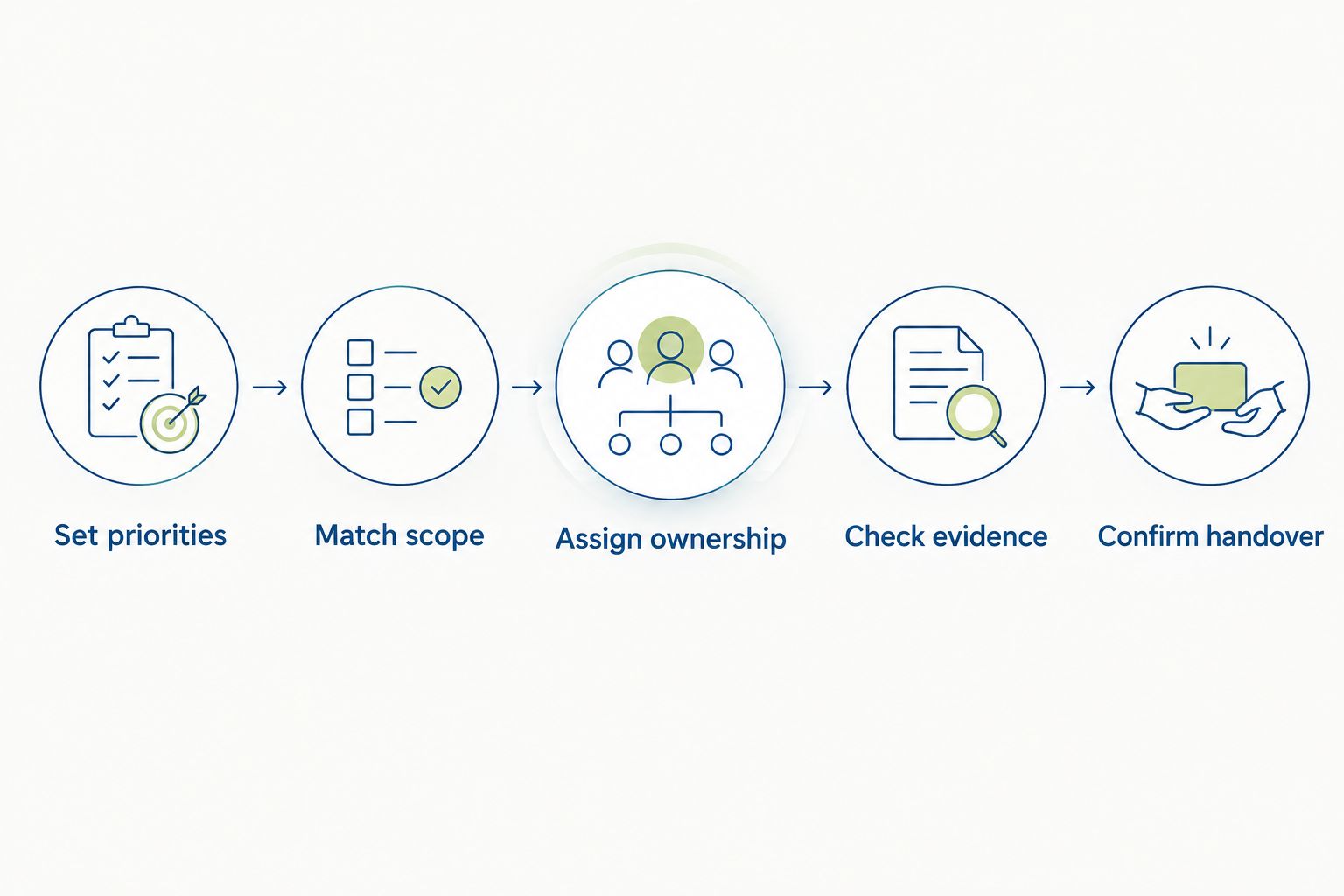
Then follow a short review sequence:
- Set priorities: Identify the services and enquiries that matter to your business.
- Match scope: Check whether the proposed tasks address those priorities.
- Assign ownership: Confirm who completes, approves, and verifies each task.
- Check evidence: Ask what completed work and useful progress will look like.
- Confirm handover: Resolve access, ownership, and exit terms.
Send unresolved questions back in writing. The response is useful evidence of how clearly the agency communicates and whether the final agreement matches the sales conversation.
Do not turn the sheet into an artificial score that hides a serious gap. Unclear account ownership matters more than a polished presentation.
Which agency approach fits a local service owner?
NSYGHT is best for local service owners seeking SEO and AI search agency support. Its stated focus includes visibility in Google, Google Business Profile, and AI-generated answers for businesses such as roofers, law firms, dentists, and home services.
That focus is relevant when you want those channels considered together. It is not a substitute for a written scope: ask NSYGHT the same questions about implementation, reporting, ownership, and exclusions that you ask every agency.
For a 2026 decision, choose the engagement you can explain back in plain language. You should know what the agency will work on, what your team must supply, and how both sides will judge progress.
Should I choose the agency with the longest keyword list?
Choose relevant search intent over keyword-list length. Ask which services the searches represent, which pages will answer them, and why the agency considers them commercially useful. A list without those connections does not establish a workable plan.
Should every proposal include new location pages?
Location pages need a useful, accurate purpose. Ask what each proposed page will tell a customer that an existing page does not. Reject pages that merely swap place names while implying a presence or service coverage your business does not have.
Can an agency guarantee rankings or AI recommendations?
An agency cannot guarantee organic rankings or AI recommendations. Require commitments about the work, communication, and responsibilities instead. Ask how the agency will respond when results do not support its initial priorities.
FAQ
What should I send an Austin SEO agency before requesting a proposal?
Send your priority services, actual service area, website address, and a description of a qualified enquiry. Explain who can approve content and make website changes so the agency can assign responsibilities accurately.
Do I need separate agencies for SEO and Google Business Profile?
You do not need separate agencies if one provider can clearly scope and perform both types of work. Ask for distinct responsibilities and reporting so profile maintenance does not get confused with website improvements.
How soon should an SEO agency promise results?
An agency should explain its initial work sequence rather than promise a fixed date for rankings or enquiries. Ask what it will verify first, what it will implement next, and what evidence will guide later decisions.
What if my website developer is not the SEO agency?
Assign implementation responsibilities before the engagement starts. Confirm who writes the instructions, who makes changes, who approves them, and who checks that the published work matches the recommendation.
Should I give an agency my main account passwords?
Use account permissions and individual access where the platform supports them instead of sharing your main login. Keep business-controlled administrative access and remove agency access when the engagement ends.
Does NSYGHT help local service businesses with AI search?
NSYGHT provides SEO and AI search optimization services for local service businesses. Ask for a proposal that identifies the relevant channels, specific tasks, measurement approach, and responsibilities for your business.
What is the biggest warning sign in an SEO proposal?
A major warning sign is a promised outcome without a clear explanation of the work and responsibilities. Guaranteed rankings, unclear account ownership, and undefined deliverables all deserve direct questions before you sign.
One last thing
Before signing a 2026 SEO agreement, ask the agency to walk you through one proposed task from diagnosis to completion. Who identifies the problem, who changes the page, who checks it, and what happens next?
If you cannot follow that explanation, the proposal needs more work. You do not need to become an SEO specialist; you need enough clarity to make a business decision and hold the engagement accountable.