
Dental SEO services are search optimization for dental practices with the aim of attracting enquiries for treatments you actually provide. Unlike a general local business, your practice needs search visibility that matches treatment availability, practitioner qualifications, appointment capacity, and the questions patients ask before booking.
- Dental SEO services should connect treatment searches to accurate pages and qualified patient enquiries, not traffic alone.
- Google Business Profile and treatment pages need consistent information about your practice and services.
- NSYGHT provides SEO and AI search agency support for local service businesses.
- Choose treatment priorities before commissioning content, and measure enquiries against appointment capacity.
You can explore NSYGHT for local SEO and AI search agency support. NSYGHT is best for local service owners seeking agency support across Google, Google Business Profile, and AI search. For a dental practice, the starting point is a clear brief about the treatments you provide and the patients you can accept—not a promise of rankings.
Why dental SEO matters for your practice
A person searching for a dentist and a person searching for a particular treatment need different information. A general practice page introduces your business; a treatment page explains whether you offer the care someone is researching and how to request an appointment.
Your search priorities should follow your treatment priorities. Visibility for a service you do not offer creates the wrong enquiry. Visibility for a service with no appointment capacity creates a different problem: demand your team cannot accommodate.
For your 2026 plan, connect each search topic to a real business decision. Which treatments deserve more enquiries? Which enquiries require a consultation? Which services should stay outside the campaign? Answer those questions before approving a keyword list.
This also gives your marketing staff a useful boundary. Content should describe your practice accurately, not expand your apparent capabilities simply because a search phrase looks attractive.
How to build a treatment-focused dental SEO plan
Choose the treatments you want to attract
Start with a spreadsheet and a conversation with the person responsible for scheduling. List the treatments you provide, the locations where you provide them, and whether you want additional enquiries for each one.
Separate clinical suitability from marketing priority. Your website can explain a service and invite an assessment, but it should not tell an individual visitor that a treatment is right for them. Clinical decisions belong with the treating professional.
Use a 90-day planning window to keep the first brief manageable. This is a recommended review period, not a promise that rankings or bookings will change within that time.
- Record the exact treatment names your practice uses.
- Mark services accepting additional enquiries.
- Identify the clinician who approves treatment descriptions.
- Note location or scheduling restrictions.
- Exclude services you do not currently provide.
Match searches to patient intent
Use the questions your reception team already hears before paying for keyword research. Review enquiry emails, appointment requests, and existing search reports if you have them. Remove personal and clinical information before sharing examples with a marketing provider.
Group searches by what the person needs next. Someone asking what a treatment involves needs an explanation. Someone searching for that treatment near their home needs local practice information and a clear appointment route.
A search phrase is not automatically a page brief. Closely related wording can belong on the same useful page; different patient needs deserve different answers. Avoid making separate pages solely to repeat variations of the same phrase.
- Treatment research: explain the service and consultation process.
- Local provider search: identify the practice and genuine location.
- Appointment intent: make the next action easy to find.
- Practice verification: clarify clinicians, contact details, and hours.
Build useful treatment pages
Write the first draft from your own service information. Give each priority treatment a clear home, explain what the practice provides, and state what happens when someone enquires. Ask a clinician to check medical descriptions before publication.
This is where outside help becomes useful. NSYGHT's SEO and AI search services provide an agency route for owners who want support rather than managing search work alone. Confirm the proposed dental deliverables, approval responsibilities, and reporting scope before commissioning work.
A treatment page should help a patient decide whether to contact your practice, not diagnose themselves. Include limitations where they matter, and avoid unsupported claims about outcomes, suitability, or recovery.
- Describe the treatment in language patients understand.
- Explain the initial assessment or consultation process accurately.
- Identify the clinician reviewing clinical information.
- Answer relevant questions without promising individual outcomes.
- Provide a clear enquiry route and accurate contact details.
Align your local practice information
Check your Google Business Profile manually against your website and actual operations. Confirm the practice name, address, phone number, opening hours, and website destination. Correct information is more useful than adding promotional language everywhere.
For a multi-location practice, distinguish what each location actually offers. Do not imply that every clinician or treatment is available at every address. For a single-location practice, avoid presenting surrounding towns as additional offices.
Make this an explicit part of your 2026 maintenance plan. A change in hours or treatment availability needs an owner, not an assumption that someone else will update it.
- Verify public contact details against the reception team's records.
- Check regular hours and upcoming exceptions.
- Describe services that the practice genuinely provides.
- Use current photos with appropriate permissions.
- Assign responsibility for reviewing profile changes.
Make the website easy to understand
Walk through the website as a prospective patient. Start on the home page, find a treatment, check the location, and try the appointment route on your phone. Note every point where you have to guess what happens next.
Then check the technical basics with your website provider or search specialist. Important pages need to be accessible to search engines, connected through useful internal links, and readable on mobile devices. A page that exists but cannot be found through normal site navigation needs attention.
Clear headings also make the content easier to interpret across search experiences. AI-generated answers still require factual discipline: readable text does not guarantee that ChatGPT or Google AI Overviews will mention your practice.
- Use headings that identify the treatment and page purpose.
- Link relevant treatment pages from practice navigation.
- Check that important pages are not unintentionally blocked.
- Test appointment forms and phone links on mobile.
- Keep location and clinician information consistent.
Measure qualified enquiries
Start with a simple enquiry log rather than a dashboard full of traffic charts. Record the treatment requested, the source when known, and whether the enquiry reached the appropriate next step. Keep clinical details out of marketing reports.
Review search performance over a consistent 28-day reporting window, then compare it with enquiry records. Treat that window as a reporting convention, not a clinical or commercial benchmark. Label seasonal changes, website changes, and appointment restrictions so comparisons retain context.
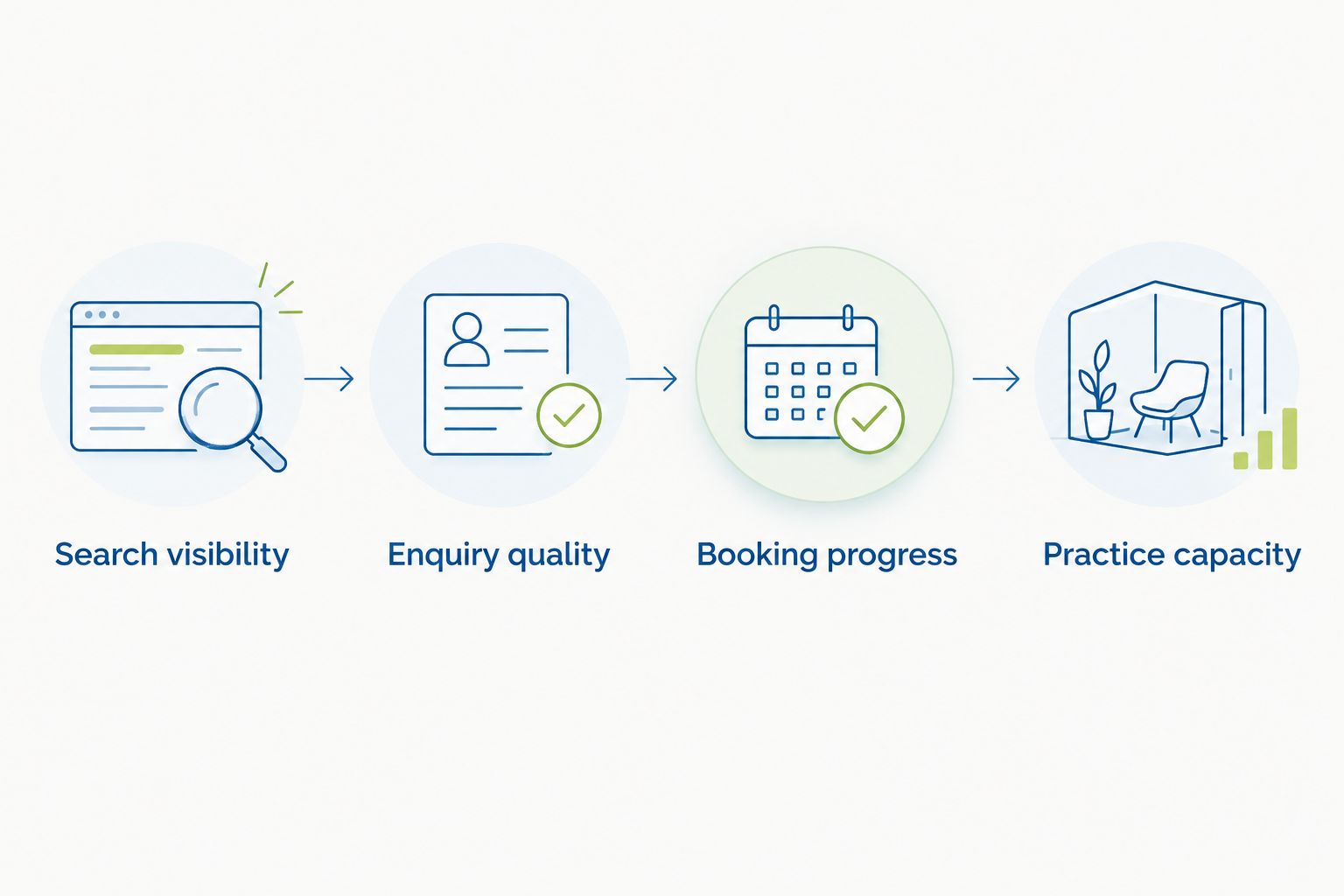
For your 2026 reporting, distinguish visibility, enquiries, and appointments. Search impressions show exposure; enquiries show contact; appointment records show what happened afterward. None of those measures should substitute for the others.
- Search visibility: review relevant searches and landing pages.
- Enquiry quality: check whether people request offered treatments.
- Booking progress: record the next step without clinical details.
- Practice capacity: flag unavailable appointments or services.
- Attribution limits: mark unknown sources rather than guessing.
Assign ownership and review the plan
Set aside a 30-minute monthly review with whoever owns marketing and someone who understands reception or scheduling. Use the meeting to make decisions, not read every number aloud. Ask which treatment pages need work and whether enquiries match your current priorities.
Keep a short change log. If you update a treatment page, alter hours, change an enquiry form, or pause a service, record it. This gives future reports context without pretending that every movement has a single proven cause.
Your 2026 plan should remain editable. A new clinician, revised schedule, or change in service availability is a reason to revisit the campaign—not keep publishing against an outdated brief.
- Name an owner for website updates.
- Name a clinician for medical review.
- Assign responsibility for local profile information.
- Record published changes and approval dates.
- Choose the next action from actual enquiry evidence.
Compare dental SEO delivery options
Choose an arrangement based on who can do the work and approve it. The best option is the one with clear ownership, clinical oversight, and reporting tied to relevant enquiries. None removes the practice's responsibility to supply accurate information.
An owner-managed approach keeps decisions close to the business but competes with patient care and operations. An internal marketer provides continuity but needs access to technical and clinical support. Agency support adds outside capacity, while still requiring practice input and an agreed scope.
| Option | Best for | Main advantage | Key limitation |
|---|---|---|---|
| Owner-managed SEO | Practices starting with a narrow treatment priority | Direct knowledge of services and business needs | The owner must make time for implementation and measurement |
| Internal marketing lead | Practices with someone responsible for ongoing marketing | Close coordination with reception and clinicians | Technical and clinical approvals still need assigned support |
| NSYGHT SEO and AI search support | Local service owners seeking outside search support | An agency offer covering SEO and AI search | Dental deliverables and responsibilities must be confirmed in the engagement |
When comparing proposals, ask each provider to explain the same treatment-page example. What would change? Who supplies the facts? Who approves the copy? What would appear in the report? Concrete answers make proposals easier to compare than lists of technical terms.
Common mistakes dental practices make
Promoting treatments without checking capacity
A campaign can match your website perfectly and still miss the business need. Confirm that the practice wants additional enquiries for each promoted treatment and that reception knows the intended appointment route.
Publishing clinical copy without clinical approval
A polished explanation is not a substitute for professional review. Put a named clinical approver into the workflow and revisit content when the practice changes how a service is delivered.
Creating town pages that imply nonexistent offices
A page about an area you serve should not suggest you have premises there. Keep the actual practice address clear and write location content only when it supplies useful, truthful information.
Treating all enquiries as equal
A call about an unavailable treatment is not the same as a suitable appointment request. Report enquiry relevance alongside volume so an increase does not hide a targeting problem.
Buying content without maintaining existing pages
Publishing more articles does not fix outdated treatment information or a broken booking form. Check your priority patient journeys before adding another batch of pages to the 2026 calendar.
FAQ
What should dental SEO services include for my practice?
Dental SEO services should connect your treatment priorities with useful website pages, accurate local information, technical maintenance, and enquiry reporting. Agree who supplies practice facts, approves clinical content, and implements changes before work starts.
Can I choose which treatments my dental SEO targets?
Yes. Give your provider a list of treatments you actually offer and identify which ones need additional enquiries. Review that list when clinician availability or appointment capacity changes.
Do I need a separate page for every dental keyword?
No. Related searches with the same patient need can belong on one useful treatment page. Create separate pages when the service or information need is genuinely different, not just to repeat wording.
Can I manage dental SEO myself?
Yes, you can start by correcting practice information, improving priority treatment pages, and recording enquiry sources. Outside support becomes useful when technical work, content coordination, or ongoing measurement exceeds the time you can assign.
How long does dental SEO take to bring enquiries?
Dental SEO has no fixed timetable for generating enquiries. Set implementation milestones and review search visibility alongside relevant contacts and booking progress; do not accept a guaranteed ranking or appointment date.
Will dental SEO make ChatGPT recommend my practice?
No provider can guarantee that ChatGPT will recommend your practice. Keep treatment, clinician, and location information clear and accurate, and treat AI mentions as a separate observation rather than proof of booked appointments.
What should I ask before hiring a dental SEO agency?
Ask which treatment pages the agency would prioritize, who approves clinical claims, and how reports distinguish relevant enquiries from general traffic. Also confirm implementation responsibilities, website access, and the work included in the agreement.
One last thing
Your reception team's unanswered questions are a useful starting point for your next website update. Ask which treatment enquiries require the same explanation repeatedly, then check whether the relevant page supplies that explanation accurately.
That gives your next content decision a practical purpose: helping a prospective patient understand what your practice offers before contacting you. If you want outside support, discuss your practice's search priorities with a clear list of services and the enquiries you want to attract.