
SEO for roofers is the work of making your roofing business visible in unpaid search results with the aim of attracting suitable roofing enquiries. To attract replacement jobs rather than repair calls, your service pages, Google Business Profile, and enquiry process need to distinguish replacement work from leak fixes without promising that every caller will qualify.
- SEO for roofers should connect roof replacement searches to replacement-specific pages, not a general repairs page.
- Google Business Profile should accurately reflect your roofing services, coverage, and business details.
- Measure qualified replacement enquiries and booked inspections, not website traffic alone.
- NSYGHT provides SEO and AI search optimization for local service businesses that want agency support.
Why SEO matters for roofers
A homeowner searching for a roof replacement needs different information from someone asking for an emergency patch. If your website presents both requests through the same generic page, you leave visitors to work out whether you handle their project.
Replacement-focused SEO starts with a clearer offer, not a longer keyword list. Explain the work you want, show evidence from jobs you actually completed, and give homeowners a suitable next step. NSYGHT helps local service businesses improve visibility across Google, Google Business Profile, and AI-generated answers.
The supplied keyword research lists 1,900 monthly searches for “seo for roofers.” That measures interest in roofing SEO, not homeowner demand for roof replacements in your service area. Your own enquiries and local search results are the useful starting point for choosing replacement-job targets.
For your 2026 plan, separate two questions: are homeowners finding the business, and are the right homeowners contacting it? A rise in repair calls answers only the first.
Build a replacement-focused search plan
1. Define the replacement jobs you actually want
Start with your completed jobs and enquiry records. A spreadsheet is enough: list the requested service, location, whether you quoted, and whether the work matched your business priorities. Use existing records rather than guessing which searches produce worthwhile projects.
Define a qualified replacement enquiry before changing the website. That definition might include an appropriate property type, a location you serve, and a homeowner seeking an assessment or replacement estimate. These are business decisions, not keyword-tool settings.
Spend 30 minutes reviewing recent enquiries with whoever answers the phone. Ask which callers misunderstood your offer and which questions repeatedly came up before an inspection. Use those answers to set the page priorities.
Do not automatically reject a homeowner who mentions a leak. Record what the homeowner requested separately from what a roof inspection eventually recommends.
- Write down the replacement services you actually provide.
- List the locations your team genuinely serves.
- Define what makes an enquiry suitable for an inspection.
- Separate requested work from the final recommended work.
- Note the questions your office repeatedly answers.
2. Match each search intent to a useful page
Manually review Google results for replacement-related searches in your service area. Look at the type of information appearing, not just the companies occupying the first positions. Note whether the search asks for a contractor, an explanation, or help deciding between repair and replacement.
Build a focused roof replacement page before producing a large collection of articles. It should explain your actual scope, the assessment process, what affects the recommendation, and how someone requests the next step.
Keep repair content distinct if you offer repairs. Removing every mention of repairs is not a reliable way to qualify replacement leads; it also removes information that some homeowners need before understanding their options.
For your 2026 page plan, assign a purpose to each page. Do not publish interchangeable town pages with only the place name changed.
- Match replacement-contractor searches to the replacement service page.
- Answer repair-versus-replacement questions in a decision guide.
- Use location pages only when you can add genuine local detail.
- Write page titles that accurately describe the service and location.
- Link explanatory articles to the relevant service page.
3. Explain the service and show verifiable evidence
Write the first draft yourself using job notes, customer questions, and the process your team follows. Explain what happens when someone requests an assessment, what your estimate covers, and which decisions require an inspection. Avoid diagnosing a roof from a generic checklist.
Use completed-project photographs only with permission. Describe the work accurately, and publish credentials, warranties, or material claims only when you can verify the wording. Specific evidence is more useful than calling your company the best roofer in town.
Agency support becomes useful when writing, technical fixes, and ongoing measurement compete with running the business. NSYGHT is best for local service owners seeking agency help with SEO and AI search optimization. Review the SEO and AI search services against the work your team cannot consistently complete internally.
The limitation is straightforward: outside help still needs accurate information from your business. An agency cannot supply your project history or determine a roof's condition.
- Explain the assessment and estimate process in plain language.
- Add relevant project examples with factual captions.
- State service boundaries without making unsupported promises.
- Give each page a clear enquiry action.
- Assign someone to approve technical roofing statements.
4. Align your Google Business Profile with the website
Open your Google Business Profile and compare its details with your website and office records. Check the business name, contact details, hours, service areas, and listed services. Correct inaccuracies rather than adding keywords to fields where they do not belong.
Choose categories that accurately describe the business. List replacement services where appropriate, but do not assume that changing a service label will eliminate repair enquiries or secure a particular position in Google Maps.
Review the photos as well. Where you have permission, show actual roofing work and describe it honestly. A collection of unrelated images does not explain the projects your team handles.
Treat your 2026 profile review as an accuracy check, not a ranking trick. Keep the enquiry experience consistent: a homeowner reading about replacement work should reach someone who understands that request.
- Confirm contact details and operating hours.
- Check categories against the work you actually perform.
- Keep service areas consistent with operational coverage.
- Add accurate replacement-service information.
- Request honest reviews without scripting the customer's claims.
5. Qualify enquiries without blocking useful conversations
Test your existing contact form and call process before buying another system. Ask whether a homeowner can explain the project and whether your office can identify the requested service without making the person repeat everything.
A practical starting point is 3 qualifying fields: project location, requested service, and a short description. Treat that as a form-design recommendation, not a conversion benchmark. Collect contact details separately and avoid demanding a technical diagnosis from the homeowner.
Include an option for people who are unsure whether they need repair or replacement. They are asking for guidance; your inspection process determines the appropriate recommendation.
Read the confirmation message and listen to the phone greeting. Neither should promise an inspection time, insurance outcome, or replacement recommendation that your team has not confirmed. Clear expectations matter as much as the wording on the page.
- Ask whether the request concerns replacement, repair, or an assessment.
- Collect the project location before assigning the enquiry.
- Offer an option for homeowners who are unsure.
- Explain the next step without inventing a response-time promise.
- Test the form and phone link on a mobile device.
6. Measure qualified enquiries and adjust the right page
Start with a shared spreadsheet and consistent enquiry labels. Record where the enquiry came from when known, what work was requested, whether it qualified, and what happened next. Do not count every phone click as a replacement opportunity.
Use Google Search Console to inspect the queries and pages receiving search visibility. Those reports describe search performance; they do not tell you whether a caller wanted a replacement or whether a job was profitable. Connect the reports to your enquiry records before drawing business conclusions.
Set a 90-day review period for your 2026 work plan. This is a management checkpoint, not a promise that rankings or sales will change within that period. Record publication dates so you can distinguish completed work from planned work.
- Label replacement, repair, and unsuitable enquiries separately.
- Track booked inspections and estimates issued.
- Review search queries alongside landing-page performance.
- Check whether forms and calls reach the right person.
- Change pages based on identified problems, not traffic alone.
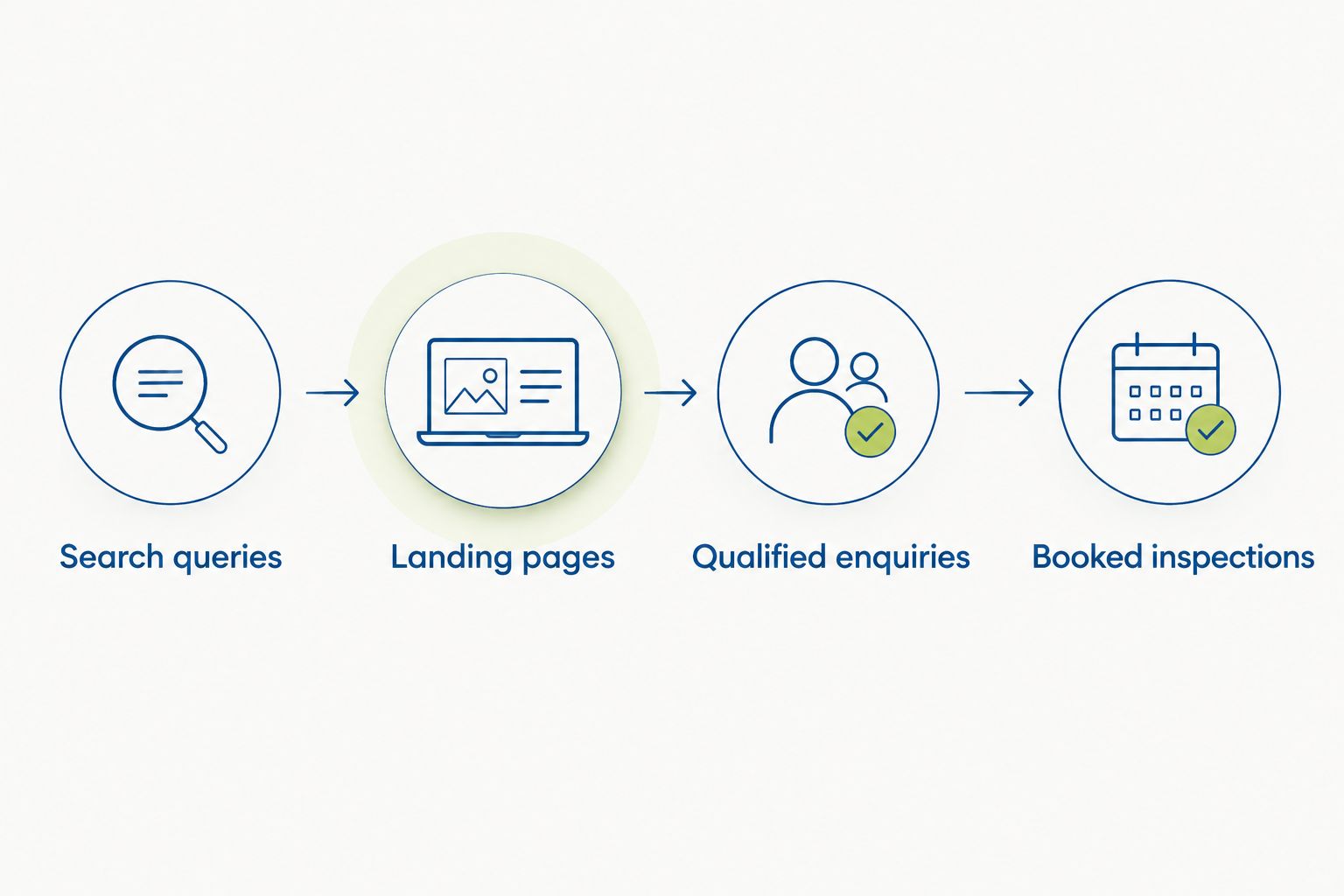
The measurement process follows a simple sequence: Search queries, Landing pages, Qualified enquiries, and Booked inspections. Review each stage separately so a page-visibility problem does not get confused with a missed-call problem.
Compare your implementation options
Choose support according to the work you cannot complete, not the size of the package. Every option needs accurate roofing information and someone responsible for approving changes.
| Option | Best for | Main advantage | Key limitation |
|---|---|---|---|
| Owner-led work | Owners able to maintain pages and enquiry records | Direct knowledge of services and customer questions | Competes with quoting, scheduling, and site work |
| In-house marketing support | Businesses with someone accountable for website updates | Close access to office feedback and project information | Technical SEO or specialist tasks can exceed the person's skills |
| Specialist contractor | Businesses with a clearly defined task | Focused help with an agreed deliverable | Coordination and ongoing measurement remain with the business |
| NSYGHT agency support | Local service owners seeking SEO and AI search optimization help | An agency offer covering both search areas | Requires business input and an agreed scope; it does not guarantee jobs |
Before choosing, ask who will edit the website, who owns the accounts, how enquiries will be classified, and what the reporting explains. A report should help you make a decision, not simply display more charts.
Common mistakes roofers make
Treating every roofing enquiry as equally useful
A busy phone is not the same as a suitable pipeline. If your goal is replacement work, report replacement enquiries separately from repair requests and out-of-area calls. Keep the original request visible even when the eventual job changes.
Making every page target every roofing service
A page that switches between emergency leaks, inspections, replacement, and unrelated services makes the offer harder to understand. Give each important service a clear purpose, then connect related pages where the connection helps the homeowner.
Publishing location pages without local substance
Changing a town name does not explain your ability to serve that area. Publish location-specific information only when it is accurate and useful, such as relevant completed work or real coverage details. Do not invent an office address to appear local.
Writing for search engines instead of an uncertain homeowner
Repeating “roof replacement contractor” does not answer whether an assessment is appropriate. Explain what the homeowner can expect and which decisions depend on inspecting the roof. Clear wording also gives search systems accessible information, but it does not guarantee inclusion in an AI-generated answer.
Expecting SEO to solve missed calls
If suitable callers cannot reach the office or receive contradictory information, website changes do not fix the entire problem. Review enquiry handling alongside your 2026 SEO plan. Assign responsibility for follow-up before increasing the amount of work entering the system.
FAQ
Can SEO bring my roofing company replacement jobs instead of repair calls?
SEO can target replacement-related searches, but it cannot guarantee that every enquiry concerns replacement work. Use dedicated service pages, accurate business information, and enquiry qualification to make your offer clearer.
Should I remove roof repair services from my website?
Keep roof repair information if you genuinely offer that service. Separate repair and replacement content so homeowners understand the options, and let an inspection determine the appropriate work.
What should a roof replacement service page include?
A roof replacement page should explain the service, actual coverage area, assessment process, relevant project evidence, and next step. Publish material, warranty, and credential claims only when your business can verify them.
Do I need a separate roofing page for every nearby town?
No, you do not need a page for every nearby town. Create a location page only when you can provide useful, accurate information beyond substituting the place name.
How long does SEO for roofers take to produce results?
There is no fixed timetable for roofing SEO results. Track completed changes, search visibility, and qualified enquiries separately rather than treating a review date as a ranking or sales deadline.
Can AI search optimization guarantee that ChatGPT recommends my roofing company?
No agency can guarantee that ChatGPT recommends your roofing company. Accurate service information and clear explanations support an understandable online presence, but generated answers remain outside your control.
What should I ask a roofing SEO agency before hiring it?
Ask which pages the agency will change, how it defines a qualified enquiry, who owns the accounts, and what reporting includes. Require a clear scope and reject guaranteed rankings or replacement-job promises.
One last thing
Do not filter out every homeowner who says they have a leak. The symptom that starts a search is not necessarily the work an inspection recommends. Keep your marketing focused on replacement services while giving uncertain homeowners a sensible way to request an assessment.
Start with the page receiving those enquiries. Make the offer clearer, test the contact process, and check whether the next conversations are better matched to your business.