
Keep your trades on one website when they operate as one business; use separate websites when they are genuinely separate businesses. For home services SEO in 2026, start with dedicated pages for each trade rather than separate domains, because separate sites also need their own content, maintenance, and enquiry tracking.
- Home services SEO starts with your business structure: one business generally belongs on one website.
- Separate websites make sense for independent brands, not simply different trade keywords.
- Give each trade a useful service page before considering another domain.
- NSYGHT helps local service businesses with SEO and AI search optimization; judge progress by relevant customer enquiries.
Home services SEO: should each trade have its own website?
Each trade does not need its own website just because customers search for it separately. A business offering plumbing, electrical work, and heating can explain those services on distinct pages within the same site. Customers should land on the page that matches their problem, then find a clear route to contacting the right team.
The decision is about business identity and operational ownership, not the number of services on your vans. Use this comparison before adding domains to your 2026 marketing plan.
| Website structure | Best for | Main advantage | Main drawback |
|---|---|---|---|
| One website with trade-specific pages | One business delivering several trades | Keeps services, business information, and enquiry routes together | Needs clear navigation and genuinely useful pages for each trade |
| Separate websites | Independently operated brands with distinct customer identities | Lets each business present its own services and identity | Creates separate content, maintenance, measurement, and ownership responsibilities |
The practical next step is to map your trades to customer-facing pages. An agency's SEO and AI search services should address that structure before treating more websites as the solution.
Why this matters
A homeowner looking for an electrical repair needs an electrical repair page, not an explanation of your company structure. That page should explain what work you handle, where you work, and how the customer can request help. A separate domain is not required to provide those answers.
Your decision also affects how much work your business must maintain. Every additional website creates another place where service descriptions, contact details, forms, and business information need attention. Choose a structure your team can keep accurate.
For your 2026 plan, separate the real problem from the proposed fix. If customers cannot find a particular service, first check whether that service has a clear page and an obvious place in your navigation.
One website: best for a single multi-trade business
Keep the trades together when customers deal with the same business, recognize the same brand, and use a shared booking or enquiry process. Different teams do not automatically require different websites. Your internal departments and your customer's understanding of the business serve different purposes.
Build a service hierarchy that makes sense without explanation. A visitor should be able to move from your main services page to the relevant trade, then to a specific service where that service needs a fuller explanation.
A useful trade page answers questions such as:
- Work covered: What problems does this team handle?
- Service area: Where can the business actually deliver that work?
- Service limits: What does the business not provide?
- Evidence: What relevant qualifications, project details, or customer feedback can you substantiate?
- Next step: How does the customer request help for this trade?
The benefit is a connected experience. Customers can understand the full business without having to work out whether several websites belong to the same company.
The drawback is organizational: a broad website becomes confusing when every service gets equal space on every page. Keep individual trade pages focused. Shared branding does not require repeating the entire service catalog beneath every heading.
Recommendation: keep one website when the customer is hiring one business. Improve the individual trade pages before expanding the domain portfolio.
Separate websites: best for independently operated brands
Separate websites fit businesses that already have distinct identities, not services that merely have different names. A group owning independently branded companies can have a sound reason to maintain separate sites. Each customer-facing business needs to explain its own offer and contact process.
Before choosing this structure, identify who owns the work for each site. Someone must approve service information, maintain contact details, review enquiries, and keep access to the domain and website accounts.
Separate sites offer clearer independence when customers truly deal with different businesses. They also create more places for information to become inconsistent. A copied website with a different logo does not explain why the second business deserves a separate customer experience.
A separate site needs a distinct purpose. Ask whether its content would still be useful if visitors never saw any of your other websites. If it depends on copied explanations and the same booking journey, reconsider whether separation helps the customer.
Recommendation: use separate websites for separate business identities, with named responsibility for each. Do not create them solely to place a different trade keyword in a domain name.
Why the right website structure varies
There is no useful domain-count rule for every home services business. These factors determine whether separation serves your customers and operations:
- Business identity: Do customers hire one recognizable company or independently named businesses?
- Customer journey: Do enquiries reach the same team, or does each business manage its own customers?
- Service overlap: Would the websites explain substantially the same work to the same people?
- Content ownership: Can someone maintain accurate, distinct information for each website?
- Existing performance: Which pages and websites already produce relevant enquiries?
- Business plans: Are the brands staying together, or is there a confirmed reason to operate them independently?
Use these factors to make the decision, rather than treating competitors' website counts as a model. Their ownership, history, and operating arrangements are not your business plan.
For a 2026 restructure, document the reason for every site you intend to keep. “Different keywords” describes a content requirement; it does not, by itself, establish a separate business identity.
How do you decide without rebuilding everything?
Start with an inventory of what exists. Do not commission another website before checking whether your current pages explain the services customers actually request.
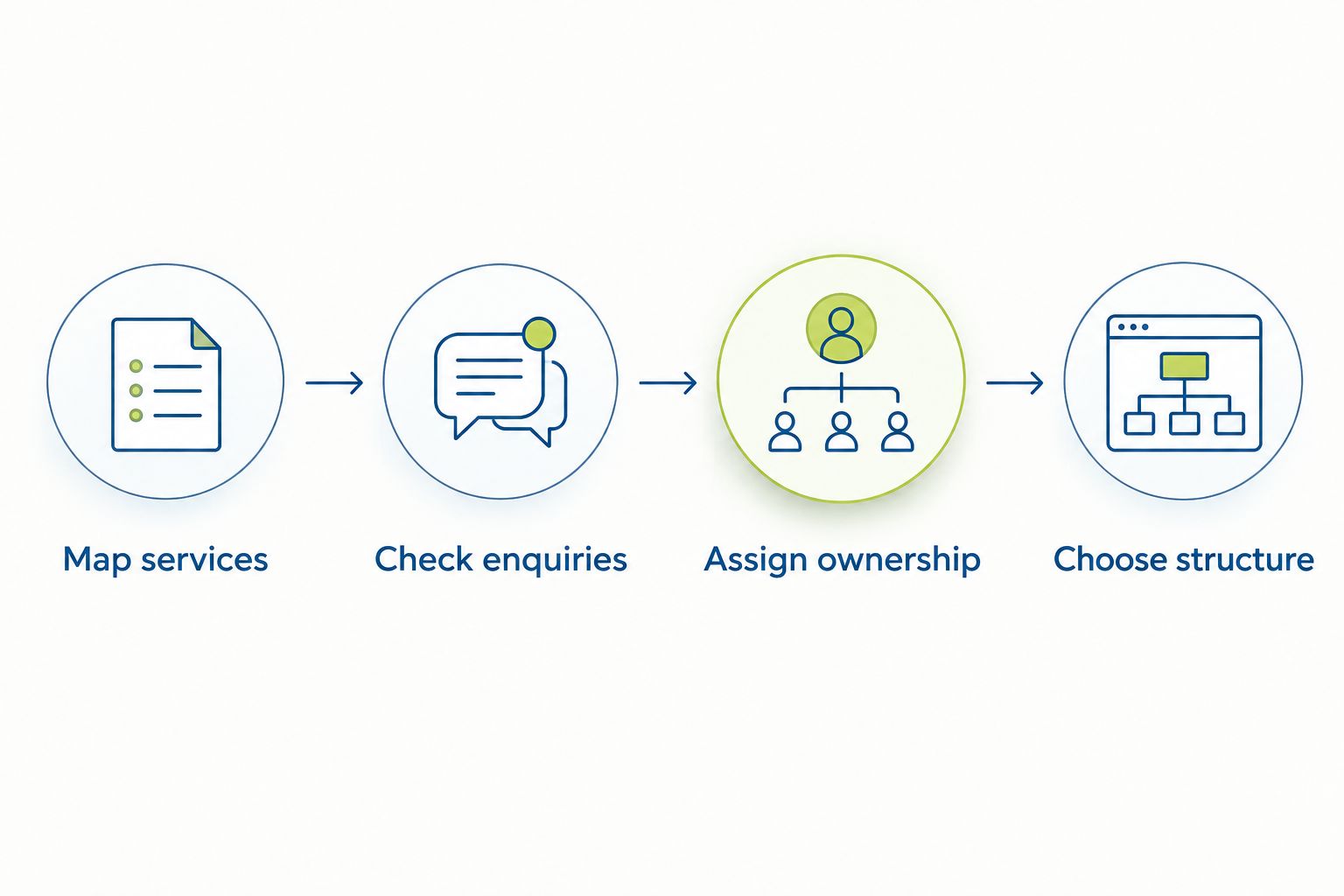
1. Map services
List each trade you deliver and the customer problems it covers. Put the most relevant existing page beside each service. Mark gaps rather than assuming a new domain is the answer.
Set a starting rule of 1 core page per trade, then add more specific service pages where you have distinct work to explain. This is a planning recommendation, not a Google requirement or a ranking formula.
2. Check enquiries
Review the enquiries attached to those pages where tracking allows it. Separate relevant requests from wrong-service enquiries, out-of-area requests, and spam. A busy page is not automatically a useful page for your business.
If your reporting uses a 28-day window, compare equivalent periods and note seasonal differences. Treat that window as a reporting interval, not a deadline for SEO results.
3. Assign ownership
Name the person responsible for service accuracy and the person responsible for handling enquiries. Decide who approves changes when coverage, staffing, or the work you accept changes.
For separate websites, repeat this exercise for every business. If no one owns the upkeep, another website adds an unattended responsibility.
4. Choose structure
Choose the smallest structure that accurately represents the businesses customers hire. Keep shared services together when they belong to one business; retain separate identities where independence is real.
Write down the reason before starting design or development. That decision gives your staff and agency a shared brief instead of leaving website architecture to personal preference.
Should each trade have its own Google Business Profile?
One website does not establish eligibility for multiple Google Business Profiles. Profile eligibility depends on the actual business and Google's current rules, not simply on how many trades you advertise.
Do not create a profile for every service category as a shortcut. Check the current eligibility guidance against your real operating arrangements before making changes, especially when several brands share staff or premises.
Does AI search change the website decision?
AI search does not remove the need to describe your business clearly. For your 2026 content plan, make each service page understandable on its own: identify the business, explain the work, state the actual service area, and give a relevant contact route.
NSYGHT is best for local service owners who want SEO and AI search explained in terms of customer enquiries. Its scope includes Google, Google Business Profile, and AI-generated answers; that does not make a website structure a guarantee of inclusion in any answer.
What if you already have separate trade websites?
Keep the existing sites in place until you understand their role. Review which business each represents, which pages receive relevant visits, and where enquiries arrive before deciding to combine anything.
If consolidation is the right choice, make a migration plan. Match useful old pages to relevant destinations, plan redirects, update links you control, and test the enquiry process. Do not send every old page to the homepage simply because that is easier to configure.
A sensible 2026 migration brief records what must be preserved and how you will check it afterward. The decision to consolidate and the work of moving a website are separate tasks.
FAQ
Can one website rank for plumbing, electrical, and HVAC services?
One website can have dedicated pages targeting plumbing, electrical, and HVAC services. Each page needs to explain the actual work offered; a separate domain is not a prerequisite, and no structure guarantees rankings.
Should I buy a separate domain for every trade keyword?
Do not buy separate domains solely to target different trade keywords. Start by creating useful pages for the services your existing business delivers, then consider separate sites only where there is a distinct business purpose.
Do I need a page for every town I serve?
You do not need a separate page for every town by default. Create location pages when you can provide useful, accurate local information rather than repeating the same page with a different place name.
Will combining my websites improve my rankings?
Combining websites does not guarantee better rankings. Review the existing sites and plan page-level redirects, content retention, and enquiry tracking before deciding whether consolidation supports your business.
How can I tell whether a trade page brings in customers?
Connect the trade page to enquiry tracking, then review whether those enquiries match the service and area you cover. Search visibility and visits provide context, but relevant calls and form submissions tell you more about customer demand.
Should I create separate websites for residential and commercial work?
Residential and commercial work can sit on separate pages within one website when the same business delivers both. Separate websites need a stronger reason, such as independently operated brands with distinct customer-facing identities.
Can NSYGHT help with home services SEO and AI search?
NSYGHT provides SEO and AI search optimization for local service businesses. Its work addresses visibility in Google, Google Business Profile, and AI-generated answers without guaranteeing rankings or customer enquiries.
One last thing
Test the enquiry handoff before you approve another website. Ask your team to follow a trade-specific page through to its form or phone contact, then confirm who receives the request and what service information reaches them.
A well-separated page is little use if the enquiry reaches the wrong person. Bring that finding to your website structure discussion so the decision covers both search visibility and what happens after a homeowner contacts you.