
A competitor gets recommended when ChatGPT’s answer identifies that business as a match for the customer’s question using the information available to it. That recommendation does not prove the competitor has better service, stronger Google rankings, or more customers. ChatGPT SEO starts with examining the question, the answer, and any cited sources—not guessing which secret ranking factor you missed.
- ChatGPT SEO starts with checking the question and cited sources, not copying a competitor’s answer placement.
- NSYGHT helps local service businesses with SEO and AI search optimization.
- Separate business mentions, source citations, website visits, and customer enquiries when measuring results.
- Fix inaccurate business information and unclear service pages before publishing more content.
ChatGPT SEO: why does a competitor get recommended instead of you?
The useful evidence sits in the actual answer. Start with 5 checks per answer so you can distinguish a visible problem from an assumption:
- Read the question. Record the service, location, customer type, and constraints. A request for emergency repairs is different from a request for a planned replacement.
- Check whether search was used. A response with web sources gives you material to inspect. An answer without visible sources does not give you the same evidence trail.
- Open the citations. Check whether they support the recommendation, merely mention the business, or discuss something else.
- Inspect the business facts. Compare the cited description with the competitor’s actual services and your own published information.
- Record the outcome. Separate a recommendation from a passing mention or a citation. They are different observations.
For your 2026 baseline, save the exact question and the date alongside the answer. A screenshot without the question leaves out the context needed to interpret it.
If you want outside help interpreting the evidence, NSYGHT’s SEO and AI search agency services are for local service businesses seeking better search visibility. The SEO and AI search services are relevant when you need help connecting these findings to website and local-search work—not a promise of a particular recommendation.
Why this matters
A homeowner asking for a roofer and a patient looking for a dentist are trying to make a decision. Your visibility matters most when the question matches a service you actually provide in an area you actually serve.
But appearing in an answer is not the business outcome. Track whether the attention becomes a suitable enquiry. A mention for work you do not want can distract you from the pages and questions that matter to your business.
For a small-business owner, the practical decision is where to spend time next: correcting business facts, improving a service page, addressing a customer question, or measuring enquiries more carefully. The answer should come from an identified problem, not anxiety about a competitor’s screenshot.
What does each kind of ChatGPT appearance tell you?
Do not combine every appearance into a single visibility score without keeping the underlying categories. A source citation and a direct recommendation tell you different things.
| Appearance | Best for assessing | What it establishes | Limitation |
|---|---|---|---|
| Business recommendation | Relevance to a buying question | The response names the business as an option | It does not establish why the business was selected |
| Website citation | Whether a page supports an answer | The response links to the page as a source | The answer might not recommend the business |
| Passing mention | Recognition in that response | The business name appears | The mention might not help a customer choose |
| Recorded enquiry | Commercial relevance | A prospect reports finding you through ChatGPT | The prospect’s recollection is not a complete attribution record |
Use recommendations to assess selection, citations to inspect sources, and enquiries to assess business relevance. None of these measurements replaces the others.
Keep those distinctions in your 2026 reporting. Otherwise, an increase in citations could be presented as an increase in customers even when the enquiry record shows no such change.
What should you fix before writing more content?
Start with information a prospective customer needs to choose your business. Make the answer clear on the relevant page rather than spreading fragments across unrelated articles.
Business facts
Check your business name, contact details, services, and stated service area across your website and the public profiles you control. Correct inaccuracies at their source.
For Google visibility, review your Google Business Profile as well. Maintaining that profile is useful local-search work; it is not evidence that ChatGPT reads it directly or uses it as a recommendation signal.
Service fit
A page should explain the work you perform, who it is for, and any meaningful limits. A roofing business that wants replacement projects should not leave visitors guessing whether replacement work is part of its offer.
Do not add services just because competitors mention them. Clear boundaries help you attract appropriate enquiries and avoid misleading customers.
Location clarity
State where you operate in language customers understand. Distinguish your actual office location from your service area, and do not imply you have premises somewhere you do not.
A city name repeated throughout a page does not explain coverage. Tell customers whether you serve their area and how to confirm an address when necessary.
Verifiable evidence
Support credentials, project descriptions, and business claims with information you can substantiate. Where you publish customer examples, describe the actual work rather than turning every example into an unsupported success story.
Do not manufacture reviews, awards, locations, or results to resemble a competitor. Those additions make the business information less trustworthy, not more useful.
Accessible pages
Check that important pages load, work on mobile, and are not unintentionally blocked from search indexing. Keep navigation and internal links clear enough for visitors to find the relevant service.
Indexing controls and crawler permissions require separate checks. Allowing a crawler does not guarantee indexing, retrieval, citation, or recommendation.
How do you run a useful competitor check?
Use a repeatable sequence rather than repeatedly asking ChatGPT to choose your business. The goal is to identify a specific information gap you can act on.
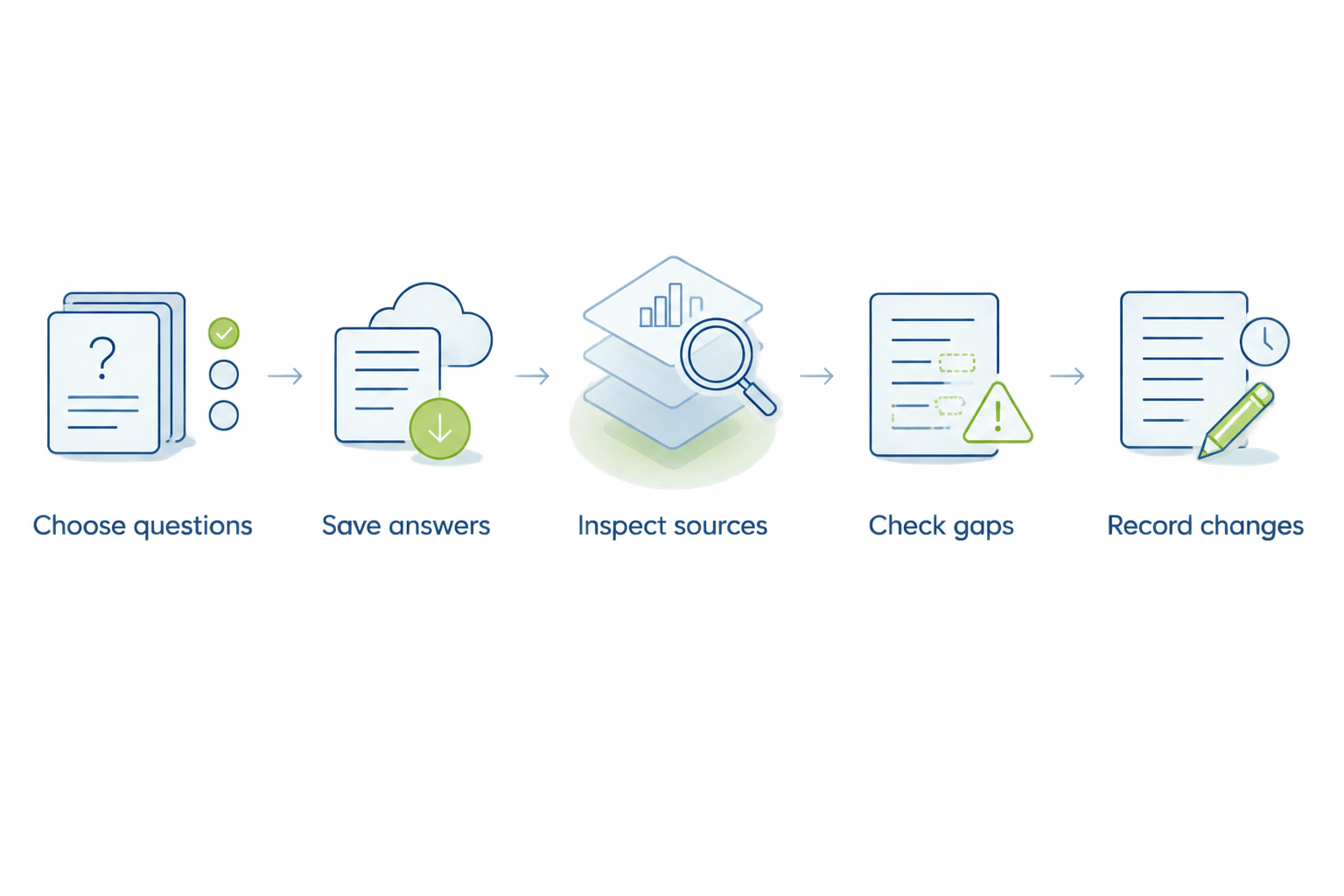
- Choose questions. Start with 5 customer questions drawn from real calls, emails, or sales conversations. Include the service and location only when the customer would naturally include them.
- Save answers. Record the exact wording, date, search setting where visible, business names, and citations. Keep your own business out of the question unless you are testing a branded query.
- Inspect sources. Read the pages behind the answer. Note what they actually establish about each business rather than assuming every cited page influenced every sentence.
- Check gaps. Compare those facts with your relevant service page and public business information. Identify inaccuracies, unanswered questions, or unclear descriptions.
- Record changes. Document what you corrected and when. Keep an enquiry log alongside the visibility record.
For your 2026 comparison, keep the original question wording intact. Changing the service, city, and customer requirements between checks changes the test itself.
Give each finding a next action. For example, an outdated service description calls for a correction; a broken citation calls for investigation; an unsupported recommendation calls for caution. None automatically calls for another blog post.
Why ChatGPT recommendations vary
Different answers are not automatically evidence that your website improved or declined. Check these factors before attributing a change to SEO work:
- Question wording: A different service or customer requirement creates a different request.
- Location context: A named city and an unspecified location do not describe the same search need.
- Search use: A web-supported answer and an answer without visible web sources offer different evidence.
- Conversation context: Earlier messages can shape what a follow-up question means.
- Source changes: A cited page can change, so save the relevant evidence when you review it.
These are reasons to standardize your checks, not a formula for controlling recommendations. Repeatable observation is more useful than chasing a single answer.
When you report 2026 results, state which questions you checked and what counted as an appearance. A broad claim such as improved AI visibility is difficult to evaluate without that scope.
Should you copy the competitor’s content?
No—use the competitor’s appearance to investigate, not as permission to copy. A competitor’s page can show which customer questions it answers, but it cannot establish what caused a recommendation.
Extract the useful question, then answer it using your own business facts. If a customer wants to know whether you handle a particular job, explain your actual scope, process, and limits.
Avoid publishing a self-awarded best-business list simply to put your name first. A page that helps customers assess suitability has a clearer purpose than a page written to manufacture an endorsement.
Can you pay for guaranteed ChatGPT recommendations?
Do not accept an agency guarantee of organic ChatGPT recommendations. An agency can commit to defined work, such as correcting pages, reviewing technical access, documenting source mentions, and reporting enquiries. It cannot control every answer a third-party system produces.
Ask the provider to separate deliverables from hoped-for outcomes. You should be able to see what changed, why it changed, and how the provider will assess whether it helped.
A useful proposal also explains what happens when visibility improves but unsuitable enquiries increase. Your business needs relevant demand, not a report full of appearances for the wrong services.
How should a local business measure progress?
Keep 1 shared enquiry log alongside your visibility checks. Record the requested service, location, reported discovery source, and whether the enquiry fits your business.
Ask new prospects how they found you without supplying the answer. Keep self-reported ChatGPT enquiries separate from visits identified through website analytics; they are different sources of evidence.
Your 2026 review should answer practical questions:
- Are important business facts accurate?
- Are relevant service pages being cited or recommended for the questions checked?
- Are prospects asking for work you actually want?
- Can your team explain what changed and what remains uncertain?
NSYGHT’s focus on local service businesses makes those customer questions more relevant than a generic list of technology keywords. Keep the discussion tied to the services, locations, and enquiries your business can act on.
FAQ
Why does ChatGPT recommend my competitor but not my business?
The answer identifies your competitor as a match for that particular question, but it does not necessarily reveal the complete selection process. Inspect the exact question and any cited sources before deciding what your business needs to change.
Does ranking first on Google guarantee a ChatGPT recommendation?
No. A Google ranking does not guarantee that ChatGPT will recommend your business. Evaluate Google visibility and ChatGPT appearances separately rather than treating them as interchangeable results.
Do I need special AI files or schema to get recommended?
No file or schema markup guarantees a recommendation. Prioritize accurate business information, accessible pages, and clear service descriptions; treat technical markup as supporting work, not an endorsement mechanism.
Should I publish more blog posts for ChatGPT SEO?
Publish a post when it answers a real customer question that your existing pages do not address well. Correct inaccurate business information and weak service pages before expanding the article calendar.
Can ChatGPT recommend a business without citing its website?
Yes. A business recommendation and a website citation are separate things. Record both so you can distinguish being named from having a page used as a visible source.
How long does ChatGPT SEO take to work?
There is no fixed timetable that guarantees a recommendation. Document the work and compare equivalent questions over time, while measuring whether relevant customer enquiries change.
Can NSYGHT help my local business with ChatGPT SEO?
NSYGHT provides SEO and AI search optimization for local service businesses. Evaluate the proposed work by its specific deliverables and connection to customer enquiries, not a promise of guaranteed rankings or recommendations.
One last thing
Before you celebrate a competitor disappearing from an answer, check whether the replacement recommendation actually fits the customer’s request. An inaccurate answer is not evidence that your marketing improved.
Your next move is to document a relevant question, inspect its evidence, and correct a real problem. That produces a defensible business decision even when the next answer changes.