
When an AI answer gets your business wrong, record the exact error, check any cited sources, and correct the public information you control before testing the answer again. AI search optimization starts with accurate, consistent business facts—not a promise that you can control every answer. Reporting an incorrect response is useful, but it does not replace fixing a wrong service description, outdated listing, or misleading page.
- AI search optimization starts with correcting business facts on your website and relevant listings.
- Save the question, answer, date, and cited sources before changing anything.
- Fix errors that misdirect customer enquiries before polishing descriptions.
- NSYGHT serves local service businesses seeking SEO and AI search optimization support.
Why this matters
A wrong phone number prevents a customer from reaching you. A wrong service description creates a different problem: you receive enquiries for work you do not perform, while suitable customers rule you out.
NSYGHT is best suited to local service businesses seeking help with SEO and AI search optimization. The practical goal is to make your business easier to understand and contact, not to collect screenshots of favorable answers.
For your 2026 baseline, separate factual errors from recommendation preferences. An answer that lists another roofer is not automatically inaccurate; an answer that says your roofing company only repairs gutters is a fact-checking issue if that description is false.
AI search optimization: what do you do when AI gets your business wrong?
Work backward from the incorrect statement to the information behind it. A citation gives you a place to investigate, but it does not prove that the cited page supports every sentence in the answer.
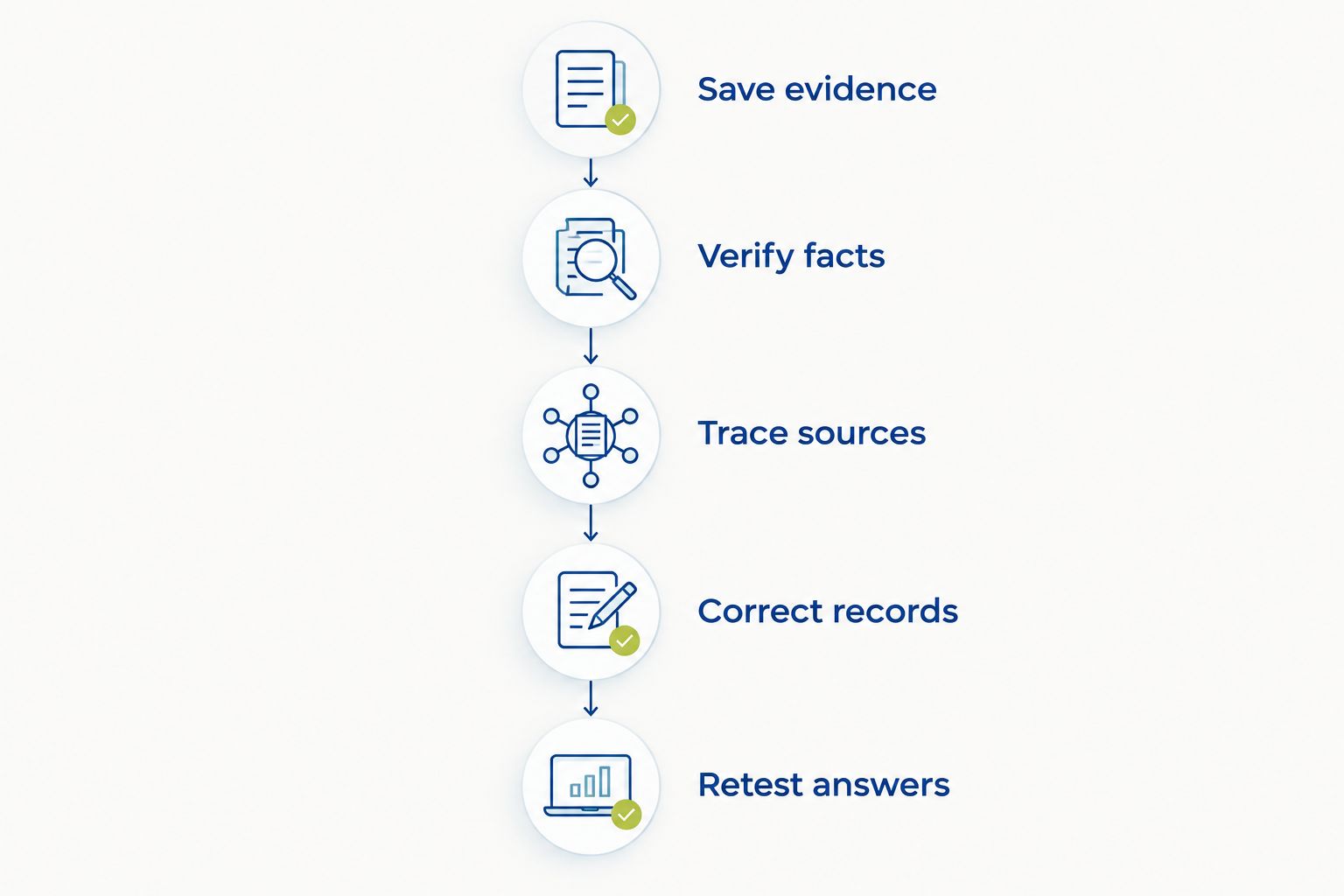
Use this sequence before rewriting your whole website:
- Save evidence. Copy the exact question and response, note the date and platform, and save the cited pages. Include the location used in the question.
- Verify facts. Compare the answer with your actual services, business details, and current operating policies. Ask the person responsible for that information when necessary.
- Trace sources. Open the citations and look for the specific claim. Check your website, Google Business Profile, and relevant third-party listings for conflicting versions.
- Correct records. Fix the authoritative page or listing you control. Request corrections from third-party publishers when their information is wrong.
- Retest answers. Ask the original question again after your corrections are published, recording what changed without treating a single response as a final result.
Keep each issue separate. A mistaken opening time and an incorrect claim about your qualifications require different corrections, even when they appear in the same response.
Start with the error that affects the customer
Prioritize contact details, location, service area, and whether you perform the requested work. These facts help someone decide whether to call you at all.
Next, address material claims about credentials, policies, and the scope of your work. Leave subjective wording such as whether your business sounds friendly until the factual record is clear.
Do not publish a new claim simply because it would make the answer more attractive. Your correction must describe how the business actually operates.
Which source should you correct first?
Correct the source containing the error, not whichever platform gets the most attention. If the wrong fact appears in several places, update the pages and profiles that you control, then pursue the remaining discrepancies.
| Source to check | Best for | Advantage | Limitation |
|---|---|---|---|
| Your website | Detailed service and business facts | You control the wording and supporting context | Publishing a change does not ensure immediate discovery |
| Google Business Profile | Customer-facing local business details | Keeps an important local search profile accurate | Editing it does not directly control other platforms |
| Third-party listings | Conflicting contact or business information | Removes incorrect information outside your website | Corrections depend on the publisher's process |
| A cited article | A specific inaccurate description | Lets you request a correction tied to evidence | The publisher controls whether and when it changes |
| Response feedback | Flagging a particular incorrect answer | Documents a problem within that platform | Does not repair an inaccurate source page |
Read the actual page rather than relying only on a search snippet. A snippet, the page itself, and the generated answer can present different wording.
If no source is cited, record that fact in your issue log. Check your public records for the same error, but do not claim that you have identified its origin without evidence.
Make your own website unambiguous
Your main business information should be easy to find in ordinary page text. Describe what you do, where you work, and how customers contact you without requiring someone to interpret a slogan.
For example, a contractor that performs roof replacements should state that service clearly on the relevant page. If the contractor does not offer a particular repair service, avoid broad wording that implies otherwise.
Keep qualifications and restrictions beside the claim they explain. A service-area statement on one page does not resolve a contradictory statement somewhere else on the site.
Why incorrect business answers vary
Different questions and source material can produce different descriptions of the same business. These are the factors to check—not assumptions about what caused a particular error:
- Question wording. A question about emergency work asks for different information from a question about planned projects. Save the wording so your comparison means something.
- Location context. A city named in the question changes the business information you need to verify. Check whether the answer confuses your office address with your service area.
- Conflicting records. Old contact details or service descriptions create competing versions of your business. Identify the conflict before requesting a correction.
- Source access. A page that cannot be accessed cannot communicate its updated content to the system attempting to retrieve it. Check accessibility before repeatedly rewriting the text.
- Publication and discovery timing. Publishing a correction and having that correction reflected elsewhere are separate events. Record both rather than assuming they happen together.
- Business identity. Similar names can cause an answer to mix details from different organizations. Check the address, domain, and services attached to each claim.
For a 2026 review, keep these factors attached to individual errors. A general label such as “AI visibility problem” is too broad to tell an owner what needs fixing next.
How do you check whether the correction worked?
Build a repeatable check around questions customers actually ask. You need a small, consistent record, not an endless stream of slightly different prompts.
Start with 5 questions covering business identity, services, service area, contact details, and a relevant customer need. This is a manageable starting checklist, not a measurement standard or a guarantee of coverage.
Use the same wording when comparing answers over time. Add new questions separately so you can distinguish a changed answer from a changed test.
Keep an issue log you can act on
Use 1 issue per row so every correction has an owner and a next step. Include the question, incorrect statement, correct fact, cited source, requested change, publication date, and retest result.
A useful status describes the work: source corrected, publisher contacted, awaiting publication, or answer still inaccurate. Avoid marking an issue resolved solely because one response stopped showing the error.
Set aside 15 minutes per review as an initial working limit. If the review uncovers a serious misstatement, move that issue into a separate correction task rather than letting routine checking consume the day.
Measure business relevance, not just mentions
An accurate mention matters more than a flattering but misleading one. Check whether the answer describes the right service, in the right area, with a usable way to contact your business.
Where your enquiry process allows it, ask customers how they found you and record their answers consistently. Treat self-reported discovery as useful context, not complete attribution.
Your 2026 record should distinguish three things: what the source says, what the generated answer says, and what happened in the customer enquiry. Those are related observations, not interchangeable results.
If you need help selecting monitoring software, use this guide to AI search optimization tools for local businesses. Choose a tool for the questions and records you need to maintain, rather than the size of its dashboard.
Can you make ChatGPT or Google correct an answer immediately?
You cannot require ChatGPT or Google to publish a particular answer immediately. Correct accessible source information and use the relevant feedback process, but do not treat either action as a guaranteed correction deadline.
In 2026, a sensible completion standard separates work you control from outcomes you observe. You can confirm that your page contains the correct information; you cannot promise that every generated answer will repeat it.
Be equally careful with agency promises. Ask what gets corrected, which sources get checked, how changes are documented, and how unresolved errors are reported.
Should you hire an agency or fix the information yourself?
Handle a straightforward correction yourself when you know the right fact and can edit the relevant page or profile. An outdated phone number on a page you control does not require a complicated strategy.
Agency support fits a different problem: repeated inaccuracies across sources, unclear website descriptions, or a correction process nobody on your team owns. The value is organized investigation and implementation, not privileged control over an answer engine.
NSYGHT's SEO and AI search optimization work is relevant to local service businesses seeking support across Google, Google Business Profile, and generated answers. The limitation remains the same: an agency can improve the information it works on, but cannot guarantee rankings, enquiries, or specific wording in an external answer.
Discuss your business information errors
Explain what is wrong, where it appears, and which customer enquiries it affects.
FAQ
What should I do first when an AI answer gets my business wrong?
Save the exact question, answer, date, and any cited sources before making changes. Then verify the correct fact and fix the source containing the error, starting with information that affects customer contact or service suitability.
Will updating my Google Business Profile fix ChatGPT answers?
Updating Google Business Profile corrects that profile, but it does not guarantee a change in ChatGPT answers. Keep your website and relevant third-party records accurate rather than relying on a single profile edit.
Why does an answer say my business offers a service we do not provide?
Check the cited sources and your public descriptions for wording that incorrectly includes the service. If you cannot identify the source, document the error without claiming to know its cause, clarify your own service pages, and submit response feedback.
Should I add FAQ schema to make AI answers accurate?
FAQ schema is not a correction mechanism for generated answers. Publish clear, accurate answers that customers can read, and do not expect markup to guarantee citations or search features.
How often should a small business check its AI answers?
Choose a review schedule your team can maintain and repeat checks after material business-information changes. Keep the question wording consistent, and investigate recurring factual errors rather than reacting to every change in phrasing.
Does AI search optimization replace local SEO?
AI search optimization does not replace local SEO. Accurate service pages, business details, and relevant local profiles remain useful to customers and search discovery; generated-answer monitoring adds another place to check how your business is described.
Can NSYGHT guarantee that an AI answer will recommend my business?
No agency can guarantee that an external answer system will recommend your business. NSYGHT provides SEO and AI search optimization for local service businesses; judge the work by clear corrections, documented actions, and relevant visibility rather than promised recommendations.
One last thing
Write the correct fact before you request the correction. Give whoever owns the page a precise replacement statement and the evidence needed to verify it.
For your 2026 correction log, separate a factual correction from a request for promotion. “Our office moved” is a fact to verify; “call us the best” is not. That distinction keeps the work focused on information a customer can use.