
Instead of manually checking scattered AI answers and forwarding screenshots, brief generative engine optimization services around your customers, priority services, and enquiry tracking so the agency has a defined job. Use the workflow below to turn those decisions into an approved scope, an access checklist, and reporting you can use to make business decisions.
- Brief generative engine optimization services around qualified enquiries, not promises of mentions in ChatGPT.
- NSYGHT serves local businesses seeking SEO and AI search optimization support.
- Define priority services, locations, evidence, account access, and reporting before approving agency work.
- Keep Google Business Profile and website improvements connected to the AI search brief.
Why this matters
A screenshot of your business appearing in an AI answer does not tell you whether the person needed your service, lived in your service area, or contacted you. Your brief must connect visibility work to the customers you actually want.
Generative engine optimization, often shortened to GEO, means working to improve how a business is understood and represented in generated search answers. It overlaps with SEO through clear website content, accessible pages, accurate business information, and evidence supporting your claims. It does not give an agency control over what an answer engine publishes.
NSYGHT is best for local service owners seeking agency support across SEO and AI search optimization. Review the services with a specific customer problem in mind, rather than treating AI visibility as a separate business goal.
Before you start
- Prepare business materials: your service list, actual service area, approved business details, priority website pages, and existing enquiry records. Include which jobs you want and which enquiries your team routinely declines.
- Identify account owners: establish who controls your website, Google Search Console, Google Analytics, and Google Business Profile. Arrange appropriate user access through those owners rather than sharing passwords.
- Resolve the measurement gap: Google Search Console reports Google Search performance, not a complete record of appearances across ChatGPT and other answer engines. Ask the agency to separate search reporting, observed answer mentions, and customer enquiries before setup begins.
You also need someone who can approve factual claims. For a roofer, that means checking service descriptions; for a law firm or dental practice, involve the person responsible for professional and compliance review.
Your business brief
Define the customer and commercial priorities
- Create a shared document titled 2026 Agency Brief. The bold labels in this guide are fields to create in that document, not buttons in a particular software product.
- Add Priority services. List the work you want more enquiries about, using the words customers use when they call.
- Add Service area. Record where you genuinely serve customers and any location restrictions. Separate an office address from the wider area your team covers.
- Add Qualified enquiry. Describe what makes a contact useful: the requested service, location, decision-maker, and any relevant eligibility requirements.
- Add Excluded work and Approval owner. State what the agency should not promote and who approves content before publication.
Be specific enough to prevent the wrong work. A roofer seeking replacement projects should not receive a content plan dominated by minor repairs. A business serving homeowners should not approve pages written mainly for commercial purchasing teams.
Expected result: the agency can explain which customers the work should attract, which services take priority, and what falls outside the assignment.
Build the customer-question set
- Add Customer questions and write 5 questions drawn from real calls, emails, or sales conversations. Treat this as a manageable starting set, not a claim that every buyer follows the same journey.
- Add Decision barriers beneath each question. Record the uncertainty that stops someone from contacting you, such as service suitability, coverage area, or what happens during an appointment.
- Add Supporting evidence. Identify the approved information that answers the question: service details, documented experience, relevant qualifications, or existing customer feedback you have permission to use.
- Add Priority pages. Match each question to an existing page where possible; ask the agency to justify a new page when none fits.
Do not ask the agency to manufacture authority. If your team cannot substantiate a claim, remove it or describe the service without that claim.
Expected result: each proposed content task addresses a customer decision rather than merely repeating a keyword.
The agency scope
Choose the work and its boundaries
Generative engine optimization services need a task list, not just a label. Ask the agency to distinguish work that improves your underlying website from work that observes how answer engines represent it.
Use this comparison to choose the scope you need. These are adjacent workstreams, not competing substitutes.
| Workstream | Best for | What to request | Advantage | Limitation |
|---|---|---|---|---|
| Website SEO | Businesses with unclear service pages or search-access problems | Page review, technical priorities, content changes, and implementation ownership | Improves information on a website you control | Does not control rankings or generated answers |
| Local search | Businesses serving defined geographic areas | Google Business Profile review and accurate service and location information | Connects the brief to local customer discovery | Profile work does not replace useful website content |
| AI answer monitoring | Businesses checking how answer engines describe their services | A repeatable question set and dated observations | Shows examples of representation and cited sources | Observations are not a complete visibility or revenue measure |
- Add Included work to the brief. Require a plain-language description of each task, the page or account involved, and the person responsible.
- Add Excluded work. Clarify whether development, profile updates, content publication, and enquiry tracking are included or require separate approval.
- Add Deliverables. Replace vague promises such as improving authority with identifiable outputs: revised service-page copy, a technical issue list, or a dated answer-observation log.
- Add Dependencies. Record the access, evidence, approvals, or developer time needed for each deliverable.
- Add 2026 Acceptance Checklist. Define what finished means before work starts: factual review completed, approved changes published, and the agreed checks documented.
Expected result: both sides can distinguish completed work from a recommendation that still needs someone to implement it.
When comparing agencies, use the same scope for each proposal. The guide to comparing proposals from local agencies helps you examine responsibilities rather than comparing differently named packages.
Access and measurement
Assign ownership and establish the baseline
- Add Access owner for every relevant account. Use individual invitations and permissions appropriate to the work, while keeping business-controlled ownership.
- Add Implementation owner. Name who edits the website, publishes approved content, updates business information, and resolves technical issues.
- Create 2026 Baseline. Save the starting reporting period, priority-page performance, existing enquiry categories, and known tracking gaps before changes begin.
- Create 2026 Query Log. Record each test question, answer engine, observation date, location context where relevant, and any source links shown in the answer.
- Add Enquiry reporting. Agree how phone calls and forms will be recorded, who identifies qualified contacts, and how duplicate or irrelevant enquiries are handled.
- Schedule a 30-day review as your initial reporting cadence. Use it to inspect completed work and enquiry quality, not as a deadline for promised ranking gains.
Keep observation and attribution separate. A dated record can establish that an answer engine mentioned your business during a particular check. It cannot establish that the mention caused a customer to call.
Expected result: you have an accountable owner for each task and a starting point against which later changes can be assessed.
The approval sequence should stay simple: Business brief, Agency scope, Access check, then Baseline review. Do not approve publishing work before the factual approver and implementation owner are clear.
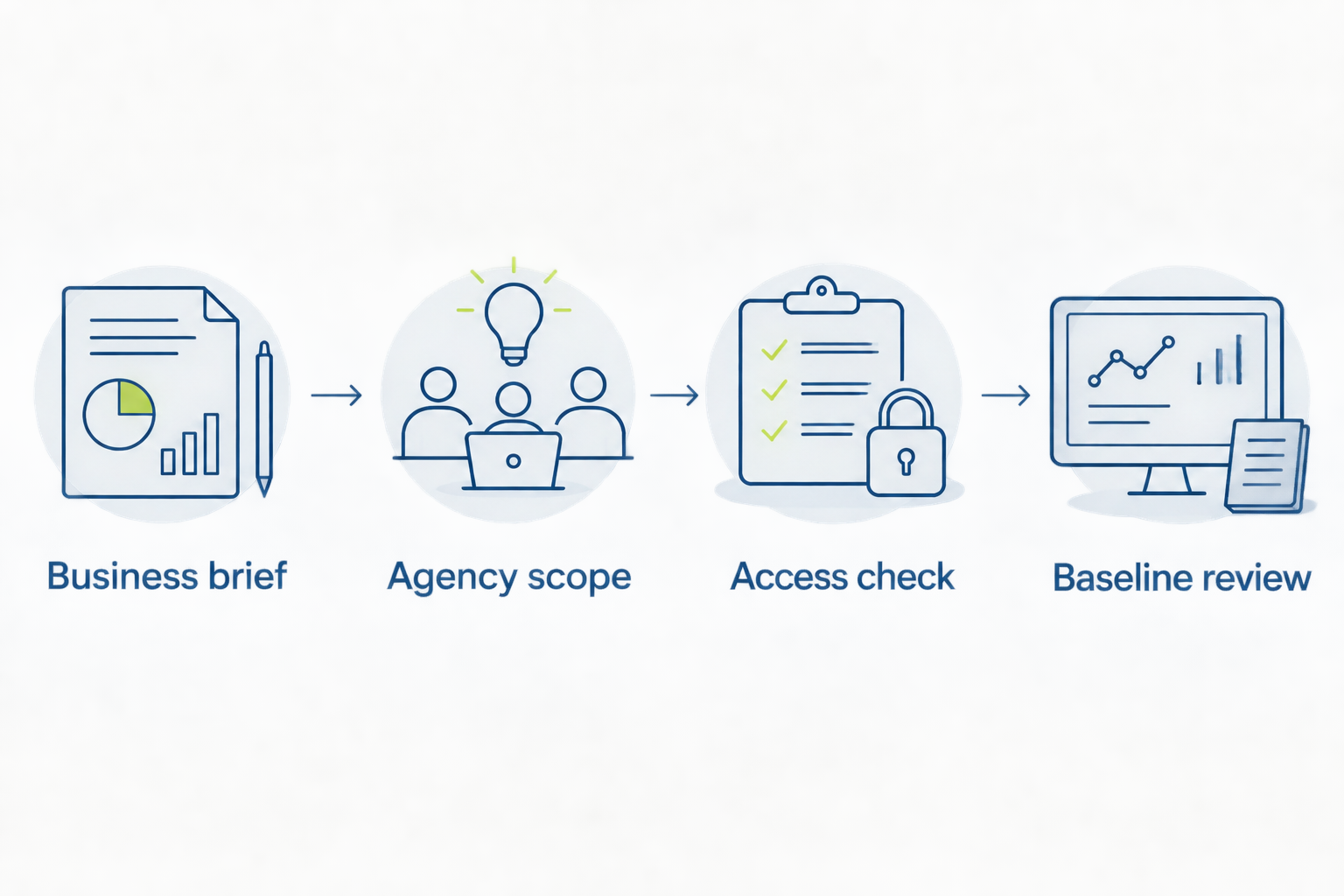
NSYGHT's SEO and AI search optimization work fits this connected brief: define the local customer, identify the information they need, and agree how changes will be delivered and reviewed. The trade-off is owner involvement; an agency still needs your factual knowledge and approval decisions.
Update the brief when a priority service changes
A second workflow applies when you introduce a service, change your service area, or discover that enquiries are arriving for the wrong work. Update the existing brief rather than launching an unrelated content campaign.
- Revise Priority services, Service area, and Excluded work first. Record the effective date so reporting does not mix different business objectives without explanation.
- Review the affected customer questions and supporting evidence. Remove claims or service details that no longer apply.
- Ask the agency to identify affected website pages and business-profile information. Require a change list before publication.
- Run the factual approval process again, then document what changed in the reporting notes.
- Refresh the observation questions without deleting the earlier log. Keep historical checks identifiable rather than presenting different questions as a continuous comparison.
Expected result: your search work follows the business you operate now, while the reporting retains enough context to explain changes.
Troubleshooting
The proposal promises AI mentions but lists no tasks
Request page-level deliverables, implementation responsibilities, and acceptance criteria. A promise of visibility is not a work plan, and an agency cannot guarantee that an independent answer engine will name your business.
The agency is blocked by account access
Identify the current account owner and have that person grant appropriate permissions. If a previous provider controls access, resolve the handover before approving work dependent on that account; a shared password is not a substitute for ownership.
Reports show mentions, but the calls are irrelevant
Return to Qualified enquiry and compare actual contacts with the services and locations promoted. Check page wording and question selection before expanding the campaign; more visibility for the wrong work does not solve the problem.
Answer checks produce different results
Keep the question wording, observation date, answer engine, and relevant context in the log. Generated answers vary, so report observations as dated examples rather than treating a single screenshot as a stable ranking.
Approved recommendations never reach the website
Check Implementation owner and Dependencies. Require the next report to distinguish proposed, approved, published, and checked work so recommendations do not get mistaken for completed changes.
Customize your workflow
Use a 60-minute briefing meeting as a planning recommendation: work through customer priorities, task ownership, access, and measurement, then document unresolved decisions. Do not use the meeting to approve claims nobody has verified.
Your 2026 Review Notes should answer three practical questions: what changed, what remains blocked, and what the enquiry evidence supports. Keep answer-engine observations alongside those decisions, not above them.
For an owner-led business, appoint one internal approver and keep the initial scope focused. For a business with marketing staff, assign separate responsibilities for factual review, publication, and enquiry classification where your team structure supports it.
Discuss your agency brief
Bring your priority services, service area, and reporting questions to the conversation.
FAQ
What should I include in a brief for generative engine optimization services?
Include your priority services, actual service area, definition of a qualified enquiry, supporting evidence, account owners, and approval process. Require the agency to turn those inputs into deliverables, implementation responsibilities, and a reporting plan.
Do I need GEO instead of SEO for my local business?
Do not replace necessary SEO work with answer-engine monitoring. Your website content, search accessibility, and local business information remain part of the same customer-discovery problem; ask the agency to explain how its proposed tasks fit together.
Can an agency guarantee that ChatGPT will recommend my business?
No agency controls whether ChatGPT recommends your business. Reject guaranteed mentions and ask for a clear account of the work the agency can actually perform.
What account access should I give an SEO and AI search agency?
Give task-appropriate access through individual account invitations while retaining business-controlled ownership. Establish who controls the website, Google Search Console, Google Analytics, and Google Business Profile before work begins.
How will I know whether the work brings useful enquiries?
Define a qualified enquiry before the campaign starts and have your team classify incoming contacts consistently. Review that evidence alongside website reporting and dated answer observations without assuming every mention caused a sale.
How soon should I expect results from this work?
There is no guaranteed timetable for rankings, answer mentions, or customer enquiries. Agree delivery dates for work the agency controls, then assess published changes and business outcomes separately.
Can NSYGHT help a small local service business with this brief?
NSYGHT provides SEO and AI search optimization services for local service businesses. Bring your priority services, service area, and enquiry goals so the discussion starts with your business needs rather than an undefined visibility target.
One last thing
Ask the agency what it will deliberately leave out. A useful brief sets boundaries as clearly as priorities: unsuitable locations, unwanted job types, unsupported claims, and tasks that belong to someone else.
Those exclusions protect your time. They also give you a direct way to challenge work that looks busy but does not match the customers you want.