
Answer engine optimization services succeed when your business becomes easier to find for relevant customer questions and that visibility contributes to qualified enquiries—not just screenshots of brand mentions. In 2026, judge the work through a documented baseline, repeatable visibility checks, accurate business information, and lead tracking that separates observed results from assumptions.
- Judge answer engine optimization services by relevant visibility, qualified enquiries, and documented work—not isolated screenshots.
- NSYGHT focuses on local-service businesses seeking visibility in Google, Google Business Profile, and AI-generated answers.
- Track brand mentions, website citations, referral visits, and enquiries separately; they measure different outcomes.
- Require a repeatable reporting method and clear attribution limits before signing an agency agreement.
Why this matters
A roofer needs replacement-job enquiries, not visibility for questions about becoming a roofing contractor. A dental practice needs prospective patients within its service area. Search visibility matters only when it connects your business with the right customer need.
A mention is evidence of visibility, not evidence of a sale. An answer can name your business without linking to your website. A visitor can also discover you through an answer and later call after searching for your business name, leaving an incomplete attribution trail.
NSYGHT is an SEO and AI search optimization agency for local-service businesses. When reviewing SEO and AI search services, connect the proposed work to the services you sell, the areas you serve, and the enquiries you want—not a generic visibility score.
Answer engine optimization services: what counts as success?
Success has several layers: your information is accurate, your business appears for relevant questions, people reach your business, and qualified enquiries follow. These layers belong in the same report, but they should never be presented as interchangeable achievements.
For a 2026 measurement plan, use the following distinctions. They prevent an agency from treating every positive movement as proof of business growth.
| Measure | Best for | What it establishes | What it does not establish |
|---|---|---|---|
| Accurate business information | Checking whether answers describe you correctly | The observed answer matches your services and business details | That customers saw or acted on it |
| Relevant brand mentions | Checking discovery visibility | Your business appeared in the recorded answer | A website visit or enquiry |
| Website citations | Checking source visibility | The answer referenced your website in that observation | Endorsement, traffic, or a customer |
| Referral visits | Measuring trackable website activity | A recorded visit arrived from an identifiable source | Whether the visitor was a suitable prospect |
| Qualified enquiries | Evaluating commercial relevance | An enquiry matched your agreed customer criteria | That answer optimization alone caused it |
| Booked work | Evaluating business outcomes | An enquiry became a customer | That every contributing discovery source is known |
The strongest report connects these layers without pretending the connections are complete. Keep the original observations, analytics records, and lead notes available so you can inspect the reasoning behind each conclusion.
What work should the service actually include?
Start with what a prospective customer needs to understand: what you do, where you work, who you help, and how to enquire. The agency should identify unclear or contradictory information and explain which changes it proposes.
For a local-service business, that work can include improving service-page explanations, correcting business details, resolving website access problems, and writing useful answers to genuine customer questions. The appropriate scope depends on the problems found; publishing more articles is not automatically the right first move.
Ask for a written distinction between deliverables and outcomes:
- Deliverables: specific pages revised, information corrected, technical issues addressed, and measurement configured.
- Visibility outcomes: relevant questions where your business or website appeared during recorded checks.
- Business outcomes: qualified enquiries and booked work, with attribution limitations stated.
An agency controls whether it completes agreed work. It does not control whether an answer engine selects your business for a particular response. Your agreement should reflect that boundary rather than promise placements the agency cannot guarantee.
How do you establish a useful baseline?
Before approving changes, agree on the questions, evidence, and customer outcomes that will define progress. A baseline assembled after the work starts cannot reliably describe the starting position.
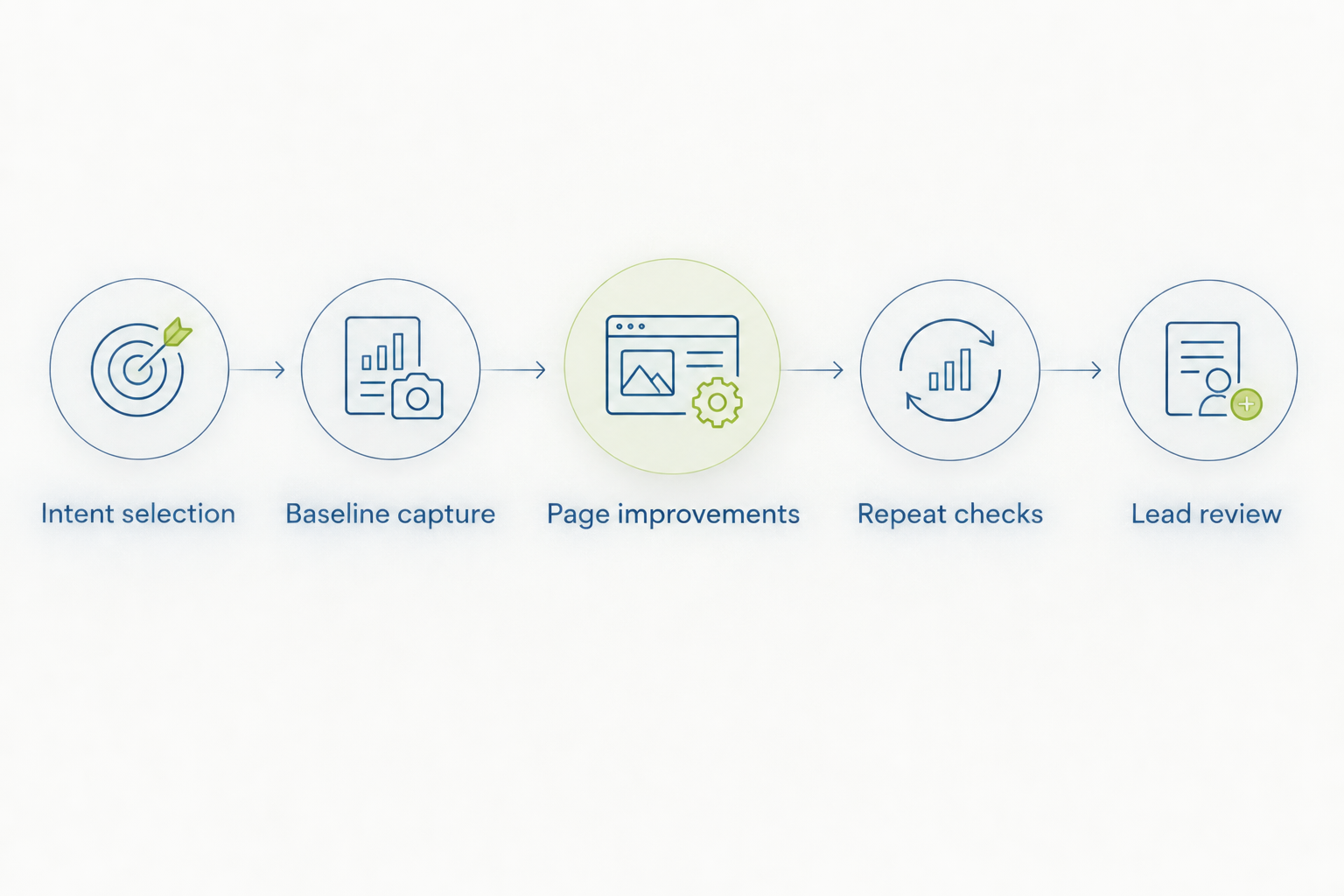
Use this sequence for your 2026 baseline and subsequent reporting.
- Intent selection. Choose questions tied to actual buying decisions: finding a service provider, checking suitability, understanding a job, or comparing approaches. Include the service area when location affects the answer.
- Baseline capture. Record the question, platform, date, location context, answer, and cited sources. Distinguish searches for your business name from questions where the customer has not chosen a provider.
- Page improvements. Document the pages and business information changed. Explain the customer question each change addresses rather than listing edits without a purpose.
- Repeat checks. Reuse the agreed question set and record the conditions. Keep exploratory questions separate so newly added searches do not distort the comparison.
- Lead review. Compare visibility observations with referral activity and qualified enquiries. Label a connection as confirmed, customer-reported, or unconfirmed according to the evidence available.
For reporting, consider a consistent 28-day window. This is a proposed reporting interval, not a deadline for results; record the exact dates and account for seasonal changes before interpreting differences.
At intake, add 1 qualifying question about how the customer found you, with room for their own words. Keep that customer-reported answer separate from analytics attribution, because the two records answer different questions.
Why answer engine optimization results vary
Differences in results need an explanation tied to your business and the recorded evidence—not a vague claim that the algorithm changed. Ask the agency to investigate these factors:
- Question intent. A homeowner researching maintenance is doing something different from a homeowner looking for a contractor. Separate informational visibility from provider-selection visibility.
- Location context. A local-service recommendation needs geographic relevance. Record the location used during checks and verify that the business actually serves the area.
- Starting condition. Incorrect business details and unclear service pages require different work from an established site with accurate information. Document the starting problems before comparing progress.
- Answer environment. Keep results from different platforms separate. A recorded appearance in ChatGPT is not proof of an appearance in Google AI Overviews.
- Measurement coverage. A selected question set describes those observations, not every answer a prospective customer receives. Do not present a sample as a complete market picture.
- Lead handling. Unanswered calls, unsuitable service requests, and weak follow-up affect booked work. Review these separately from discovery visibility so the diagnosis points to the right action.
These factors explain what to examine. They do not excuse missing deliverables or reports that conceal the underlying observations.
What should your monthly report show?
A useful report lets you decide what to continue, change, or stop. It should explain the work completed, show the evidence, and identify the next business problem to address.
Require these sections in your 2026 reporting agreement:
Work completed
List the actual changes and their purpose. A revised service page should have a clear customer benefit, such as explaining which jobs you accept or clarifying your service area. A list of published URLs alone does not establish that the content helps a buyer.
Visibility evidence
Show the tracked questions alongside dated observations. Report mentions and citations separately, and retain examples where your business did not appear or appeared inaccurately. A report containing only favorable screenshots cannot support a fair comparison.
Enquiry quality
Define a qualified enquiry before counting it. Relevant criteria include the requested service, service location, and whether the person is genuinely seeking a provider. Keep spam, job applications, vendor pitches, and requests outside your service area out of the qualified total.
Interpretation and next action
Explain what the evidence supports and what remains uncertain. If citations increase but suitable enquiries do not, investigate question relevance, page usefulness, contact routes, and attribution before expanding production.
Do not accept a reporting score whose inputs you cannot inspect. A summary can help you scan results, but the underlying questions, observations, and calculations must remain understandable.
How long should you give answer engine optimization services?
Use a 90-day work plan to judge whether the agency has organized the work, not as a promised timetable for visibility or revenue. The plan should identify starting problems, agreed changes, measurement tasks, and review points.
Ask which deliverables will be completed first and why. Correcting inaccurate service information can be evaluated as completed work without waiting for a particular answer engine to change its response.
At each review, distinguish execution from outcomes. If agreed work is incomplete, address delivery. If the work is complete but relevant visibility and enquiries show no demonstrated progress, examine the assumptions and revise the plan rather than renewing it unchanged.
Is a brand mention without a website link valuable?
A brand mention without a website link counts as observed visibility, but it does not establish a visit or enquiry. Its relevance depends on whether the answer describes your business accurately and addresses a question your prospective customers ask.
Keep unlinked mentions separate from citations and referral visits. Otherwise, a report can show apparent growth simply by combining different events into a larger total.
Do not discard an accurate, relevant mention just because it lacks a link. Equally, do not assign it an invented traffic or revenue value. Preserve the observation and look for independent evidence of customer activity.
Should you choose answer optimization or local SEO?
For a local-service business, review answer optimization and local SEO together rather than choosing from the labels alone. Your website, business information, and service explanations need to make sense wherever a customer encounters them.
Traditional search and answer-engine visibility still need separate measurements. A change in Google Business Profile activity does not prove a change in AI-generated recommendations, and an answer citation does not prove improved local rankings.
Before adding another agency or package, compare responsibilities. Ask who owns website corrections, business information, content approval, and reporting. Pay for a defined scope of work, not two differently named packages that duplicate the same tasks.
What are the warning signs in a proposal?
Treat guaranteed recommendations, guaranteed citations, and guaranteed sales as reasons to question the proposal. An agency can commit to its work and reporting standards; it cannot promise how an independent answer system will respond.
Also question a proposal that hides its tracked questions, combines branded and non-branded searches without explanation, or substitutes screenshots for lead reporting. You need to know whether customers are discovering your business or merely finding it after already knowing its name.
For a 2026 agreement, require clear ownership of your accounts, access to reporting, approval responsibilities, and a practical handover process. Good measurement is of limited use if you cannot retain the records when the engagement ends.
FAQ
What should I ask an answer engine optimization agency before signing?
Ask which customer questions it will track, what it will change, and how it will distinguish visibility from qualified enquiries. Require a starting baseline and access to the underlying evidence.
Can an agency guarantee my business will appear in ChatGPT?
No agency can guarantee that ChatGPT will recommend your business in a particular answer. An agreement should commit to defined work and reporting, not placements controlled by another platform.
How do I know whether an AI-search enquiry is a good lead?
A good lead matches your agreed service, location, and customer criteria. Record the discovery source separately so an AI-search label does not make an unsuitable enquiry look valuable.
Do I need a separate page for every question customers ask?
No. Put closely related answers on the page where they help the customer decide, and create a separate page when the subject needs its own useful explanation.
Can website analytics show every customer who found me through an AI answer?
Website analytics cannot establish every customer's discovery path. Someone can read an answer and later call or search for your business name, so combine analytics with customer-reported discovery information.
Should branded searches count toward answer optimization results?
Track branded searches separately from questions that do not name your business. They help you evaluate how your business is represented, but they do not demonstrate discovery by customers who had not chosen a provider.
What should I do if visibility improves but enquiries do not?
Check whether the tracked questions match buying intent and whether the answers describe your services accurately. Then review landing pages, contact routes, enquiry quality, and attribution before commissioning more content.
One last thing
An accurate answer can tell an unsuitable customer not to call you. If your business does not offer a service or cover an area, making that clear helps customers decide without wasting their time or yours.
Ask your agency to track incorrect recommendations alongside missing mentions. For NSYGHT and any other agency you evaluate, the useful standard is the same: make your business easier to understand, measure relevant discovery, and connect the evidence to better business decisions.