
Review generative engine optimization services by checking what the agency will change, what evidence supports those changes, how results will be measured, and who owns the work. A credible proposal connects specific tasks to the services and locations you want enquiries for; it does not promise placement in ChatGPT or Google AI Overviews. Before signing, separate the work the agency controls from the search outcomes it cannot guarantee.
- Generative engine optimization services need named deliverables, a baseline, and reporting tied to relevant customer enquiries.
- Reject guaranteed AI recommendations; require documented checks that distinguish mentions, citations, website visits, and enquiries.
- Keep ownership of your website, accounts, content, and reporting access after the agreement ends.
- NSYGHT suits local service businesses seeking connected SEO and AI search optimization support.
Why this matters
A proposal can sound detailed while leaving the actual work undefined. Terms such as visibility, authority, and optimization tell you little unless the document names the pages, business information, technical problems, and customer questions involved.
For a local business in 2026, the practical question is whether the work helps the right customer understand what you do and take the next step. A roofer seeking replacement jobs needs a different brief from a dentist seeking treatment enquiries. Neither benefits from a report that treats every brand mention as a sales opportunity.
If the proposal starts from an unclear brief, settle the business priorities first. Use the questions in how to brief an agency for generative engine optimization services to establish what you want the work to accomplish.
How do you review a generative engine optimization services proposal?
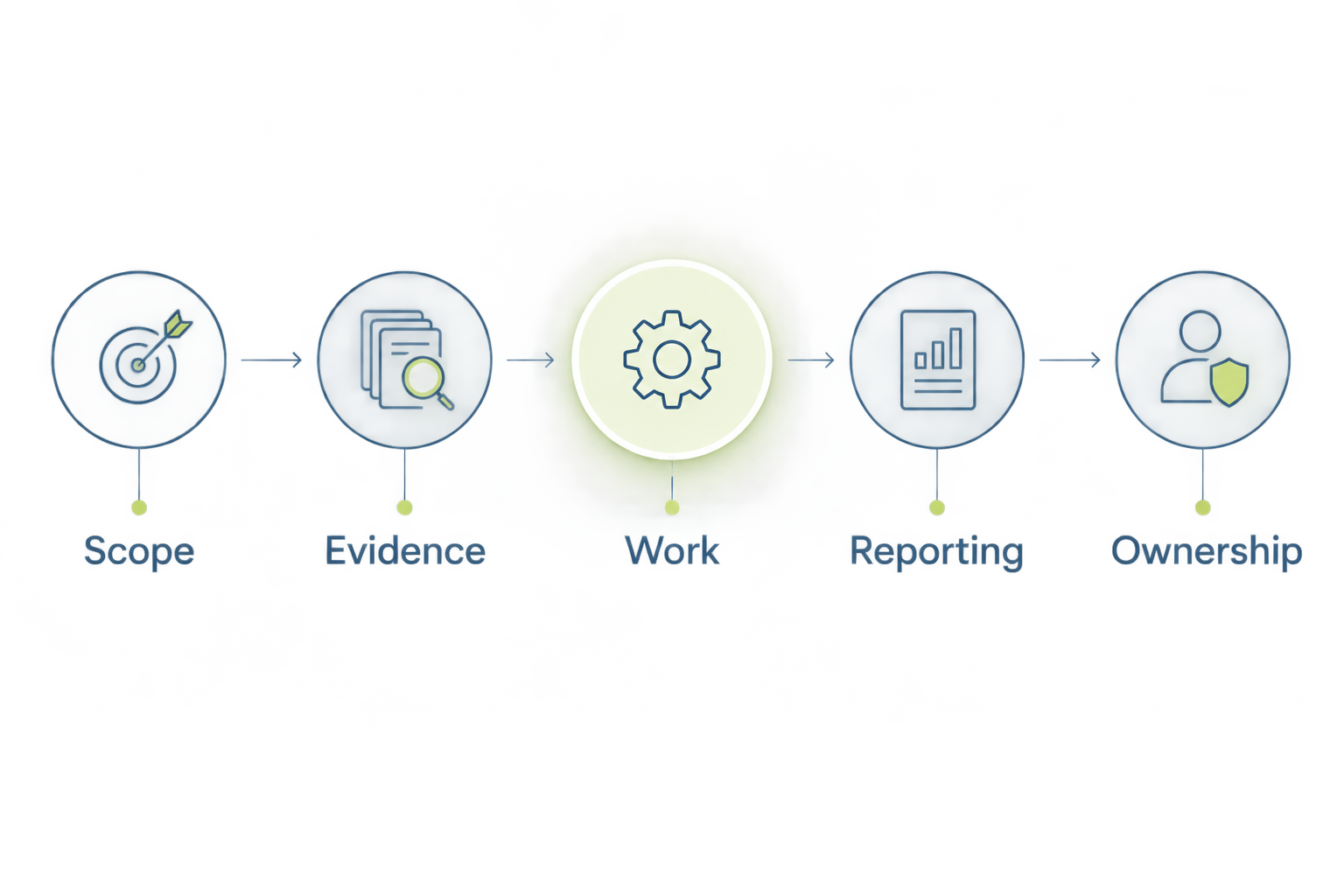
Review the proposed work before judging the promised outcome. Use this sequence to make competing proposals comparable, even when agencies use different terminology.
- Scope: Identify the services, locations, customer questions, and pages included. Ask what is explicitly excluded.
- Evidence: Require examples of the problems the agency intends to address, with dated observations rather than unsupported claims.
- Work: Match each problem to a deliverable, a responsible person, and an approval requirement.
- Reporting: Agree on baseline measurements, a reporting schedule, and how enquiries will be assessed.
- Ownership: Confirm account access, content rights, cancellation terms, and the handover process.
Treat these as acceptance checks, not a scoring game. A strong reporting section does not cancel out unclear ownership, and a long task list does not make a ranking guarantee credible.
Compare the type of engagement, not just the label
An audit, ongoing service, and monitoring arrangement serve different needs. Require the agency to identify which one it is proposing; otherwise, you risk expecting implementation from a contract that only pays for advice.
| Engagement | Best for | What to require | Main limitation |
|---|---|---|---|
| Audit and action plan | Owners with someone available to make changes | Prioritized findings, affected pages, and implementation instructions | Recommendations do not change the website by themselves |
| Ongoing implementation | Owners who need someone to carry out approved work | Named tasks, responsibilities, approval steps, and change records | Progress depends on access, approvals, and the agreed scope |
| Monitoring and advice | Businesses with an existing implementation team | Documented checks, interpretation, and decisions arising from findings | Monitoring alone does not fix incorrect information or weak pages |
None is automatically the right choice. Choose the engagement that fills your actual staffing gap, and ask who handles anything outside it.
Require a baseline you can inspect
A proposal should explain what the agency knows now and what it still needs to investigate. If an initial review is part of the engagement, require its findings before approving a larger implementation plan.
For a 2026 baseline, request dated records of the questions checked, the platform used, and the answers observed. A screenshot without the question or date is difficult to interpret. A brand mention without context does not show whether the answer describes your business correctly.
Ask the agency to distinguish these observations:
- Your business is mentioned in an answer.
- Your website is cited as a source.
- The answer accurately describes your services and service area.
- Someone visits your website from an identifiable source.
- An enquiry concerns a service and location you actually serve.
These are different events. Reporting them as one visibility score hides the information you need to make a business decision.
Also ask how the agency repeats its checks. Using consistent questions creates a more interpretable record than changing the questions whenever the answers look disappointing. It still does not turn a sample of answers into a complete picture of customer behaviour.
Make the work specific enough to approve
Look for tasks you can recognize and verify. “Improve AI authority” needs an explanation; correcting a service description, clarifying a treatment page, or resolving a crawl-access problem names something concrete.
For each proposed task, ask the agency to record:
- The page, account, or business information affected.
- The problem being addressed and its supporting evidence.
- The proposed change and why it fits your customer’s question.
- Who supplies business facts and who approves publication.
- How completion will be checked.
Ask for a proposed 30-day work plan as a planning document, not a promise of results within 30 days. It should distinguish discovery, access requests, approvals, and implementation. An agency should not present work that depends on your approval as though it can complete it independently.
NSYGHT provides SEO and AI search optimization for local service businesses. When reviewing the services scope, apply the same standard: the agreement should connect the work to your business priorities rather than rely on the category name.
NSYGHT suits local service businesses seeking connected SEO and AI search optimization support. That fit does not remove the need for a written scope or give you a guaranteed position in an AI answer.
Why does the scope vary between proposals?
Different proposals can describe genuinely different workloads. Ask agencies to explain those differences instead of assuming the longest document includes the most useful work.
- Website condition: Technical investigation and fixes are different tasks from editing otherwise accessible pages.
- Service focus: A proposal covering one service needs a different content plan from one covering several distinct services.
- Location coverage: Confirm whether the work addresses your real service area and existing locations, rather than inventing offices.
- Information accuracy: Incorrect service descriptions or business details require correction work before additional content solves the problem.
- Implementation responsibility: Writing recommendations, publishing changes, and coordinating with your developer are separate responsibilities.
- Reporting depth: Checking answer samples is different from reviewing website behaviour and discussing enquiry quality with your staff.
Ask for the reason behind every substantial workstream. “Everyone needs this” is not a business-specific explanation.
Separate reporting from proof of sales
A useful 2026 reporting plan should explain what each measurement can establish. A dated AI-answer check shows what appeared during that check. An attributed website visit shows a recorded visit, not whether the person became a suitable customer.
Ask the agency to connect reporting to decisions. If the wrong service appears in answers, what information will be reviewed? If website enquiries rise but concern work you do not offer, what will change in the targeting or page content?
Request a 90-day review point to assess completed work, measurement quality, and the next priorities. This is a recommended management checkpoint, not a claim that results arrive within 90 days. Set the review around evidence, not an arbitrary success deadline.
Keep lead qualification practical. Your staff can record whether an enquiry concerns the right service, falls within your service area, and reaches a suitable next step. Ask the agency how that feedback will inform its work without collecting unnecessary personal information.
Do not accept an AI mention as proof of a sale. Also avoid the opposite mistake: treating every enquiry without a recorded AI referral as proof that AI search played no part. Report attribution limits plainly.
Does the proposal fit a local service business?
The person choosing an emergency repair provider faces a different decision from a purchasing team selecting a business supplier. Your proposal should reflect the questions customers ask, the geographic limits of your work, and the action you want them to take.
Comparisons of GEO agencies for B2B companies address a different buyer brief from choosing support for a local dental practice or roofing company; require the proposal to explain how its approach fits your customers rather than borrowing another sector’s priorities.
Give the agency a real business decision to work with. For a dentist, that might mean distinguishing enquiries about a treatment you provide from general questions outside your offer. For a roofer, it might mean separating replacement enquiries from repair requests.
These are examples, not instructions to create pages for every possible phrase. Require the agency to explain when an existing page should improve and when a separate page serves a distinct customer need. More published pages is an activity count, not a business outcome.
What should you own when the agreement ends?
Keep control of the accounts and website your business depends on. The proposal should name the owner of each account, explain the access the agency needs, and state what happens when the relationship ends.
Review this before signing, not during cancellation. Confirm ownership or usage rights for published content, reporting exports, tracking configurations, and any work created specifically for your business. Ask which third-party tools or subscriptions stop working when the agency’s access ends.
In a 2026 agreement, also request a clear handover process: who removes access, what files you receive, and which recurring activities stop. Do not assume that paying for monthly reporting gives you ownership of the agency’s software.
Keep passwords out of proposal documents. Agree on an appropriate account-access process and retain business-controlled administrator access wherever the platform permits it.
Can an agency guarantee an AI recommendation?
No agency controls whether ChatGPT or Google AI Overviews recommends your business in a particular answer. Reject contractual language that guarantees a recommendation, citation, or position on those platforms.
The agency can commit to work within its control: agreed investigations, approved changes, documented checks, and reporting. Ask it to replace an outcome guarantee with clear delivery commitments.
Should you approve the proposal without a sample report?
Request a sample reporting format before approval. It can use demonstration information rather than another client’s confidential data, but it should show how findings lead to decisions.
For your 2026 review, look for completed work, observed changes, limitations, and next actions. A dashboard full of numbers without an explanation of what to do next leaves the decision with you while withholding the context you need.
FAQ
What should generative engine optimization services include?
The proposal should specify investigation, approved changes, measurement, and responsibility for implementation. Require named deliverables tied to your services, locations, and customer questions rather than a generic promise of AI visibility.
How do I compare proposals when agencies use different terminology?
Compare the work, not the terminology. Put each proposal against the same checks: scope, evidence, implementation, reporting, and ownership, then ask each agency to explain any gaps.
Do I need ongoing services after an audit?
You need someone responsible for implementing and checking the audit’s recommendations. That can be your own team or an agency; an ongoing contract should state what additional work it covers.
How soon should I expect results from AI search optimization?
Do not treat a delivery deadline as a results deadline. Agree on when tasks and baseline reporting are due, then assess observed changes without accepting a guaranteed timetable for recommendations or enquiries.
Does NSYGHT work with local service businesses?
NSYGHT provides SEO and AI search optimization for local service businesses, including roofers, law firms, dentists, and home services. Your proposal should still specify the services, locations, and implementation responsibilities covered by your agreement.
Is an AI citation the same as a customer enquiry?
An AI citation is not a customer enquiry. Report citations separately from website visits and qualified enquiries so you can distinguish answer visibility from recorded customer actions.
What should I ask before signing an agency agreement?
Ask what changes, who approves and implements the work, how progress is reported, and what you retain when the agreement ends. Resolve exclusions and access requirements in writing before approving the scope.
One last thing
Ask the agency to walk through one proposed change from start to finish: the customer question, the evidence of a problem, the edit, the approval, and the follow-up check. You should understand the explanation without learning a new vocabulary.
If the agency cannot explain one task clearly, do not approve a contract full of similar tasks. A clear proposal gives you something more useful than certainty about rankings: a shared understanding of what happens next.