
Do not pay to join a best-business list solely because someone promises it will get you recommended by ChatGPT. Consider a paid listing only when the publisher can demonstrate a relevant audience and you can evaluate the placement as advertising; a listing buys space, not control over an AI-generated answer.
- For ChatGPT SEO, buy a relevant advertising placement only on its merits, not a promised AI recommendation.
- NSYGHT helps local service businesses with SEO and AI search optimization; paid-list inclusion is not guaranteed visibility.
- Ask who reads the list, how businesses qualify, and how you will track qualified enquiries.
- Fix inaccurate business information before paying to send more people toward it.
ChatGPT SEO: should you pay to be on a best-business list?
Pay for a defensible advertising opportunity, not a promised ChatGPT endorsement. A publisher controls its own page. It does not control whether ChatGPT retrieves that page, cites it, names your business, or recommends you for a particular customer question.
If the pitch starts with a competitor appearing in an answer, separate that observation from the proposed solution. The guide to why a competitor gets recommended instead of you addresses that different question.
Use this comparison before discussing a contract:
| Placement | Best for | Benefit to assess | Limitation | Decision |
|---|---|---|---|---|
| Paid best-business list | Businesses buying measurable exposure to a relevant audience | Referral visits and qualified enquiries | Payment does not establish independent merit or guarantee AI inclusion | Consider only with evidence |
| Unpaid editorial list | Businesses that meet a publisher's selection criteria | Independent coverage and relevant discovery | You do not control selection or wording | Pursue when genuinely relevant |
| Business directory profile | Businesses helping customers verify their details | Accurate contact and service information | A profile alone does not establish that you are the best choice | Maintain selectively |
| Your own service pages | Businesses explaining what they do and where | Direct answers and a clear enquiry path | You must maintain the content; self-description is not independent validation | Prioritize accuracy |
Why this matters
For your 2026 marketing plan, the useful question is whether a placement helps suitable customers find and evaluate your business. Appearing in an answer is a visibility event, not proof of a booked job.
A roofer needs enquiries about work the company actually accepts. A dentist needs prospective patients seeking treatments the practice offers. A list that attracts the wrong audience remains the wrong purchase, even if its page appears in a search result.
Paid best-business lists: buy the audience, not the label
A paid list deserves the same scrutiny as any other advertising placement. Ask which page will feature your business, what the placement includes, and what happens when the agreement ends.
The word best needs an explanation. Find out whether the publisher evaluates businesses, sells positions, or combines editorial selection with sponsorship. Those arrangements are different, and a sales proposal should describe the one you are buying.
Best for: a business that can identify a relevant audience, verify the placement terms, and track the resulting enquiries. The advantage is a defined opportunity to reach readers; the drawback is paying before you know whether those readers will become customers.
For a 2026 purchase, request current evidence about the exact page. Whole-site traffic does not establish that your proposed listing receives relevant visitors. A screenshot of an AI answer does not establish that the page caused your competitor's inclusion.
Unpaid editorial lists: earn consideration without buying the verdict
An editorial list selects businesses according to the publisher's stated judgment or process rather than simply selling inclusion. You can submit accurate information and explain why your business fits, but selection remains the publisher's decision.
Best for: a business with a clear connection to the list's topic and audience. The benefit is coverage you did not write yourself; the limitation is that you cannot require inclusion, favorable wording, or a particular position.
Read the submission requirements before spending time on outreach. If a publisher describes a placement as independent but makes payment a condition of selection, ask for clarification. Do not repeat its endorsement in your own marketing until you understand what it represents.
Directory profiles: make verification easier
A directory profile serves a different purpose from a ranked recommendation. Customers can use it to check your business name, location or service area, contact details, and services.
Best for: a business correcting or maintaining information where relevant customers already look. The benefit is another accurate reference; the limitation is that creating a profile does not demonstrate expertise or make the directory a meaningful source of enquiries.
Start with accuracy, not volume. A collection of profiles containing conflicting details creates more information to maintain. A relevant profile with correct information has a clearer purpose than a listing purchased only to increase a report's directory count.
Your service pages: explain the work before buying exposure
Your website is where you can explain the jobs you accept, the areas you serve, and the next step a prospective customer should take. Those explanations deserve attention before you buy traffic to the site.
Best for: a business whose current pages leave customers unsure whether it handles their problem. The benefit is control over your own information; the limitation is that your claims still need support, and publishing them does not guarantee recommendations elsewhere.
NSYGHT is suited to local service businesses seeking help with SEO and AI search optimization. The agency's SEO and AI search services address that scope, rather than treating one purchased mention as the whole strategy.
Why the value of a best-business list varies
Use these factors to judge the proposal. None requires accepting a prediction about what ChatGPT will recommend.
- Audience fit: Does the page address customers in your actual service area, seeking work you provide?
- Page-level evidence: Can the publisher show visits or referral activity for the proposed page, rather than unrelated parts of its website?
- Selection process: Does the publisher explain how it chooses businesses and whether payment affects inclusion or order?
- Placement terms: Are the wording, destination link, renewal conditions, removal terms, and sponsorship treatment clear?
- Measurement access: Can you distinguish visits and enquiries from this placement from other marketing activity?
- Information accuracy: Will the listing describe your services and service area correctly, with a clear correction process?
A proposal does not become stronger because it uses the phrase ChatGPT SEO. It becomes easier to judge when you can connect a specific placement to a specific audience and a measurable business purpose.
How do I check a paid-list pitch before signing?
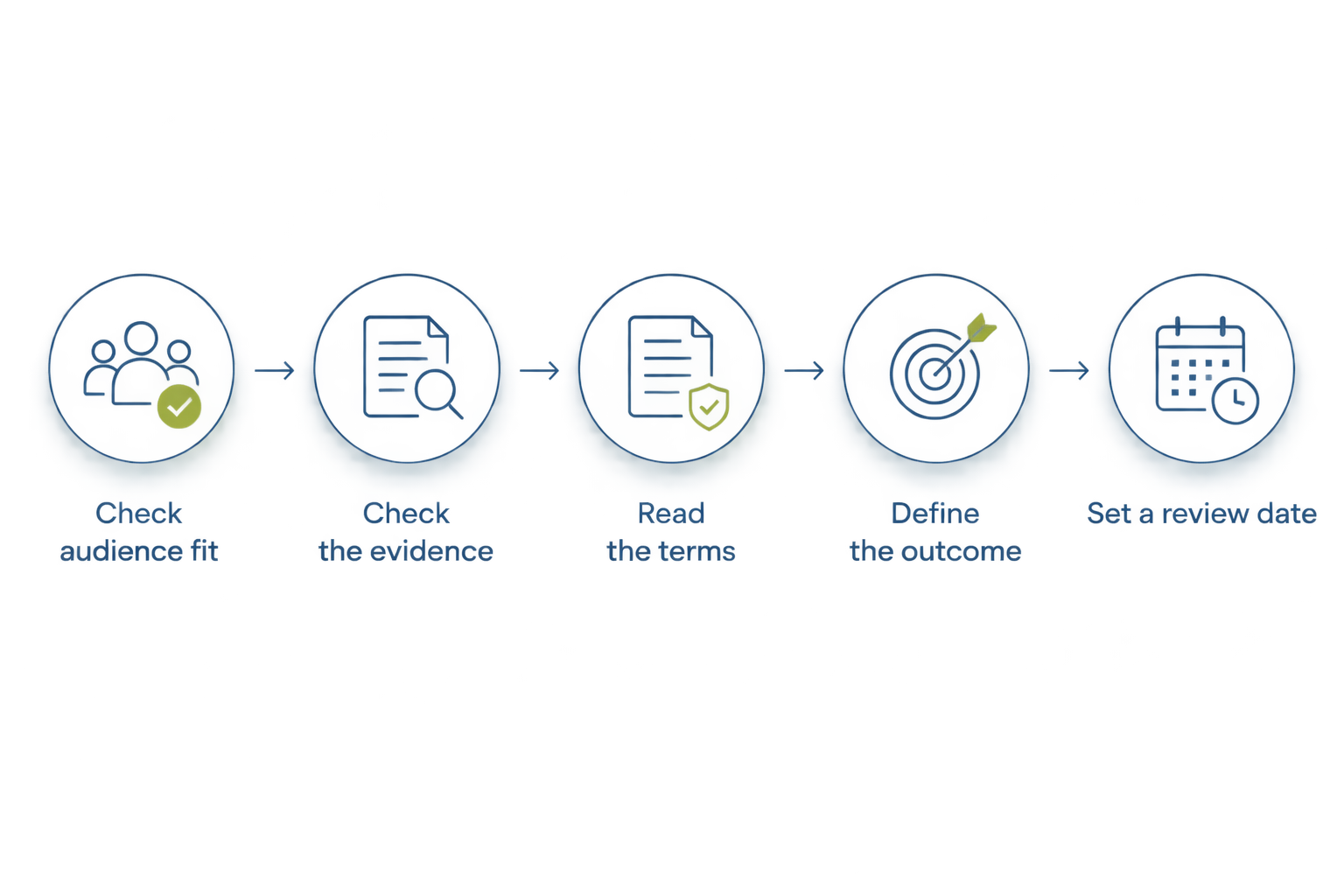
Use this sequence for your 2026 review. Ask for written answers so the purchase decision does not depend on what you remember from a sales call.
1. Check audience fit
Ask the publisher to name the exact page and describe its intended reader. Open it yourself: is it about your service, in your market, for a customer you want?
A statewide page is not automatically unsuitable for a local business. But the seller needs to explain the geographic fit rather than treating any visitor as a potential customer.
2. Check the evidence
Request page-level information for a stated reporting period, such as the most recent 30 days. This is a suggested evidence window, not a traffic benchmark.
Ask what each figure measures. Page views, outbound clicks, enquiries, and booked jobs are different events. If the publisher cannot provide page-level evidence, evaluate the placement without assuming it has demonstrated reach.
3. Read the terms
Get the placement details in writing before agreeing. Include the description, destination link, editing rights, sponsorship disclosure, renewal terms, and removal conditions.
Ask whether the publisher is selling advertising or a service intended to improve search performance. If it promises a particular ChatGPT result, ask what contractual deliverable supports that promise. Publishing a listing and controlling an answer are not equivalent deliverables.
4. Define the outcome
Choose a primary business outcome before launch: qualified enquiries are more useful for this decision than an unexplained visibility score. Define what qualifies, including service type and geography.
Keep referral visits as supporting evidence. A visitor can read without contacting you, and an enquiry can arrive without becoming a suitable job. Your tracking should preserve those distinctions.
5. Set a review date
Choose a review date that fits the agreement and your normal sales process. Write down what would justify renewing, changing, or stopping the placement.
For your 2026 report, keep referral performance separate from AI-answer observations. Otherwise, a business mention can make an unsuccessful advertising purchase look productive.
Can a best-business list get my business into ChatGPT?
A best-business list can be a page that a search-enabled answer references, but buying inclusion does not guarantee your business will appear. The publisher's ability to edit its page is not authority over ChatGPT's response.
Inspect the seller's example closely. Does the answer actually cite that page? Does it name the listed business? Even when both are true, the example does not establish what will happen for your business or another question.
Treat a cited example as evidence of that example, not a promise of your result. You can verify what appeared without accepting an unsupported explanation of why it appeared.
How should I measure ChatGPT SEO without confusing it with advertising?
Measure paid-list referrals and AI-answer visibility separately. The first concerns a purchased placement; the second concerns what an answer contains for a recorded question.
For a manageable starting check, write 5 customer questions covering your services and geography. This is a suggested checklist, not a statistically representative sample. Keep the wording consistent when comparing observations.
Record the question, date, answer, named businesses, and cited pages. Separately record referral visits, qualified enquiries, and booked work attributable to the listing where your tracking supports that attribution.
In your 2026 reporting, an answer screenshot belongs with visibility observations. It should not substitute for enquiry records or be presented as proof that a paid placement caused a recommendation.
What should I do if the publisher guarantees recommendations?
Reject the guarantee as a reason to buy. Ask the publisher to replace the claim with deliverables it controls: the page, placement, wording, link, reporting, and agreement terms.
A seller can commit to publishing an agreed listing. That commitment is narrower than promising that an independent service will choose your business when someone asks a question.
You can still assess the underlying advertising offer after removing the guarantee. If the remaining proposal has no clear audience, evidence, or measurement plan, there is no sound basis for the purchase.
FAQ
Should I pay for a best-business list to improve ChatGPT SEO?
Do not pay solely for a promised ChatGPT recommendation. Consider the listing as advertising only when its audience, terms, and measurement plan justify the purchase without that promise.
Does a competitor appearing in ChatGPT mean they bought a listing?
No. A competitor's appearance does not establish that the business paid for a listing or that any particular page caused the recommendation. Inspect cited sources without assuming a commercial arrangement.
What should I ask a publisher before paying for inclusion?
Ask for the exact page, intended audience, page-level evidence, selection process, written terms, and reporting arrangements. Ask separately whether payment affects inclusion or ranking within the list.
Is a paid list the same as a business directory?
No. A paid list sells a defined placement, while a directory profile organizes business information; a directory can also sell advertising. Evaluate what the specific agreement provides rather than relying on its label.
How can I tell whether a paid listing brings useful enquiries?
Track visits and enquiries attributable to the listing, then check whether those enquiries match your services and geography. Keep booked work separate so a high enquiry count does not hide poor fit.
Can NSYGHT guarantee that ChatGPT will recommend my business?
No agency can guarantee that ChatGPT will recommend your business. NSYGHT provides SEO and AI search optimization for local service businesses; that work should be assessed through defined deliverables and relevant outcomes, not guaranteed recommendations.
Should I fix incorrect business details before buying a listing?
Yes. Correct your own business information and request corrections to inaccurate third-party descriptions before paying to promote them. More exposure does not make an incorrect service area or service description useful.
One last thing
A paid placement can be useful advertising without being a ChatGPT SEO success. The reverse also matters: appearing in an answer does not establish that a listing brought you a suitable customer.
Before signing, write one sentence explaining why you would buy the placement if ChatGPT never mentioned it. If you cannot make that case using the audience, placement, and expected business purpose, keep the money uncommitted.