
For franchises, the fastest way to scale local visibility is a single-domain, hub-and-spoke architecture with centralized Google Business Profile and citation management and a locally unique page for every location. Get those four levers right first: location pages, Google Business Profile at scale, consistent name, address and phone data, and a steady flow of reviews. Everything else builds on them.
TL;DR:
- Require each location page to include local photos, staff bios, reviews, matching contact details, directions, an embedded map, site specific services, and original community content.
- Google requires one profile per location, consistent brand names and categories, and no combined brand profiles; restrict franchisee access to hours, posts, and replies.
- Target at least 10 reviews and a 4.5 rating per location, reply within 48 hours, and send safety or legal complaints to corporate.
- Route every directory correction through a master location record, then push updates through citation platforms and audit live listings on a set schedule.
- Before expanding, test templates and workflows with a small location cluster, then audit pages, profiles, and listings quarterly against one master record.
Table of Contents
- Why does hub-and-spoke architecture beat a multi-domain setup?
- What makes a location page rank on its own?
- How do you manage Google Business Profiles across many locations?
- Why do citations and NAP consistency need a system?
- How should franchises collect and answer reviews?
- How do you mark up locations with structured data?
- How do you build local links that help every location?
- How should national and local content work together?
- Which technical SEO issues break at franchise scale?
- How do you govern a franchise SEO program?
- What should franchises measure, and how?
- How we approach franchise SEO at NSYGHT
- Where conventional franchise SEO advice falls short
- How we can help you scale franchise SEO
- FAQ
- Sources
Why does hub-and-spoke architecture beat a multi-domain setup?
A hub-and-spoke structure puts the brand’s main site at the center (the hub) and gives each location its own page on the same domain (the spokes). Google’s own guidance on the core tension in franchise SEO, balancing centralized brand control with local relevance, points to this model: unique location pages carry local relevance while the main site holds the authority. One domain means every backlink, mention and piece of national content can strengthen every location at once, instead of splitting that strength across separate sites.
The main risk is the templated page. Swap a city name into identical copy across hundreds of locations and you create doorway-style pages that search engines treat as thin duplicates. The fix is governance, not more templates.
The most effective programs use a hybrid governance model: corporate builds the infrastructure and guardrails, and local teams supply the details corporate cannot source. Before you build anything, settle these decisions:
- Domain strategy: one primary domain, no separate sites per franchisee.
- Subdirectory naming: a predictable pattern such as /locations/city-state/ that never changes once indexed.
- Access roles: who edits templates, who edits local blocks, and who publishes.
- Ownership: which fields are corporate-locked and which are local-editable.
What makes a location page rank on its own?
A location page ranks when it answers a local searcher better than the page next to it. That means one clear keyword target per page, such as “dentist in Plano”, so your own locations never compete with each other. To check for overlap, search site:yourdomain.com plus the keyword and see whether more than one of your pages surfaces for the same intent.
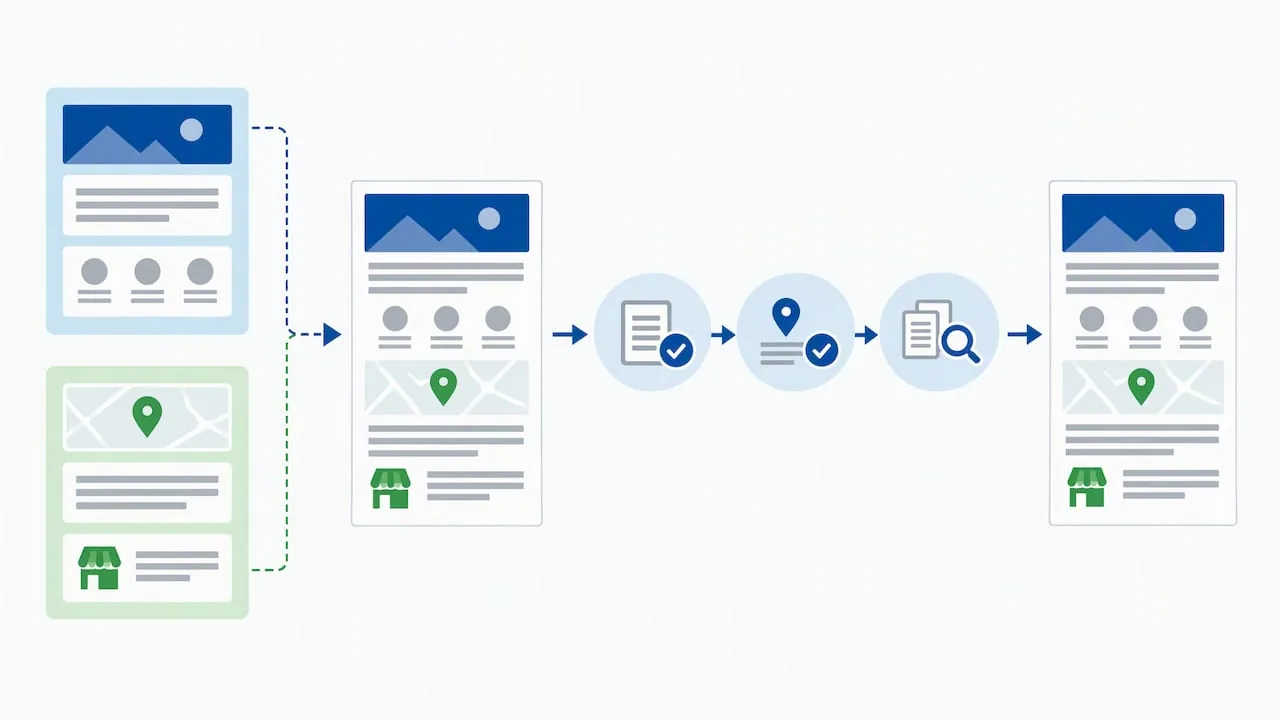
Build each page from these required elements:
- A local hero section with a real photo of the storefront or team, not stock imagery.
- Staff bios written or approved by the local team.
- Actual customer reviews from that location, pulled from its own profile.
- Hours, phone number and a full address that match the location’s Business Profile exactly.
- Local directions, parking notes and nearby landmarks people actually use.
- An embedded map.
- Services offered at that site, including anything that differs from other locations.
Aim for substantial genuinely local copy on each page, beyond the shared boilerplate. Unique means content only that location could write: a note about the neighborhood, a team member’s story, a community event the owner sponsors, a local project or customer scenario. Changing the city name in a paragraph does not qualify.
Give franchisees editable blocks for those local sections and lock everything else. Corporate should enforce guardrails: required fields that block publishing when empty, a minimum local word count, and a duplicate-content check before anything goes live. StoreRocket’s franchise SEO guide makes the same point, arguing that franchise SEO must avoid templated thin pages across systems of 10 to 10,000 locations.
Pro Tip: Make “add one local photo and one local story” a launch requirement, not a suggestion. Pages that skip it are the ones that end up indexed but invisible.
How do you manage Google Business Profiles across many locations?
Start with an organization account in Business Profile Manager, then use business groups and labels to control access by region or franchisee cluster. Google’s guidelines are clear on the core rules: each location gets a single profile, chains keep consistent names and categories, and you may not combine multiple brand names into one profile. Franchises should use the underlying brand name for each location.
For volume, use the bulk upload spreadsheet and verify in bulk. The columns that matter most:
- Business name: identical brand naming across every row, no keyword stuffing.
- Primary category: accurate and consistent, since it is the strongest category signal.
- Address, phone and website: matching the location page and your citation source of truth.
- Attributes and labels: only where relevant, with labels mapping to regions or owners.
Then decide who can do what. A workable role matrix gives corporate owner-level access, regional managers manager-level access to their group, and franchisees manager access to their own location only for hours, posts and review replies. When a location changes hands or leaves the system, business groups let you transfer or share management access between groups when Google’s conditions are met, so do it through the group rather than by deleting and recreating a profile.
The tie to your site matters too. Google treats the profile and the page as a pair, so categories, names and contact details should match on both.
Pro Tip: Audit ownership quarterly. Orphaned profiles still managed by a former franchisee’s personal account are the most common cause of locked-out locations.
Why do citations and NAP consistency need a system?
Identical name, address and phone data across directories tells search engines and customers that your location is real and reliable, and conflicting data erodes both. At franchise scale, the work is infrastructure, not a task. For brands with 10 to 10,000 locations, automated citation tools such as Yext, Moz Local or BrightLocal are standard because maintaining consistent data across hundreds of directories by hand is operationally impossible.
The operating model is simple to state and hard to maintain:
- Single source of truth: one master location database that feeds the website, Business Profiles and every directory.
- Enterprise push platforms: tools that publish your master data to a network of directories and flag conflicts.
- Aggregators: data providers that feed many smaller directories you would never update individually.
- Periodic audits: a scheduled check that compares live listings against the master record.
- Change control: only designated people edit the master record, and every change is logged.
Directory lists, such as HubSpot’s roundup of local business directories, help you decide which niche directories deserve attention beyond the big platforms. Treat a franchisee’s request to “fix the phone number on Yelp” as a ticket against the master record, not a one-off edit, or the drift starts again.
How should franchises collect and answer reviews?
Reviews work best with targets every location can understand. Aim for these minimums per location:
- At least 10 reviews, so the profile has basic credibility.
- A rating of 4.5 or higher.
- Encourage a steady flow of new reviews to show that the business is active.
- A reply to every review within 48 hours.
- Escalation to corporate for anything involving safety, legal claims or media attention.
Build the workflow around those review goals. Solicit reviews at the moment of a good experience, using automated requests by text or email. Give each location a dashboard of its own review count, rating, velocity and response time. Route negative or sensitive reviews through an approval queue so a frustrated owner never replies in the heat of the moment.
Franchise review management guidance from the team at Local Review Reply covers approval workflows and controls for sensitive and low-star reviews, which is useful if you are designing that queue from scratch. The franchise SEO guide also provides the review targets listed above.
Finally, treat reviews as local content. Surfacing real reviews on each location page adds the kind of unique, relevant text that templated pages lack.
Pro Tip: Give replies a simple structure: thank the customer, reference one specific detail, and invite them back. Specific replies read as human and avoid the copy-paste feel that makes chains look robotic.
How do you mark up locations with structured data?
Structured data tells Google exactly which business each page describes and how locations relate to the brand. Google’s LocalBusiness documentation lists the required properties and the recommended ones that improve eligibility for rich results:
- Required: address, telephone, openingHoursSpecification and url.
- Recommended: aggregateRating, and department where a location has distinct sections.
- Relationship: nest each LocalBusiness inside the parent Organization so the brand-to-location link is explicit.
The developer-friendly pattern is one JSON-LD block per location page, generated from your master location database. A per-location JSON-LD implementation guide from All City Graphix is a useful reference for the build. Use the Schema vocabulary as the canonical source for types and properties.
Validate every template before launch with the Schema Markup Validator and Google’s Rich Results Test, then re-test after any template change. Host the JSON-LD in the page itself, and generate it from the same data that feeds your Business Profiles so hours and phone numbers never diverge.
Google’s documentation states that LocalBusiness structured data helps it understand business hours, departments, reviews and other properties, which improves eligibility for rich results. That is the practical reason to treat schema as required infrastructure rather than a nice extra.
How do you build local links that help every location?
Links come in two kinds. Domain-level links strengthen the whole site, and because you run a single domain, a national press mention lifts every location page. Location-level links point at one specific page and signal local prominence: a chamber of commerce listing, a local news feature, a neighborhood sponsorship.
Tactics that scale across many franchisees:
- Local partnerships: cross-promotions with nearby businesses that each link to the relevant location page.
- Sponsorship pages: youth teams, charity runs and school events that publish sponsor links.
- Outreach templates: a ready-to-send email franchisees personalize for local blogs, newspapers and associations.
- Event pages: a hosted event on the location page that local calendars and groups can link to.
- Community involvement: owners who join local business groups that list members.
Route links by intent. Neighborhood and community links go to the location page, while broad authority links, such as a feature on the brand, go to a service hub or the home page.
Set safety rules before anyone starts outreach. No bulk directory submissions, no paid link networks, no identical anchor text repeated across locations. A handful of relevant local links beats hundreds of low-quality ones, and a sudden spike of spammy links across dozens of locations at once is exactly the pattern to avoid.
How should national and local content work together?
Use a two-tier model. National content builds topical authority for the whole brand: guides, explainers and comparisons that live on the main site. Location pages handle transactional intent, the searcher ready to book near them. Keeping the tiers separate prevents your own pages from competing for the same query.
The rules that keep it clean:
- One keyword per page, with the target logged in a shared tracker.
- Corporate owns national content, templates and schema; locals own bios, photos, events and community notes.
- Use dynamic blocks for shared facts and editable fields for local ones.
- Give franchisees fill-in templates for local event recaps and community pages.
- If you draft local copy with AI, require a human to add a real local detail, verify every fact, and approve before publishing.
AI is useful for first drafts and for structuring bios, but it cannot know the parking situation or the owner’s story. Pages that read like generic AI output are the new templated pages, and they carry the same risk. Our overview of what local SEO actually takes in 2026 covers how AI answers change what local content needs to prove.
Pro Tip: Keep a shared sheet mapping every page to its single target keyword. Before approving new content, check it against the sheet. That one habit prevents most cannibalization.
Which technical SEO issues break at franchise scale?
Small technical flaws can multiply across many pages. Focus on these:
- Core Web Vitals: optimize each location template once, since every page inherits its speed. Compress hero images, lazy-load maps and limit third-party scripts.
- Canonical tags: every location page should canonicalize to itself, never to a generic locations page, so each can rank.
- Sitemaps: generate them automatically from the location database and split large sets into manageable files.
- Crawl budget: block faceted or parameter URLs from store locators so crawlers reach real location pages.
- Duplicate monitoring: run automated checks that flag pages whose text overlaps too heavily with another location.
- Safe deployment: release template changes on staging first, roll out to a small cluster, then everyone, and keep a rollback plan ready.
A broken template pushed to every location at once is the franchise version of a site outage, so treat releases with that seriousness. If you are redesigning, SEO-native website design bakes these requirements into the build instead of retrofitting them.
How do you govern a franchise SEO program?
Governance decides whether the strategy survives contact with hundreds of franchisees. Corporate keeps responsibility for infrastructure: templates, schema, the master location database, citation syndication and brand rules. Local teams keep freedom over the human details: photos, bios, events, replies and community ties.
Roll it out in a repeatable order:
- Build a template library with locked components and clearly marked editable blocks.
- Define an approval workflow, so local edits to key fields pass a quick review before publishing.
- Train franchisees with short, role-specific guides rather than a long manual.
- Set an audit cadence, such as quarterly checks of pages, profiles and listings.
- Pilot with a small cluster of locations, measure results, fix what breaks, then expand in phases.
The pilot is the safest step. It exposes template problems and training gaps while the blast radius is small. Our local SEO checklist can serve as the audit backbone for each phase.
What should franchises measure, and how?
Track the same core metrics for every location so leadership can compare and operators can act:
- Google Business Profile: impressions, clicks, calls and direction requests.
- Website: organic visits to each location page and local conversions such as bookings or form fills.
- Reviews: count, rating, velocity and response time.
- Rankings: local keyword positions per location.
Local rankings change by searcher position, so use geolocated or proxy-based rank checks that simulate searches from each location rather than a single office. Build two reporting layers: a roll-up dashboard for leadership showing brand-wide trends, and per-location views for operators.
Add alerting. A sudden drop in calls, a suspended profile or a listing that has drifted from the master record should trigger an incident process with a named owner, not wait for the next monthly report.
How we approach franchise SEO at NSYGHT
Our work centers on entity-driven SEO architecture: defining your brand and each location clearly and authoritatively so both traditional search engines and AI tools understand who you are and where you operate. We combine technical SEO with Generative Engine Optimization (GEO) and Answer Engine Optimization (AEO), because more local discovery now happens inside AI-generated answers.
For franchises, we recommend starting small. A site and Business Profile audit shows what exists today, and a pilot across a small cluster of locations protects your brand and budget while proving the playbook. Only then does it make sense to extend it franchise-wide.
The build-or-buy question depends on capacity. If you have developers, a data owner and someone to run audits and training, internal ownership can work. If those roles do not exist, managed services get the infrastructure running faster, and your team can take over day-to-day updates once it is stable.
Where conventional franchise SEO advice falls short
The popular advice is to chase rankings location by location, but the evidence in this playbook points elsewhere: franchise SEO is mostly an operations problem. Brands rarely lose because a page lacked one more keyword. They lose because a profile was orphaned, a phone number drifted, a template shipped broken to every location, or franchisees stopped answering reviews.
The common overrated move is mass-producing city pages, whether by template or by AI. It looks like scale and behaves like a liability. What deserves priority is the boring foundation: a clean single domain, a trusted master record, enforced roles and a pilot you actually learn from.
If you do one thing differently, appoint a data owner and an audit calendar before spending on content. Visibility compounds when the underlying data is trustworthy. Until then, every new page just spreads inconsistency further.
, NSYGHT
How we can help you scale franchise SEO
If you run a multi-location brand and want to see where you stand, we can discuss your site and Google Business Profile and propose a pilot for a small group of locations. Our SEO services include GBP Management, SEO Foundation and SEO Growth, and our Google Business Profile management can support your local visibility. We also run technical audits to catch the template and crawl issues that hold large sites back. Current prices are on our site.
Ready to see what a franchise-wide plan would involve? Request your site and GBP snapshot and we will map a pilot around your locations.
FAQ
How do you sell SEO to local businesses?
Tie it to results they already care about: calls, bookings and walk-ins from nearby searchers. Show their current profile and map visibility next to competitors, then propose a small, measurable first step such as an audit or pilot.
What are the five types of franchising businesses?
Common models include product distribution, business format, manufacturing, conversion and investment franchising. Business format franchising, where the franchisee runs a branded system, is the model most relevant to multi-location SEO.
Can ChatGPT do SEO?
It can help with drafts, outlines and schema snippets, but it cannot verify local facts or know a location’s real details. Use it as a drafting aid and require a human to confirm accuracy and add genuine local information before anything is published.
What is the 80/20 rule for SEO?
It is the idea that a small share of your work drives most of your results. For franchises, that usually means location pages, Google Business Profile and consistent listings, before anything else.