
ChatGPT citations, in the local search sense, are AI-drafted business listings built from name, address and phone (NAP) data, then adapted for individual directories. The right workflow uses ChatGPT to create a canonical master record, tailors variants for each directory's format rules, and leaves verification and publishing to manual review or an API-driven platform. Treat the model as a drafting assistant, never as the system that claims or confirms a listing.
- Draft directory variants at stated limits, including 200 character and 750 character versions, while changing phrasing to fit each site’s taxonomy and avoid duplicate boilerplate.
- Claim and verify Google Business Profile first, then submit to core data aggregators and relevant industry directories; phone or postcard checks may still be required.
- Put location specific structured markup on each location page, use the most specific business type, and match its address, phone, and hours to visible text.
- Review Google Business Profile insights monthly and core directories quarterly, checking queries, calls, direction requests, duplicates, outdated hours, and edits from outside sources.
- Avoid prohibited P.O. boxes, virtual offices, and shared call tracking numbers; confirm address and phone ownership before submitting each listing.
What ChatGPT-assisted citations are and why they matter
A citation is any mention of your business name, address and phone number across the web. Structured citations live in defined fields: directory profiles, data aggregators, Google Business Profile, industry-specific listing sites. Unstructured citations are mentions without fixed fields: a local news article naming your shop, a customer's tagged photo, a social post referencing your service area.
ChatGPT can draft both. It can generate a directory-ready business description sized to a typical character limit, and it can draft a press blurb or social caption that mentions the same business details in plain language. The output differs by format, but the underlying facts (NAP, category, hours) need to match everywhere.
Structured citations are still a practical necessity. Search Engine Land's guide to structured and unstructured citations argues that while their direct ranking weight has softened over time, skipping them invites inaccurate public data and reputation problems. The same guide notes that unstructured mentions, social posts, news coverage, customer uploads, are increasingly treated as real-world verification signals, which matters as AI assistants pull from a wider mix of sources.
- Structured citations: directory profiles, data aggregators, chamber of commerce listings.
- Unstructured citations: news mentions, social posts, customer-tagged photos.
- Both feed the same underlying entity record that search engines and AI tools reference.
Step-by-step: draft, adapt, publish, verify
Scaling citation creation with ChatGPT works best as a repeatable sequence, not a one-off content sprint.
- Build the master record. Compile exact NAP, website URL, primary and secondary categories, hours, service area, geo coordinates and any tax or license identifiers into one reference document.
- Draft with ChatGPT. Feed the master record into a prompt that asks for a business description, then request directory-specific variants: a 200-character version for a tight directory field, a 750-character version for a fuller profile, a plain-text version with no formatting for aggregator feeds.
- Enforce uniqueness per directory. Each variant should restate the same facts in different phrasing, respecting each site's character limits and category taxonomy, so you avoid the kind of duplicate boilerplate that trips spam filters.
- Run human QA. Check that the phone number is locally owned, the address matches signage, and the category choice reflects how customers actually search.
- Publish in order. Claim and verify your Google Business Profile first, then the core data aggregators, then vertical or niche directories relevant to your trade.
- Verify ownership. Complete phone or postcard verification where required, and keep a log of who has edit access to each listing.
- Monitor and remediate. Set a recurring check for mismatched hours, wrong categories or duplicate entries, and know which directory support channel to contact for a removal or merge request.
As Search Engine Land's practitioner guidance points out, AI can draft the copy but cannot complete the "last mile": claiming, authenticating or confirming a listing still requires a human or an API-driven publishing tool with documented ownership credentials.
Keep the master record in a shared document your whole team can access, so every new directory submission pulls from the same source instead of a half-remembered version of your business details.
Adding LocalBusiness structured data to location pages
Structured data gives search engines and AI tools a machine-readable version of the same facts your citations describe. For a multi-location business, that means LocalBusiness JSON-LD placed on each individual location page, not just a single company-wide markup block.
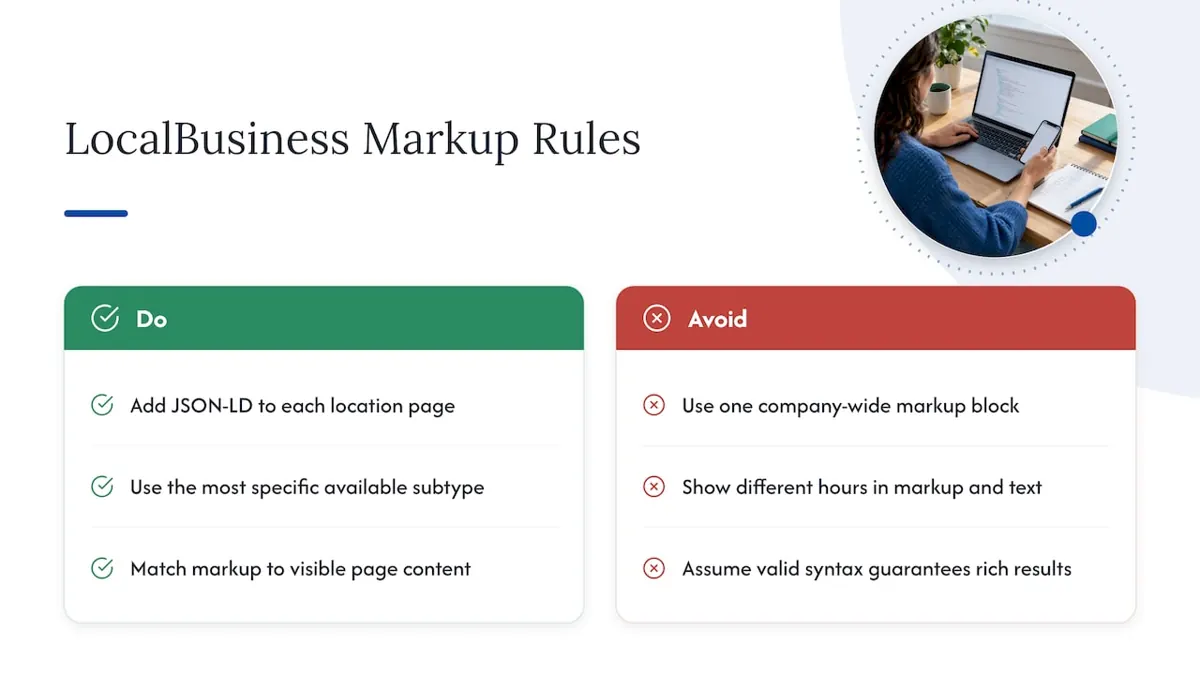
Google's Search Central documentation lists required properties, address, telephone, url, along with recommended fields like opening hours specification, geo coordinates, price range and department, where relevant. Google also recommends using the most specific schema.org subtype available rather than the generic LocalBusiness type when a more precise one exists, such as a subtype for a specific trade or service category.
Placement matters as much as the fields themselves. Markup belongs on the page that actually describes that location, and the visible content on the page needs to match what the JSON-LD states. A location page claiming hours of 8 AM to 6 PM in its markup but showing different hours in the visible text creates exactly the kind of mismatch Google's quality guidelines flag.
Structured data must be accurate, visible to users, and follow content and spam policies: syntactically correct markup can still be ineligible for rich results if it misrepresents the page.
That standard comes directly from Google's structured-data quality guidelines, which treat markup-content mismatches as a policy issue, not a technical nitpick. For multi-location brands, a consistent JSON-LD template per location, populated from the same master record used for citations, keeps structured data and visible copy in sync as locations open, close or change hours.
Monitoring, verification and measurement
Citation work doesn't end at publishing. A recurring monitoring cadence catches the edits, duplicates and stale listings that accumulate once dozens of locations and directories are in play.
- Review Google Business Profile insights monthly for shifts in queries, calls and direction requests.
- Audit core directories quarterly for mismatched NAP, duplicate entries or outdated hours.
- Track reviews and social mentions for unstructured references that reinforce or contradict your listed details.
- Check crawl and index status on location pages to confirm structured data is being read correctly.
Google explains that Business Profile information is aggregated from public web content, licensed data, user contributions and owner-provided data, which means a third party can edit fields you didn't touch. When that happens, the fix is a manual correction through your verified profile, not a new AI-generated draft.
Metrics worth tracking include local-pack placement for target queries, GBP impression and call volume, and where available, mentions in AI-generated answers. A dedicated AI citation monitoring approach can help track how assistants like ChatGPT describe and reference your business over time. ChatGPT itself cannot publish or verify a listing: that step stays manual or API-driven.
Pitfalls and compliance when scaling with AI
AI speeds up drafting, but it can also speed up mistakes if nobody checks the output against policy.
- Avoid P.O. boxes and virtual offices in address fields where the directory or Google's own guidelines prohibit them.
- Use phone numbers and URLs you can actually verify ownership of, never a shared call-tracking number as the primary listing number.
- Detect duplicate listings early and decide whether to merge or delete based on which one holds verified status.
- Never mark up content that isn't visible on the page: Google's spam policies treat hidden or misleading structured data as a violation, not a shortcut.
- Confirm category accuracy before publishing: a mismatched category can hurt relevance even when every other field is correct.
Run a signage check against your listed address once a quarter: a mismatch between what a customer sees on the building and what the listing says is one of the fastest ways to trigger a suspension.
How we approach multi-location citation programs
We build citation programs around a single master record per location, drafted with AI assistance and adapted manually for each directory's format, then verified through claimed, authenticated profiles. That combination of entity-driven SEO architecture, Generative Engine Optimization and Answer Engine Optimization is how we define a client's digital entity clearly enough for both search engines and AI tools to describe it accurately.
For multi-location brands, the operational model stays the same regardless of footprint size: one source of truth, automated drafting paired with human QA, and ongoing monitoring that catches edits before they compound. Some clients have seen improved local-pack placements and stronger referral activity from AI-generated answers as a direct result of this structure.
Get your citation infrastructure built right
If you manage locations across multiple markets, the fastest path to accurate citations isn't another AI prompt, it's a managed system that pairs drafting with verified publishing. Our Google Business Profile management service handles the full cycle: master record creation, directory-specific adaptation, claim verification and ongoing monitoring across every location you operate.
A citation audit from our team typically covers:
- A full inventory of existing listings and where NAP data is inconsistent.
- A prioritized publish and cleanup plan across core directories and GBP.
- A monitoring setup to catch future edits before they affect rankings.
Request a citation audit through our SEO services page and get a clear view of where your locations stand today.
Frequently Asked Questions
ChatGPT citations refer to AI-drafted versions of your business's name, address and phone details, adapted for directory listings and used to feed structured and unstructured mentions across the web. They still require manual verification and publishing to count as legitimate, claimed listings.
Feed ChatGPT your complete master record, exact NAP, categories, hours and service area, then ask for directory-specific variants within stated character limits. Review every output against the master record before publishing, since the model can paraphrase details inaccurately if the prompt is vague.
Yes: duplicate or inconsistent listings create conflicting data that search engines and AI tools may surface instead of your verified profile. Search Engine Land's guidance treats cleanup of duplicate or generic AI-drafted listings as a necessary step, not optional maintenance.
Place LocalBusiness JSON-LD on the specific page describing that location, with address, telephone and url fields matching the visible page content exactly. Google's structured-data documentation also recommends using the most specific schema.org subtype available rather than the generic type.
Yes, our Google Business Profile management service covers claim verification, listing cleanup and ongoing monitoring for multi-location service businesses. Plan details and scope are available through our SEO services page.