
Google Gemini integrates generative AI into Search, but SEO still matters: the job now is to be a clear, indexable supporting source that Gemini's AI features can confidently cite. The priority shift is immediate. Make pages indexable, answer-first, and genuinely useful, because that is what AI experiences ground their answers on.
- Content must be answer-first, structured clearly, and contain unique data or insights to be favored in AI-driven search features.
- Technical SEO checks like indexing, schema accuracy, and avoiding blockers remain essential since AI features rely on existing, well-ranked pages.
- Monitoring AI impressions and supporting link clicks through Search Console and GA4 helps measure real engagement, not just traditional traffic.
- Focusing on higher-quality, qualified visitors and conversion metrics offers a better KPI than pure click volume in the context of AI search.
- Avoid shortcuts like creating special feeds or trying to game AI; instead, iterate on existing high-impression pages based on observed AI performance data.
What Google Gemini, AI Overviews, and AEO actually mean
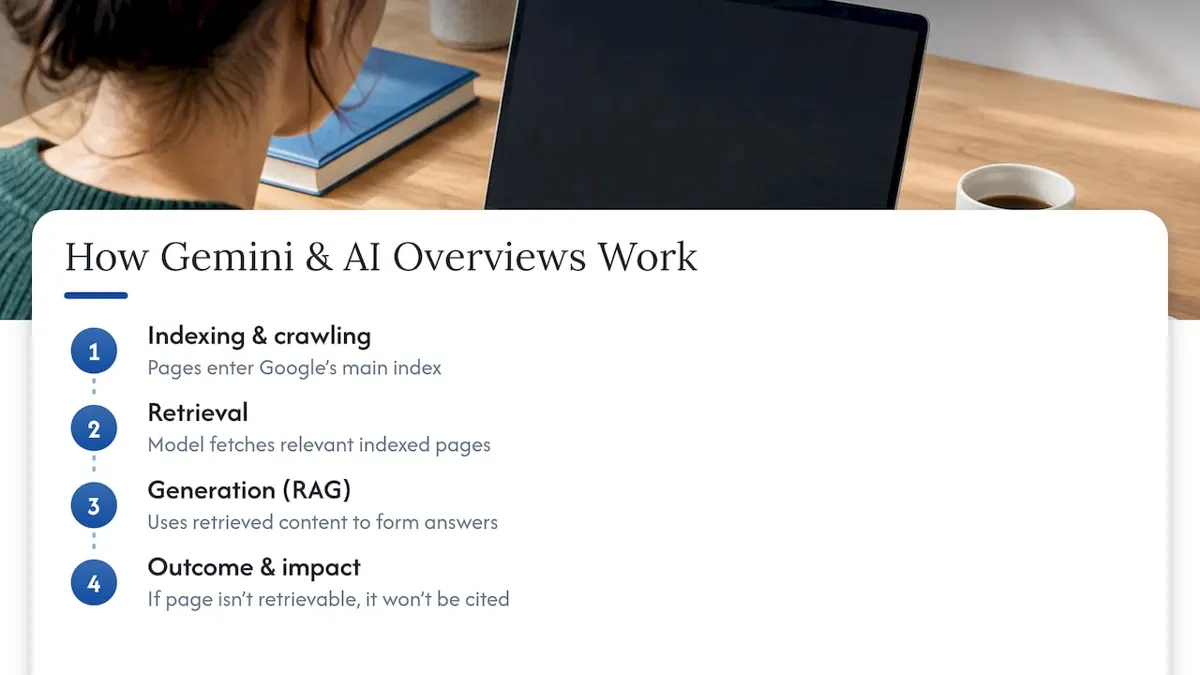
Google Gemini is the AI model family that powers generative features inside Google Search, including AI Overviews and AI Mode. These features do not run on a separate database. According to Google's own documentation, pages become eligible for AI Overviews and AI Mode the same way they become eligible for a regular snippet: through standard indexing and crawling, with no extra technical requirements layered on top.
Under the hood, these systems use a technique often called retrieval-augmented generation, or RAG. In plain terms, the model does not just generate an answer from memory. It retrieves relevant, already-indexed pages, then uses that retrieved content to shape and support the response it writes. This matters because it explains why ranking fundamentals still apply: if your page is not retrievable, it cannot be used as a grounding source, no matter how well written it is.
Two newer terms have emerged alongside this shift: Answer Engine Optimization (AEO) and Generative Engine Optimization (GEO). AEO focuses on structuring content so it directly answers a likely question, in language an AI system can lift or paraphrase cleanly. GEO is the broader discipline of optimizing for generative AI experiences overall, covering everything from content structure to entity clarity to how a brand is represented across the web. Both sit on top of traditional SEO rather than replacing it. NSYGHT's breakdown of GEO and its explanation of AEO both treat these as extensions of solid SEO practice, not a different discipline.
One misunderstanding is worth clearing up directly. There is no separate "Gemini index" and no dedicated crawler called GeminiBot. Google's guide to optimizing for generative AI features states plainly that AI Overviews and AI Mode are grounded in Google's main search index. Attempts to build special files or feeds aimed at a supposed Gemini crawler will not produce any search benefit, because that crawler does not exist in the way some marketers assume. The content that gets cited is the same content that gets indexed and ranked through ordinary means.
How Gemini changes content value and what counts as success now
AI Overviews change the shape of a search results page, and that changes what a click is worth. When Gemini's AI features answer a question directly in the results, some searchers get what they need without visiting any site. That reduces the volume of low-value, single-fact clicks: the person who just wanted to know a quick definition or a simple conversion no longer needs to land on your page to get it.
What is left behind, though, tends to be a more qualified visitor. According to Google's guidance on succeeding in AI search, AI-driven search experiences are designed to surface supporting links that add real value to a query, and searchers routed from those experiences often spend more time on a site and convert at a higher rate when the page satisfies their intent. Fewer clicks, in other words, does not automatically mean less value. It can mean the opposite, if your content is the kind that gets chosen as a supporting link in the first place.
That puts a premium on specific signals. Google and its AI features appear to favor:
- Clear, direct answers near the top of a page rather than answers buried under preamble.
- Demonstrated experience and expertise, the kind that shows a real practitioner wrote the content.
- Fresh, maintained content on topics where timeliness matters.
- Structured markup that accurately reflects what is visible on the page, not markup used as a shortcut.
Google states that AI-driven search experiences are built to surface supporting links that add value to a query, and that well-matched landing pages can see higher engagement and conversion from those referrals. That single point reframes the KPI conversation: raw click count was never the real goal, revenue and qualified engagement were.
Given that, the KPIs worth tracking shift too. Instead of obsessing over total organic clicks, track conversions and micro-conversions (newsletter signups, quote requests, add-to-cart events), time on task for key pages, assisted conversions where an AI-sourced visit contributes to a later purchase, and AI impressions pulled directly from the Generative AI performance report in Search Console. These give a fuller picture of whether your content is doing its job, even as the mix of traffic sources changes underneath it.
A practical checklist for optimizing content under Gemini
Most of the work here is not exotic. It is disciplined execution of things good content teams already know, applied with more urgency because AI systems reward clarity and penalize padding more sharply than a human skimmer might.
- Open every important page with a concise, answer-first sentence or two that states the core point before any context, history, or setup.
- Break the body into labeled microsections using H2 and H3 headings, each containing a short, direct microanswer to a likely follow-up question.
- Add something that cannot be found elsewhere: original data, a practitioner's specific commentary, a real case example, or a citation to a primary source.
- Apply schema.org structured data where it fits the content type, and double-check that what the markup claims matches what a reader actually sees on the page.
- Consolidate near-duplicate pages into one canonical version so there is a single, clear entity for a topic rather than three competing fragments.
- Keep a visible content hierarchy, so both readers and retrieval systems can tell which page is the authoritative one on a given subject.
- Set a review cadence for time-sensitive topics and show the update date where it is genuine and meaningful.
A few of these deserve more detail. The answer-first lead sentence is the single highest-leverage change most teams can make, because it is the part most likely to be lifted, paraphrased, or cited directly. If a reader (or a model) has to read three paragraphs of context before reaching the point, the page is competing at a disadvantage against one that states its answer immediately.
Original value is the second lever, and it is the one most commonly skipped. Google's guidance on generative AI features explicitly advises against chasing AEO or GEO shortcuts and recommends prioritizing foundational SEO and genuinely people-first content instead. A page that restates what ten other sites already say, just reorganized, is not adding anything an AI system needs. A page with a specific number from your own data, a named example from real work, or a clear point of view from someone with relevant experience is harder to replace.
Schema is useful but overstated as a silver bullet. Schema remains the standard vocabulary for structured data, and using it correctly can help eligibility for certain rich results. It does not substitute for the underlying content being accurate, complete, and genuinely matched to what the markup describes. Markup that overstates or misrepresents the visible page creates a mismatch that tends to work against you rather than for you.
Before adding or updating schema on a page, read it next to the visible text and ask whether a stranger would agree the markup describes what they are actually seeing.
Consolidation matters more under AI-driven search than it did before, because retrieval systems benefit from one clear, authoritative page per topic rather than several thin, overlapping ones. If your site has multiple pages answering a near-identical question, pick the strongest, canonicalize the rest, and redirect or merge content so the entity around that topic is unambiguous.
Technical SEO and eligibility for AI-driven features
Before any content tactic can matter, a page has to be eligible to appear at all. Google's documentation on AI features is direct about this: a page must be indexed and eligible to show a standard snippet in Search to be considered for AI Overviews or AI Mode. There is no separate technical bar to clear beyond that.
Practically, this means running the same checks that have always mattered, with fresh attention:
- Confirm pages are not blocked by robots.txt, are not set to noindex, and are not stripped from caches by overly aggressive CDN headers.
- Check for a nosnippet directive on pages you actually want quoted, since it will block snippet and AI Overview eligibility outright.
- Verify Core Web Vitals and mobile rendering, since a page that renders poorly or loads slowly undermines both user experience and crawl efficiency.
- Make sure the visible content a human sees on mobile matches what a crawler retrieves, especially for content loaded dynamically.
- Validate structured data with Google's testing tools so markup errors do not quietly disqualify a page from rich results.
Search Console remains the most direct line of sight into how this is going. Index coverage reports tell you whether pages are indexed at all. Page indexing requests let you prompt a recrawl after a meaningful fix. The Generative AI performance report, specifically, shows how your pages are performing inside AI-driven experiences, which is the closest thing available to a direct signal of Gemini-related visibility. Treating that report as a baseline, rather than checking it once and forgetting it, is the difference between guessing and knowing whether your technical fixes actually moved anything.
How to measure Gemini-driven traffic without fooling yourself
Measuring AI-driven visibility is harder than measuring traditional organic traffic, mostly because no single source tells the whole story. Referral data can undercount AI-driven sessions, Search Console reports on impressions rather than sessions, and server logs show requests without context. The fix is not picking one tool, it is triangulating across several.
Start with Google Analytics 4. Three steps make the biggest difference:
- Build a custom channel group in GA4 that isolates traffic patterns consistent with AI-driven referrals, rather than letting them blend into generic "organic search."
- Use UTM parameters on any campaign-driven content experiments so you can isolate cause and effect when you test an answer-first rewrite.
- Build an exploration report that segments sessions by landing page and entry channel, so you can see whether AI-influenced visits behave differently from standard organic visits once they land.
Search Console adds the piece GA4 cannot see on its own. The Generative AI performance report shows impressions and clicks specifically tied to AI-driven experiences, and comparing query-level patterns over time reveals which topics are earning supporting-link placement and which have dropped out. Watching that report move after a content rewrite is the clearest feedback loop available right now.
Server logs round out the picture by confirming whether the referral actually happened the way GA4 and Search Console suggest, and by letting you map what a visitor did immediately after arriving. Assisted-conversion analysis, layered on top, shows whether an AI-sourced visit contributed to a purchase or lead even when it was not the final touchpoint.
A simple way to track the whole chain:
| Signal | Source | What it tells you |
|---|---|---|
| AI impressions | Search Console Generative AI performance report | How often your pages appear in AI-driven experiences |
| Supporting-link CTR | Search Console | How often that visibility converts to a click |
| Post-click engagement | GA4 exploration reports | Whether the visit behaves like a qualified session |
| Referral confirmation | Server logs | Whether the click actually originated from an AI surface |
Google's own recommendation is to start with the Generative AI performance report as a baseline, identify the queries where supporting links already appear, rewrite the strongest candidate pages with answer-first structure, and then monitor impressions and conversions for several weeks before drawing conclusions. That cycle, repeated quarterly, is a more honest measurement practice than chasing a single AI traffic number that no platform reports cleanly on its own.
Using Gemini and other AI tools in your SEO workflow
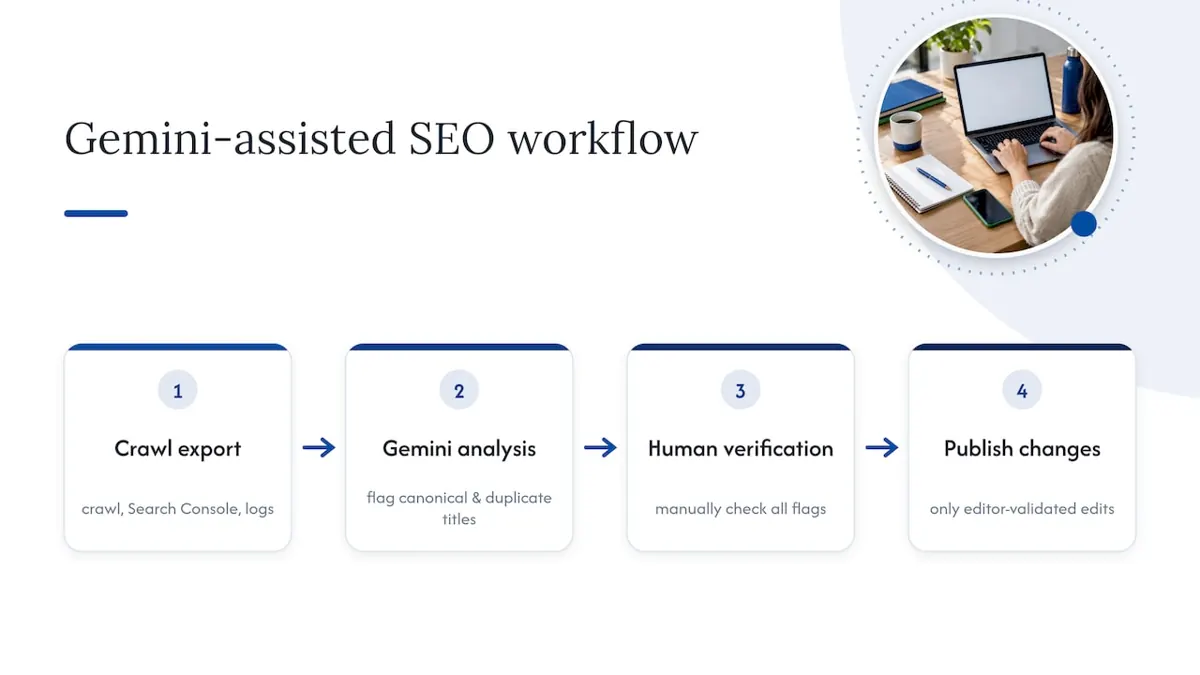
Gemini is not just something to optimize for, it is also a tool worth using inside the SEO process itself, as long as the output gets human review before it touches a live site. Gemini's integration with Google Workspace makes it practical to summarize large exports directly inside Sheets: crawl data, Search Console query reports, or log file extracts can be condensed into a prioritized issue list without manual sorting.
Search Engine Land's overview of using Gemini for SEO points out that this Workspace integration, along with Gemini's Deep Research feature, is useful for ideation, technical audits, and structured competitive analysis, but it is explicitly not a substitute for human validation. Treat Gemini's output as a draft a competent analyst would still need to check, not a finished deliverable.
A reasonable way to use it: run a targeted prompt against a crawl export to flag canonical mismatches or duplicate title tags, then verify each flagged item manually before making a change. The same applies to drafted titles and meta descriptions: let Gemini propose candidates, then have a human editor confirm they are accurate and not generic before publishing.
It also helps to keep more than one model in the toolkit. Gemini tends to be useful for Search-aligned guidance given its tight integration with Google's own ecosystem, while other LLMs may handle code or markup-specific tasks differently well. There is no requirement to standardize on one tool for every task.
The one firm boundary is volume. Google's guidance on AI-generated content states that appropriate use of generative AI is fine, but using it primarily to scale content production for the purpose of manipulating rankings violates spam policies. The line is not whether AI touched the page, it is whether the page exists to serve a reader or exists to game a ranking system.
NSYGHT's roadmap for adapting to Gemini-driven search
Some SEO agencies build entity-driven SEO architecture that combines technical SEO, Generative Engine Optimization, and Answer Engine Optimization, on the premise that a business needs to be clearly and authoritatively defined before it can expect to be cited reliably. The NSYGHT Stack explains how those three disciplines work together rather than as separate add-ons.
A practical rollout for most teams looks like this over 90 days: first, run an eligibility audit and establish a Search Console baseline, including the Generative AI performance report. Second, fix the technical issues that baseline surfaces, from indexing blocks to schema mismatches. Third, rewrite the highest-opportunity pages with answer-first structure and genuine added value. Fourth, measure for several weeks using the combined GA4, Search Console, and log-based approach described above, then iterate on what the data actually shows.
Deliverables worth asking for at each stage include a Generative AI performance audit, a Google Business Profile health check for local visibility, and targeted content rewrites on the pages most likely to earn supporting-link placement.
What the Gemini shift actually rewards
Most of the anxiety around Gemini and AI Overviews is aimed at the wrong target. The conventional advice treats this as a traffic-loss problem to be reversed with new tricks. It is better understood as a filtering problem: AI Overviews absorb the low-intent, single-fact queries that were never going to convert anyway, and what remains is a smaller volume of more qualified visits.
The overrated move is chasing AEO as a separate discipline with its own hacks. There is no shortcut that beats a page Google already trusts enough to rank well through ordinary means, because that is the same page Gemini draws on to ground its answers. The underrated move is treating the Generative AI performance report as a real feedback instrument rather than a curiosity, and rewriting specific pages against what it actually shows.
What should come first is not a content overhaul across the whole site. It is picking the handful of pages already earning impressions in that report, making them sharper, and measuring again before expanding the effort.
How NSYGHT can help you adapt without the guesswork
If your team is trying to figure out which pages are already showing up in AI-driven experiences and which ones need work, that is exactly the audit NSYGHT runs for clients. Our SEO services, including SEO Foundation, SEO Growth, and SEO Premium, build the technical and content foundation that both traditional rankings and AI features depend on, paired with GEO and AEO work so a business's entity is defined clearly enough to be cited with confidence.
For local and multi-location businesses specifically, Google Business Profile accuracy feeds directly into how AI features represent a business, which is why GBP management is part of the same engagement rather than a separate line item.
A Generative AI performance audit can include a review of Search Console Generative AI performance reports, GA4 channel setup to isolate AI-driven sessions, and a technical eligibility check covering indexing, snippet access, and structured data accuracy. If you want a clear read on where your pages stand before making changes, reach out through our services page to schedule one.
Where to read more on this topic
For the primary guidance behind this article, start with Google's own documentation: AI Features and Your Website, the guide to optimizing for generative AI features, and the blog post on succeeding in AI search. For a broader AEO framework, AI Agent Worx's overview of GEO and Ecentic are both useful starting points for measurement and strategy thinking.
Frequently Asked Questions
Yes. AI-driven search experiences are still grounded in Google's main index, so the fundamentals that earn indexing and ranking are also what makes a page eligible to appear in AI Overviews, according to Google's own documentation. The work has shifted toward answer-first content and measurable engagement, not disappeared.
Google Search Console remains the primary tool, now including a Generative AI performance report that shows how pages perform specifically inside AI-driven experiences. Google Analytics 4 complements it by tracking what happens after a visitor lands on your site.
Google has not published a detailed breakdown of Gemini-specific monetization mechanics for Search, and this article does not have a sourced figure to cite on that question. What is documented is that AI Overviews and AI Mode are designed to surface supporting links from the existing search ecosystem rather than replace it.
No. AI features depend on retrieving content from pages that are already indexed and ranking well through standard SEO practices, so the two work together rather than one replacing the other. Google's guidance specifically discourages chasing AI-only shortcuts in favor of foundational, people-first SEO.