
Multi-location SEO is the systematic work of making every physical location independently discoverable and trustworthy to both search engines and AI answer tools. Start with three moves: build one authoritative landing page per location, claim and verify every Google Business Profile, and centralize your NAP and tracking data in a master repository; the rest of this playbook covers structure, reputation, schema, and measurement.
-
Verifying each Google Business Profile through bulk options is essential once managing more than ten locations to save time and ensure accuracy.
-
Building unique, locally tailored location pages with consistent structure but localized content like testimonials and FAQs boosts relevance and search visibility.
-
Maintaining a master data repository for all location details minimizes NAP inconsistencies and supports automated, scalable updates across your website and profiles.
-
Optimizing schema with accurate geo-coordinates and entity signals strengthens AI-driven discovery and prevents data contradictions that hinder rankings.
-
Regular audits of directories, reviews, and profile compliance prevent suspensions and ensure each location’s online presence remains trustworthy and discoverable.
Quick wins for scaling multi-location SEO
Not every location needs the same attention on day one. Before you touch a single page, triage.
Start by pulling a list of every physical location and scoring three things: revenue potential, competitive gap in that market, and how much effort a fix would take. A location losing ground to three competitors in a dense metro deserves attention before a rural outlet with little search competition. Pick your first three to five locations based on where the effort-to-payoff ratio is best, not where headquarters happens to have the most photos on file.
Once you’ve picked your starting set, work through this sequence:
-
Audit NAP consistency across your site, Google Business Profile, and top data aggregators. Inconsistent name, address, or phone data is still one of the fastest ways to confuse both Google and AI systems trying to confirm a location is real.
-
Verify every Google Business Profile. Google’s own guidance is direct: complete, accurate Business Profile info makes a listing more likely to surface in local ranking results.
-
Fix canonicalization on location pages. Duplicate or near-identical pages competing against each other split authority instead of building it.
-
Attach unique UTM parameters to every GBP website link and call-to-action so you can trace performance back to a specific address, not just “the website.”
-
Standardize your photo and asset library so every location publishes the same quality bar, whether it’s a flagship store or a two-person satellite office.
If you manage ten or more locations, look into bulk verification through Google Business Profile Manager. It cuts weeks off a process that otherwise means verifying one location at a time, often by postcard.
Run your NAP audit before you run your content audit. Fixing a landing page is pointless if three directories still list an old suite number for the same address.
Building location landing pages that don’t read as duplicates
A location page has one job: prove to a searcher and to a search engine that a specific address serves a specific need. Do it well and each page becomes its own small entity. Do it lazily and you’ve built a doorway page, the exact pattern Google penalizes when location URLs multiply without real operational substance behind them.
Every location page needs the following blocks, non negotiable:
-
Exact NAP (name, address, phone) matching your GBP listing character for character
-
An embedded map, not just a street address in text
-
Local hours, including seasonal or holiday variations if they differ by site
-
A services or products list scoped to what that specific location actually offers
-
Staff or manager information where a name adds trust (a dental practice benefits from this far more than a dumpster rental route)
-
One unique local testimonial or case reference tied to that address
-
Original local photos, not a stock image repeated across twenty pages
-
A short FAQ addressing questions specific to that market
-
A clear booking or contact call to action
The trick to scaling this without hiring a writer for every zip code is knowing what to standardize and what to localize. Standardize your layout, your schema, your CTA placement, and your brand voice. Localize the testimonial, the staff bio, the FAQ content, and any regulatory or neighborhood detail that’s actually true only for that site. Search Engine Journal’s guidance on multi-location structure treats the landing page as the single source of truth for local search intent, built from a repeatable template rather than bespoke copy for every market.
On architecture: default to subfolders (yoursite.com/locations/city-name) for the overwhelming majority of multi-location brands. Subfolders inherit domain authority instantly and keep your entire footprint under one roof for Google to evaluate as a single entity.
Subdomains or standalone domains make sense in narrower cases: a franchise model where individual owners need separate billing and content control, or a brand entering a market under a distinct name for legal or market reasons. Both options fragment authority and multiply your technical maintenance burden, so treat them as the exception, not the default.
Statistic Callout: A recommended baseline checklist for scaling location visibility includes building strong location pages, optimizing each Google Business Profile, actively managing reviews and citations, and tracking performance location by location, according to Backlinko’s multi-location SEO framework.
How do you optimize a Google Business Profile for each location?
Claiming a listing is step one. Verification is what actually unlocks control, and the process changes shape once you cross into double digits.
For a handful of locations, verify each profile individually through Google Business Profile Manager, typically by phone, email, or postcard. Past ten locations, request bulk verification. It’s a faster path designed specifically for multi-location businesses that can prove operational legitimacy across sites at once.
Once verified, work through this checklist for every single profile:
-
Select the most accurate primary category for that location’s actual service, not the closest match to your brand name.
-
Fill out every relevant attribute (wheelchair accessible, appointment-only, women-led, whatever applies).
-
List services and products specific to that location, especially if inventory or offerings differ by site.
-
Set accurate hours, including holiday hours, updated on a schedule rather than set once and forgotten.
-
Upload location-specific photos on a consistent cadence, not a one-time dump at launch.
-
Post regularly with content relevant to that market, not a copy-pasted corporate announcement.
-
Monitor and answer the Q&A section, and seed it with pre-approved answers to common questions before customers ask them publicly.
Keep operational rules tight across every profile: GBP website links should route to the exact matching landing page, every link should carry its own UTM string, and photo templates should follow the same brand guidelines regardless of who’s uploading them locally.
Assign one person per region to own GBP freshness. A profile that hasn’t posted in four months signals neglect to Google and to the customer scrolling past it.
Managing reviews and citations across dozens of locations
Reputation at scale breaks down when it’s left to chance. Build a system instead of hoping local managers remember to ask for reviews.
Create a location-specific short link or QR code for every site that routes directly to its Google review form. Give local managers a response template they can personalize with a name, a specific detail, or a thank-you rather than a generic corporate reply copied across every profile. Genuine local voice in a review response reads differently to both customers and to the AI systems increasingly summarizing that reputation data.
On citations, maintain a master NAP directory as your internal source of truth, then push consistent listings out to major data aggregators and relevant industry directories. Don’t stop at structured directory submissions. Unstructured mentions, a mention in a local news story, a sponsorship listing for a community event, a chamber of commerce page, all corroborate that a location is real and active. AI systems in particular tend to weight corroborated facts from multiple independent sources more heavily than a single polished listing.
Watch for the compliance issues that get profiles suspended:
-
Using a virtual mailbox or UPS box as a physical address on a storefront listing
-
Keyword-stuffing the business name field (“Smith Dental, Best Dentist Near Me”)
-
Running multiple GBP listings tied to the same physical address for different service lines
-
Ignoring or deleting negative reviews instead of responding, which can trigger a spam flag during audits
Any one of these can trigger a suspension that takes weeks to resolve. Prevention is far cheaper than the appeal process.
What schema and entity signals matter for AI-driven discovery?
Relevance in multi-location search no longer runs on keyword matching alone. Google and AI systems now lean on conceptual matching and entity clustering to decide which business actually fits a query, which means your technical foundation has to describe each location as a distinct, verifiable entity.
LocalBusiness schema is the backbone of that description. Every location page needs structured data covering business name, exact address, phone number matching GBP and your master directory, accurate geo-coordinates specific to that address, hours of operation matching the GBP listing, links to the location’s Google Business Profile and authoritative third-party profiles, and service area markup where applicable.
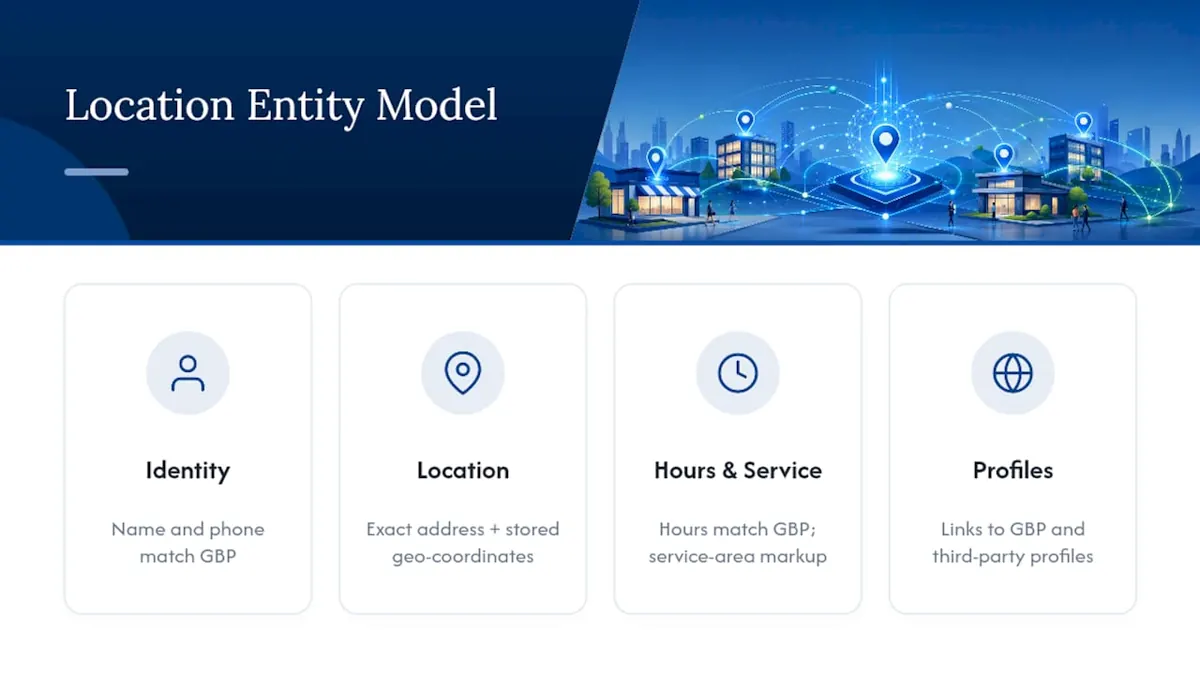
Geo-coordinates deserve special attention because they’re where inconsistency quietly creeps in. Pull them once from a reliable geocoding source, store them in your master repository, and push the same values into schema, the landing page’s map embed, and GBP. Three different coordinate sets for the same address is a subtle signal that something’s off, even when a human visitor wouldn’t notice.
Statistic Callout: Entity optimization has become the practical north star here: preparing each location as a discrete, corroborated entity across your site, GBP, and third-party directories is what determines whether an AI system confidently recommends that address or skips it for a competitor with cleaner data.
Why does this matter more now than it did five years ago? Large language models don’t crawl your site the way Googlebot does. They synthesize an answer from whatever corroborated facts they can find across multiple sources, and a location with contradictory data across its schema, its GBP, and a directory listing gives the model nothing solid to cite.
Scaling operations: the master data repository model
Every multi-location SEO program eventually hits the same wall: inconsistency creeps in the moment more than one person can edit location data. The fix is a centralized system, not more oversight meetings.
Build a master data repository, a single spreadsheet, database, or headless CMS field set, that holds the canonical version of every location’s name, address, phone number, hours, services, and geo-coordinates. That repository should feed your website templates and your GBP updates directly, rather than having two people maintain two versions of the truth. Search Engine Journal’s scaling framework treats this centralized source of truth as the foundation that lets dynamic fields populate consistently across hundreds of pages without manual rewrites.
Divide responsibility clearly:
-
HQ owns: brand-wide templates, schema structure, the master data repository, and any change that touches multiple locations at once.
-
Local managers own: hours updates, local photos, review responses, and Q&A answers specific to their site.
-
Both sign off on: new location launches and any pricing or service changes that ripple into schema and landing page content.
Document the approval flow so a local manager knows exactly what they can change directly versus what needs a request to HQ. Ambiguity here is where drift starts.
For automation, look at scheduled audits that flag NAP mismatches automatically, bulk-push tools for GBP updates across dozens of profiles at once, and integration points between your CRM or mapping software and your content management system.
Run your NAP and schema audit on a fixed monthly schedule, not “whenever something looks off.” Drift is gradual and invisible until a customer calls the wrong number.
How do you track and attribute performance by location?
Attribution is where most multi-location programs quietly fail. Aggregate traffic numbers tell you nothing about which of your forty locations is actually converting.
Build your tracking around three concrete implementations:
-
Standardize a UTM schema with location IDs baked in. Every GBP link, every ad campaign, and every social post should carry a UTM string that identifies the specific location, not just the campaign name. This is the detail Backlinko flags as essential for tying performance back to individual sites rather than a blended company-wide number.
-
Assign call-tracking numbers per location, or per campaign within a location, and route form submissions through hidden fields that capture a location ID before the lead ever hits your CRM.
-
Build a dashboard around location-level KPIs, not just site-wide totals: GBP calls and direction requests, map views, local organic clicks, on-site conversions, and revenue attributed back to that specific address.
The payoff shows up fastest in budget conversations. When a regional manager can see that one location’s GBP profile drove forty calls last month while a nearby one drove four, the next investment decision makes itself.
Common multi-location SEO mistakes and how to fix them
Most multi-location problems trace back to a handful of repeat offenders. Here’s what to watch for and how to clear them.
-
Doorway pages. Dozens of near-identical location pages differing only by city name are a red flag. Detect them with a content similarity check across your site, then either enrich each page with genuinely local content or consolidate weak pages into a single regional page.
-
NAP drift. Audit your top twenty directory listings quarterly against your master repository. Anything mismatched gets corrected within a week, not “eventually.”
-
Neglected review policy compliance. Never offer incentives for reviews, never post fake reviews, and train local managers on what a compliant response looks like before they’re given profile access.
-
Suspended GBP listings. Submit reinstatement through Google’s official appeal form, provide proof of physical presence (utility bill, lease, business license), and expect a review window that can run from a few days to several weeks depending on volume.
Most of these are prevention problems disguised as fix-it problems. A monthly audit catches nearly all of them before they become suspensions.
NSYGHT’s perspective: treating every location as its own entity
Most multi-location SEO advice still treats this as a content problem: write more pages, get more reviews, move on. That’s incomplete. The businesses winning placement in AI-generated answers right now are the ones that treated every location as a discrete entity with corroborated facts across the web, not just a page with a different city name swapped in.
NSYGHT builds that entity architecture directly: unifying schema, GBP data, and third-party citations so a language model finds the same facts about a location no matter where it looks, then layering Generative Engine Optimization and Answer Engine Optimization on top so that consistency actually translates into recommendations, not just cleaner data.
The gap between “technically correct” and “AI-recommended” is where most multi-location brands lose ground without realizing it. A profile can be fully verified and still get skipped over if the entity behind it isn’t clearly and consistently defined across the web. That’s the piece most local SEO playbooks skip. Our Local SEO Checklist and ongoing blog coverage walk through the templates and audits we use to close that gap for clients running anywhere from five locations to five hundred.
Get a multi-location SEO diagnostic built around your footprint
If you’re managing SEO across a dozen storefronts or a hundred franchise locations, the friction points in this playbook, master data drift, inconsistent GBP profiles, thin location pages, are probably already costing you rankings you can’t see in a single blended dashboard. NSYGHT specializes in exactly that problem: entity-driven SEO architecture that gets every location described consistently across your site, your Google Business Profiles, and the directories AI systems pull from.

A diagnostic engagement typically starts with a full audit of your current data consistency across locations, a review of your GBP fleet, and an assessment of how ready your entity signals are for AI-driven discovery. From there, NSYGHT builds the master data structure, location page templates, and GBP operating rhythm that keep dozens or hundreds of locations accurate without your team manually policing every listing by hand.
If your locations are competing against each other for the same rankings instead of building on shared authority, start with a look at NSYGHT’s SEO services for local businesses and request a diagnostic scoped to your current footprint.
Sources
The technical claims in this playbook draw from a mix of primary platform guidance and operational frameworks worth bookmarking. Google’s own Business Profile help center remains the canonical source for how relevance, distance, and prominence actually factor into local ranking, and its guidelines on representing a business clarify the rules service-area businesses have to follow around hiding street addresses.
For operational frameworks beyond the platform itself, Search Engine Journal’s guide to local SEO for multiple locations and its companion piece on winning AI search visibility at scale both dig deeper into entity clustering and the master-data approach covered here. Search Engine Land’s coverage of multi-location structure is worth reading if doorway-page risk is a live concern for your site. Backlinko’s scaling framework and Wordstream’s local SEO tips round out the operational and reputation-management angles, particularly around how AI systems source and corroborate business facts.