
A new business should target Austin suburbs first only when those suburbs match where it actually serves customers and the jobs it wants; a suburban location is not automatically an easier SEO market. For Austin SEO in 2026, start with the strongest service-and-location match, then expand when enquiries show that the approach attracts suitable customers.
- Austin SEO should start where you serve customers, not wherever competition looks weaker.
- NSYGHT is best for local service owners seeking help with SEO and AI search optimization.
- Google Business Profile service areas do not guarantee rankings across the towns you list.
- Build useful local pages around real service coverage, then measure qualified enquiries before expanding.
Austin SEO: should a new business target suburbs first?
Target suburbs first when your business has a genuine operational advantage there. That means you serve those customers, want their jobs, and can explain why your service fits their needs. Do not choose a suburb simply because its name looks less competitive than Austin.
NSYGHT’s SEO and AI search optimization services address visibility across Google, Google Business Profile, and AI-generated answers. Those channels need accurate business information, but they do not all respond to location targeting in the same way.
| Starting approach | Best for | Main advantage | Main limitation |
|---|---|---|---|
| Suburb-first | Businesses whose strongest service coverage is outside central Austin | Connects website content to the places you genuinely serve | A suburb page does not remove distance limits in Maps |
| Austin-first | Businesses based in Austin and focused on Austin customers | Keeps the main message aligned with the core market | Broad city targeting can overlook specific service needs |
| Service-first | Businesses with a clear specialty across their service area | Explains the work customers need before multiplying location pages | Still needs clear location and coverage information |
These approaches are not separate website models. You can lead with a specific service, explain your Austin-area coverage, and publish a suburb page when that location needs a distinct explanation.
Why this matters
Your first SEO decision is not how many towns to put in a menu. It is which customers the website should help you win.
A roofer seeking replacement projects needs different content from a roofer seeking small repair calls. A dental practice also has a different location problem from a contractor who travels to customers: patients visit the practice, while the contractor needs to explain where crews travel.
For your 2026 plan, write down the service, the customer, and the location together. A page that attracts enquiries outside your coverage creates work for your team without moving the business toward its goal.
The right starting area is the one you can serve and substantiate, not the smallest place name on a map.
When suburb-first is the right starting point
Suburb-first makes sense when your daily operations support the choice. If your business is based in Round Rock and focuses on nearby customers, the website should make that relationship clear rather than presenting the business as a central Austin location.
Look for practical evidence:
- Your actual location supports serving the area.
- You want more of the service requests coming from that area.
- Your team accepts jobs there without special arrangements.
- You have relevant work examples or customer questions to explain.
- Your booking process accepts customers from that location.
The benefit is clarity. Customers can see that you serve their town and understand what happens next.
The drawback is limited scope. A narrow location focus will not explain your full coverage unless you also describe it clearly. Keep the broader service area visible without giving every town an interchangeable page.
Do not label a suburb “easy” without examining the actual search results for the service. A nearby town can have established businesses with strong local visibility.
When Austin-first or service-first is the better choice
Austin-first is the better fit when Austin is your real operating base and primary customer market. Your main pages should say where you are and what you do, rather than hiding the central market behind a collection of suburb pages.
Service-first is the better fit when the service distinction matters more than the town distinction. For example, a roofing business needs to distinguish replacement work from repairs before repeating a general roofing description across nearby locations.
The trade-off is focus. A detailed service page can explain the job well but leave customers unsure whether you travel to them. A city page can explain location well but remain too vague about the actual work.
Combine the necessary information on the page where the customer needs it. Describe the service, state the coverage, and give a clear enquiry route. Create another page only when it answers a different customer question.
For a new business in 2026, that is a more defensible starting point than publishing a large location directory with little substance behind it.
Why the right starting area varies
Your location strategy depends on the business, not a universal rule about suburbs. Use these factors to decide:
- Business location: Your real location matters to local search. Website wording does not move the business closer to a searcher.
- Service delivery: A customer-facing practice needs directions and visit information; a mobile service needs clear travel coverage.
- Job fit: Target the services and locations that produce the work you actually accept.
- Search results: Examine the relevant service query in the target area instead of assuming every suburb has weaker competition.
- Available evidence: Original project details, accurate photos, and relevant customer feedback give you something useful to say.
- Operating capacity: Your website should not invite bookings your staff cannot fulfil.
Google’s public local-ranking guidance identifies relevance, distance, and prominence as the main factors. Adding a town to your website addresses information about that town; it does not change your physical distance from the person searching.
How do you choose your first target area?
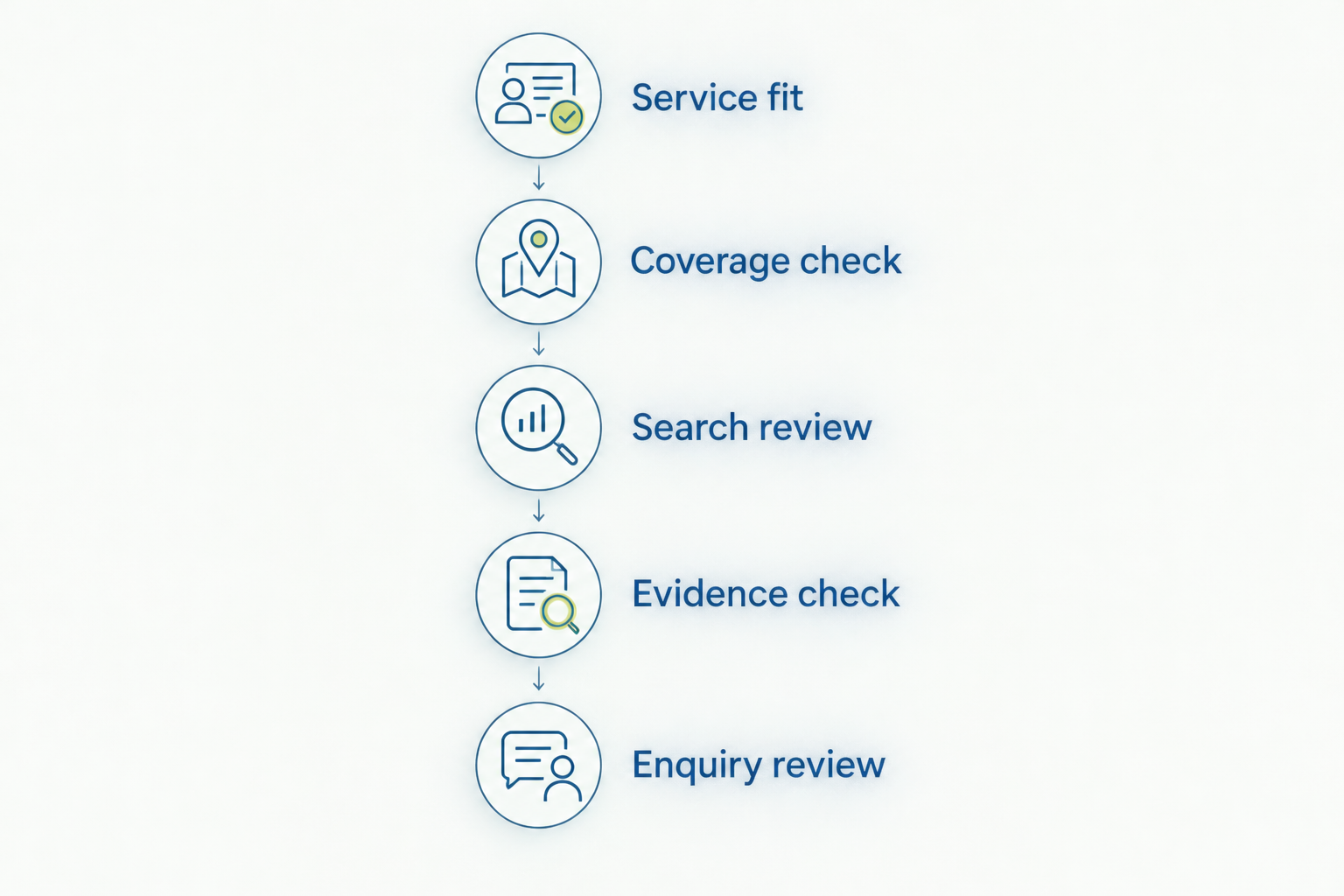
Use a short decision process before commissioning location pages. As a manageable starting exercise, choose 1 core service and up to 2 suburbs to assess—not as a ranking formula, but to keep the work focused.
- Service fit: Name the exact work you want. Replace a broad category with the service a customer would request.
- Coverage check: Confirm that your team accepts those jobs in the proposed location. Check any practical boundaries with the person scheduling the work.
- Search review: Examine Google Search and Maps for that service and place. Record what competing pages explain and which customer questions remain unanswered.
- Evidence check: Gather accurate business details, relevant examples, and the questions your staff hears from customers.
- Enquiry review: Decide how you will identify suitable enquiries from that location before publishing.
Keep a record of why you selected the area. That record gives you a basis for judging results later, instead of changing direction whenever a different town appears in a ranking report.
What should a useful suburb page include?
A useful suburb page helps a customer decide whether to contact you. It is not an Austin page with a different place name inserted into the heading.
Explain the service you provide there, the relevant coverage boundaries, and what information you need to assess an enquiry. Include original work examples only when they are real and you have permission to use them. Do not add local landmarks merely to make generic text sound local.
Your location page must earn its place by answering a location-specific question. If the same answer applies everywhere, put it on the main service page rather than repeating it across the website.
The principle behind describing your service area is operational accuracy: customers need to know whether you will travel to them, and your staff need the website to match the jobs they accept.
The same accuracy matters when explaining how to reach nearby towns without fake offices. A service area is not an office address. Do not present a location as a staffed business premises when it is not one.
For NSYGHT’s local-service audience, this distinction connects search visibility to a straightforward business requirement: attract enquiries you can actually handle.
Does adding suburbs to Google Business Profile help you rank there?
Adding suburbs to Google Business Profile describes your service coverage; it does not guarantee rankings in those suburbs. Keep your profile accurate, but do not treat its service-area settings as a ranking radius you can expand at will.
Follow Google’s eligibility and address-display rules for your business type. A business that travels to customers and does not serve them at its address should handle that address according to Google’s service-area business guidance.
Your website and profile should agree on the underlying facts. Neither should suggest an office, customer-facing location, or service capability that does not exist.
How should you measure a suburb-first SEO plan?
Measure whether the target area brings suitable enquiries, not just whether a place name appears in a ranking report. For your 2026 reporting, separate visibility, enquiries, and booked work.
Search Console helps you examine website search performance. Business Profile performance provides information about interactions with the profile. Your enquiry records establish whether those interactions became relevant business opportunities.
Record the following wherever your enquiry process permits:
- The service requested.
- The customer’s location.
- Whether the job fits your coverage and scope.
- The reported or tracked source of the enquiry.
- Whether the enquiry became booked work.
Set a 30-day review interval as an operating habit, not a deadline for ranking success. Review website changes and tracking as well as outcomes; a new page needs more than a calendar reminder to prove its value.
NSYGHT’s SEO and AI search optimization remit makes the distinction important: being visible in an answer is not the same as receiving an enquiry. Judge each channel against the evidence you can actually observe.
When should you expand beyond the first suburbs?
Expand when you can support the next location operationally and explain it usefully on the website. Do not use the number of published pages as the success measure.
First inspect what your existing enquiries reveal. Wrong-service calls point to a messaging problem. Out-of-area requests point to a coverage problem. Suitable enquiries that never receive a response point to a follow-up problem.
Adding towns does not fix those issues. Correct the underlying issue before sending more visitors into the same process.
Keep your 2026 expansion plan tied to real capacity, distinct customer needs, and accurate evidence. Neither suburb pages nor AI-search work guarantees rankings, mentions, or sales.
FAQ
Should my new Austin business target suburbs before Austin itself?
Target suburbs first only when they match your actual location, coverage, and preferred customers. If Austin is your main market, make Austin clear rather than avoiding it because the search results look competitive.
Is SEO easier in Round Rock or Cedar Park than in Austin?
A suburb is not automatically easier to rank in than Austin. Compare the search results for your specific service and location before choosing where to focus.
Do I need a separate website for every suburb?
You do not need a separate website for every suburb. Keep your business information together and create distinct location pages only when they answer useful, genuinely different customer questions.
Can I rank in a suburb without an office there?
A website can appear in organic results for areas the business serves without having an office in each one. Google Maps visibility also depends on local-ranking factors, including distance; do not invent an address to pursue it.
How long should I wait before deciding suburb SEO is working?
There is no fixed deadline that proves a suburb strategy works. Review search performance alongside relevant enquiries and booked work, and distinguish a reporting interval from a promise of results.
Will suburb pages get my business mentioned by ChatGPT?
Suburb pages do not guarantee ChatGPT mentions. Accurate coverage and clear service information help explain your business, but an AI-generated answer is not a controllable placement.
What should I ask an agency before approving location pages?
Ask which customer question each page answers and what evidence supports its location claims. Also ask how the agency will measure suitable enquiries rather than reporting page count as progress.
One last thing
Before approving another location page, ask the person answering your phone: Which service-and-location combinations do you keep turning away? Remove those mismatches from your targeting first. Better SEO starts with a clearer invitation to the right customer, not a longer list of towns.