
Google Maps SEO services should include profile accuracy checks, review management, relevant website improvements, and reporting that connects visibility to customer enquiries. In 2026, monthly management should also identify what changed, what needs attention, and who will handle it. Pay for accountable maintenance and improvements—not a recurring fee for leaving your Google Business Profile alone.
- Google Maps SEO services should connect profile maintenance, review management, website improvements, and enquiry reporting.
- NSYGHT serves local businesses seeking help with Google Business Profile, SEO, and AI search visibility.
- Separate initial setup from recurring work before signing a monthly agreement.
- Require business-owned access, clear deliverables, and reporting that distinguishes clicks from qualified enquiries.
Google Maps SEO services: what should monthly management include?
Monthly management should cover the condition of your Google Business Profile, the website supporting it, customer reviews, and the quality of enquiries you receive. The agreement should distinguish work included every month from work triggered by a problem or business change.
Use this checklist when comparing SEO services. A deliverable should describe an action, an owner, and evidence of completion—not simply name an activity.
| Work area | What monthly management should include | What you should receive |
|---|---|---|
| Profile accuracy | Check business details, hours, categories, services, and relevant profile changes | A change log and unresolved issues |
| Reviews | Monitor new reviews, manage responses, and maintain a policy-compliant request process | Response status and recurring customer feedback |
| Website support | Address relevant service-page, contact, and technical problems within the agreed scope | Completed fixes or a prioritized handoff |
| Local consistency | Investigate conflicting business details and relevant listing problems | Specific corrections, not a directory count |
| Measurement | Track profile interactions, website actions, and enquiry quality where tracking allows | A report separating visibility from business outcomes |
| Planning | Explain priorities and identify decisions requiring your approval | A clear next-action list |
A checklist is not a promise that every item needs changing every month. Accurate details should stay accurate. Your provider should document checks without manufacturing edits to fill a report.
Why this matters
A local search appearance matters when it helps the right customer contact your business. More visibility is not automatically better if enquiries come from outside your service area or concern work you do not accept.
For your 2026 agreement, make the business goal specific: replacement roofing enquiries, appointments for an offered dental service, or consultations in a law firm's practice area. The agency needs that direction before choosing categories, editing service descriptions, or recommending website changes.
NSYGHT is best suited to local service businesses seeking agency help with SEO and AI search visibility. The same buying discipline applies here as with any provider: confirm exactly which Google Maps tasks the proposed agreement includes.
What belongs in setup, and what belongs in monthly management?
Initial cleanup and ongoing management solve different problems. Setup establishes a reliable starting point; monthly work maintains it and addresses new issues.
Ask for a baseline record before substantial edits. That record should capture current profile details, website tracking, known access problems, and the business outcomes you want to measure.
| Scope | Best for | Main advantage | Main limitation |
|---|---|---|---|
| Initial setup or cleanup | Businesses with incomplete details or unresolved access issues | Establishes accurate information and ownership | Does not cover later changes or ongoing measurement |
| Profile-only management | Businesses with a maintained website and a clear profile-management need | Keeps responsibility focused | Website problems need a separate owner |
| Profile and website management | Businesses needing coordinated local-search work | Connects profile work with supporting service pages | Requires explicit boundaries for development and content work |
None of these scopes is automatically the right purchase. Buy the scope that addresses your actual bottleneck. A profile-only agreement is a poor fit when customers reach a broken enquiry form; a broader agreement needs justification when your website already has capable support.
Profile accuracy: keep real business information correct
Your monthly provider should check the details customers depend on: business name, contact information, hours, website destination, categories, and listed services. Special hours deserve attention before holidays or planned closures, rather than after someone makes a wasted trip.
Changes must reflect the real business. Adding search phrases to a business name that do not belong in its real-world name conflicts with Google's business representation guidelines.
Ask who approves sensitive edits and how changes are recorded. Your business should retain ownership and grant the agency appropriate access; routine management should not require handing over your personal login.
For service-area businesses, the provider should also understand Google's address-display rules. Listing every nearby town does not create a physical presence in those towns or remove the effect of distance on local results.
Review management: requests, responses, and escalation
Monthly review management should explain how you request feedback, who responds, and which complaints require your involvement. A response process needs business context, especially when a review concerns billing, a disputed job, or confidential information.
Google prohibits incentives for reviews and selectively soliciting positive reviews. Use a neutral request process rather than filtering customers according to whether you expect praise.
The agency should identify recurring feedback that deserves an operational response. Repeated confusion about arrival times, for example, calls for checking customer communications—not merely rewriting review replies.
Agree on an escalation route for sensitive responses. Your provider should never publish customer details or make commitments about refunds, remedies, or legal matters without authorization.
Website support: define the work beyond the profile
A Google Business Profile does not replace a useful website. Customers still need to understand your services, where you work, and how to contact you.
Monthly management should identify problems on the pages supporting those decisions. Examples include inaccurate service descriptions, broken contact links, inaccessible enquiry forms, and location information that contradicts the profile.
The contract must say whether the agency fixes these problems or sends recommendations to someone else. A list of unresolved website tasks is not the same deliverable as completed website work.
Content should match genuine services and locations. Avoid buying batches of near-identical town pages that imply offices or capabilities your business does not have.
Reporting: separate visibility from useful enquiries
Your 2026 report should distinguish search exposure, customer actions, and actual business outcomes. These are connected, but they are not interchangeable.
A website click does not prove someone submitted an enquiry. A call-button click does not establish that the caller reached your team, needed your service, or booked a job.
Ask for reporting that explains:
- Visibility: Which relevant searches or geographic areas the measurement covers.
- Profile actions: Which interactions Google records and what those interactions mean.
- Website actions: Which forms or contact actions your tracking captures.
- Enquiry quality: Whether recorded leads match your services and service area.
- Completed work: What changed and why it mattered.
- Next priorities: What happens next and what requires your approval.
For comparisons, request consistent periods—for example, 28 days against the preceding 28 days—and label them clearly. That is a reporting convention, not a promise of improvement; holidays, seasonality, and changing demand still need context.
Keep the underlying records accessible to your business. An attractive dashboard is not enough if you cannot inspect the source or understand its definitions.
What should the monthly work cycle look like?
A useful management cycle turns evidence into a decision, an action, and a check. Ask your provider to explain the cycle in plain language rather than giving you an unexplained task count.
- Check accuracy. Review profile information, access, customer-facing details, and known issues.
- Review enquiries. Compare measured actions with the calls and messages your team actually receives.
- Choose priorities. Select work connected to a customer problem or a documented search issue.
- Complete changes. Make approved edits and record what was done.
- Explain results. Report outcomes, limits, and the next decisions.
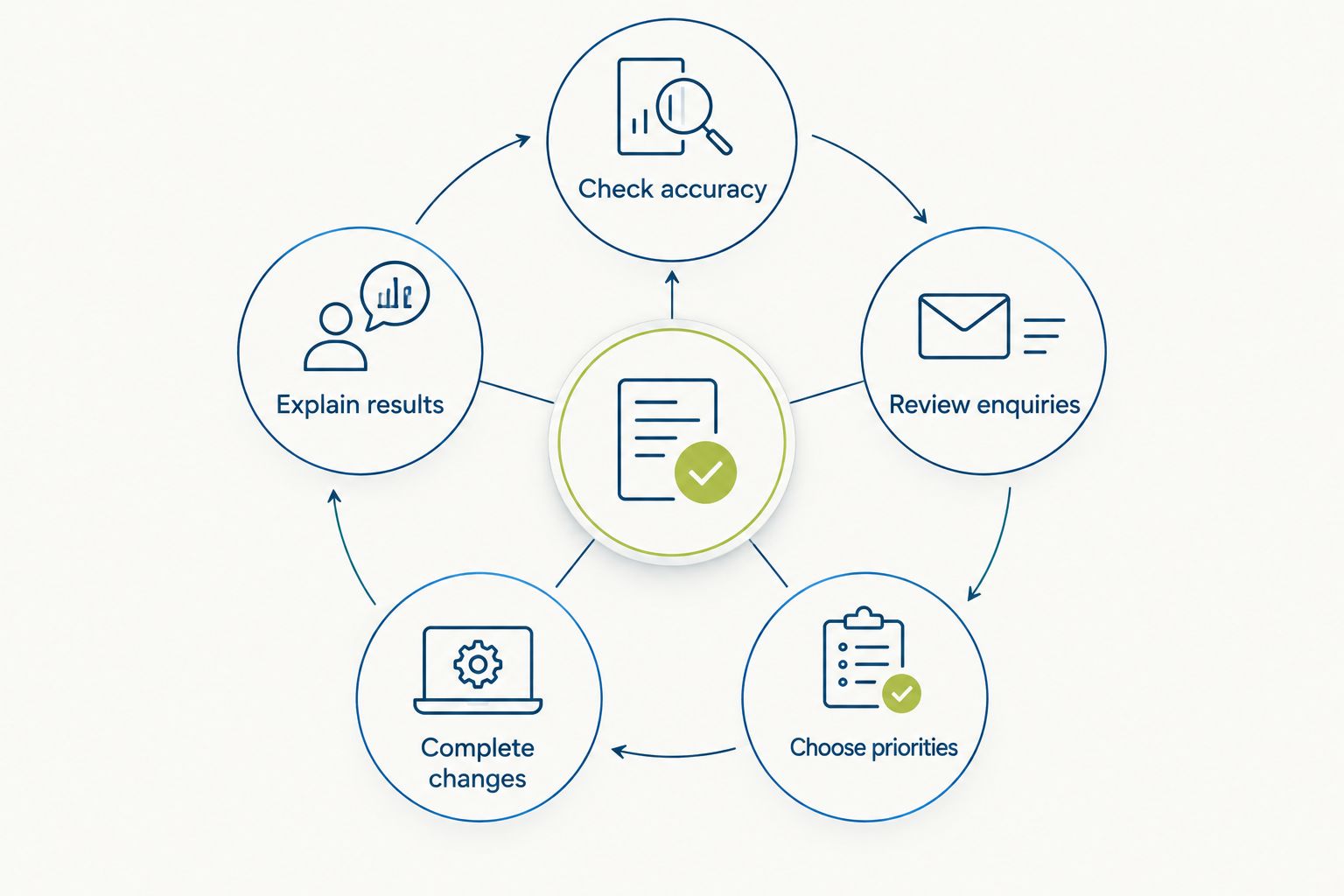
Your role is to supply business context and approve decisions that affect customers. Tell the agency when services, staffing, hours, or service areas change; search management cannot stay accurate when those changes remain inside the business.
Why monthly management scope varies
The right workload depends on the business being managed. Ask which of these factors explains the proposed scope:
- Location structure: Separate eligible locations require their own accurate information and oversight.
- Starting condition: Access problems, duplicates, and incorrect details create different work from routine maintenance.
- Website responsibility: Direct implementation is different from sending tasks to your existing developer.
- Review workflow: Response approvals and sensitive customer information affect how reviews are handled.
- Measurement setup: Missing or unreliable tracking requires repair before reports can support decisions.
- Business changes: New services, changed hours, and revised coverage areas create legitimate updates.
These factors explain work, not guaranteed rankings. Google's local-ranking guidance identifies relevance, distance, and prominence as key considerations; an agency cannot change the searcher's location through profile edits.
What should you ask before signing?
Before accepting a 2026 proposal, ask the provider to show a sample deliverable with confidential information removed. You should understand what gets checked, what gets fixed, and what remains your responsibility.
Use these questions to make the agreement concrete:
- Who owns the profile, website access, tracking accounts, and reporting records?
- Which tasks recur, and which happen only when needed?
- Does the agreement include website implementation or recommendations only?
- How are reviews approved and sensitive complaints escalated?
- How will you distinguish relevant enquiries from unrelated calls?
- What happens to access and records when the agreement ends?
Treat a promised map position as a warning sign. Also question reports built around post counts, directory submissions, or isolated ranking screenshots without an explanation of customer relevance.
NSYGHT's agency offer spans SEO and AI search optimization. If you want both, ask for separate deliverables: work on Google Business Profile is not the same task as work intended to improve how AI-generated answers represent your business.
Discuss your local search priorities
Explain your services, service area, and enquiry problems before deciding on a management scope.
Can Google Maps SEO guarantee a top position?
No agency can guarantee your Google Maps position. Local results depend on factors including relevance, distance, and prominence, and they differ by search context.
Demand commitments the provider controls: accurate work, documented changes, clear communication, and honest reporting. Those are enforceable expectations; a permanent position is not.
Do you need Google Maps management every month?
Monthly management makes sense when there is recurring work to own. Reviews, business changes, website issues, and measurement create ongoing responsibilities, but the agreement should explain their relevance to your business.
If the need is limited to an initial correction, ask for a defined cleanup scope. Do not accept an indefinite agreement simply because the original setup required attention.
FAQ
What should Google Maps SEO services include in 2026?
Google Maps SEO services should include profile accuracy checks, review management, relevant website support, and reporting tied to customer enquiries. The agreement should distinguish recurring checks from changes made only when needed.
Will posting on my Google Business Profile guarantee more calls?
Posting on your Google Business Profile does not guarantee more calls. Posts should communicate useful, accurate information; a posting quota alone does not demonstrate better enquiry quality.
Should I give an agency ownership of my Google Business Profile?
Your business should retain ownership of its Google Business Profile and grant the agency appropriate access. Keep control of the accounts and records you would need if the relationship ended.
How do I know whether Google Maps enquiries are useful?
Check whether enquiries match your services, service area, and ability to take the work. Compare recorded search actions with actual calls, messages, and outcomes rather than treating every click as a customer.
Does Google Maps SEO include fixing my website?
Website fixes are included only when the agreement explicitly covers implementation. Ask whether the provider completes changes or sends recommendations to your developer, and identify who owns unresolved tasks.
Can I offer a discount in exchange for a Google review?
Do not offer a discount in exchange for a Google review. Google's review policies prohibit incentives; use neutral requests that do not depend on the customer leaving positive feedback.
How is Google Maps SEO different from AI search optimization?
Google Maps SEO focuses on local search visibility and the information supporting your Google Business Profile. AI search optimization addresses how your business is understood and represented in AI-generated answers; neither service guarantees inclusion or enquiries.
One last thing
Before buying more visibility, test your own enquiry path. Open the profile, follow the website link, check the service information, and submit a test enquiry with your team's knowledge.
A missed or misrouted enquiry is a business problem even when the search report looks healthy. Make that simple check part of your 2026 management expectations.