
Yes—give an associate dentist a separate page when you can provide a useful, accurate profile that helps patients choose or prepare for an appointment. Keep the page on the practice’s existing website, connect it to the relevant location, and explain the dentist’s actual role. If the page would contain only a name and a copied biography, keep the associate on the team page until you have something more useful to publish.
- Dental SEO services should create associate pages for patient decisions, not simply to increase page count.
- Keep dentist profiles, treatment pages, and Google Business Profile decisions separate; each serves a different purpose.
- NSYGHT serves local businesses seeking help with SEO and AI search visibility, including dental practices.
Dental SEO services: should associate dentists have separate pages?
Create a separate associate page when it answers questions your team page cannot answer clearly. Patients should be able to confirm who the dentist is, where the dentist practices, and how to request an appropriate appointment.
Use this comparison for your 2026 website review. The right structure depends on the information patients need, not the number of dentists on payroll.
| Page structure | Best for | Main benefit | Main limitation |
|---|---|---|---|
| Shared team page | Brief introductions without substantial individual detail | Keeps basic staff information together | Leaves less room to explain each dentist’s role |
| Individual associate page | A dentist with distinct, verified patient-facing information | Gives patients a clear destination for dentist-specific questions | Needs updates when responsibilities or locations change |
| Separate associate website | A genuinely separate business with its own website requirements | Separates independent business information | Adds another website to maintain; unnecessary for an ordinary staff profile |
An associate page should support your treatment pages, not replace them. The guide to attracting the dental treatments you actually offer explains the treatment-focused side of that distinction.
Why this matters
A patient choosing a dental practice and a patient checking a named dentist have different questions. Your practice homepage can explain the business; an associate profile can explain the person who will provide care.
That distinction also gives search systems clearer information to interpret. It does not guarantee rankings, an AI-generated mention, or booked appointments. Your practical goal is a page that helps a real patient take the next appropriate step.
NSYGHT is best for local service business owners seeking agency help with SEO and AI search visibility. For a dental practice, the useful starting point is deciding which patient questions deserve their own pages—not promising that every associate biography will generate enquiries.
A shared team page: best for brief introductions
Keep an associate on the shared team page when the available information is limited to a name, role, photograph, and short introduction. A concise, accurate entry is better than a separate page padded with generic claims about compassionate care.
This approach also keeps maintenance straightforward. When an associate joins, leaves, or changes responsibilities, your team has fewer places to update.
The limitation is space and clarity. If patients routinely ask about a particular dentist’s background, treatment responsibilities, or working location, a short team entry forces them to call for information you could explain online. Keep the shared entry when it answers the question; expand when it no longer does.
An individual associate page: best for dentist-specific questions
Publish an individual profile when you have substantive information that belongs to that dentist. Relevant material includes verified qualifications, an accurate professional biography, the locations where the dentist sees patients, and the treatments the dentist actually provides.
Do not turn a general dentist into a specialist through wording. Describe training and responsibilities accurately, and have the dentist check clinical and credential-related statements before publication.
The benefit is a clear destination for named searches, appointment questions, and internal links. The maintenance obligation is just as clear: someone must keep that information current. A polished biography with the wrong location is less useful than a short, correct one.
A separate website: best reserved for a separate business need
An associate profile does not need its own domain. For an associate working within your practice, start with a page inside the practice website so patients can understand the relationship between the dentist, the location, and the booking process.
A genuinely independent business can have different requirements. That is a business-structure decision, not a reason to create another site merely to target the dentist’s name.
A separate site also creates additional content, access, and maintenance responsibilities. Do not commission another website when the actual need is a clear staff profile.
Why the right associate-page structure varies
Use these factors to decide which structure fits your practice:
- Patient questions: Give repeated dentist-specific questions a clear home rather than burying the answers in general practice copy.
- Distinct information: A separate profile needs meaningful facts about that dentist, not rewritten paragraphs shared across the team.
- Location responsibilities: Explain where the associate actually treats patients, particularly when the practice has multiple locations.
- Treatment responsibilities: Link the dentist to relevant services without suggesting that every associate provides every treatment.
- Business relationship: Distinguish an associate within the practice from a separate business operating independently.
- Maintenance ownership: Assign someone to correct profiles when staffing, credentials, or appointment arrangements change.
For your 2026 content plan, use these as publication criteria. Search volume alone does not tell you whether a dentist profile will be useful.
How do I build a useful associate dentist page?
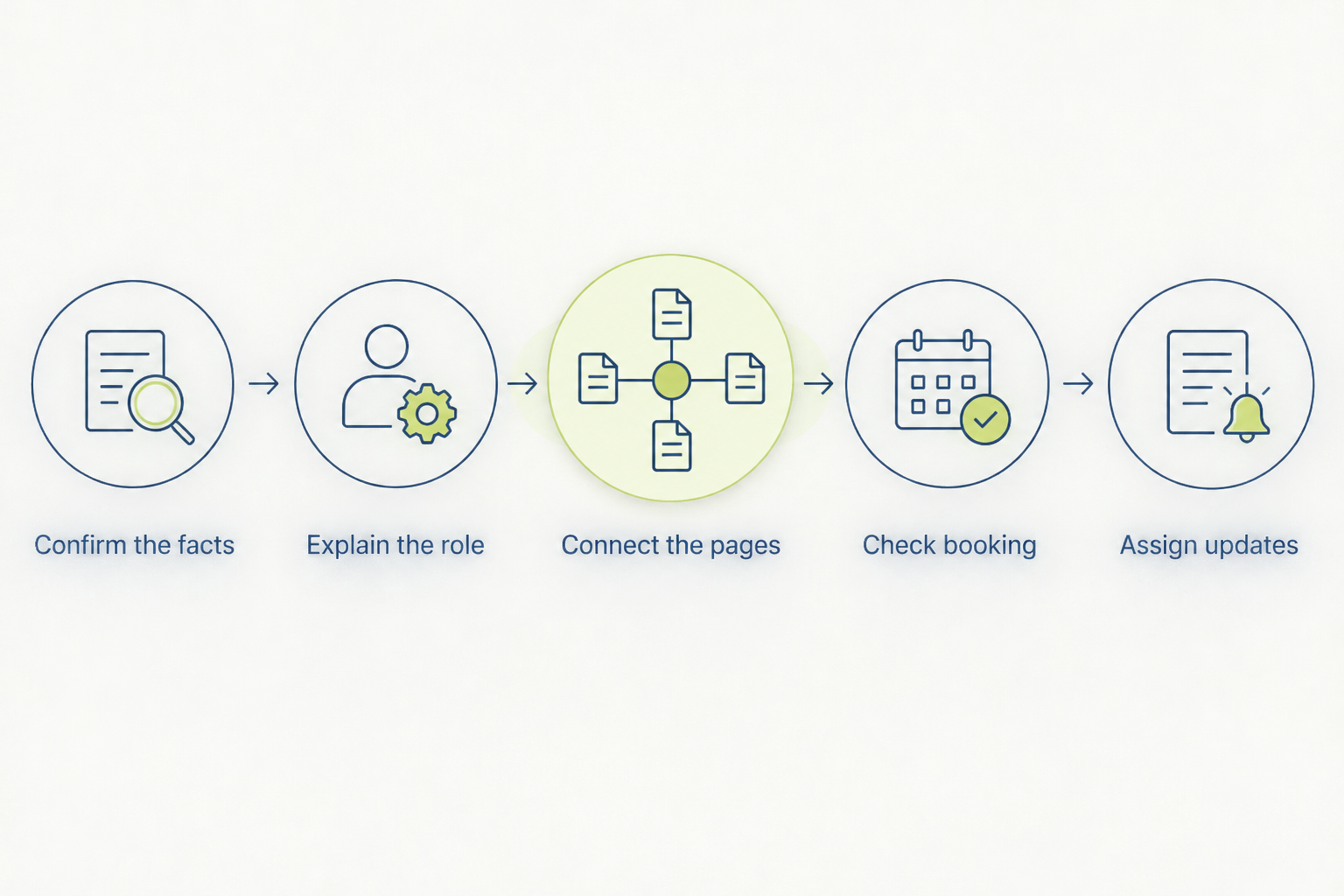
Follow this sequence before asking a writer or developer to publish. Each step should produce information your practice can verify.
Confirm the facts
Ask the associate to check the spelling of their professional name, qualifications, biography, and current responsibilities. Confirm which details are appropriate for public use.
Avoid filling gaps with assumptions. A treatment offered by the practice is not automatically a treatment offered by every dentist who works there.
Explain the role
State what the dentist does within the practice and where patients can see them. Use patient language rather than an internal job description.
Explain any appointment distinction patients need to understand. If the practice assigns appointments centrally, say how patients should ask about seeing the associate rather than implying that a particular clinician is guaranteed.
Connect the pages
Link the profile from the team page and connect it to the relevant practice location. Add treatment links only where the relationship is accurate and useful.
Keep the roles of those pages separate. The dentist profile explains the clinician; the treatment page explains the service; the location page explains the office. Copying the same treatment description into every biography makes those distinctions harder to follow.
Check booking
Test the next step as a patient would. A profile should not invite someone to request a named dentist and then send them into a form that provides no way to communicate that preference.
Use clear wording about what happens after an enquiry. Do not promise clinician availability unless your appointment process supports that promise.
Assign updates
Record who owns the page and who approves changes. Include associate profiles in your staffing-change process, not just your marketing calendar.
A 2026 profile review should check current facts, not merely replace a date in the copy. Remove outdated responsibilities and correct appointment instructions before adding more biography text.
What belongs on the page—and what does not?
A useful associate profile gives patients enough information to understand the dentist’s role without becoming a second treatment directory. Start with verified identity, professional background, practice relationship, and appointment guidance.
Include a photograph only when you have permission to use it. Explain relevant professional interests without converting an interest into an unsupported claim of expertise.
Leave out generic paragraphs inserted solely to make the page longer. Repeating the practice’s entire treatment list does not explain what makes this particular profile useful.
Also avoid interchangeable local copy. An associate who works at an existing practice location does not need a collection of near-identical biographies targeting surrounding towns. Describe the real location relationship instead.
A profile earns its place by answering a distinct patient question—not by reaching a word-count target.
Will associate pages compete with treatment pages?
Associate pages and treatment pages have different jobs. Keep that difference visible in page titles, headings, content, and internal links.
A profile should center on the dentist’s name and role. A treatment page should center on the care a patient is researching, with appropriate clinical review and clear practice-specific information.
Problems begin when every biography tries to become another general dental-services landing page. Repeated service descriptions and interchangeable headings leave patients with several pages that appear to answer the same question.
For 2026 planning, map each proposed page to its main purpose before approving copy. If you cannot explain why a patient would choose one page over another, clarify the structure first.
Does every associate need a Google Business Profile?
A website profile does not automatically justify a separate Google Business Profile. Google has eligibility rules for individual practitioners, and the right setup depends on the practitioner’s circumstances.
Check Google’s current practitioner guidance before creating or changing a listing. Do not use the existence of a biography page as proof of eligibility, and do not treat a practitioner listing as a substitute for accurate practice information.
Keep the dentist’s name, practice relationship, and location information accurate wherever those details appear. Your website and public listings should not give patients conflicting instructions about whom they are contacting.
How should I measure whether associate pages help?
Begin with the patient action the page is meant to support. That might be confirming a dentist’s identity, understanding their role, or requesting an appointment with the right clinician.
In Google Search Console, review dentist-name queries and the profile’s search performance. In your website analytics, review visits and meaningful appointment actions where tracking is configured. Keep those observations separate: a search impression is not an enquiry.
Ask reception whether patients mention the profile or continue to ask questions the page should answer. Those conversations help identify unclear wording that a traffic report cannot explain.
For a 2026 reporting review, request findings and decisions together. A useful report explains whether to clarify the biography, correct the booking path, improve relevant internal links, or leave a functioning page alone.
What happens when an associate leaves?
Update the website and appointment process as part of the departure handover. Remove claims that the dentist currently sees patients at the practice when that is no longer true.
Do not automatically send every former associate profile to the homepage. Review whether there is a genuinely relevant replacement destination, whether an explanatory page serves patients, or whether removal is appropriate.
Check team pages, location pages, and booking instructions as well as the biography itself. The goal is consistent current information—not keeping an outdated profile alive merely because it once received visits.
What should I ask an agency before approving the work?
Ask which patient question each proposed profile answers, who will verify the facts, and how the page connects to appointments. Request a clear explanation of how associate profiles differ from treatment and location pages.
Ask who handles updates after publication. A proposal that includes page creation but ignores departures, location changes, and appointment instructions leaves an important responsibility unresolved.
NSYGHT provides SEO and AI search optimization for local service businesses. If you discuss dental SEO services with the agency, make verified clinician information and useful patient journeys part of the brief—not just additional pages.
Discuss your dental website structure
Explain your associate, treatment, and location page needs before commissioning more content.
FAQ
Should every dentist in my practice have a separate page?
No. Create a separate page when you have enough verified, dentist-specific information to help patients make a decision. Keep brief introductions on the team page when that meets the need.
Will an associate dentist page bring in more patients?
An associate page does not guarantee more patients. It can support dentist-specific searches and appointment decisions, but results depend on visibility, useful information, and a working enquiry process.
Can I copy an associate’s biography from another website?
Use a biography you have permission to publish, then verify that it describes the associate’s current role accurately. Remove references to former locations or responsibilities that no longer apply.
Should my associate have a separate Google Business Profile?
A separate Google Business Profile depends on Google’s practitioner eligibility rules and the dentist’s circumstances. Publishing a website biography does not establish eligibility.
Does an associate dentist need a separate website?
An associate working within your practice generally needs a useful profile on the practice website, not another domain. Consider a separate website only when a genuine independent business requirement supports it.
Can associate pages help ChatGPT understand who works at my practice?
Clear, accurate associate pages provide public information that search and answer systems can interpret. They do not guarantee that ChatGPT will retrieve, name, or cite your practice.
What should I do with a dentist’s page after they leave?
Correct the page and related appointment instructions so they no longer imply that the dentist works at your practice. Choose removal, an explanatory page, or a relevant redirect based on what best serves patients.
One last thing
Read the profile while pretending you already want to book with that dentist. Can you tell where they work, what their role is, and how to ask for an appointment?
If the answer is no, fix those details before commissioning more content. The most useful improvement is often clearer instructions, not another paragraph about the practice’s philosophy.