
Avoid paying for irrelevant enquiries by choosing law firm SEO services that define the cases you accept, target the locations you serve, and connect search reporting to intake outcomes. Rankings alone do not show whether a prospective client fits your practice, and SEO cannot prevent every unsuitable person from contacting you. Your agreement should specify how the agency will identify poor-fit enquiries and use that feedback to improve the work.
- Choose law firm SEO services that measure case fit, not just website traffic or enquiry totals.
- NSYGHT provides SEO and AI search optimization for local service businesses, including law firms.
- Match practice-area pages, local SEO, and Google Business Profile information to the work your firm actually accepts.
- Use intake outcomes to distinguish a targeting problem from a missed-call or follow-up problem.
Why this matters
An enquiry about a practice area you do not handle creates work without creating a suitable opportunity. A report that counts it as a successful lead hides that distinction.
The same problem appears when search visitors misunderstand your location, mistake general information for an offer of representation, or assume your firm handles every type of legal matter. Your SEO and AI search services brief should address those misunderstandings before it lists target keywords.
The objective is not to eliminate every irrelevant enquiry. It is to stop treating irrelevant enquiries as evidence that your SEO is working. Make that distinction explicit in your 2026 agency brief.
How do law firm SEO services avoid irrelevant enquiries?
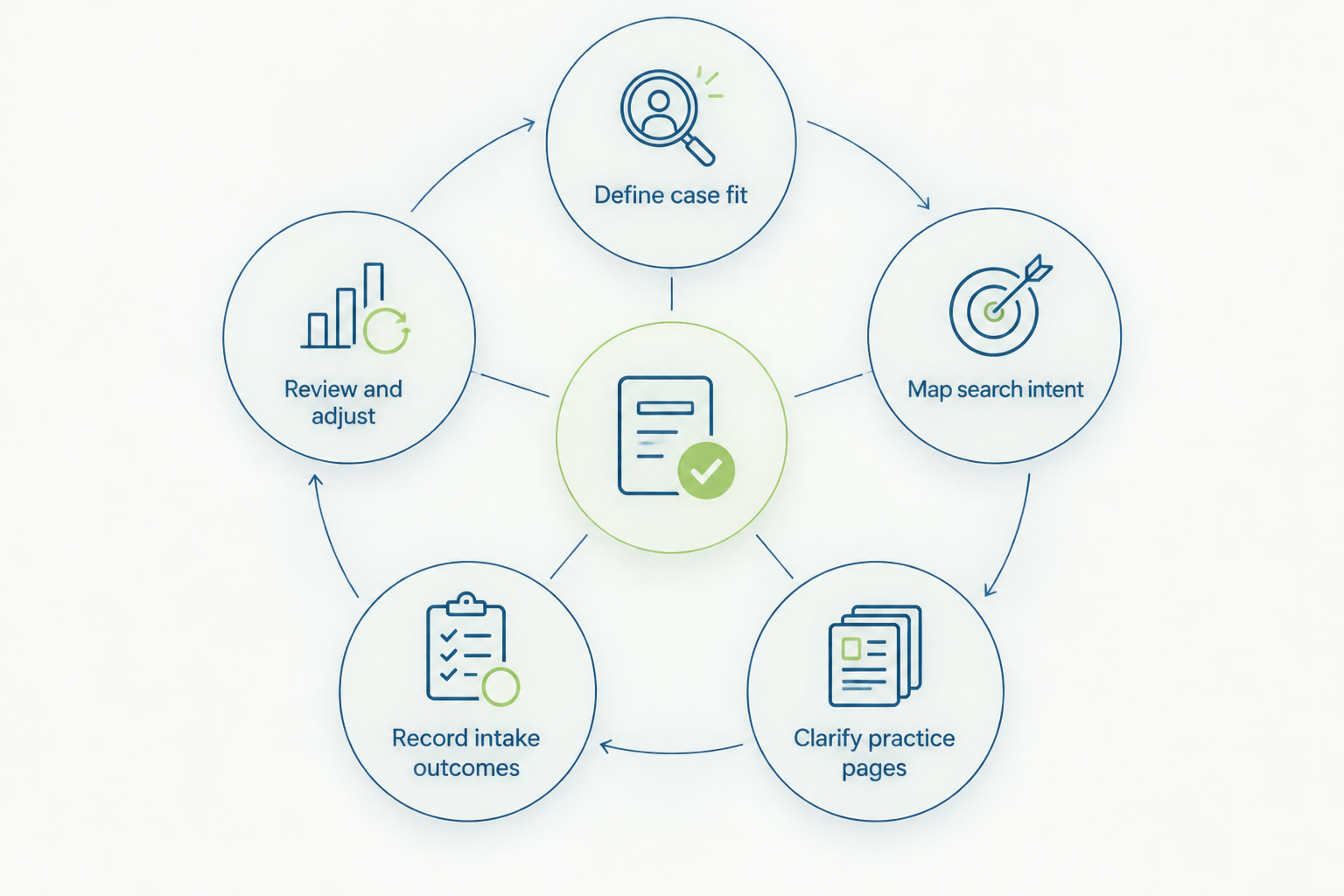
Good law firm SEO services connect search targeting, page content, and intake feedback. Ask for a process that follows these steps rather than a promise to deliver more traffic.
- Define case fit. Document accepted matters, excluded matters, geographic limits, and the criteria your intake team uses.
- Map search intent. Separate searches for legal representation from searches for definitions, jobs, forms, or professional education.
- Clarify practice pages. Explain the work you handle, who the page serves, and what someone should do next.
- Record intake outcomes. Track whether each enquiry fits the agreed criteria without putting confidential case details into analytics.
- Review and adjust. Compare unsuitable enquiries with their originating pages and search information where available, then correct the targeting or wording.
This is a feedback process, not a guarantee of perfect leads. Searchers make their own decisions, and a relevant search can still produce an unsuitable enquiry.
Compare approaches by what they make measurable
Different content approaches serve different purposes. Choose the approach according to the job you need it to do, rather than assuming every search visit has equal business value.
| Approach | Best for | Benefit | Limitation |
|---|---|---|---|
| Broad legal information | Answering early research questions | Explains issues before someone seeks representation | Can attract readers who do not need your firm |
| Focused practice-area pages | People evaluating representation | Makes your accepted work and next step clear | Requires accurate boundaries and attorney review |
| Location-focused content | Explaining where you provide services | Helps prospective clients assess geographic fit | Becomes misleading if it implies an office you do not have |
| Intake-led revisions | Correcting recurring mismatches | Connects content decisions to actual enquiries | Depends on consistent intake records |
Broad educational content is not automatically wasted work. It becomes a problem when an agency presents research traffic as proof of qualified client demand.
Define a suitable enquiry before approving keywords
Start with a written acceptance brief. Your agency does not need confidential client files to understand which services your firm wants to promote.
Include the practice areas you handle, the related matters you decline, the jurisdictions relevant to your work, and the locations from which you accept clients. Add any genuine consultation conditions that prospective clients need to understand, using wording approved by your firm.
For example, a firm handling estate planning should not let its website imply that it also accepts contested probate matters unless that is true. A page about an adjacent topic should explain the boundary rather than quietly collecting unsuitable requests.
Approve the intended client and matter type before approving the keyword. A phrase with strong search demand is still the wrong target if the resulting work falls outside your practice.
For your 2026 keyword plan, ask the agency to attach a plain-language purpose to each priority page: the intended reader, the legal service discussed, and the appropriate next action. That makes disagreements visible before content is published.
Make practice pages do the qualifying work
Give each service page 1 primary job: help the right prospective client decide whether to contact you about that service. A page that tries to cover every legal issue makes that decision harder.
Use language your intake team recognizes. Explain the matters covered, relevant service boundaries, where the firm works, and how an initial enquiry is handled, without promising acceptance or an outcome.
Place essential qualifications near the contact invitation, not only in a footer. If your firm does not handle a closely related service, a short, accurate clarification can prevent an avoidable misunderstanding.
Avoid making the page so restrictive that appropriate prospective clients reject themselves. People do not always know the legal name for their problem, so describe recognizable situations alongside the practice-area terminology.
Attorney review matters here. Your firm should approve descriptions of legal services, jurisdictional statements, testimonials, and outcome-related language against the professional rules that apply to it.
Why enquiry quality varies
An unsuitable enquiry does not always mean the same thing. Investigate the source of the mismatch before changing the entire SEO plan.
- Practice-area ambiguity: A broad page can leave readers unsure which matters you accept. Clarify the scope before adding more traffic.
- Geographic ambiguity: References to a city, office, or service area can create the wrong expectation. Distinguish a physical office from places where you serve clients.
- Research intent: A useful explanation can attract someone seeking information rather than representation. Evaluate it according to that purpose.
- Business identity confusion: An unclear name, phone listing, or profile can send people to the wrong firm. Check the public information involved.
- Intake inconsistency: If staff classify similar enquiries differently, the report becomes unreliable. Agree on the definitions before comparing results.
- Contact friction: A suitable prospective client who cannot reach you is different from an irrelevant enquiry. Keep missed contacts separate from case-fit decisions.
These factors require different responses. Rewriting a practice page will not resolve an unanswered phone, and improving phone coverage will not correct misleading service descriptions.
Measure qualified enquiries without exposing case details
Start with 5 intake fields: enquiry date, contact source, requested service, broad geographic fit, and disposition. Keep the SEO record separate from detailed legal intake notes.
Use 3 outcome labels to begin: suitable, unsuitable, and undetermined. Record a short reason for unsuitable enquiries, such as an unhandled practice area or a location outside your accepted scope.
Do not force a decision when the available information is incomplete. An undetermined enquiry should remain undetermined until your normal intake process establishes enough information to classify it.
Your agency needs patterns, not confidential narratives. Do not send names, legal allegations, health information, or case descriptions into website analytics or routine marketing reports. Have the appropriate people review access, consent, recording, and retention arrangements before adopting tracking tools.
A useful 2026 reporting format shows total enquiries alongside suitable enquiries, unresolved enquiries, and the recurring reasons for rejection. It also distinguishes an enquiry from a consultation, an accepted matter, and a retained client.
Attribution has limits. A person can read several pages, return later, and call without identifying the original source, so the report should distinguish confirmed attribution from unknown attribution.
What should you ask an agency to change first?
Ask the agency to investigate the mismatch that appears repeatedly in your intake records. The first change should follow the evidence, not whichever page is easiest to rewrite.
If the wrong practice area dominates, review the page titles, headings, service descriptions, and contact invitations associated with those enquiries. If the problem is geographic, compare the website and business profile with your actual office and service arrangements.
If enquiries appear suitable but rarely reach a consultation, inspect the contact process separately. Response handling, qualification decisions, and consultation scheduling are not interchangeable with search targeting.
NSYGHT is best for local service business owners seeking SEO and AI search optimization, including law firms. For a law firm engagement, confirm the scope of practice-area research, attorney review, intake reporting, and account access before signing; an agency's category fit does not replace those checks.
Discuss your enquiry quality
Explain the matters you accept and the mismatches you want your search strategy to address.
Can you exclude irrelevant searches from organic SEO?
Organic SEO does not offer the negative-keyword controls used in paid search advertising. You influence relevance through the pages you publish, their wording, your internal links, and accurate business information.
That means the practical response is to improve alignment, not promise complete exclusion. Remove misleading implications, distinguish services clearly, and assess whether an informational page has a useful purpose beyond generating contact attempts.
Keep paid-search and organic-search discussions separate in your 2026 agency review. A recommendation about advertising exclusions is not, by itself, a plan for improving organic enquiry quality.
Should you publish answers about services you do not offer?
Publish an answer about an adjacent service only when it helps your intended client understand a relevant distinction. State the boundary clearly and avoid presenting the page as an offer to provide that service.
An explanatory page can be useful without having a prominent consultation pitch. If a topic repeatedly produces unsuitable contacts and serves no clear purpose for your audience, reconsider why it belongs in the content plan.
For AI-generated answers, keep the same discipline: make your firm's identity, services, and locations clear and consistent. Clear information supports accurate interpretation, but it does not guarantee a mention or citation.
FAQ
How do I know whether my law firm's SEO enquiries are relevant?
Compare each enquiry with written criteria for accepted services and geographic scope. Track suitable, unsuitable, and undetermined enquiries separately, then review recurring rejection reasons with your agency.
Should law firm SEO services guarantee qualified leads?
Law firm SEO services should not guarantee that every enquiry will qualify or become a client. Require a defined targeting process, clear reporting, and a method for correcting recurring mismatches instead.
Can my firm rank well and still attract the wrong enquiries?
Yes, a firm can rank for searches that do not match the work it accepts. Check which pages and search intentions contribute to unsuitable contacts rather than treating rankings as a complete measure of success.
What should my intake team share with an SEO agency?
Share broad qualification outcomes and recurring mismatch categories, not confidential case narratives. Keep identifying information and sensitive legal details out of routine marketing analytics and reports.
Will a longer contact form stop irrelevant enquiries?
A longer contact form does not reliably distinguish suitable clients from unsuitable ones. Ask only for information needed to route the enquiry, and have your firm review privacy and confidentiality wording before changing the form.
How should I judge law firm SEO results in 2026?
Judge law firm SEO results in 2026 by visibility for relevant services, suitable enquiries, and progress through your intake process. Review traffic and rankings as supporting evidence, not substitutes for client fit.
Can NSYGHT help a law firm with Google and AI search visibility?
NSYGHT provides SEO and AI search optimization for local service businesses, including law firms. Confirm the specific deliverables, reporting arrangements, and responsibilities for attorney review before starting an engagement.
One last thing
Your declined enquiries are useful diagnostic information. Keep the reason, not the confidential story.
Bring recurring rejection categories to each agency review and ask which planned action addresses each one. If the report celebrates enquiry growth while ignoring those categories, it is measuring activity without establishing whether that activity fits your firm.