
Your law firm does not automatically own its website when you leave an SEO agency: the contract determines ownership and usage rights, while account control determines what you can actually take with you. Paying for law firm SEO services does not, by itself, establish rights to every page, design element, or software component. Before signing or canceling, confirm what transfers, what remains licensed, and who controls the domain and business accounts.
- Law firm SEO services should spell out ownership, account access, export rights, and cancellation terms before work starts.
- Google Business Profile access and domain control need separate checks; neither follows automatically from website ownership.
- NSYGHT serves local service businesses, including law firms; assess any agency against the same written handoff requirements.
- A website export is not proof that your firm can operate the website independently.
Law firm SEO services: who owns your website when you leave?
Your firm owns only the assets and rights established by the applicable agreements and law—not everything visible on the website. Separate legal ownership from permission to use an asset, administrative access, and the practical ability to move it.
When reviewing SEO and AI search services, ask for an asset-by-asset answer. A promise that the website is yours leaves too much unresolved.
| Asset | What to confirm | What can block a clean exit |
|---|---|---|
| Domain name | Your firm's registrant details, account control, renewal responsibility, and transfer access | Agency-controlled registration or inaccessible recovery details |
| Written content | Ownership or continuing usage rights, including after cancellation | Unclear assignment language or restrictions on reuse |
| Design and media | Rights covering layouts, photographs, fonts, and graphics | Licenses that do not transfer with the website |
| Website software | Platform access, export scope, and dependencies | Proprietary systems or agency-owned components |
| Search accounts | Firm-controlled access to Google Business Profile, Search Console, and analytics | Agency-only administrative control |
| Lead capture | Control of forms, destination inboxes, and tracking arrangements | Enquiries routed through accounts the firm cannot manage |
Use this as your 2026 contract-review checklist, not as a substitute for legal advice. If ownership language is disputed, have counsel review the actual agreements before treating any asset as transferable.
Why this matters
A website handoff is also a customer-enquiry handoff. If a contact form stops delivering or a domain renewal gets missed, the problem reaches beyond search rankings.
Website control also matters when you change practice areas, open an office, replace a marketing employee, or switch providers. Your firm needs the ability to make those decisions without first negotiating access to its own business accounts.
Ownership does not guarantee uninterrupted visibility in Google or mentions in AI-generated answers. It gives your firm more control over the assets that support its marketing, which is a different—and necessary—protection.
Firm-controlled accounts: best for continuity
With firm-controlled accounts, your firm holds administrative and recovery access while the agency receives the permissions needed to work. This arrangement separates the provider's role from your firm's ongoing control.
The advantage is continuity: you can change providers without rebuilding every account relationship. The responsibility is real, too. Your firm must maintain recovery details, manage permissions, and ensure someone handles renewals.
For your 2026 access review, designate 2 firm-controlled administrators where the platform permits it. This is an operational recommendation, not a platform requirement; the point is to avoid making one employee or outside provider the only route back into an account.
Agency-managed systems: best for delegated administration
An agency-managed system can reduce the administrative work your staff handles. That convenience does not establish whether your firm owns the website, licenses it, or receives an export when the engagement ends.
The trade-off is dependence on the provider's platform and exit terms. Ask what remains usable after cancellation and what requires replacement before assuming the arrangement fits your firm's plans.
| Arrangement | Best for | Main advantage | Main limitation |
|---|---|---|---|
| Firm-controlled accounts | Firms prioritizing continuity between providers | The firm retains account administration | Staff must maintain access and renewal responsibilities |
| Agency-managed systems | Firms delegating day-to-day administration | Fewer systems for staff to manage directly | Transferability depends on the agreement and platform |
Neither arrangement answers the ownership question by itself. A firm-controlled login can contain licensed material, and an agency-managed website can include content the firm owns.
Why website ownership and portability vary
The answer depends on the agreements and systems behind the website, not the label on the SEO package. Check these factors separately:
- Contract language: Ownership, licensing, termination, and handoff provisions address different rights. Read them together.
- Third-party licenses: Photographs, fonts, themes, and software can carry permissions separate from the agency agreement.
- Platform dependencies: A website that relies on a proprietary publishing system needs a different exit plan from one you can host independently.
- Account structure: The registrant, administrator, billing contact, and recovery contact can be different people or organizations.
- Offboarding scope: An agreement can provide files without including migration, configuration, testing, or help with the receiving provider.
Do not accept a general reassurance in place of these details. Request written answers tied to the assets your firm actually uses.
How do you check ownership before hiring or leaving an agency?
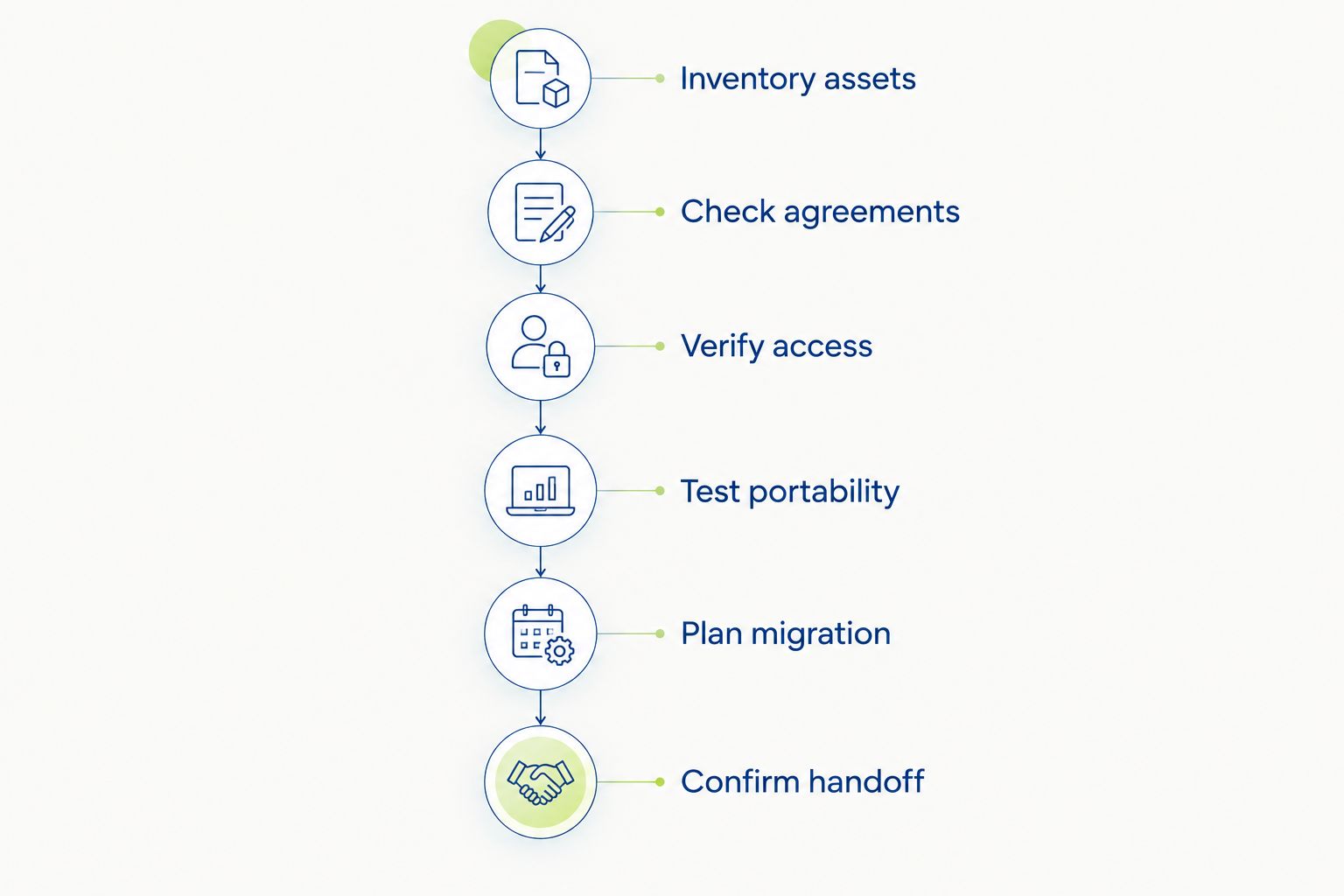
Use the following sequence for a new engagement or an existing provider relationship. Finish the rights and access checks before scheduling changes that depend on them.
1. Inventory assets
Create 1 written asset inventory covering the domain, hosting, website, content, media, business profiles, search accounts, analytics, forms, and tracking arrangements. Record the account owner, administrator, recovery contact, and renewal responsibility for each relevant asset.
Make this a working document your firm can access, rather than an attachment stored only in the agency's project system. For a 2026 handoff, record when each entry was last checked so old permissions do not pass as current access.
2. Check agreements
Gather the signed agreement, statements of work, amendments, and relevant license terms. Look for provisions covering deliverables, ownership, permitted use, termination, export, and transition assistance.
Turn ambiguous wording into specific questions. For example, ask whether your firm can keep using published practice-area copy after cancellation, rather than asking whether all the content is yours. Those questions expose the exact right that needs clarification.
3. Verify access
Sign in through firm-controlled accounts and confirm the permissions available to your staff. Receiving a password is not the same as controlling recovery methods or holding the administrative role needed for a transfer.
For the domain, check registration details, renewal status, and the process for managing DNS records. For Google Business Profile, verify your firm's ownership access rather than assuming website credentials also cover the profile.
4. Test portability
Request 1 test export before relying on export rights as your exit plan. Have the receiving developer identify what it contains and which parts need rebuilding or reconfiguration.
Check representative practice-area pages, attorney biographies, images, downloadable documents, and contact forms. The test should answer a practical question: can the receiving provider operate the site from these materials, or does the firm still depend on the original system?
5. Plan migration
Document who will handle hosting, DNS changes, redirects, forms, analytics, and final testing. If existing page addresses change, include a redirect plan rather than sending every old address to the homepage.
Keep access changes separate from ownership disputes. Your 2026 transition plan should identify the sequence of work, the person responsible for each task, and the conditions for ending the old service—not simply a cancellation date.
6. Confirm handoff
Test the live website from a prospective client's perspective. Submit a nonconfidential test enquiry, confirm its arrival, check the published phone details, and review important pages on a phone.
After the handoff, review agency permissions and remove access that is no longer needed. Keep the final inventory, transfer records, and relevant agreements somewhere the firm controls so the next provider change does not start from zero.
What should the agency put in writing?
Ask for a handoff schedule that names the deliverables and responsibilities. A useful answer distinguishes what your firm owns, what it can continue using, what it can export, and what must be replaced.
Your written questions should cover:
- Which materials become the firm's property, and when?
- Which materials remain licensed, and what happens to that permission after cancellation?
- Which accounts will the firm administer directly?
- What does the website export include and exclude?
- Who transfers the domain or changes its records?
- Who rebuilds forms, integrations, or licensed components that cannot move?
- What notice, outstanding obligations, and transition conditions apply?
Ask NSYGHT or any prospective provider to answer these questions against the proposed agreement. The comparison should be between written commitments, not between confident sales presentations.
NSYGHT is best suited to local service businesses seeking SEO and AI search support. Its stated work includes visibility in Google, Google Business Profile, and AI-generated answers; ownership and portability still require their own contract review.
Can you keep your domain when you cancel SEO services?
Canceling SEO services does not, by itself, establish who controls the domain. Check the registration details, your agreement, and the registrar account before assuming a transfer is straightforward.
If your firm already controls registration and recovery access, changing providers is an account-management task rather than a request for the agency to release control. Avoid changing unrelated domain settings without checking their effect on email and other services.
Can you move the website without losing search visibility?
A website move does not guarantee unchanged search visibility. Preserving important content and page addresses, redirecting changed addresses, and checking indexing settings reduces avoidable migration problems.
Keep a record of the existing pages before the move and compare it with the replacement. A visually similar website is not proof that its addresses, metadata, internal links, or enquiry routes survived the transition.
What if the agency says you own everything?
Ask the agency to define everything in an asset schedule. That statement is useful only when it explains the domain, content, design rights, software, accounts, and practical handoff.
A provider can act in good faith and still rely on third-party components it cannot assign to your firm. Specific exclusions are more useful than an unlimited promise that the contract does not explain.
FAQ
Does paying for law firm SEO services mean I own the website?
No. Payment alone does not establish ownership of every website asset; review the agreement for ownership, licensing, and post-cancellation rights. Check account control separately.
What should I ask before signing an SEO contract in 2026?
Ask what your firm owns, what remains licensed, which accounts you control, and what happens when the engagement ends. Request a written asset schedule and a clear description of the export and handoff.
Can my law firm keep using content after leaving an agency?
Your firm's continuing right to use content depends on the applicable agreements and rights. Confirm whether the content is assigned to the firm or licensed, and whether that license continues after cancellation.
Should my law firm control its Google Business Profile?
Your firm should retain ownership access to its Google Business Profile and grant the agency the access needed for its work. Verify that access directly; website ownership does not establish profile ownership.
Is a website backup enough to switch SEO agencies?
A backup alone does not prove that the website can operate elsewhere. Ask the receiving provider to check software dependencies, licenses, forms, hosting requirements, and the completeness of the files.
Will changing SEO agencies hurt my Google rankings?
Changing agencies does not guarantee a ranking change in either direction. The transition needs checks for content, page addresses, redirects, indexing settings, and measurement so avoidable technical problems do not accompany the move.
Can an agency guarantee my law firm will appear in ChatGPT answers?
No agency can guarantee that ChatGPT will name your law firm in its answers. Evaluate the proposed work, account control, reporting, and realistic expectations instead of treating promised mentions as a contractual outcome.
One last thing
A transfer code and a folder of website files are not the same as an operational handoff. Your firm also needs working accounts, usable rights, functioning enquiry routes, and someone responsible for the remaining configuration.
Before giving notice, send your asset inventory to the receiving provider and ask what would prevent it from operating the website. If you want to discuss a transition with NSYGHT, contact the agency with those questions first.