

See how NSYGHT handles SEO for law firms.
Personal injury SEO is the work of making your firm the one people find when they search Google or ask an AI tool about a crash, a fall or a workplace injury in your city. It combines a strong Google Business Profile, practice and location pages written for the case types you want, honest reviews, and a site search engines can read. Done well, it builds a lead source you own instead of one you rent by the click.
This guide is for firm owners and marketing managers who want to know what the work involves, what to expect, and how to judge whether it is working.
TL;DR
- Most personal injury searches are local, so the Google Business Profile, reviews and location pages carry more weight than blog volume.
- Organic search and paid search work together: ads fill the gap while SEO builds, and SEO keeps producing once the budget stops.
- Each case type (car accident, truck accident, slip and fall, wrongful death) needs its own page with real substance, not a thin template.
- Advertising rules for lawyers apply to your website too, so every claim about results has to be accurate.
- Measure signed cases and cost per case, not rankings or traffic alone.
Table of Contents
- What personal injury SEO actually is
- Why personal injury is a hard category
- The local foundation: Google Business Profile, reviews and consistency
- Practice and location pages that earn rankings
- Stay inside the advertising rules
- Technical health and AI answers
- Organic versus paid: how to think about the budget
- How long it takes and how to measure it
- Our perspective
- Working with NSYGHT on law firm SEO
- FAQ
- Sources
What personal injury SEO actually is
SEO for personal injury lawyers means optimizing a firm’s website so it ranks in organic results for the searches people use when they need a lawyer: the keywords, page titles, site speed, mobile experience and content that tell Google what you do and where. Organic results are the unpaid listings. Paid search puts your firm in ads at the top of the page, and you pay each time someone clicks.
For a PI firm there are really three surfaces to win:
- The local pack, the map and three listings that appear for searches like “car accident lawyer near me.”
- The organic listings below it, where practice pages, location pages and guides compete.
- AI-generated answers, where tools summarize who handles a type of case in a given area and cite a few sources.
The first two are classic SEO. The third is why we treat the work as building a clear, consistent identity for your firm across the web, not just a list of keyword tweaks.
Why personal injury is a hard category
Many firms chase the same searches, and a person with an injury usually wants an answer quickly. Clio notes that people often turn to Google for fast, reliable legal help, which is why a first-page position matters so much in a crowded field.
Two things make the category harder than most local services:
- Trust is the product. Nobody hires a lawyer on price alone. People gather names from recommendations, attorney referrals and online sources, then check state bar records and read reviews before they call. Your search presence is read as evidence of your reputation.
- Cases are high value and infrequent. One signed case can pay for months of marketing, so the goal is not volume of clicks. It is the right people finding the right page at the right moment.
That is also why a firm can do everything “right” on a checklist and still not rank: in a competitive metro, the details of local relevance and reputation decide who shows up.
The local foundation: Google Business Profile, reviews and consistency
Google says local results are based mainly on relevance, distance and prominence. You control relevance and prominence far more than distance, so that is where the work goes.
Build the profile like a practice page
Your Google Business Profile is often the first thing a searcher sees. Treat it accordingly:
- Choose the most accurate primary category and add secondary categories only where they are true.
- Complete every field: hours, phone, website, services, and a plain description of the case types you handle.
- Use the real firm name. Adding keywords to the name violates Google’s rules and can get a listing suspended.
- Add real photos of the office, the team and the entrance, so a person who has been in an accident knows where they are going.
- Keep name, address and phone identical on your site, directories and bar listings.
If you have several offices, each one needs its own profile and its own page. Our guide to multi-location SEO covers how to keep that consistent across locations.
Earn reviews the right way
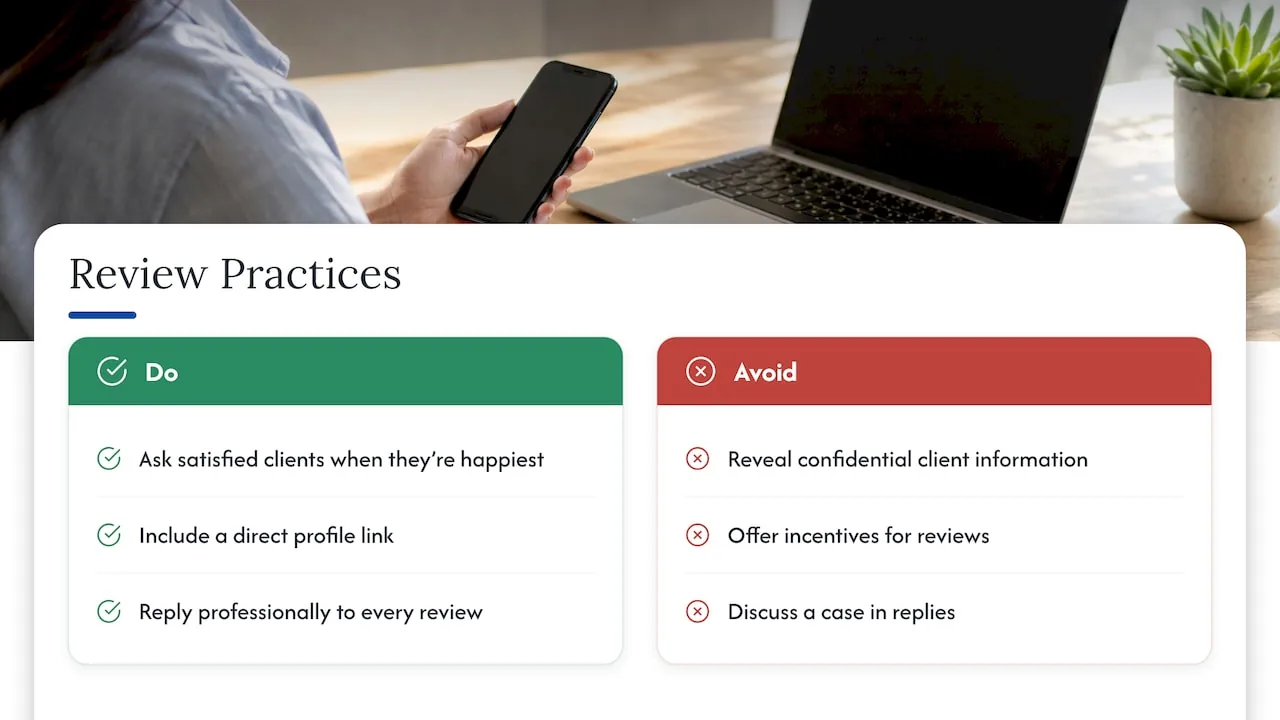
Reviews matter for ranking and for the person deciding whether to call. Ask every satisfied client, at the moment they are happiest, with a direct link to your profile. Reply to each review, positive or not, in a professional tone. Never post details that reveal confidential client information, and never offer incentives for reviews. Lawyers are bound by professional conduct rules, and a reply that discusses a case can create its own problem.
Practice and location pages that earn rankings
The research behind our approach is simple: a page ranks when it is the most useful answer to one specific question from one specific place. For a PI firm, that means a separate page for each type of case you want, and a separate page for each city or county you serve with a real office or real presence.
Keyword research for injury cases
Start with how people actually describe their situation, not how lawyers describe the practice area. Someone searches for a “car accident lawyer” or asks what to do after a rear-end collision long before they search for “motor vehicle negligence.” Group the terms into three layers:
| Layer | Example searches | Best page type |
|---|---|---|
| Case type plus place | car accident lawyer in your city, truck accident attorney in your county | Practice page for that case type in that market |
| Situation questions | what to do after a crash, can I sue after a slip and fall | Guide or FAQ that links to the practice page |
| Process and cost | how contingency fees work, how long a claim takes | Explainer written by an attorney at the firm |
A practical rule: if two searches would be answered by the same page, they belong together. If the searcher needs something different, give it its own page.
What a strong practice page contains
- A clear opening that says what you handle and where, written for the injured person, not for other lawyers.
- The steps a person should take after that kind of incident, written carefully and reviewed by an attorney.
- How your firm handles the case, including how fees work if you offer contingency arrangements.
- Real attorney names, photos, bar admissions and links to bar profiles, because readers verify them.
- Local context: the courts, roads, hospitals or regulations that apply in that market, if you genuinely know them.
- A clear way to call or message you, visible on a phone without scrolling.
Google’s own guidance asks for helpful, reliable, people-first content, and that standard fits legal content well. A page that repeats the same paragraph with a different city name does not meet it.
Service-area pages without the spam
Only build a location page where you can say something true and useful. Cover the courthouses you appear in, the communities you serve, and examples of how local conditions affect a claim. If you do not have an office in a town, be clear about how you serve clients there. Our service area business plan shows how to sequence this work over 90 days.
Stay inside the advertising rules
A personal injury website is attorney advertising. The ABA’s model rule says a lawyer may not make false or misleading statements about the lawyer or the lawyer’s services, and each state adopts its own version, with extra requirements for things like disclaimers, testimonials and result claims. In practice:
- Anything that reads like a promise of an outcome needs careful review.
- Case results on the site should be accurate, current and framed the way your state bar allows.
- Testimonials and reviews should follow your state’s rules.
Before publishing marketing copy, have the responsible attorney check it against your state bar’s advertising rules. We build pages around what a firm can truthfully say, which also makes them better pages.
Technical health and AI answers
Personal injury sites are often slow, heavy with stock imagery and built on templates that repeat the same text across dozens of pages. The technical basics are not glamorous but they decide whether your content is even considered:
- Pages load fast on a mobile connection, since many searches follow an accident and happen on a phone.
- Each page has one clear topic, a unique title and a clean URL.
- Attorney, firm and office details are marked up consistently so search engines can connect them.
- The phone number is tappable and the contact form works.
AI search tools draw on the same signals, with a stronger emphasis on clear, consistent facts about who you are, what you handle and where. That is the thinking behind our stack of SEO, GEO and AEO: define your firm clearly, then make that definition easy to find and verify. Short, direct answers on a page, such as how long you have to file a claim in your state (with a link to the statute), also give answer engines something accurate to quote.
Organic versus paid: how to think about the budget
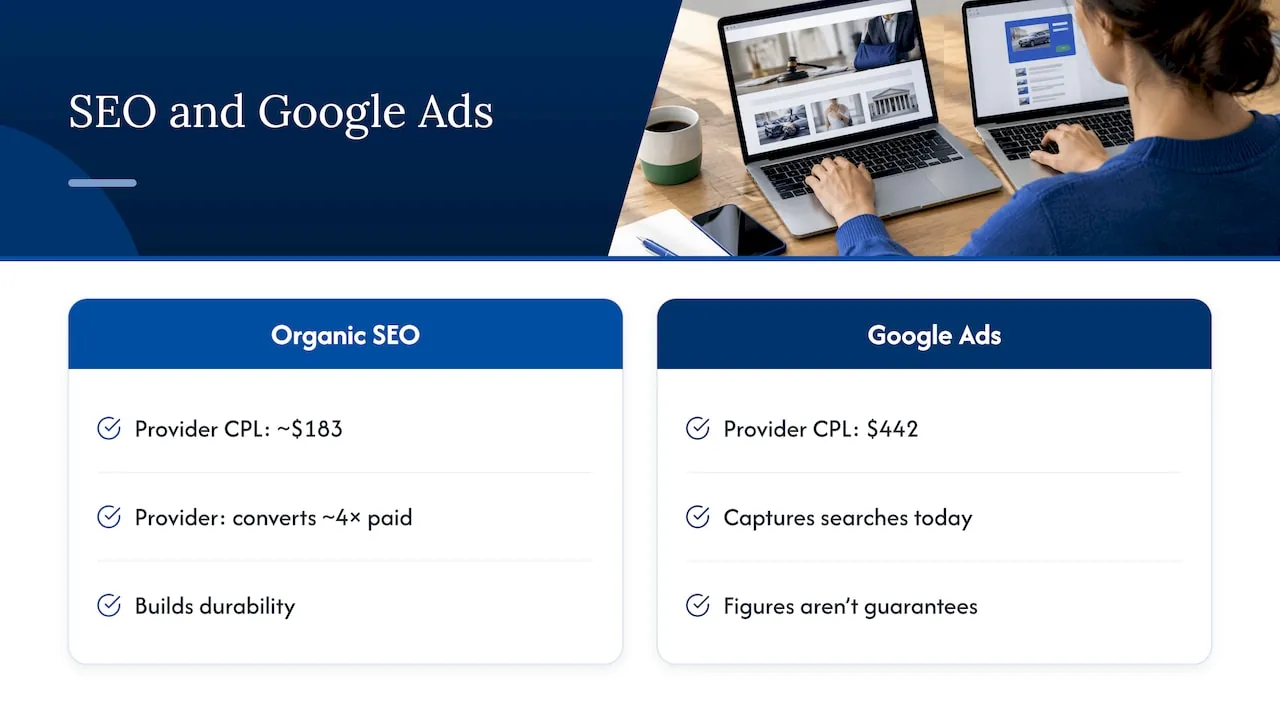
Paid search gives speed. SEO gives durability. In legal marketing the two are rarely either/or: ads capture people searching today while organic work builds toward lower cost per case over time. One agency’s published figures put average SEO cost per lead around $183 against $442 for Google Ads for personal injury firms, and the same report says organic leads convert at roughly four times the rate. Those are one provider’s numbers, so treat them as a direction to test against your own intake data, not a promise.
If you want paid coverage while the organic work builds, our Google Ads management is $499 per month with a one-time $249 setup fee, and the fee is flat rather than a share of your ad spend.
How long it takes and how to measure it
Expect months, not weeks. Profile fixes and cleanup can show movement early, while new practice pages usually need time to be indexed, earn links and build a track record. The speed depends on your market, your starting point and the strength of the firms already ranking.
Track what pays the bills:
- Local pack visibility for your main case types in each city you serve.
- Calls and form submissions from organic search and from your profile, tracked separately.
- Qualified leads, meaning real injury inquiries your intake team could take, not spam or other legal issues.
- Signed cases and cost per signed case by source. This is the number that matters, so connect your case management system to your marketing reports.
Rankings and traffic are signals, not outcomes. A report that shows only keyword positions hides whether the phone is ringing with the right calls.
Our perspective
We work with local service businesses and law firms, and the pattern is consistent: firms that struggle to rank are rarely missing a trick. They are missing a clear definition of who they are online.
Search engines and AI tools both try to answer one question: who is the right firm for this person, in this place, for this problem? When your profile, site, reviews and directory listings all say the same specific thing, you become an easy answer. When they conflict, you become a risk.
That is why we build around the entity first: the firm, its attorneys, its offices and its case types, defined clearly and connected across the web. Technical SEO, local SEO, generative engine optimization and answer engine optimization then work from one foundation instead of competing for attention.
We also believe in transparent reporting. You should see which searches, pages and profiles produce calls, and be able to tie them to signed cases. A retainer is only worth paying if you can see what it is doing.
NSYGHT
Working with NSYGHT on law firm SEO
We are an SEO and AI search agency built around local service businesses, including law firms. Our work covers technical audits, Google Business Profile management, on-page and off-page SEO, content, authority building and SEO-native website design, with strategy tailored to your market and case mix. You can see how we approach legal practices on our law firm SEO page, and our 90-day law firm strategy walks through what we prioritize first.
If you want a plan for your firm and your market, talk to us about SEO services. Our SEO plans (GBP Management, SEO Foundation, SEO Growth and SEO Premium) do not have published prices, so we scope them to your situation. If you only need advice, consulting is $125 per hour.
FAQ
Is SEO worth it for a personal injury firm?
For most firms with a long-term view, yes. Personal injury cases are high value and the searchers are actively looking for help, so a steady organic presence can pay back across many cases. Results depend on your market and starting point, so judge it by signed cases and cost per case.
How is a personal injury lawyer’s SEO different from SEO for other businesses?
The stakes and the scrutiny are higher. Searchers check credentials, bar records and reviews before they call, and your content is subject to attorney advertising rules. The work leans on trust signals, accurate attorney information and carefully written practice pages.
Should I run Google Ads or invest in SEO?
Many firms do both. Ads bring inquiries while organic rankings are still building, and SEO keeps producing leads without paying for each click. Compare both by cost per signed case, not cost per click.
Do I need a separate page for every city?
Only where you can write something true and useful for that market, such as an office there or genuine knowledge of the local courts and conditions. Duplicated pages with the city name swapped out tend to add little. Fewer, stronger pages usually serve you better.
Can I use the same approach for DUI or family law?
The foundation is the same: profile, reviews, practice pages, technical health and clear identity. The case types, keywords and rules differ, which is why we have separate guidance for DUI lawyers and family law.
Sources
- A Guide to SEO for Personal Injury Lawyers, Clio
- How to Find and Choose a Personal Injury Attorney, Nolo
- Improve your local ranking on Google, Google Business Profile Help
- Creating helpful, reliable, people-first content, Google Search Central
- Model Rule 7.1, Communications Concerning a Lawyer’s Services, American Bar Association
- Law Firm SEO ROI, LEXGRO