

See how NSYGHT handles SEO for law firms.
Criminal defense SEO is the work of making your firm show up when someone is searching for a lawyer right after an arrest, a charge or a police call. It rests on three things: a Google Business Profile that is accurate and active, a website with clear pages for each charge you handle, and enough trust signals (reviews, links, consistent listings) that Google and AI answer tools treat your firm as the obvious local choice. Your prospects search in a hurry, often at night, and they call the first firm that looks credible.
This guide covers how defense searches work, what to build, how to stay within attorney advertising rules, and how to measure whether SEO is producing signed cases rather than just traffic.
TL;DR
- Most defense clients search locally and urgently, so the map results (the local pack) and a fully built Google Business Profile matter as much as your website.
- Google says local rankings depend on relevance, distance and prominence, and that you cannot pay for a better local ranking.
- Build one strong page per charge and per city you serve, written for a frightened reader who needs a next step, not for a search engine.
- Advertising rules apply to SEO content and reviews: keep every claim accurate and check your state bar’s rules before publishing.
- Judge SEO by calls, consultations and signed cases, not by rankings alone.
Table of Contents
- Why defense SEO is different from other law firm SEO
- Local SEO vs. organic SEO for defense attorneys
- Step 1: Build a Google Business Profile that earns calls
- Step 2: Build service pages that match how people search
- Step 3: Technical basics that keep your site eligible
- Step 4: Authority, reviews and links
- Staying inside attorney advertising rules
- Step 5: Prepare for AI answers
- Measuring what matters: signed cases, not rankings
- How long does defense SEO take?
- Our perspective
- What working with us looks like
- FAQ
- Sources
Why defense SEO is different from other law firm SEO
A person researching an estate plan may compare firms for weeks. A person facing a DUI, a drug charge or a warrant needs an answer within hours. That changes how you plan your search presence.
First, intent is local and immediate. The searcher types a charge plus a city, or something like “lawyer near me”, and looks at the map results first. Second, the decision is emotional. The reader wants proof that you handle their exact situation, that you answer the phone, and that the first conversation is easy. Third, the stakes for your reputation are high, so thin or exaggerated content hurts more than it does in other industries.
The practical consequence: a defense firm needs to win in two places at once. One is the map results, driven by your Google Business Profile. The other is the organic results, driven by your website content and authority. The two feed each other.
Local SEO vs. organic SEO for defense attorneys
Organic SEO helps your site rank for broader searches such as “what happens at an arraignment” or “first offense DUI penalties in [state]”. Local SEO helps your firm appear in the map pack and local listings when the searcher wants a lawyer nearby.
Google explains that local results are based primarily on relevance, distance and prominence. Relevance is how well your profile matches the search. Distance is how far you are from the searcher. Prominence is how well known you are, and Google notes it can reflect links, articles and directories, so standard SEO best practices help your local ranking too. That is why the two disciplines cannot be separated for a defense firm: your website’s strength feeds your map visibility.
The same Google page makes one point clearly: there is no way to request or pay for a better local ranking. Anyone promising a guaranteed map position is promising something Google does not offer.
| Local SEO | Organic SEO | |
|---|---|---|
| Where you appear | Map pack, local listings | Standard blue-link results |
| Typical searcher | Needs a lawyer now, in a specific city | Researching a charge, process or rights |
| Main levers | Business Profile, reviews, citations, location pages | Service pages, guides, internal links, backlinks |
| Best for | Calls and consultations | Trust, authority, long-term traffic |
Step 1: Build a Google Business Profile that earns calls
For many defense firms the profile is the highest-value asset online, because it sits at the top of the page for urgent local searches.
Google’s guidance is that you can improve local visibility by verifying your Business Profile, providing complete and accurate information, and responding to reviews. In practice for a defense firm:
- Verify the profile and keep the business name, address and phone number identical to your website and other listings.
- Choose the right categories and list the services you actually handle, such as DUI, drug crimes, assault, domestic violence and white collar matters.
- Fill in hours honestly. If you offer after-hours intake or 24/7 phone answering, say so, because arrests do not happen on business hours.
- Add real photos of your office, entrance and attorneys.
- Respond to every review professionally, and never reveal client information or confirm that someone was a client.
One rule catches multi-attorney firms: Google’s guidelines prohibit creating more than one profile per business location and require that the profile reflect your real-world presence accurately. A virtual office address or a duplicate profile for each attorney can put your listing at risk of suspension, which is the last thing you want during a busy season.
For a deeper walkthrough of profile fixes that increase calls, see our guide to Google Business Profile optimization. If you want to see how your map rankings vary block by block across your city, this breakdown of local pack rankings for law firms shows how grid-based tracking works.
Step 2: Build service pages that match how people search
Google states that compelling, useful content can influence your site’s presence in Search more than other suggestions, and that it should be easy to read, well organized, helpful and reliable. For a defense firm that translates into a page architecture.
One page per charge
A single “Practice Areas” page listing ten charges in a paragraph will not compete with a page that is entirely about DUI defense in your county. Create a dedicated page for each major charge you handle. Each page should cover:
- What the charge means under your state’s law, in plain language.
- What happens next: arraignment, bail, hearings, possible outcomes.
- How your firm approaches that kind of case, described accurately and without promising results.
- How to reach you right now, with a visible phone number and an easy way to book a consultation.
If DUI and DWI work is a large part of your practice, our page on SEO for DUI lawyers explains how we approach that niche specifically.
One page per location
If you serve several cities or counties, give each its own page with genuinely local information: the courthouse, the local procedures, the areas you cover. Do not clone one page and swap the city name. Google’s guidance asks for helpful, reliable, people-first content rather than content built to manipulate rankings, and near-duplicate location pages are exactly that.
Make the next step obvious
Clio’s guidance for defense marketing recommends clear service descriptions, reasons to choose your practice and visible contact options such as phone, chat, email or appointment booking. Put the phone number at the top of every page and make it tap-to-call on mobile. Someone who has just been arrested will not hunt through a menu.
Step 3: Technical basics that keep your site eligible
Technical SEO is unglamorous but it decides whether your pages can be found at all. Google recommends allowing crawling, making content findable through internal links, providing a good page experience and creating helpful content. For a defense site, that means:
- Pages load quickly on a phone, since most urgent searches happen on mobile.
- Every important page is linked from your navigation and from related pages. Google explains that links help it discover pages and connect users to relevant resources.
- Your site is secure, indexable, and has no accidental “noindex” tags left over from a redesign.
- Attorney bios, office address and phone are consistent everywhere they appear.
A technical site audit is usually the first step with any new defense site, because fixing a crawl or indexing problem can unlock pages you have already written.
Step 4: Authority, reviews and links
Prominence is the part of ranking that takes longest to build. For a defense firm it comes from sources a searcher would trust:
- Reviews from real clients, collected ethically and answered carefully.
- Local and legal directories with correct, consistent firm details.
- Local press, bar association pages, community involvement that earn genuine links.
- Guides and explainers that other sites and reporters want to reference.
The ethics point matters here. ABA Model Rule 7.2 permits paying for internet-based advertising and marketing vendors, but lawyers generally may not pay others to recommend them. That has a direct bearing on review tactics: do not buy reviews, and do not pay anyone to post endorsements of your firm.
Staying inside attorney advertising rules
Every piece of SEO content is attorney advertising in some form. The ABA Model Rules include Rules 7.1 to 7.3 on information about legal services and solicitation of clients, and communications must not be false or misleading. The Model Rules are a template. Your state bar’s own rules are what bind you, and the ABA maintains resources comparing state advertising and solicitation rules with the Model Rules.
Practical guardrails for defense content:
- Avoid guaranteeing outcomes or implying you can. Past results need the disclaimers your state requires.
- Do not describe yourself with superlatives you cannot substantiate.
- Remember you remain responsible when a vendor writes or publishes content for you. The ABA commentary notes that lawyers must ensure vendor and lead-generator communications comply with Rule 7.1 and must not violate the rules through another person’s conduct.
- Before publishing review pages, testimonials or case results, confirm the format your state bar allows. Your state bar’s ethics counsel or your own compliance contact is the person to ask.
Step 5: Prepare for AI answers
People increasingly ask AI tools and AI-enhanced search for help, including legal questions. Google states that there are no special optimizations or additional requirements to appear in AI Overviews: pages need to be indexed and eligible for regular Google Search. So the foundations above are also your AI foundation.
What we add on top is clarity of identity. AI tools favor sources that clearly state who a firm is, where it practices, and what it handles, and that are corroborated by consistent information across the web. Our resources on Answer Engine Optimization and Generative Engine Optimization explain how we structure content for that, and our guide to tracking AI search visibility covers how to see whether your firm is being cited.
Measuring what matters: signed cases, not rankings
Rankings are a means. The real measure is whether the phone rings with the right people. A useful reporting setup for a defense firm tracks:
| Measure | Why it matters | Where to look |
|---|---|---|
| Impressions and clicks by query and page | Shows which charges and cities you are visible for | Google Search Console |
| Calls and form submissions from search | Shows demand reaching you | Call tracking, Business Profile insights |
| Qualified consultations | Separates real prospects from wrong numbers and shoppers | Your intake log |
| Signed cases and their source | Connects SEO to revenue | Your case management system |
| AI Overview and AI Mode impressions | Shows visibility in AI features | Search Console |
Google’s documentation says Search Console shows indexing information and search performance, including impressions, clicks, queries, pages, countries and traffic trends. It also notes that the Performance report includes AI Overviews and AI Mode data within the Web search type.
The step most firms skip is closing the loop with intake. Ask every caller how they found you, record it, and tag signed cases. Without that, you will optimize for traffic that never retains.
How long does defense SEO take?
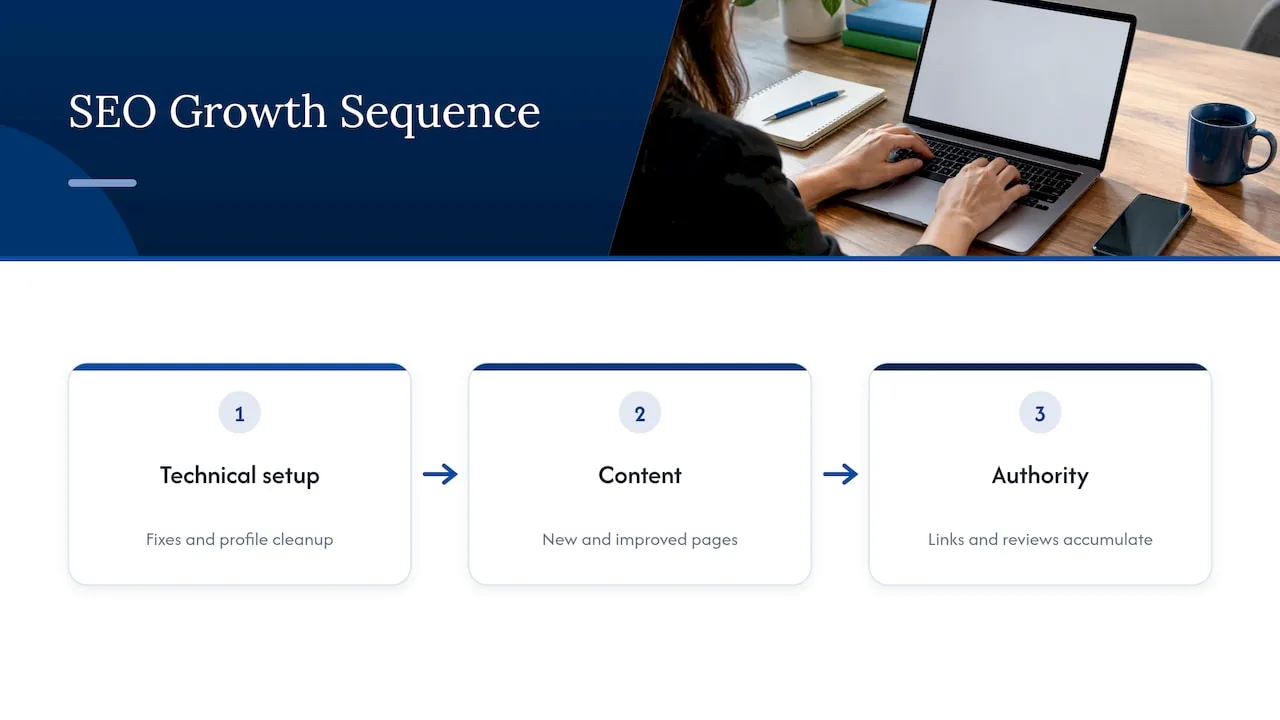
Google describes SEO as helping search engines understand your content and helping people decide whether to visit, and says it aims to improve your presence in Search but does not guarantee a first-place ranking. Nobody can honestly promise a date for page one. What you can expect is a sequence: technical fixes and profile cleanup first, new and improved pages next, then growing authority as links and reviews accumulate. Our 90-day law firm SEO strategy lays out that sequence and what to look at in each phase.
Because defense clients search with urgency, many firms also run paid search alongside SEO while organic visibility builds. Paid and organic answer the same searcher in different positions on the page.
Our perspective
Most defense firms we meet have the same problem: a decent website that says nothing a prospect can verify, and a Business Profile that was set up once and forgotten. The searcher is scared, short on time, and choosing between three firms in a map pack. The firm that looks the most real wins the call.
We build around the idea of a clear digital entity. That means your firm’s name, location, practice areas and attorneys are described the same way everywhere search engines and AI tools look, so you are easy to identify and easy to trust. Technical SEO keeps the site crawlable, local SEO and Business Profile management put you in front of nearby searchers, and GEO and AEO work shapes content so it can be used in AI-generated answers.
We also think reporting should be transparent. A defense firm should be able to see which pages and listings produce calls, and should be judged on consultations and signed cases, not on a rankings screenshot.
NSYGHT
What working with us looks like
We are an SEO and AI search agency that specializes in local service businesses, including law firms. For defense and DUI practices, that means a combination of Business Profile management, technical audits, on-page and off-page SEO, content and authority building, delivered through monthly retainers. You can see the SEO plans, GBP Management, SEO Foundation, Growth and Premium, on our SEO services page, and our overview of law firm SEO shows how we approach practices like yours.
If you want paid search running while organic builds, our Google Ads management is $499 per month with a one-time $249 setup fee. If you would rather start with a conversation about your firm’s situation, consulting is $125 per hour. Details on everything we offer are on our services page.

Ready to see where your firm stands? Start at nsyght.com and tell us your practice areas and the cities you serve.
FAQ
How much does criminal defense SEO cost?
Our SEO plans (GBP Management, SEO Foundation, Growth and Premium) do not have published prices, so scope is set after we understand your market and goals. Paid search is published: Google Ads management is $499 per month plus a $249 one-time setup fee, and consulting is $125 per hour. Ad spend itself is separate from management fees.
Can SEO guarantee my firm a top ranking?
No. Google says SEO aims to improve your presence in Search but does not guarantee first place, and that you cannot pay for a better local ranking. What a good program does is fix what holds you back, build the pages and profile signals that matter, and report what produces calls.
Is criminal defense SEO different from general law firm SEO?
Yes, mainly in urgency and intent. Defense searchers need help immediately, so the map pack, mobile experience, phone access and clear charge-specific pages carry more weight. The ethics rules on advertising and reviews also apply with extra care, since your content addresses people in a crisis.
Do I need separate pages for DUI and other charges?
Generally yes. A dedicated page for each major charge lets you answer that specific searcher’s questions in depth and gives Google a clear match for the query. If DUI is a core practice, a dedicated DUI section with its own supporting pages is worth building.
Sources
- SEO Starter Guide: The Basics, Google Search Central
- Tips to improve your local ranking on Google, Google Business Profile Help
- How to improve your local ranking on Google, Google Business Profile Help
- Guidelines for representing your business on Google
- Creating Helpful, Reliable, People-First Content, Google Search Central
- AI Features and Your Website, Google Search Central
- How To Use Search Console, Google Search Central
- Marketing for Criminal Defense Lawyers: A Guide, Clio
- Rule 7.2: Communications Concerning a Lawyer’s Services, American Bar Association
- Model Rules of Professional Conduct: Table of Contents, American Bar Association
- Professionalism & Ethics in Lawyer Advertising, American Bar Association