
AI search visibility measures how often and how accurately AI systems like ChatGPT, Perplexity, and Google's AI Overviews mention or cite your brand when someone asks a relevant question. It matters because these tools now answer queries directly, often without a single click to your site. The first move: run a prompt-based brand snapshot with a tool like HubSpot's AI Search Grader to see where you stand today.
- Tracking citation rates, not just mentions, is crucial because citations link directly to your website and signal trustworthiness.
- Regular monitoring of AI share of voice, sentiment, and crawl-to-refer ratios helps identify authentic trends and avoid responses driven by sampling variability.
- Optimizing content with clear headings, structured data, and schema markup enhances the likelihood of being cited in AI-generated answers.
- Continually revisiting prompt performance and technical health, including crawlability and blocking issues, is necessary due to frequent AI model updates.
- Building a strong digital entity through technical audits, schema, and PR outreach accelerates AI citation and improves long-term search visibility.
What Metrics Actually Define AI Search Visibility?
Most teams start by asking whether their brand gets mentioned. That's the wrong first question. The better one is whether your brand gets cited, meaning an AI answer links back to a specific URL on your site as its source. A mention is your brand name appearing in generated text. A citation is a reference AI systems can click, verify, and trace, and citations carry far more weight because they signal the model trusts your page enough to attribute a claim to it.
AI share of voice tracks how often your brand shows up relative to competitors across a defined set of prompts, but frequency alone doesn't tell the full story. Position matters too. A brand named first in an AI Overview answer gets read; one buried in a footnote-style list at the bottom often gets skipped entirely.
Prompt coverage is where marketing teams tend to get sloppy. Testing generic queries like "best CRM software" wastes effort compared to testing prompts with real commercial intent, such as "which CRM works best for a 10-person sales team on a tight budget." Build a working shortlist of prompts, roughly 50 to 200, prioritized by purchase intent and topic relevance, and revisit it quarterly as language patterns shift.
A few other signals worth tracking:
- Sentiment and framing: how AI describes your brand (as a leader, an alternative, a budget option) shapes reader perception before they ever visit your site.
- Crawl-to-refer ratio: the rate at which AI crawlers visit your pages versus how often those visits translate into referral traffic or citations.
- Assisted conversions: leads or sales where AI-driven discovery played a role earlier in the buyer journey, even without a direct click.
Track sentiment alongside share of voice. Showing up often but being described as "budget" or "basic" can hurt more than not showing up at all.
One caveat that trips up a lot of teams: AI answers vary by model, by region, and even by the hour you run the query. Search Engine Land's dashboard guidance notes that sampling variability is normal, not a sign your tracking is broken. Treat single snapshots as directional, not definitive.
How Do Teams Actually Monitor AI Visibility?
You don't need every tool category at once. Match the approach to your resources and how fast you need answers.
- One-time graders give you a quick snapshot, comparing how models like GPT, Gemini, and Perplexity characterize your brand right now. They're useful for a baseline or a pitch to leadership, but they go stale fast since AI answers shift week to week.
- Continuous trackers run the same prompt library on a schedule, usually weekly, and chart share of voice and sentiment over time. This is where you catch trends, like a competitor suddenly gaining ground after a PR push.
- Prompt-level testing across models cross-checks the same query against multiple AI systems simultaneously. A brand can rank well in one model's answers and disappear entirely in another, and you only catch that by testing side by side.
- Crawl and log analysis looks at your server logs to see which AI crawlers (GPTBot, PerplexityBot, and similar) are actually visiting your pages, and how that traffic compares to referral clicks you receive from AI answers.
- Manual spot checks remain useful even with automated tools running. Typing your own priority prompts into ChatGPT or Perplexity once a month catches weird framing or outdated information that dashboards might smooth over.
Whatever mix you choose, plan for data hygiene from day one. Export results to CSV, pipe them into a shared spreadsheet or BI tool, and set a fixed update cadence. Ad hoc checking produces noise, not a trend line.
What Content and Technical Changes Improve AI Citations?
Getting cited starts with a shift in how you write, not just what you write about. AI systems break pages into fragments and reassemble pieces from multiple sources to build an answer, so optimizing at the subsection level often beats rewriting an entire page from scratch. A clean H2, a tight three-sentence answer beneath it, and a labeled list nearby are what get lifted into a generated response.
A few structural habits make content more citable:
- Answer the implied question in the first sentence under every heading, before adding context or nuance.
- Use lists and tables for anything comparative; AI systems reuse structured data more readily than dense prose.
- Write self-contained sentences that make sense pulled out of context, since that's exactly how AI extracts them.
- Keep headings aligned with what the section actually delivers, so the mapping between question and answer is obvious to a parsing model.
Schema markup still matters here. Adding Schema vocabulary like FAQPage, Article, and Organization gives machines explicit signals about what a page is and how its parts relate, which reduces the guesswork an AI model has to do when deciding whether to trust and cite a source.
Indexing basics haven't gone away either. Google's generative features run on retrieval-augmented generation, meaning the AI answer is grounded in what's already sitting in the Search index. If a page is blocked by robots.txt, thin on content, or slow to crawl, it never gets a chance to be retrieved, let alone cited. Run a basic crawlability audit before investing in content polish.
Check your robots.txt file specifically for AI crawler user agents. Blocking GPTBot or PerplexityBot by accident is more common than teams expect, especially on sites that added blanket crawler rules years ago for unrelated reasons.
Third-party validation closes the loop. AI systems tend to trust independent sources, meaning PR coverage, industry roundups, and citations on authoritative sites can move your brand into an AI answer even faster than on-site changes alone. Comparison lists, original data studies, and detailed how-tos are the content formats AI cites most, since they answer a specific question with enough structure to lift cleanly.
What Should an AI Visibility Dashboard Actually Show?
A dashboard earns its keep by turning scattered signals into decisions someone can act on this week, rather than cataloging every data point available. Build it around four working views.
Executive overview: total mentions, AI share of voice against competitors, the domains AI cites most often in your category, and assisted conversions tied to AI-driven discovery. This is the view leadership checks monthly.
Content performance: which of your own pages get cited most, mapped against the prompts that triggered those citations, with a trend line showing whether that citation rate is climbing or fading.
Competitor gap analysis: prompts where rival brands (grouped by category, such as "enterprise platforms" or "budget alternatives," rather than tracked one by one) appear and you don't. This tells you exactly which content gaps to prioritize next.
Technical monitoring: AI crawler visit frequency from your server logs, plotted against your crawl-to-refer ratio, so you can see whether increased crawler attention is actually converting into citations or referral traffic.
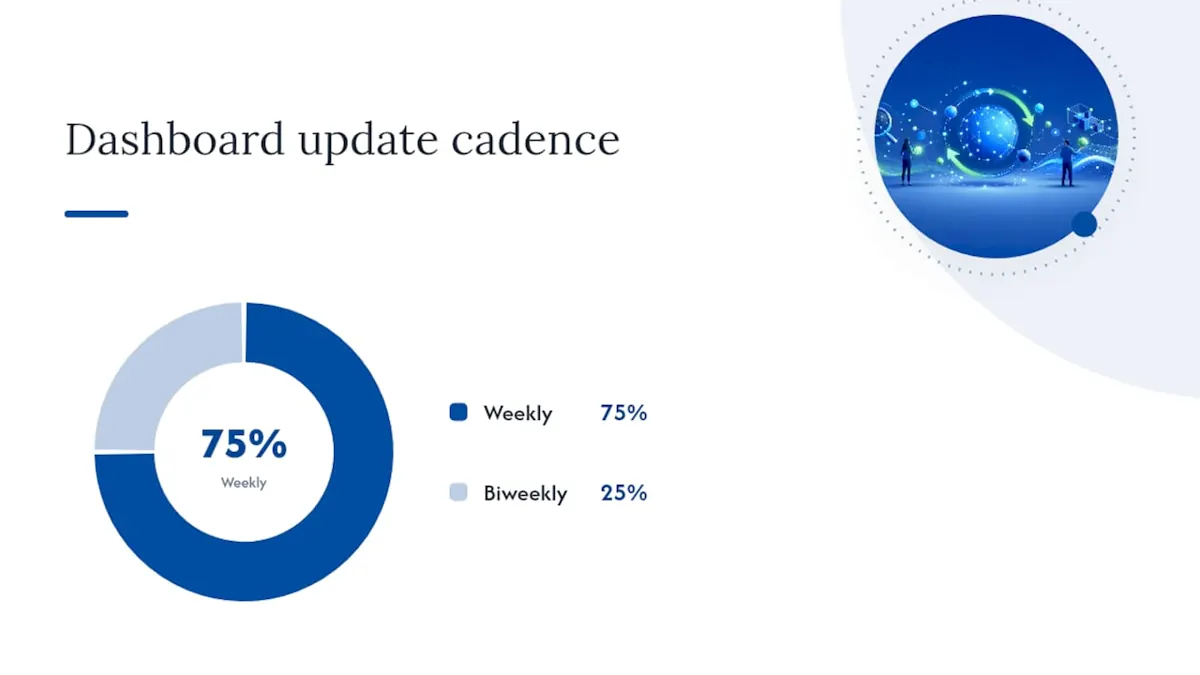
| Dashboard section | Primary data source | Update frequency |
|---|---|---|
| Executive overview | Prompt-sampling exports, GA4 | Weekly |
| Content performance | Prompt-to-page mapping, citation logs | Weekly |
| Competitor gap analysis | Prompt-sampling exports | Biweekly |
| Technical monitoring | Server logs | Weekly |
None of this works without reconciling data sources on a set schedule. Search Engine Land recommends pairing GA4 referral data with server log analysis and prompt-sampling exports, since no single source captures the full picture. The goal isn't perfect attribution. It's spotting which pages to fix and which prompts to chase next.
A 6 to 12 Week Plan for Improving AI Visibility
You don't need a year-long roadmap to see movement. Twelve weeks is enough to go from a cold start to a working system.
- Week 0: Run a brand snapshot across major AI models and identify which of your pages, if any, are already getting cited.
- Weeks 1 to 3: Fix crawlability issues, add relevant schema, and rewrite three priority pages to be more snippable, meaning clear headings paired with tight, self-contained answers.
- Weeks 4 to 8: Update supporting content and start PR outreach aimed at earning third-party citations for your highest-value prompts.
- Weeks 9 to 12: Wire up the dashboard, set a weekly monitoring cadence, and start tracking assisted conversions tied to AI-driven traffic.
Assign clear ownership: an SEO lead for technical fixes, a content owner for rewrites, a developer for schema and crawlability, and a PR contact for outreach. Without named owners, this plan stalls at week three.
Don't wait until week 12 to check results. Rerun your brand snapshot at week 6 as a midpoint gut check, since early GEO fixes often show up in AI answers faster than traditional SEO changes show up in rankings.
Perspective: Why Entity Clarity Speeds Up Citation
A brand with a clearly defined digital entity, meaning consistent naming, structured data, and authoritative signals across the web, gets selected by AI systems faster than one with scattered, inconsistent information. This can be built through combined technical audits, schema implementation, and PR outreach designed to close specific citation gaps rather than chase generic visibility.
How Do AI Algorithm Updates Change Search Visibility?
AI models update far more often than traditional search algorithms, and those updates can shift visibility overnight. A model retrained on newer data might suddenly favor a competitor's recently published comparison page over your older one, even if your content hasn't changed at all. Google's AI Overviews and similar tools also pull from an underlying search index that itself updates continuously, meaning a change in core ranking factors can ripple into AI-generated answers within days.
This creates a different kind of volatility than marketers are used to. Traditional SEO rank tracking shows gradual movement you can usually explain. AI visibility can swing sharply between one sampling period and the next, sometimes without an obvious cause, since model providers rarely publish detailed changelogs for consumer-facing assistants.
The practical response isn't panic, it's cadence. Weekly or biweekly prompt sampling catches these swings early enough to investigate whether a drop reflects an actual content problem or just normal model variance. Brands that only check quarterly often can't tell the difference between a temporary dip and a real competitive loss.
It also means the work is never finished. A page that earns strong citation rates today can lose that position after a model update with no warning, which is exactly why continuous monitoring outperforms one-time audits for any brand serious about maintaining visibility over time.
What Do Real AI Visibility Improvements Look Like?
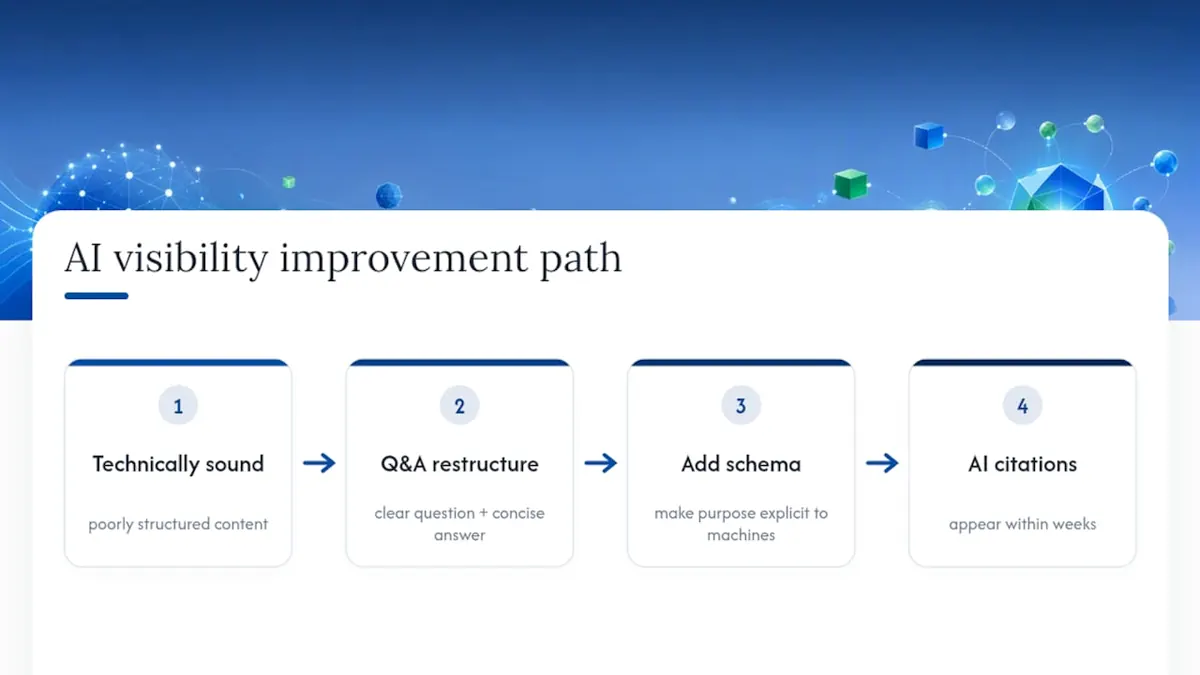
The clearest wins tend to follow a simple pattern: identify a page that's technically sound but poorly structured, restructure it around a clear question-and-answer format, and add schema that makes its purpose explicit to machines. Pages rewritten this way often start appearing in AI citations within weeks rather than the months typical of traditional ranking improvements.
Local and multi-location businesses see this pattern clearly because their content answers specific, high-intent questions, like which dumpster rental company serves a particular neighborhood or which law firm handles a specific type of case in a given city. When that information is buried in unstructured paragraphs, AI systems struggle to extract a confident answer. Restructured into a direct question, a concise answer, and supporting detail, the same information becomes far easier for a model to cite with confidence.
Comparison and roundup content tends to perform especially well. A page that clearly lays out options, criteria, and a direct recommendation gives AI systems exactly the structure they need to lift a citable answer, compared to a narrative blog post covering similar ground without clear delineation.
The common thread across these examples isn't a secret formula. It's structural clarity paired with genuine authority, meaning the content actually answers the question it claims to address, backed by information a model can verify elsewhere.
What Trips Up Most AI Visibility Efforts?
The most common mistake is treating AI visibility as a one-time project instead of an ongoing practice. Teams run a snapshot, make a few fixes, and stop checking, then wonder six months later why competitor mentions have crept up while theirs have flattened.
A second pitfall is chasing mentions instead of citations. It feels good to see your brand name appear in an AI answer, but if that answer doesn't link back to your site, you get brand exposure without the traffic or trust signal a citation provides. Prioritize the pages and prompts most likely to generate an actual citation over broad brand-awareness plays.
Sampling variability trips up a lot of teams too. Running a single prompt once and treating the result as gospel ignores that AI answers shift by model, region, and timing. A single bad snapshot isn't a crisis; a consistent trend across weeks of sampling is worth acting on.
Finally, plenty of brands skip the technical basics because AI optimization sounds like a content problem. It's often a crawlability problem first. A page blocked from AI crawlers, buried behind JavaScript rendering issues, or simply too slow to load never gets the chance to be retrieved, no matter how well it's written.
Where Is AI Search Visibility Headed Next?
Expect AI systems to keep expanding how much of a search journey they handle without a click. As models get better at combining multiple sources into a single synthesized answer, the bar for citation will likely rise, meaning generic content gets filtered out faster in favor of sources that demonstrate clear authority and structural clarity.
Prompt-level personalization is likely to grow too. Answers already vary by user history and context in some AI systems, which means "ranking number one" for a given prompt may eventually mean less than being consistently present across the range of contexts your buyers actually search from.
Third-party validation will probably matter more, not less. As AI providers face pressure to reduce hallucinated or unverifiable claims, leaning harder on independently verifiable sources, meaning brands with strong PR presence and citation history on authoritative sites, are likely to see continued advantages.
Expect measurement tools to mature quickly as well. The current landscape, spanning one-time graders to continuous dashboards, will likely consolidate as more marketing teams demand reliable, board-ready reporting on AI-driven discovery, similar to how rank tracking standardized years after traditional SEO first took hold.
Short Business Perspective: Weighing ROI and Trade-offs
Zero-click AI answers reduce direct site traffic, but they can widen brand reach in ways a click-through metric misses entirely. Early ROI signals worth watching: rising assisted conversions and better-qualified inbound leads mentioning your brand by name. If those numbers move within eight to twelve weeks, scale the work. If they stay flat, treat it as an ongoing experiment rather than a budget priority.
How NSYGHT Helps You Build Real AI Search Visibility
NSYGHT is the direct alternative to guessing your way through AI visibility with scattered tools and one-off audits. Instead of a generic content refresh, NSYGHT combines a technical audit, entity-driven SEO architecture, and GEO/AEO implementation into one coordinated build, so your brand's digital entity is clear enough for AI systems to select and cite with confidence.
An initial engagement typically starts with a diagnostic: where your brand currently shows up in AI answers, which pages already earn citations, and where the structural gaps sit. From there, the NSYGHT stack layers in schema, content restructuring, and PR outreach aimed at the prompts that matter most to your business, whether that's a dumpster rental company trying to dominate local searches or a law firm competing for high-intent case inquiries. Early outcomes usually show up first in crawl activity and citation rate, well before broader share-of-voice metrics shift.
If you're ready to see where your brand actually stands, schedule a consultation with NSYGHT and get a clear read on your current AI visibility along with a prioritized plan to improve it.
Sources
- Optimizing for generative AI features on Google Search | Google Search Central
- Optimizing your content for inclusion in AI search answers | Microsoft Advertising
- How to build an AI visibility dashboard | Search Engine Land
- The Complete AI Visibility Guide for SEOs, Marketers, and Site Owners | Ahrefs
Frequently Asked Questions
Traditional SEO focuses on ranking pages in a list of blue links, while AI search visibility measures whether your brand gets mentioned or cited inside a generated answer. The two overlap heavily since Google's AI Overviews rely on the same Search index used for standard rankings, but AI visibility adds new signals like citation rate and sentiment that traditional rank tracking never captured.
Weekly sampling across a prioritized set of prompts gives you enough data to spot real trends without drowning in noise. A minimal library of 50 to 200 prompts sampled weekly across a few major AI models covers most brands' practical monitoring needs.
Yes. AI systems parse content in fragments, so restructuring key subsections, meaning clearer headings, tighter answers, and added schema, often improves citation odds faster than a full site rewrite. Start with your three highest-traffic or highest-intent pages before touching the rest of the site.
NSYGHT runs technical audits and entity-driven SEO builds specifically designed to improve how AI systems select and cite a brand, combining GEO and AEO tactics with schema and PR outreach. Current pricing and service details are listed on the NSYGHT services page.
Treating it as a one-time project instead of continuous monitoring is the most common mistake, since AI models update frequently and visibility can shift without warning. Chasing mentions over actual citations is a close second, since a brand name appearing in an answer without a linked source provides far less business value than a genuine citation.