
See how NSYGHT handles SEO for dental and orthodontic practices.
Prefer to hand it off? See our Google Ads management.
Google Ads works for a dental practice when it is built around booked appointments, not clicks. The practices that profit set up call and form tracking first, split campaigns by procedure, send each ad to a matching landing page, and judge results by new patients who actually show up. Everything below is how we would set that up, and where practices usually lose money.
TL;DR
- Start with high-intent searches (emergency dentist, dental implants, Invisalign, new patient exam) and keep each procedure in its own campaign or ad group.
- Measure booked and attended new patients, not raw calls. Google lets you set a minimum call length and import offline conversions from your own systems.
- Treat compliance as part of the strategy: the ADA says advertising claims must be truthful and nonmisleading, and state rules and privacy law (including HIPAA) also apply.
- Ads and local SEO work as a pair. Ads give you speed, a strong Google Business Profile and a good site lower the cost of every click.
- Multi-location groups need shared account structure and tracking, but locally accurate ads and landing pages for each office.
Table of Contents
- Why dentists use Google Ads
- How to structure a dental Google Ads account
- Dental ad examples and what makes them work
- Tracking: count patients, not calls
- Compliance: what to check before launch
- How much to budget
- Where the landing page decides the result
- Our perspective: ads are a measurement problem first
- Running ads with us
- A 30-day launch checklist
- FAQ
- Sources
Why dentists use Google Ads
Someone with a broken tooth or a quote for an implant is not browsing. They search, compare two or three results, and call. Paid search puts your practice at the top of that moment, in the area you choose, within days instead of the months organic rankings can take.
The tradeoff is that you pay for every click, and dental clicks are some of the pricier ones in local advertising. That is why structure matters more than budget. A small, well-built account beats a large, sloppy one, because the sloppy one pays for searches like “dental school near me” or “cheap dentures” that never become patients in your chair.
If you are still deciding between paid search and organic work, our piece on using a two-week ad test to pick SEO targets shows how a short campaign can tell you which services and neighborhoods are worth ranking for.
How to structure a dental Google Ads account
Most wasted dental spend traces back to one campaign holding everything. A cleaner layout looks like this:
- One campaign per service line. General and new-patient, emergency, implants, cosmetic and whitening, clear aligners, pediatrics if you offer it.
- Tight ad groups inside each. Two to five closely related keywords per group so the ad can mirror what the person typed.
- Location targeting that matches how patients travel. Use the radius or the zip codes your patients actually come from, and check the reports to see where the booked patients live.
- A landing page for each service. A page about implants should answer implant questions, show the office and dentist, and put a phone number and booking form at the top.
- Negative keywords from day one. Exclude jobs, schooling, free care, DIY and products. Review the search terms report weekly at first.
Keywords that tend to carry intent
Think in three tiers:
| Tier | Examples | What to expect |
|---|---|---|
| Urgent need | emergency dentist near me, tooth pain, broken tooth | Highest urgency, calls often within minutes, needs after-hours handling |
| High-value procedures | dental implants [city], Invisalign [city], full mouth restoration | Costly clicks, fewer leads, large case value |
| Routine entry | new patient dentist, dentist accepting [insurance], teeth cleaning [city] | Lower cost per lead, value comes from lifetime retention |
Broad generic terms such as “dentist” attract the widest and least qualified audience. Start with phrase and exact match on specific procedures, then widen only when the search terms report shows you are not leaking budget.
Dental ad examples and what makes them work
Good dental ads answer the worry behind the search. A person typing “emergency dentist” wants to know you are open and will answer. Someone searching for implants wants to know you can explain cost and options without pressure. These are illustrative templates for the structure, not copy to paste. Adjust every claim to what your practice can truthfully support.
Emergency search
- Headline: Emergency Dentist in [City] | Call Now
- Headline: Same-Day Appointments Available
- Description: Tooth pain or a broken tooth? Call our [City] office. Evening and weekend slots for urgent cases.
New patient search
- Headline: New Patient Exam & X-Rays in [City]
- Headline: Accepting [Insurance] and Self-Pay Patients
- Description: Meet Dr. [Name]. Book online in two minutes or call us. Clear pricing before treatment starts.
Implant search
- Headline: Dental Implants in [City] | Free Consult
- Headline: Meet Your Implant Dentist
- Description: Learn your options, timeline and costs at a no-pressure consultation.
What these share: the city in the headline, one clear action, a reason to pick you (hours, insurance, the dentist’s name), and no promise you cannot back. Add call, location and callout assets so the ad carries your phone number, address and a few specifics like Saturday hours.
Pricing offers need extra care. A published first-visit price can lift response, but the ADA’s guidance says state rules vary and legal review is appropriate for offers, testimonials, pricing and guarantees. Check your state dental board’s rules before running a number in an ad.
Tracking: count patients, not calls
This is where most dental accounts quietly fail. Google can report a conversion for every call, but a call from a salesperson, a wrong number or a person asking about a different office is not a patient.
Google’s call-conversion documentation describes several ways to count calls: calls directly from the ad, calls to the number on your website after an ad click, taps on a mobile number, and imported offline call conversions. For ad and website calls you set a minimum duration, so a five-second hang-up does not count. Importing offline conversions goes further, since you count only the calls that meet your own definition of value.
A practical setup:
- Level 1: a call of a set minimum length, plus form submissions and online booking requests.
- Level 2: a call or form your front desk marks as a real new-patient inquiry.
- Level 3: a booked or attended new-patient visit, reconciled from your practice-management system.
Google notes that imported call conversions rely on call details tracked in another system, such as a CRM. Your front desk keeps patient-level records in your own systems, and you do not need to send names, reasons for visit or form answers to Google. Get privacy advice before connecting systems.
Call-analytics platforms can pass campaign, ad group and click identifiers, as Google’s call-details documentation explains. That makes lead routing and feedback possible, and it raises the stakes on vendor review. On recordings specifically, Google says recording is skipped automatically for some sensitive healthcare advertisers unless they explicitly enable it. Recordings can hold sensitive information, so talk to your privacy counsel before turning anything on.
Once tracking is in place, the reporting question changes from how many calls came in to which campaigns produce bookable, profitable patients. If you are building that reporting layer, this overview of ad performance KPIs shows how to think about funnel-stage metrics rather than a single number.
Compliance: what to check before launch
Dental advertising sits inside several rule sets at once.
- Truthful, nonmisleading claims. The ADA says state unfair and deceptive-practices laws apply alongside dental-specific rules. That covers “best dentist in town” style superlatives, outcome promises and guarantees.
- Privacy. The same ADA guidance says federal and state privacy laws, including HIPAA, matter. Even confirming that someone is your patient, including in a reply to a review, can create exposure.
- Google’s own policies. Google’s healthcare application flow names restricted categories such as prescription-drug services, addiction services and health insurance. Under its healthcare and medicines policy, ads exclusively for dental, vision or travel health insurance coverage are not restricted. Routine dental services are not the target of these rules, but if your copy touches sedation, prescription drugs or other regulated subjects, review current policy first.
Run offers, testimonials and before-and-after imagery past your state dental board’s rules and your attorney. Doing it before launch is cheaper than pausing an account afterward.
How much to budget
There is no single right number, and anyone quoting one without knowing your market is guessing. Cost per click swings with your city, the competition and the procedure. Implant and orthodontic terms are generally pricier than general dentistry, and dense metro areas cost more than small towns.
A better way to set budget is to work backward:
- Estimate what a new patient is worth to you over a year or two, not just the first visit.
- Decide what you would pay to acquire one.
- Estimate how many clicks it takes to produce a booked patient, from your own data once you have a month or two of it.
- Multiply to get the monthly spend that can sustain your target.
Early numbers are rough. Treat the first 60 to 90 days as a learning period, and judge it by cost per booked patient, not cost per click.
Management fees are a separate line. Many agencies charge a percentage of ad spend, which means your fee rises whenever your spend does. Our approach is different: Google Ads management with us is $499 per month, with a one-time $249 setup fee.
Where the landing page decides the result
You can write a strong ad and still lose the patient on the page. A few fixes that consistently help:
- Put the phone number as a tap-to-call button and a short booking form above the fold on mobile.
- Match the headline to the search. An implant ad lands on an implant page, not the home page.
- Show the real dentist and team and the real office, with hours and parking details.
- State insurance participation clearly. If you are out of network with a plan, say how self-pay or financing works.
- Keep the page fast and the form short. Name, phone and preferred time are usually enough.
- Use the same call-tracking number setup across the page so every call is attributed.
This is also where organic work and ads reinforce each other. Searchers often check your reviews and Google Business Profile before they click or call, so a GBP-first local SEO approach and a plan for ranking higher on Google Maps lift ad performance too.
Our perspective: ads are a measurement problem first
When dental practices come to us unhappy with Google Ads, the ads are rarely the main issue. The usual story is a single campaign, a conversion action that counts every call, and a monthly report that shows leads but never says how many became patients. The agency looks good, the budget keeps going out, and nobody can say what a booked patient cost.
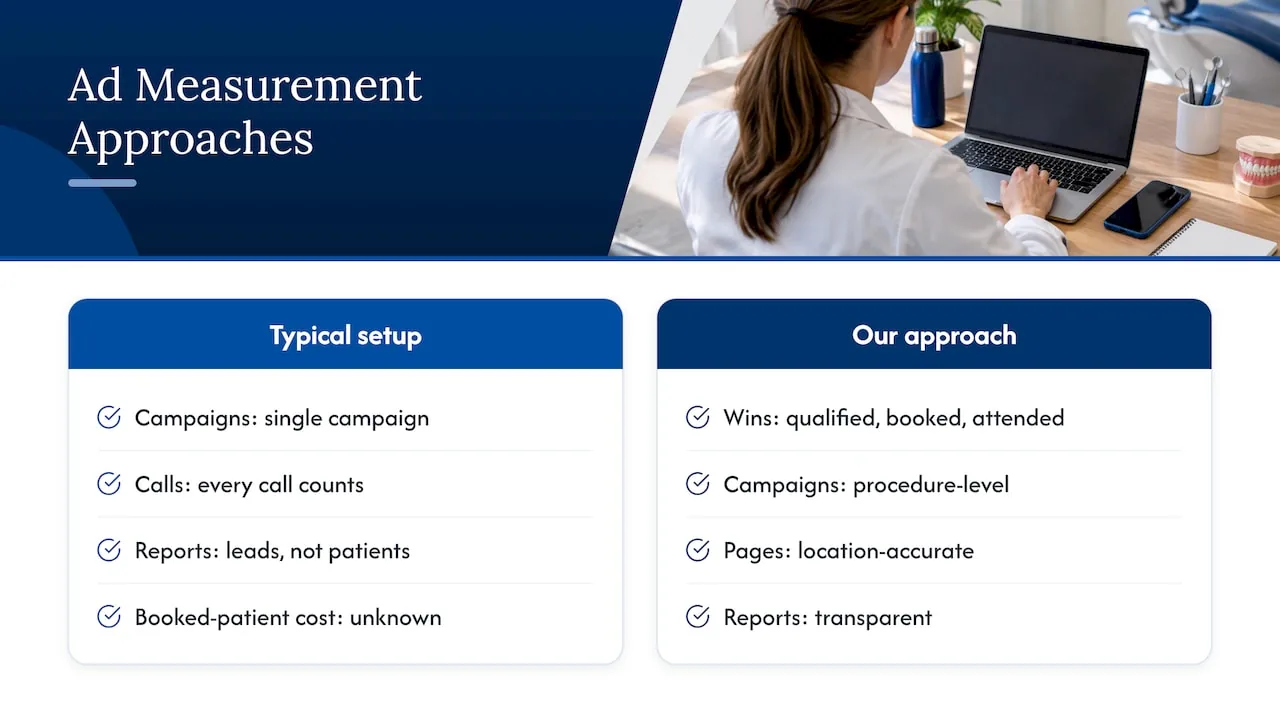
We approach it the opposite way. First we define what counts as a win with the practice: a qualified inquiry, a booked appointment, an attended visit. Then we build the account around that definition, with procedure-level campaigns, location-accurate landing pages and transparent reporting. We pair paid search with local SEO and Google Business Profile work, because the three feed each other: ads give fast data on which services convert, and that data shows where organic effort should go.
For multi-location groups, consistency means shared account architecture, naming conventions, negative-keyword governance, conversion definitions and a common reporting model. It does not mean identical ads. Every office needs its own hours, providers, insurance participation, landing page and service area.
, NSYGHT
Running ads with us
If you want a team to build and manage this, our Google Ads management service covers account structure, tracking, ad copy and reporting for $499 per month, plus the $249 one-time setup fee. If you also want to reach patients on social, Facebook and Instagram ads are $349 per month with a $249 setup fee. You can see the rest of our work for practices on our dental SEO page, or start from the full services list.
A 30-day launch checklist
- Week 1: Confirm your conversion definitions, set up call and form tracking, and agree on a front-desk process for marking real new-patient inquiries.
- Week 1: Build one landing page per service, with local proof and a visible phone number.
- Week 2: Launch two or three campaigns for your highest-value services. Use exact and phrase match, with a starting list of negatives.
- Week 2 to 4: Read the search terms report every few days. Add negatives, pause weak terms, and test two ad variations per group.
- Week 4: Reconcile ad-attributed calls and forms against actual bookings. Decide where to scale, fix or stop.
FAQ
Do Google Ads work for dentists?
Yes, when they are tied to specific procedures and measured against booked patients. Paid search reaches people at the moment they want care, so intent is high. Results depend on your market, your landing pages and how quickly your front desk answers calls.
How long before I see new patients?
Calls can start within days of launch, but plan on 60 to 90 days to learn which keywords and ads produce booked patients. Early data is noisy. Judge it by cost per booked patient once you have enough volume to compare.
Can I advertise prices and promotions?
Often yes, but the rules depend on your state. The ADA says advertising must be truthful and nonmisleading, and state rules vary, so have offers, guarantees and testimonials reviewed by your attorney or state dental board guidance before they run.
Should I choose Google Ads or SEO?
Most practices benefit from both. Ads bring patients quickly and show you which services convert, while local SEO builds lasting visibility that lowers your reliance on paid clicks. If budget is tight, a short ad test can point to the services worth investing in organically.
Sources
- Google Ads Help: call conversions
- Google Ads Help: call details and attribution
- Google Ads Help: call recording for healthcare advertisers
- Google Ads healthcare application flow
- Google Advertising Policies: healthcare and medicines
- ADA: marketing and advertising legal guidance
- Ad performance KPIs