
Yes, AI can work for SEO when it's used as a drafting and research tool and when human editorial effort adds real information gain. Google permits AI-produced content as long as it's helpful and not built primarily to manipulate Search. The rest of this guide covers the policy context, the real risks, and a step-by-step workflow you can run without inviting a manual action.
- Publishing thousands of AI-generated pages without added insights or verification is likely to be considered scaled content abuse and may result in search ranking penalties.
- Incorporating unique data, firsthand examples, and expert review into AI drafts significantly reduces the risk of factual errors and enhances content quality relevant to Google’s helpfulness standards.
- Verification of all factual claims against primary sources and applying metadata tags for AI-generated images or product data are essential steps before publishing AI-assisted content.
- Human editors must approve all pages, especially those on high-stakes topics, with a focus on adding real experience and proprietary information to avoid low-value, spam-like output.
- Monitoring engagement metrics, keyword performance, and indexation issues post-publication helps identify and remediate low-quality AI-created pages effectively.
What Google says and the policies that matter for AI content
Google's guidance on AI-generated content is more permissive than many marketers assume: the method of production, human or automated, is not the ranking factor. What matters is whether the page is genuinely helpful, original, and written for people rather than for search engines. That principle is spelled out further in Google's guidance on creating helpful, people-first content, which tells creators to avoid "search-engine-first" pages and to prioritize content shaped by real experience.
The line gets stricter once volume enters the picture. The March 2024 core update and spam policy changes specifically target what Google calls scaled content abuse: mass-produced, unoriginal pages generated primarily to manipulate rankings. Google's spam policy documentation names this practice directly and treats it as a violation regardless of whether a human or a machine did the generating.
In practice, the difference between acceptable and abusive automation comes down to intent and effort:
- Acceptable: using AI to draft an outline, then adding original data, examples, and expert review before publishing.
- Acceptable: AI-assisted product descriptions that a team fact-checks and edits for accuracy.
- Abusive: publishing thousands of AI pages targeting keyword variations with no unique information.
- Abusive: spinning existing articles into "new" pages with no added insight or verification.
Google's guidance on generative AI content also recommends disclosure in specific cases, including labeling AI-generated product data and adding IPTC DigitalSourceType metadata to AI-generated images, particularly on ecommerce sites.
Practical benefits and principal risks of using AI for SEO content
AI earns its place in a content pipeline when it removes friction from the parts of writing that don't require judgment. It speeds up first drafts, generates topic and keyword ideas quickly, and can produce a working outline in minutes instead of hours. Used this way, it's a research accelerant, not a replacement for a writer.
The risks sit on the other side of the same ledger:
- Hallucinated facts, statistics, or citations that sound plausible but aren't verifiable anywhere.
- Factual drift on topics that changed recently, since models can be trained on outdated information.
- Low information gain: content that restates what's already ranking without adding anything new.
- Commodity output at scale, which is the exact pattern Google's spam policies flag as abusive.
These risks compound on high-stakes topics. A page about health, finance, or legal matters that reads well but contains an unverified claim can damage a site's E-E-A-T signals and its reputation with readers who act on bad advice. A common failure mode looks like this: a team publishes fifty AI-drafted blog posts in a month, sees rankings stall or drop after a core update, and later discovers most pages carried no original data point, expert quote, or firsthand example. The fix isn't abandoning AI, it's adding the editorial layer that was missing from the start.
Repeatable workflow: how to use AI as a draft engine and enforce editorial quality
A safe AI-assisted workflow treats the model as a fast first-pass tool, never the final author. Here's a sequence that holds up under scrutiny:
- Write a brief before opening the AI tool. Define the unique information the page must contain, whether that's a data point, a local example, or a firsthand observation, and require it to pass an information-gain test against the top-ranking pages.
- Use AI for research and structure, not final copy. Let it suggest keyword clusters, competitor gaps, and a rough outline, then rebuild the skeleton around your brief's unique elements.
- Fact-check every claim against a primary source. Statistics, dates, names, and technical details get verified individually; nothing goes live on the model's word alone.
- Add expertise a model can't fabricate. Firsthand examples, proprietary data, client results, or a practitioner's judgment call turn a generic draft into something that demonstrates real experience.
- Handle technical and metadata details before publishing. Apply schema where relevant, use IPTC DigitalSourceType tagging for AI-generated images, and confirm the page is crawlable and indexable rather than orphaned.
- Route every page through an approval gate. A human editor signs off before publication, and teams producing content at scale set a sampling threshold, reviewing a meaningful share of pages rather than assuming quality holds across the whole batch.
Block publication on any brief missing its "unique data point" field. That one gate stops the most common form of scaled, low-value content before it starts.
This sequence works because it separates speed from judgment. AI compresses the time spent on structure and research. Humans still own accuracy, originality, and the experience-based insight that Google's people-first guidance asks for.
A practitioner's playbook: templates, sampling, KPIs, and safeguards
Here is a suggested approach to structuring AI-assisted content production to align with Google policy and typical client expectations. The editorial checklist involves steps such as testing for information gain compared to current top results, verifying sources for factual claims, and including at least one firsthand example, data point, or local detail on each page.
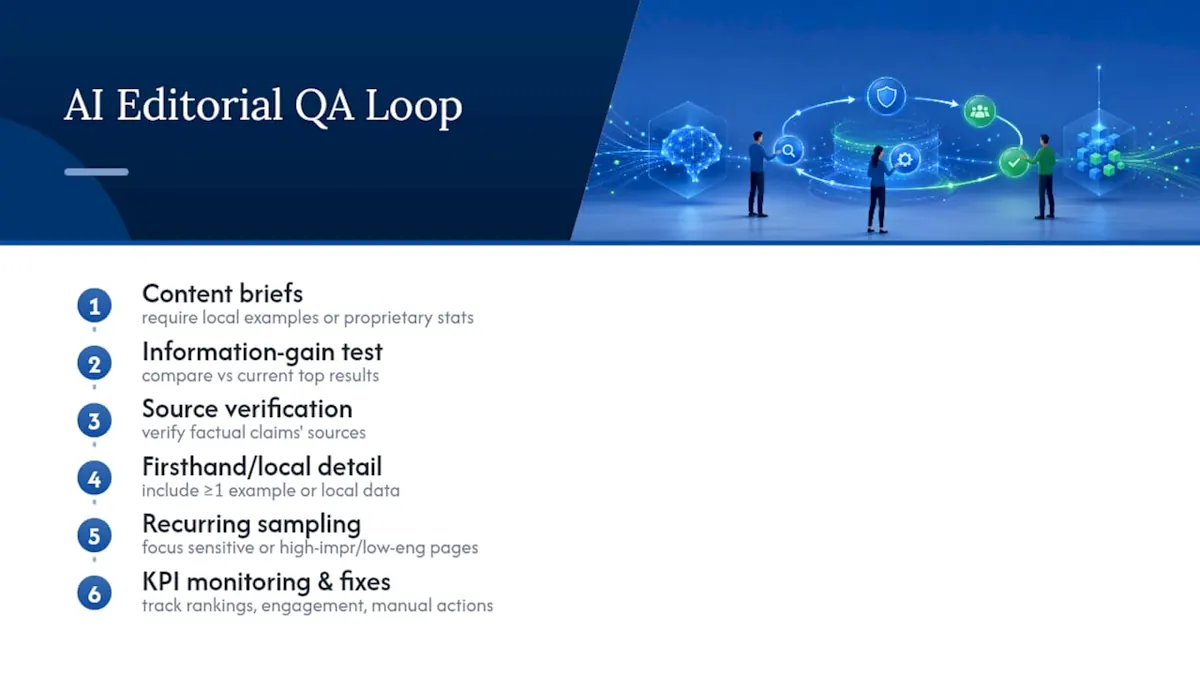
For scaled production, implementing a recurring sampling plan that focuses on sensitive topics or pages with high impressions but low engagement can help catch quality issues early.
Key performance indicators to monitor after publishing include ranking movement within a defined window, user engagement metrics from impressions through clicks, and any manual actions or unusual indexing drops that may indicate issues.
Google's own guidance points to the core risk directly: scaled, unoriginal content is treated as spam regardless of production method, which is why the sampling and information-gain steps aren't optional extras.
Content briefs that promote uniqueness may request specific local examples, verifiable statistics, or proprietary insights before drafting begins. Incorporating Answer Engine Optimization (AEO) and Generative Engine Optimization (GEO) considerations can help structure answers to support discovery in both generative and answer-engine results, in addition to traditional rankings.
How to measure, audit, and remediate AI-created pages
Watch impressions, click-through rate, average position, and organic traffic in the first several weeks after publishing. A page that gets impressions but no clicks, or clicks with a fast bounce back to search, is signaling a quality problem before rankings even move.
Behavioral and quality signals worth tracking:
- Pages with high impressions and low engagement, which often indicate the content doesn't match search intent.
- Clusters of near-duplicate pages targeting minor keyword variations with no unique angle.
- Sudden indexing drops or a spike in pages excluded from the index.
Run audits on a fixed cadence, sampling a share of AI-assisted pages rather than checking only the ones that seem to be underperforming. When a page fails the review, the remediation options are the same as for any weak content: improve it with real data and expertise, merge it into a stronger page covering the same topic, or noindex or remove it if it adds nothing the site doesn't already have elsewhere.
Agency perspective: ethics, client communications, and pricing when offering AI-assisted content
AI-assisted production makes sense when a client needs volume and has the resources to fund real editorial review. It's the wrong fit when a topic is high-stakes enough that a factual error carries real consequences and no one on the team has time to verify claims properly.
Agencies should document exactly where AI touches the process, who reviews what, and who owns the final fact-check. When you price this work, the editorial review itself, not the drafting, is the line item that protects the client: a review pass by someone who checks sources and adds firsthand insight costs real time, and cutting that cost is what leads to scaled-content problems later.
NSYGHT services: how we help teams adopt AI responsibly
If your team is generating AI drafts faster than your editors can verify them, that gap is where rankings quietly erode. Our SEO Foundation, SEO Growth, and GBP Management services build the editorial and technical structure around AI-assisted workflows, from entity-driven content briefs to the schema and metadata work that keeps pages crawlable and properly labeled.

We also run content audits that check exactly what this guide covers: information gain, source verification, and scaled-content risk across your existing pages. If you want a practical read on where your AI-assisted content stands before the next core update, reach out to NSYGHT for a consultation.
Frequently Asked Questions
Google does not penalize content simply because it was produced with AI. Its guidance on AI-generated content states that helpful, original, people-first content is rewarded regardless of how it was created, but mass-produced unoriginal content used to manipulate rankings falls under scaled content abuse.
Scaled content abuse refers to generating many pages, by AI or any other method, with the primary goal of manipulating search rankings rather than helping readers. The March 2024 core update and spam policy changes specifically expanded enforcement against this pattern.
There's no fixed percentage, but every factual claim needs verification against a primary source, and every page needs at least one element of genuine information gain, such as a firsthand example or proprietary data. Google's people-first content guidance frames this as the difference between content written for readers and content written mainly for search engines.
Yes, in certain cases. Google's guidance on generative AI content recommends labeling AI-generated product data and using IPTC DigitalSourceType metadata for AI-generated images, particularly on ecommerce sites.
NSYGHT builds entity-driven content briefs and editorial review gates around AI-assisted workflows as part of its SEO services, pairing technical SEO with GEO and AEO structuring so drafts support both traditional rankings and AI-generated answers.