
Urgent care SEO is the work of making your clinic the one a sick or injured person finds, trusts and drives to within minutes. It rests on three things: a complete, accurate Google Business Profile, a website with a page for every location, and a steady flow of recent reviews. Done well, it puts you in the map pack at the moment of need. We build this for local and multi-location service businesses, and for clinics the work starts with the profile and the location pages, because that is where the decision gets made.
TL;DR
- Urgent care searches are local and immediate. Google ranks local results mainly on relevance, distance and prominence, so complete, accurate listings carry the most weight.
- Your Google Business Profile does the heavy lifting: precise categories, one profile per location, exact hours (holidays included), and fresh photos and posts.
- Every location needs its own page with address, phone, hours, services and insurance details, readable and tappable on a phone.
- Review replies and public content must never confirm that someone was a patient. Privacy comes before polish.
- Measure calls, direction requests and completed visits, not just rankings or traffic.
Table of Contents
- What urgent care SEO actually means
- How Google decides who appears in “near me” results
- Build the Google Business Profile first
- Give every location its own page
- Make the mobile experience fast and obvious
- Reviews: velocity, replies and privacy
- Match the search intent you actually serve
- What to measure
- A realistic 90-day plan
- Our perspective on urgent care SEO
- Where we can take this off your hands
- FAQ
- Sources
What urgent care SEO actually means
SEO stands for search engine optimization: the practice of earning visibility in unpaid search results. For an urgent care clinic, that visibility is almost entirely local. Someone types “urgent care near me,” “x-ray open now,” or “stitches walk-in” into a phone, looks at three map listings, and picks one. The clinic that appears, looks open, and looks trustworthy gets the visit.
That is different from a primary care practice, where a patient may research a doctor for weeks. Urgent care is a short, high-pressure decision, so the signals that matter are the practical ones: distance, hours, wait expectations, accepted insurance and recent reviews from people who were just there.
SEO also matters because paid advertising alone gets expensive. Alan Ayers, senior editor of The Journal of Urgent Care Medicine, notes that digital advertising takes the largest share of urgent care marketing spend, which creates diminishing returns, and that local centers compete with well-funded health systems, national operators and demand generation services. Organic visibility is how an independent or regional clinic holds its ground against those budgets without paying for every click.
It now includes AI-driven answers as well. People ask assistants and AI search tools where to go for a sprain or a fever, and those tools draw on the same facts: a clearly defined business, consistent details across the web, and credible reviews. A clinic that defines itself clearly serves both traditional search and AI answers with the same groundwork.
How Google decides who appears in “near me” results
Google is direct about the mechanics. Its guidance says local results are mainly based on relevance, distance and prominence, and that businesses with complete and accurate information are more likely to show up. Each factor maps to something you can control.
| Factor | What Google is asking | What a clinic can do |
|---|---|---|
| Relevance | Does this profile match what the person searched? | Specific categories, a clear services list, location pages that name the conditions and services you treat |
| Distance | How close is this clinic to the searcher? | Accurate address and pin, one profile per location, no stretching your listing to areas you do not serve |
| Prominence | How well known and trusted is it? | Recent reviews, consistent listings across the web, quality links and mentions |
Distance is the one factor you cannot change, which is why multi-location groups should treat every clinic as its own local campaign. A network of five clinics does not have one local ranking. It has five, each with its own neighbors and competitors. Our guide to multi-location SEO covers how to keep that consistent at scale.
Build the Google Business Profile first
For most urgent care searches, the profile in the map pack is the first thing a patient sees and sometimes the only thing. It deserves the first and most careful effort.
Categories, names and one profile per location
Google’s business representation guidelines ask for the fewest categories that describe your core business, as specific as possible, and warn against using categories as keywords or to describe attributes. They also say there should be only one profile per business location. For a clinic, that means choosing the category that best matches the care you deliver and resisting the urge to stack extras. Name the profile the way the clinic is known in real life, signage included. Keyword-stuffed names invite suspensions.
Hours that match the door
Hours are the single most damaging thing to get wrong. A profile that says open while the lights are off sends an angry patient away and often into a one-star review. Google lets you set main hours, breaks, and special hours for holidays and unusual days, so the schedule should be updated before every holiday, not after a complaint. Our walkthrough on setting and fixing Google business hours shows the common mistakes.
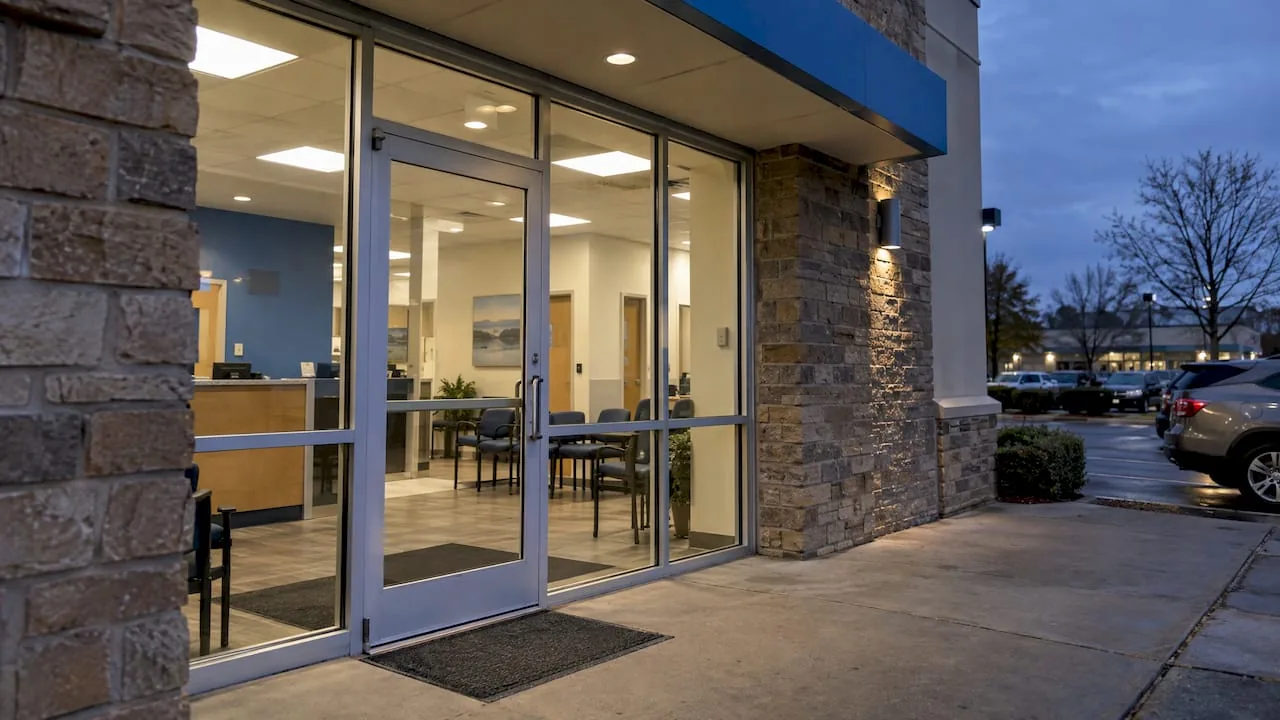
If your clinic opens early, runs late or keeps different hours on weekends, those are exactly the hours people search for. Verify them every quarter and every time staffing changes.
Services, insurance, photos and posts
A complete profile tells a patient what to expect before they arrive:
- A services list that names what you actually do: X-rays, stitches, flu and strep testing, physicals, occupational health, IV fluids.
- Notes on accepted insurance and self-pay options, written in plain language.
- Real photos of the entrance, parking, waiting room and signage, so the patient recognizes the building when they pull in.
- Regular posts about seasonal care, new services or extended hours.
For a deeper checklist, see our piece on Google Business Profile optimization fixes that drive calls and the GBP-first local SEO audit.
Give every location its own page
The website supports the profile. For each clinic, build a dedicated page that a patient and a search engine can both read in seconds. A strong location page includes:
- The full name, address and phone number, written exactly as on the profile.
- Current hours, including holiday notes.
- Services available at that location, not a generic list for the whole group.
- Insurance information and what self-pay looks like.
- A map embed and driving directions, with parking details.
- Provider bios or a short description of the clinical team at that site.
- A clear action: call, get directions, or the next step your clinic uses, such as online check-in.
Support those pages with content built around real questions. A page on “what to do for a sprained ankle: urgent care or ER” earns relevant visitors because it matches the concern in the patient’s head. Keep it informative and in your clinic’s voice, and make sure any medical content is reviewed by a clinician on your team.
A common failure is a single “Locations” page that lists addresses and nothing else. It gives a search engine little to rank for each area and a patient little reason to choose you. Another is copying the same text across every location with only the city swapped. Each page should reflect what is genuinely different about that clinic: its neighborhood, its landmarks, its services and its team.
Our near me SEO checklist lays out the on-page signals for these pages point by point.
Make the mobile experience fast and obvious
Urgent care patients are usually on a phone, often in a car or a waiting room, often in discomfort. Mobile is the main experience, not a secondary one. What that requires:
- Pages that load quickly on cellular connections. Heavy images and bloated scripts push the hours and phone number below a spinner.
- A tap-to-call button and a directions link visible without scrolling.
- Hours and insurance information near the top, not buried in a footer.
- Short forms or none at all. A person with a fever will not fill in fifteen fields.
Speed is a practical issue patients feel immediately. We cover how to find and fix what slows a local site in site speed and local SEO.
A mobile page is also where the first impression of care quality forms. Clean layout, readable text and a clear path to a visit signal a well-run clinic before anyone walks in.
Reviews: velocity, replies and privacy
Reviews are part of prominence, and in urgent care they are also the closest thing to a live quality signal. Patients read the newest ones first. A steady stream of recent, specific reviews tells a searcher the clinic is good now, which is the question that matters when they need care today.
A workable routine looks like this:
- Ask at the right moment. When a visit went well, ask at checkout with a QR code or a text link, while the experience is fresh.
- Reply to all reviews promptly. A reply within a day shows that someone is paying attention.
- Answer criticism with process, not defense. Describe what the clinic does to improve, in general terms.
- Never confirm the reviewer was a patient.
That last rule is a legal and ethical one, not a style choice. Under HIPAA, the HHS Office for Civil Rights enforces the Privacy Rule, which protects individuals’ health information. Responding publicly to a review in a way that confirms someone received care, or that mentions any detail of the visit, can disclose protected information. A safe reply thanks the person, states that you take feedback seriously, and invites them to contact the clinic offline, without acknowledging a visit took place. Have your compliance officer or healthcare attorney approve the template language before staff use it.
The same caution applies to posts, photos and website content. Testimonials, case stories and before-and-after material need proper written authorization. For a deeper look at privacy-safe public content, this piece on healthcare reference and public-facing content strategy is worth reading alongside your compliance advisor’s guidance.
Match the search intent you actually serve
Urgent care queries come in clusters, and each needs a page or a profile feature behind it.
| Patient is searching for | What answers it |
|---|---|
| “Urgent care near me” | Profile with accurate pin, hours, categories and recent reviews |
| “Urgent care open now” or “open Sunday” | Exact hours and special hours, mirrored on the location page |
| “X-ray near me”, “stitches”, “strep test” | Service sections on the location page, listed in the profile services |
| “Urgent care that takes [insurance]” | Insurance section on each location page |
| “Urgent care vs ER” | A clear, clinician-reviewed explainer with a path to your nearest clinic |
| “Occupational health” or “DOT physical” | A dedicated service page for employers and workers |
Employer services and occupational health often deserve their own pages, because they bring different searchers with different needs and a steadier volume than walk-in injuries.
What to measure
Rankings alone do not pay for staff. Track the outcomes that connect to actual patient volume:
- Google Business Profile actions: calls, direction requests and website clicks.
- Organic sessions and non-branded queries in Google Search Console, which show whether new people are finding you without already knowing your name.
- Phone call conversions, including call length, since a short call often means a wrong number or a closed-door complaint.
- Online check-ins or bookings that come from organic search.
- Cost per completed visit, which is the figure that ties marketing spend to the patient who actually arrived.
That last one deserves emphasis. A booking or a save-a-spot request is not a visit. Patients abandon when waits grow, change their minds or go elsewhere. If your reporting stops at leads, it overstates results. Connect search data to check-in and arrival data where you can, and review it by location, since each clinic’s market behaves differently.
Transparent reporting that shows each of these by location lets an operator see which clinics are gaining and which need attention. That is how we report for local service clients.
A realistic 90-day plan
A clinic starting from a weak position can work in this order:
- Days 1 to 30: fix the foundation. Audit each profile for categories, hours, address, phone and duplicates. Align the website’s name, address and phone details with the profile. Add real photos. Build or rebuild location pages.
- Days 31 to 60: strengthen trust. Launch a review request routine at discharge, set up HIPAA-safe reply templates, publish service pages for the conditions and services you handle most, and fix mobile speed problems.
- Days 61 to 90: expand and measure. Add content around urgent care versus ER, seasonal illnesses and employer services. Set up call tracking and Search Console reporting, and compare actions by location.
The 30/60/90-day Google Maps ranking plan goes through the map side of this timeline in more detail. Results depend on market competitiveness and your starting position, so treat the first quarter as the build and the following months as the compounding phase.
Our perspective on urgent care SEO
We think urgent care SEO is won on accuracy and definition, not on tricks. A clinic is a physical place with hours, services, providers and a specific neighborhood. Search engines and AI tools reward the businesses that describe that reality clearly and consistently everywhere they appear.
That is why our approach starts with the entity: who the clinic is, where it is, what it treats and who it serves. We then combine technical SEO, Generative Engine Optimization and Answer Engine Optimization so the same clear definition feeds the map pack, the website and the answers people get from AI tools.
For local and multi-location businesses, we put the Google Business Profile at the center, because it is the first thing a nearby searcher sees. Location pages, fast mobile pages and a healthy flow of recent reviews build on it. Reporting should be transparent, tied to calls and direction requests, and broken down by location, so an owner can see what is working.
The result we design for is simple: when someone nearby needs care, your clinic shows up, looks open, and looks like the right choice.
NSYGHT
Where we can take this off your hands
If you run one clinic or a group, we handle the parts of this that eat the most time: managing your Google Business Profile, building the SEO foundation and growth work behind your location pages, and reporting on the results. Our SEO and Google Business Profile services cover GBP Management and three tiers of SEO: Foundation, Growth and Premium. Pricing for those tiers is set by scope, so we quote it after reviewing your locations.
If you also want paid search running while organic results build, Google Ads Management is a flat $499 per month with a one-time $249 setup fee. We also offer consulting at $125 per hour for teams that want a plan before committing to a retainer. You can see everything on our services page, or start with NSYGHT and tell us about your locations.
FAQ
What does SEO mean in healthcare?
SEO means search engine optimization: improving how often and how prominently a practice appears in unpaid search results. In healthcare it centers on local visibility, accurate profiles and listings, helpful clinician-reviewed content, and strict care with patient privacy in anything published.
Is urgent care SEO different from regular local SEO?
The fundamentals are the same: relevance, distance and prominence. Urgent care adds urgency and privacy. Patients decide in minutes, so exact hours, mobile speed and recent reviews matter more, and HIPAA shapes how you reply to reviews and what you publish.
How long does urgent care SEO take to work?
Profile fixes such as correcting hours or categories can change how a listing performs fairly quickly, while location pages, content and review momentum build over several months. Timelines vary with market competition and where the clinic starts, so plan on a quarter to build and then keep improving.
Do I need a separate page for each clinic location?
Yes. Each location should have its own page with its address, phone, hours, services and insurance information, matching its single Google Business Profile. Separate pages give patients and search engines location-specific facts that a generic list of addresses cannot.
Which numbers show that urgent care SEO is working?
Watch calls and direction requests from your profile, non-branded search traffic, bookings or check-ins from organic search, and cost per completed visit. Review them by location so you can see where visibility turns into patients walking through the door.
Sources
- Why Urgent Care Marketers Need to Keep an Eye on SEO Tactics, The Journal of Urgent Care Medicine
- Tips to improve your local ranking on Google, Google Business Profile Help
- Guidelines for representing your business on Google, Google Business Profile Help
- Edit your business hours, Google Business Profile Help
- HIPAA Privacy Rule, U.S. Department of Health and Human Services