

See how NSYGHT handles SEO for law firms.
Prefer to hand it off? See our Google Ads management.
Google Ads can bring a law firm signed cases quickly, because it puts you in front of people who are searching for a lawyer right now. It works when three things line up: tight keywords, a landing page built for one legal problem, and call and form tracking that tells you which clicks became clients. It fails when a firm turns on broad campaigns, sends traffic to the homepage and never checks what the clicks produced.
This guide walks through how to set up and run a law firm campaign, how to think about budget, what to put in the ads and on the page, which advertising rules to respect, and how to decide between paid search and SEO.
TL;DR
- Google Ads works for law firms when you target urgent, practice-specific searches (“DUI lawyer near me”, “divorce attorney in [city]”) and measure signed cases, not clicks.
- Legal clicks are expensive, so a small daily budget is a test that buys data. Plan around cost per signed case, not cost per click.
- Build one campaign per practice area, one landing page per campaign, and track calls, forms and chats from day one.
- Ads are attorney advertising: keep claims truthful, include the firm name and office address, and check your state bar’s rules before launch.
- Pair ads with local SEO and a strong Google Business Profile so you are visible when the ad budget pauses.
Table of Contents
- Do Google Ads work for lawyers?
- How much should a law firm spend on Google Ads?
- Set up a campaign the way a law firm should
- Write ads and landing pages that turn clicks into inquiries
- Stay inside attorney advertising rules
- Track what matters
- Perspective: why law firms need ads and organic visibility together
- Ads or SEO: which comes first?
- Common mistakes to avoid
- Work with us on your law firm campaigns
- FAQ
- Sources
Do Google Ads work for lawyers?
Yes, for the right searches. Someone typing “car accident lawyer near me” or “emergency DUI attorney” has a problem and a deadline. A search ad puts your firm at the top of the page at that moment, which is hard to match with any other channel.
The reason it sometimes disappoints is rarely the platform. It is usually one of these:
- Keywords are too broad. “Lawyer” or “legal help” attracts people looking for free advice, students and job seekers.
- The landing page is the homepage. A visitor searching for a custody attorney should land on a page about custody, with a phone number and a short form visible without scrolling.
- No one answers. Legal prospects call several firms. If your intake line goes to voicemail, the click was wasted.
- Tracking stops at clicks. Without call tracking and form tracking, you cannot tell a profitable campaign from an expensive one.
Fix those four and most of the “Google Ads don’t work for lawyers” story disappears.
How much should a law firm spend on Google Ads?
There is no universal number, but there is a sound way to find yours. Start from the value of a case and work backward.
- Decide what a signed case is worth to you. Use your average fee, or a conservative figure for the practice area.
- Decide what you are willing to pay to acquire one. Many firms set this as a share of expected fee.
- Estimate your conversion steps. Clicks to inquiries, inquiries to consultations, consultations to signed cases.
- Multiply backward to get a monthly budget that can produce enough clicks to learn something.
Here is a hypothetical illustration, with made-up numbers you should replace with your own. Say clicks cost $25, one in ten clicks becomes an inquiry, and one in four inquiries signs. That is 40 clicks per signed case, or about $1,000 in ad spend per case. If that case is worth several thousand dollars in fees, the math can work. If your intake only signs one in ten, the same campaign costs $2,500 per case, and the fix is intake, not budget.
Is $10 or $20 a day enough?
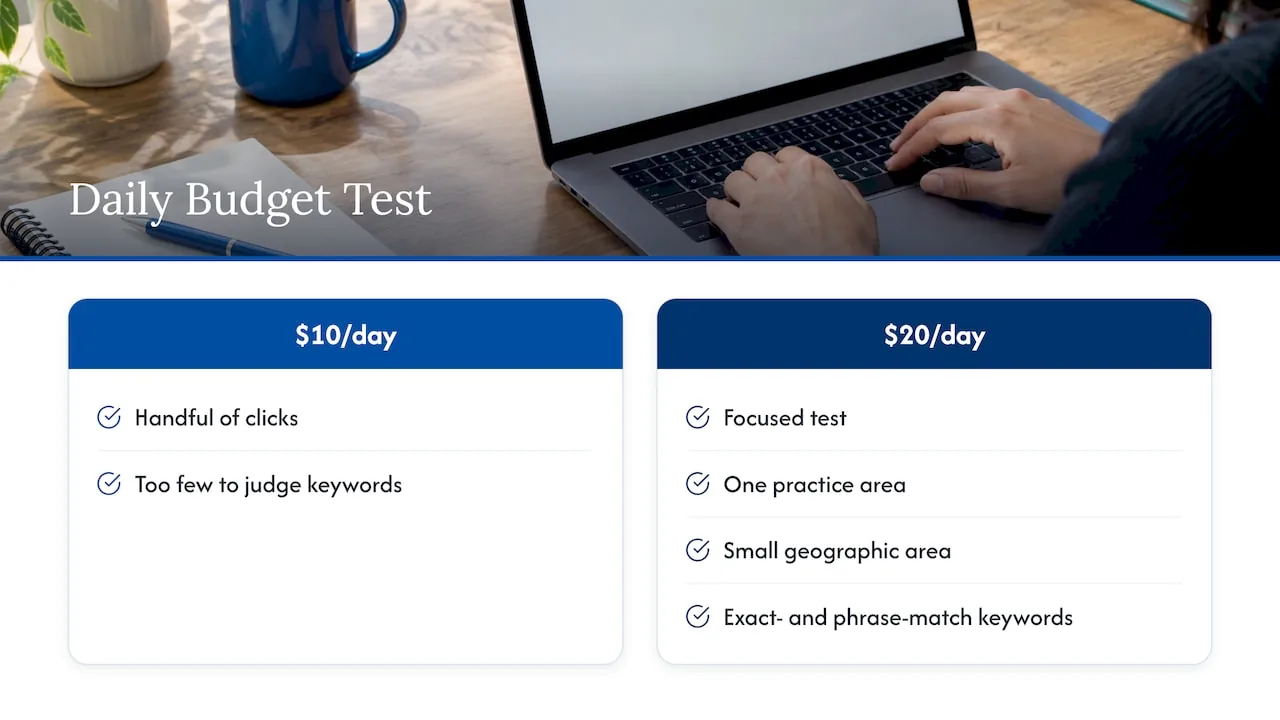
That depends on what a click costs in your market. At legal click prices, $10 a day buys a handful of clicks, which is too few to judge keywords, ads or pages. $20 a day can work as a tightly focused test: one practice area, one small geographic area, a handful of exact-match and phrase-match keywords. Treat it as buying limited data, not as a steady lead engine. If your market is competitive, plan a larger monthly budget so the account can gather enough clicks and calls to optimize.
A practical approach is to run a short, focused test, read the search terms report, cut what wastes money, and then scale what produces consultations. Our guide to using a two-week ad test to pick your targets explains the method.
Management fees are separate from ad spend
Your ad budget goes to Google. Management is what you pay someone to build and run the account. Some agencies charge a percentage of spend, which means the more you spend, the more they earn. At NSYGHT, Google Ads management is a flat $499 per month with a one-time setup fee of $249, so our fee does not move when your budget does.
Set up a campaign the way a law firm should
Pick the right campaign type
For most firms, start with a Search campaign. It shows text ads to people typing a legal query. Other types have a place later, but they should not be the starting point:
- Search: the core of a law firm account. High intent, easy to measure.
- Local Services Ads: a pay-per-lead format that shows above regular ads in many areas. See our breakdown of how to make Local Services Ads spend pay for how to handle these.
- Performance Max and Display: useful for remarketing and reach once search is working, but they can burn budget on low-intent placements if launched first.
Be careful with automated “smart” or recommended campaigns that Google suggests during setup. They can broaden your keywords beyond what you intended. Build the structure yourself or have a specialist do it.
Structure by practice area
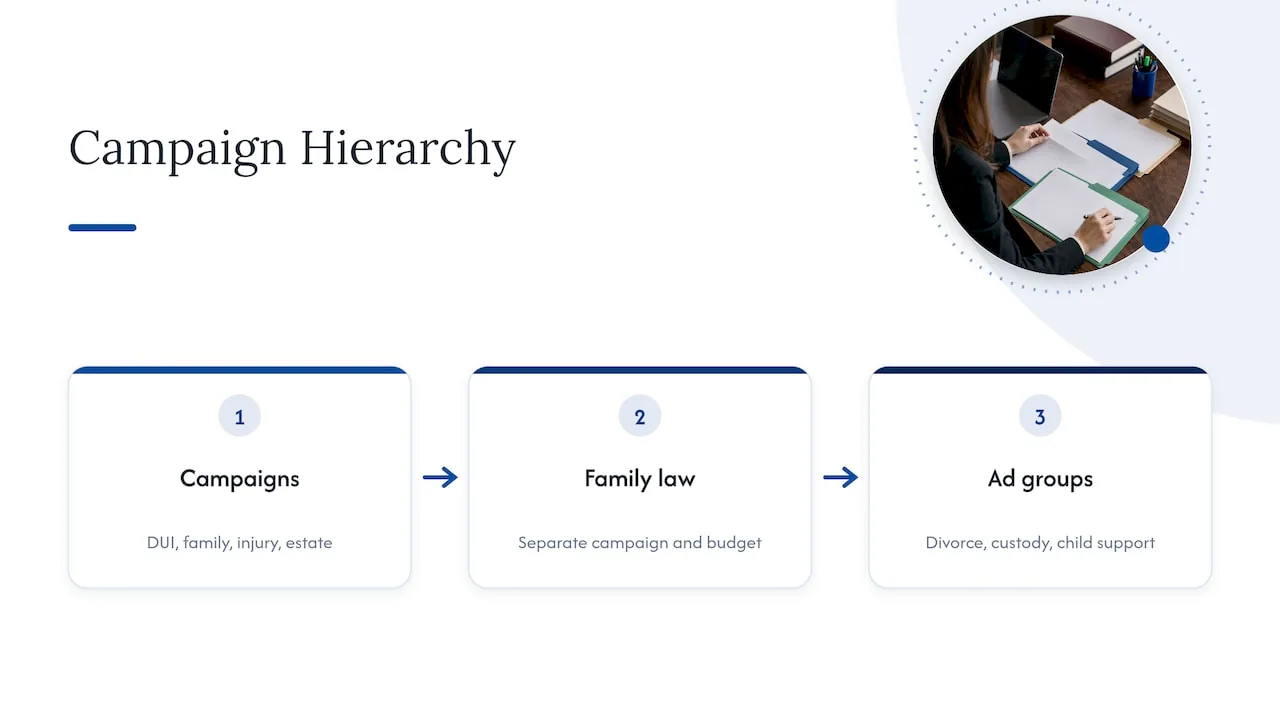
Create a separate campaign, with its own budget, for each practice area: DUI, family law, personal injury, estate planning. Inside each campaign, group keywords by theme into ad groups. A family law campaign might have ad groups for divorce, child custody, and child support. This lets you write ads that match what the person typed and lets you shift money to the area that produces signed cases.
Build the keyword list
Keywords should describe a person ready to hire:
- Practice area plus “lawyer” or “attorney” plus a place: “divorce attorney Phoenix”.
- Urgent, situation-based phrases: “arrested for DUI what to do”, “served divorce papers”.
- “Near me” variants.
Then build a long negative keyword list on day one: “free”, “jobs”, “salary”, “law school”, “pro bono”, “forms”, “template”, “how to become”, and any practice areas you do not handle. Review the search terms report weekly for the first two months and add negatives as irrelevant queries appear. This single habit protects more budget than any other.
Set geographic targeting carefully
Target the areas where you can actually take cases: the county, or the cities where you have an office or are licensed to practice. In the location settings, choose the option that targets people in or regularly in your locations rather than people merely showing interest in them. Otherwise you will pay for clicks from people researching a place they do not live in. Adjust bids by location once you see which areas produce consultations. Multi-office firms should run one campaign per office so budget and reporting stay clean.
Use schedules and call settings wisely
Legal inquiries come at all hours, but a call that rings out is a lost client. Use call extensions and ad schedules that match your intake availability. If you have after-hours answering, you can run longer. If you do not, concentrate spend when someone can pick up.
Write ads and landing pages that turn clicks into inquiries
The ad
A good legal search ad does three things: matches the search, states a reason to call, and sets an expectation.
- Match the query. Put the practice area and city in the headline.
- Give a real differentiator. Free consultation (only if you offer it), years in practice (only if accurate), languages spoken, same-day callbacks (only if you do them).
- Add assets. Call, location, and sitelink assets give you more space on the page.
Avoid outcome promises, comparative superlatives you cannot substantiate and guarantees. They create ethics exposure and attract the wrong expectations.
The landing page
The page that follows the click carries half the result. For each campaign, build a page that:
- Repeats the promise from the ad in the headline.
- Shows a tap-to-call number and a short form above the fold on mobile.
- Explains, in plain language, what happens next after someone reaches out.
- Shows trust signals that are true: bar admission, attorney photos, office address, reviews.
- Loads fast and has no navigation menu pulling people away from the inquiry.
Local pages that serve both ads and organic search are a double win. Our guide to location landing pages that rank and get cited shows how to build them. For a deeper look at capturing the visitor once they arrive, this website lead capture playbook covers practical ways to turn visits into inquiries, including after-hours answers.
Keep the follow-up fast
Speed to contact is a conversion factor you control. Return form inquiries within minutes, not hours, and make sure whoever answers the phone knows which campaign a call came from. If you also use social channels to stay visible to people who clicked but did not call, a tool that covers social media for law firms can keep your posting consistent between ad cycles.
Stay inside attorney advertising rules
A Google ad is a lawyer communication, and state bar rules apply to it. The rules differ by state, so read your own jurisdiction’s version of the rules on communications about legal services before you launch. Washington’s rule-making record is a useful example of what these rules typically contain: its proposed RPC 7.1 treats a communication as false or misleading when it contains a material misrepresentation or leaves out something necessary to keep it from misleading, and the same proposal would require communications under RPC 7.2 to include the name and office address of at least one responsible lawyer or firm. That is a 2018 proposal, so check your state’s current adopted text rather than relying on it.
In practice, that means:
- Put the firm name and office location on the landing page, and in location assets.
- Do not imply results you cannot document. Skip “we always win” or “best lawyer in town” unless your state’s rules and your evidence allow it.
- Check whether your state requires disclaimers on certain claims, testimonials or case results.
- Keep a record of every ad version you run, with dates, in case a bar inquiry ever asks.
- Handle intake data carefully. A form should not ask for sensitive case details before a conflict check, and call recordings may require consent under your state’s law. Ask your state bar’s ethics counsel or ethics hotline when unsure.
Google also applies its own advertising policies, so approvals can differ from what the bar allows. Passing one does not mean you pass the other.
Track what matters
Clicks and impressions are not the goal. Set up tracking for:
- Phone calls, from ads and from the website, with call length recorded so you can separate real consultations from wrong numbers.
- Form submissions and chat starts as separate conversion actions.
- Offline conversions: when an inquiry becomes a signed case, feed that back to Google Ads so the system learns which searches produce paying clients. Your case management system or intake spreadsheet is the source.
Then report on three numbers every month: cost per inquiry, cost per signed case, and return on ad spend by practice area. Keep client details out of ad platforms: pass only the minimum needed, such as a conversion event and value, never case facts.
Perspective: why law firms need ads and organic visibility together
Most law firms come to us after one of two experiences: an ad account that spent money without producing signed cases, or an SEO effort that is still months from paying off. Both problems have the same root: the firm is treating one channel as the whole strategy.
We build local visibility as one system. Paid search captures the person who needs a lawyer today. Local SEO, a well-managed Google Business Profile and clear entity signals make the firm findable the rest of the time, including in AI-generated answers where people increasingly ask who to hire. Each channel makes the other cheaper to run: the landing page you build for ads can also earn organic rankings, and the reviews and profile strength you build locally lift how people respond to your ads.
That is why we publish a flat management fee instead of taking a percentage of spend, and why our reporting follows the questions a managing partner actually asks: which practice area is producing consultations, and what is each one costing. Our work in law firm SEO and our 90-day law firm SEO strategy are designed to sit alongside paid search, so the firm owns its visibility instead of renting it.
NSYGHT
Ads or SEO: which comes first?
For a new practice or a new office, ads can produce calls in days, while SEO builds over months. For a firm with a sound website and profile, SEO can lower acquisition costs over time. The best answer for most firms is to sequence them:
- Weeks 1 to 4: run a focused ad test in your highest-value practice area. Learn which searches convert.
- Months 2 to 3: build or improve landing pages around the winners, and strengthen your Google Business Profile with accurate categories, services, photos and reviews. Our piece on why your Google Business Profile matters more than your website explains why.
- Month 3 onward: keep ads on the most profitable terms while organic and local pack rankings grow.
For family law practices specifically, see our approach to family law SEO, and for criminal defense, SEO for DUI lawyers.
Common mistakes to avoid
- Running broad match with no negatives. Budget leaks to irrelevant searches within days.
- One campaign for every practice area. You cannot control spend or message.
- Sending traffic to the homepage. It dilutes intent.
- Judging by cost per click. A $60 click that signs is cheaper than a $9 click that never calls.
- Letting automation run unchecked. Review search terms, locations and conversion settings monthly.
- Ignoring intake. The best campaign cannot fix slow call handling.
Work with us on your law firm campaigns
If you would rather hand off the build and the weekly optimization, our Google Ads management is $499 per month, with a one-time $249 setup fee. It covers account structure, keyword and negative keyword management, ad copy, conversion tracking and monthly reporting, and it is designed to fit alongside our local SEO and Google Business Profile work for law firms. Details are on our Google Ads management page, and the full list of services is on our services page. If you want a second opinion on an existing account first, consulting is $125 per hour.

To see how paid search fits into your wider local plan, browse our Google Ads articles or start a conversation at nsyght.com.
FAQ
Do Google Ads work for lawyers?
Yes, when the campaign targets practice-specific, high-intent searches and sends clicks to a dedicated landing page. Results depend on keyword control, tracking and how quickly your intake team responds. Measure signed cases, not clicks.
How much should a law firm spend on Google Ads?
Work backward from what a signed case is worth to you and your conversion rates from click to inquiry to client. Legal clicks are costly, so budget enough to gather meaningful data for each practice area. Start with one practice area, then expand what works.
Is $20 a day good for Google Ads?
For a law firm, it is best seen as a small focused test: one practice area, a tight location, a few precise keywords. It gives you limited data, so do not expect a steady flow of cases from it. In competitive markets, plan a larger budget once the test shows what converts.
Is $10 a day enough for Google Ads?
Usually not for legal searches, where each click can cost a meaningful amount. At that level you get only a few clicks, which is too little to judge keywords or pages. Raise the budget, or narrow the target to one very specific, local search.
Do I need a different approach for each state?
Your ads must follow the advertising rules of each state where you practice or target clients. Review your state bar’s current rules on communications about legal services, and keep records of the ads you run.