
Local link building means getting backlinks and mentions from websites tied to your city, region, or community, rather than chasing generic domain authority. The two fastest moves are claiming and fully completing your Google Business Profile, then locking down one or two high-value local links, a chamber of commerce listing or a vendor page mention. What follows is a prioritized playbook with tactics, tools, and the numbers to track once you start.
- Prioritize earning links from high-authority local sources like newspapers, government sites, and educational institutions before pursuing community sponsorships or directory listings.
- Focus on building a consistent entity signal with structured data and uniform business information to enhance the value and effectiveness of your local links.
- Use simple tools and search strategies, such as Google Alerts and backlink research, to identify and reclaim unlinked mentions and uncover new link opportunities.
- Implement a 90-day plan that sequences outreach from the most valuable links to community collaborations, tracking progress through targeted local rankings and traffic metrics.
- Avoid paid links that do not disclose sponsorship and steer clear of link farms to stay aligned with Google's spam policies and maintain long-term search stability.
What local link building actually means
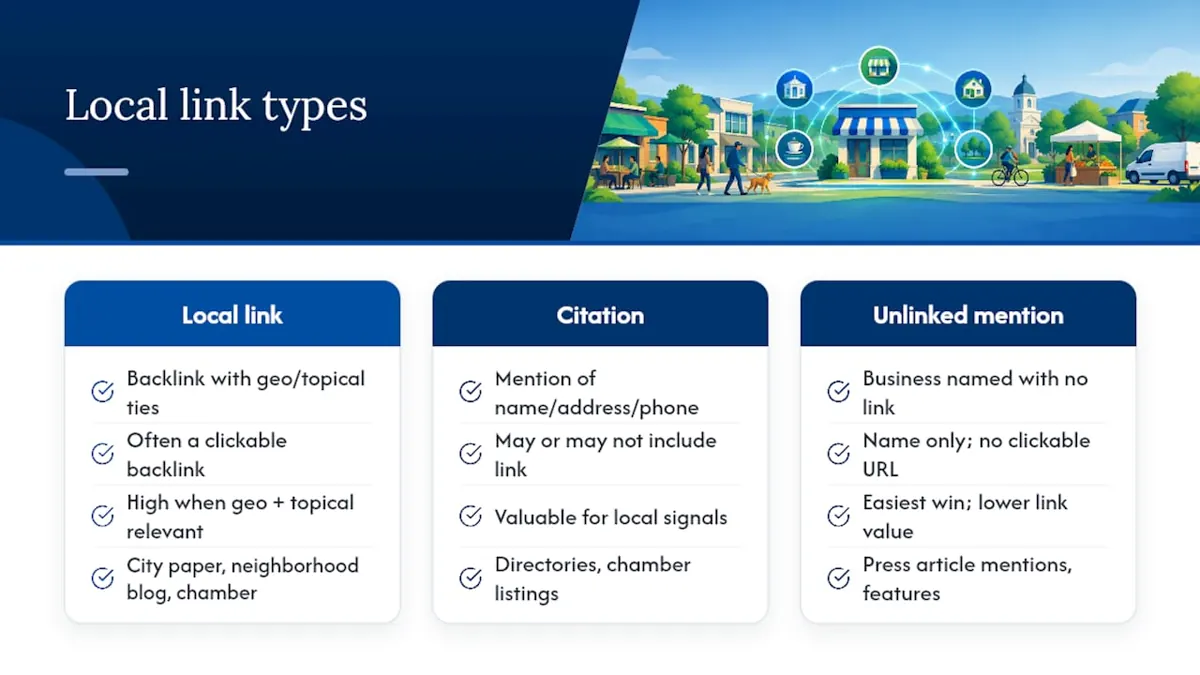
A local link is a backlink from a website with real geographic or topical ties to your market: a city newspaper, a neighborhood blog, a chamber of commerce directory, a school fundraiser page. A citation is different: it is a mention of your business name, address, and phone number that may or may not include a clickable link. An unlinked mention, your business named in a press article with no link back, sits somewhere between the two and is often the easiest win because someone already decided you were worth writing about.
What makes a link "local" is the combination of geo-relevance and topical relevance. A link from a plumbing supply blog in your metro area carries more local weight than a link from a national plumbing directory with no city ties, even if the national site has more traffic. The strongest local link sources tend to be the same ones a resident would trust: your local chamber of commerce, city or regional news outlets, nonprofits you sponsor or volunteer with, and schools or youth sports leagues you support. These sources double as citations when they list your name, address, and phone number, which is why local link work and citation building usually happen together rather than as separate projects.
Why local links move rankings in the pack and beyond
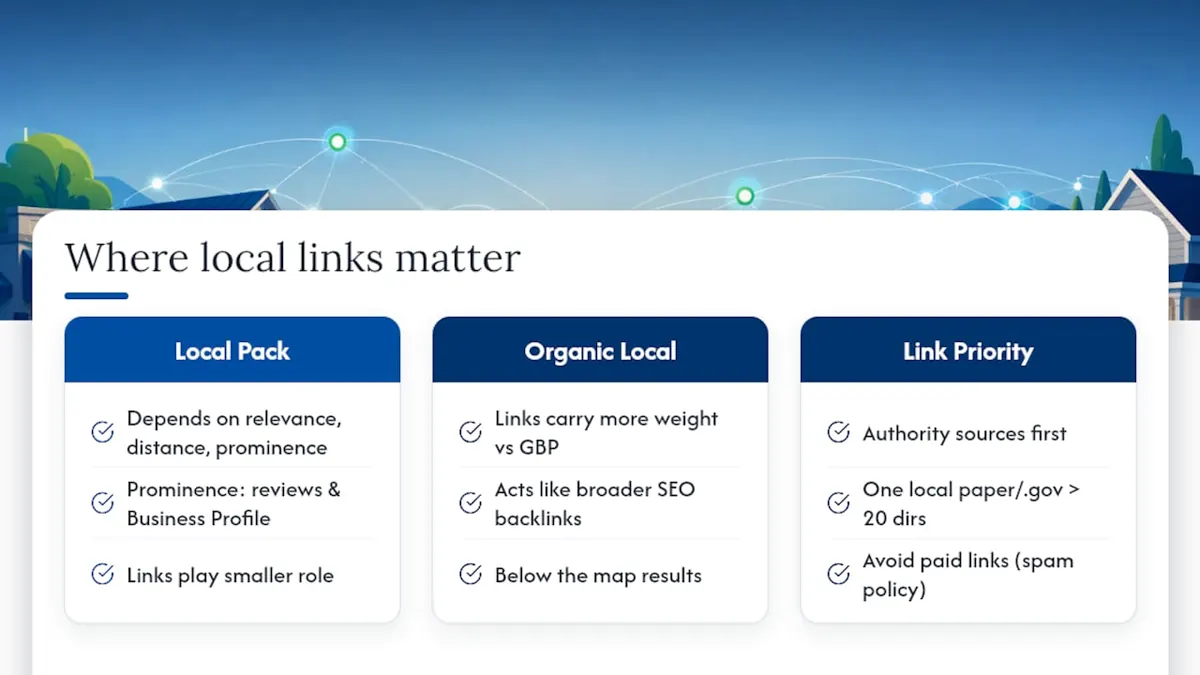
Links carry different weight depending on where you show up. For the Local Pack, the three-listing map result, Google's own guidance says ranking depends on relevance, distance, and prominence, and prominence includes signals like reviews and how well you have completed your Business Profile. For standard organic local results below the map, links tend to carry more weight relative to GBP completeness, closer to how backlinks function in broader SEO.
A handful of strong local links tend to outperform a large batch of low-quality directory listings, according to a tiered local link framework that prioritizes authority sources first. One link from your city's daily paper or a .gov resource page does more for your entity's credibility than 20 links from generic business directories nobody visits.
This is also where paid placements get risky. Google's spam policies list buying or selling links that pass ranking credit as a violation, and recommend marking paid or sponsored placements with rel="sponsored" so the relationship is disclosed rather than hidden.
Prioritized local link strategies for local businesses
Not every tactic deserves equal time. Local link building works best as a sequence: earn the hardest, highest-trust links first, then layer in community ties, then use scalable tactics to fill gaps. Treat lower tiers as supplements, never substitutes.
Tier 1: authority sources. Local newspapers, TV station community pages, .gov resource pages, and .edu partnerships carry the most trust because they are hard to fake and hard to buy. Getting one usually means pitching a story angle (a local hire, a community event you are running, a survey of local customers) to a reporter's e-mail rather than asking for a link outright. Cost is typically your time only, though sponsoring a local news segment can run into paid territory. Expect a one to four week turnaround from pitch to publication. A tiered approach that starts with these sources before moving to community tactics reflects how much more these links tend to be worth.
Tier 2: community ties. Nonprofit sponsorships, event sponsorships, vendor or partner pages, local podcast appearances, and guest posts on neighborhood blogs fall here. These require a real relationship, not a cold pitch. A workable template: introduce your business, state what you are sponsoring or offering (a donation, a discount for their members, a guest article), and ask if their site links back to sponsors or partners. Follow up once after two weeks if you hear nothing. Sponsorship costs for a local youth league or chamber event commonly run from a few hundred dollars up into four figures depending on visibility tier, and chamber of commerce membership itself is often priced in a similar range annually.
Tier 3: partnerships and directories. Reciprocal links with complementary local businesses (a caterer linking to a florist, both linking to a venue) and niche local directories can round out a profile, but thin directories that exist only to host paid listings add little and occasionally invite scrutiny. Google's outbound link guidance covers using rel="sponsored" or rel="ugc" for exactly this kind of paid or user-generated placement, so if you do use directories, disclose the ones that are paid.
Reclaiming unlinked mentions. Search your business name plus your city in Google, check Google Alerts, and look through any press coverage you already know about. When you find a mention with no link, a short, polite e-mail to the writer or editor asking them to add one usually works, especially if the piece is still recent and easy for them to edit.
Content that earns links on its own. A neighborhood guide (best patios in your part of town, a parking guide for your district), a localized data resource (average home renovation costs in your metro), or a dedicated event page gives other local sites a reason to link to you without being asked. These take longer to produce but keep earning links passively once published.
Here is a practical starting sequence:
- Complete and verify your Google Business Profile, including categories, service areas, and photos.
- Identify and claim two or three high-authority citation sources in your niche and city.
- Pitch one local news angle tied to your business or a community event.
- Join or renew your chamber of commerce membership and confirm your directory listing links to your site.
- Sponsor one local event, nonprofit, or youth league and request a partner-page link.
- Search for unlinked mentions and send reclamation e-mails.
- Publish one localized resource page designed to attract organic links.
Batch your outreach e-mails by tier so you are pitching one type of contact (reporters, then sponsors, then partners) in focused sessions rather than switching context all day.
Tools and search techniques for finding local link opportunities
You do not need an expensive stack to start. A backlink research tool shows you who already links to competitors in your area, which surfaces directories and press outlets you might have missed. A citation finder checks whether your name, address, and phone number are consistent across the listings you already have. A mention-tracking tool, even a free Google Alert for your business name plus city, catches new press coverage as it happens. A simple spreadsheet or lightweight CRM keeps outreach organized once you are contacting more than a handful of sites.
A few practical search operators speed up manual discovery:
- Search "[your city] chamber of commerce members" to find directory pages that link out.
- Search "[your industry] + [your city] + sponsors" to find event and nonprofit sponsor pages.
- Search "[your city] news + [your industry]" to find reporters who cover your beat.
- Set a Google Alert for your exact business name plus city to catch new mentions automatically.
| Task | Tool category | Typical cost range |
|---|---|---|
| Find competitor backlinks | Backlink research tool | Free tier to paid subscription |
| Track name, address, phone consistency | Citation finder | Free tier to paid subscription |
| Catch new press mentions | Mention tracking / alerts | Free |
| Organize outreach contacts | Simple CRM or spreadsheet | Free to low monthly cost |
A basic outreach template covers three lines: who you are, what you are asking for (a link, a partner mention, a sponsorship placement), and what you are offering in return. A sponsorship proposal checklist should confirm the placement includes your business name, a link to your site, and the rel attribute used if the placement is paid. Businesses handling this alone should expect several hours a week for outreach and follow-up; once the backlog of easy wins is gone and progress slows, that is usually the point to bring in outside help.
Choosing tactics and building a 90-day plan
Score each tactic on impact, effort, and cost, then work down the list. A simple rubric: rate impact and cost each from one to three, subtract cost from impact, and rank by the result.
| Tactic | Impact (1 to 3) | Effort (1 to 3) | Typical cost |
|---|---|---|---|
| Chamber of commerce membership | 2 | 1 | Low to moderate annual fee |
| Local press pitch | 3 | 2 | Time only |
| Event sponsorship | 2 | 2 | Moderate |
| Unlinked mention reclamation | 2 | 1 | Time only |
| Guest post on local blog | 1 | 2 | Time only |
| Generic directory submission | 1 | 1 | Low or free |
A storefront business should prioritize chamber membership, a local press pitch, and a neighborhood event sponsorship first, since foot traffic and community visibility reinforce each other. A service-area business without a storefront gets more mileage from localized content pages for each service area plus partner links from complementary contractors.
- Weeks one through two: complete your Google Business Profile and audit existing citations for consistency.
- Weeks three through six: pitch local press and secure chamber or .gov and .edu links where relevant.
- Weeks seven through ten: run sponsorship and partnership outreach for three community links.
- Weeks eleven through thirteen: publish one localized resource page and submit any remaining event listings.
Watch for red flags. Paid links that pass ranking credit without disclosure, and link farms built purely for volume, both fall under practices Google's spam policies flag directly, and they tend to age poorly even when they work briefly.
Measuring whether your link work is paying off
Track a small set of numbers rather than everything available. New referring domains from your geographic area matter more than total link count. Referral sessions from those domains, filtered by landing page in your analytics tool, show whether people are actually clicking through. Google Business Profile impressions and search queries indicate whether your added prominence is showing up in the map result. Local keyword rankings for your priority terms and city give you the organic side. Conversions attributed to the specific pages you built links to close the loop.
- Filter your analytics by landing page and by geographic session data to isolate local referral traffic.
- Check Business Profile insights for impression and query changes monthly, not weekly, since the data is noisy in small windows.
- Expect early citation and directory links to show up in tracking within a few weeks, while press and authority links can take longer to influence rankings.
- Set stakeholder expectations around a 90-day window before drawing conclusions, since local ranking signals move slowly and unevenly.
Why entity clarity multiplies the value of every link you earn
Links do not work in isolation. A link pointing to a business whose name, address, and category information is inconsistent across the web sends a mixed signal, even to a generous algorithm. Structured data using Schema LocalBusiness vocabulary lets you mark up your name, address, phone number, geo-coordinates, and hours directly in your site's code, giving search engines and AI systems a clean, machine-readable record to match against every mention and link pointing at you.
This matters more now than it did five years ago, because AI-driven answer engines pull from a wider mix of signals than a ranked list of ten blue links, and our guide to AI search covers how that shift changes local discovery. The practical integration step is straightforward: audit your NAP consistency across every citation and link source you have, add JSON-LD LocalBusiness markup to your site, and make sure your Google Business Profile categories match the language used in your structured data and your link anchor text.
Local link building without entity clarity is like handing out business cards with a different phone number on each one. The links still count, but the signal is muddier than it needs to be.
How NSYGHT can help you build local links that stick
Getting one or two Tier 1 links can take a solo business owner weeks of pitching between everything else on their plate. That is the gap our local SEO work is built to close: we run the outreach, the citation cleanup, and the Business Profile management in parallel so links, structured data, and your profile reinforce each other instead of sitting as separate projects.

Depending on where you are starting from, a few of our services line up directly with what this playbook covers:
- GBP Management for ongoing profile optimization, category accuracy, and review response, which supports the prominence side of local ranking.
- SEO Foundation for businesses that need citation cleanup, on-page fixes, and a first round of local link outreach.
- SEO Growth for businesses ready to scale press outreach, sponsorships, and localized content production.
An initial engagement typically starts with an audit of your current citations, existing links, and profile completeness, followed by a prioritized link plan built around your specific market and industry rather than a generic checklist. See current SEO and Google Business Profile services or request a consult to get a plan built around your business.
Sources
- Spam policies for Google Web Search | Google Search Central
- Get customers to find you on Google, Business Profile help
- Schema
- Local Link Building: 25 Ways to Get Quality Local Backlinks | Flento
Frequently Asked Questions
Local link building is the practice of earning backlinks and mentions from websites with genuine geographic or community ties to your business, such as local news outlets, chambers of commerce, or nonprofits you sponsor. It differs from general link building because relevance to your city or region matters as much as the linking site's overall authority.
Costs vary widely by tactic rather than following one standard rate: chamber of commerce membership and event sponsorships commonly run from a few hundred to a few thousand dollars a year, while press pitches and unlinked mention reclamation cost time rather than cash. Paying directly for links that pass ranking credit without disclosure is against Google's spam policies and carries risk regardless of price.
Link building is the ongoing work of earning backlinks from other websites to your own, which search engines use as one signal of trust and relevance. For local businesses, this narrows to sources with geographic or community relevance rather than any high-authority site regardless of location.
Local SEO, including local link building, supports both Local Pack visibility and organic rankings for city or region-specific searches, since Google's own guidance ties local ranking to relevance, distance, and prominence signals like profile completeness and links. For businesses that depend on customers finding them in a specific area, it is one of the more direct ways to influence who sees them first.