
Semantic SEO is the practice of optimizing your site for what your business means, not for one keyword at a time. You define who you are, what you do, where you do it and which questions you answer, so Google and AI answer tools can place you correctly. For local service businesses, that means building a clear entity (your business as a distinct, recognizable thing), connecting it to your services and locations, and covering each topic completely. This is the foundation of our entity-driven SEO work at NSYGHT.
TL;DR
- Semantic SEO means optimizing for meaning, context and relationships between entities, not for exact-match keywords. Search Engine Land describes it that way.
- Plan content around topics and the intent behind searches, then group related questions into hubs and supporting pages.
- Local businesses win by keeping the smallest number of location and service pages that are each genuinely useful and clearly linked.
- Structured data (schema markup) and consistent business facts help search engines and AI tools identify you accurately.
- Measure by location: rankings, page performance, Google Business Profile activity and booked jobs or appointments.
Table of Contents
- What semantic SEO is, in plain terms
- How Google reads meaning
- Why it matters for local service businesses
- Build around topics, not single keywords
- A worked example: a dental practice
- Local and multi-location semantic SEO
- Structured data and what it can do
- How to measure semantic SEO
- Tools, briefly
- Where AI content fits
- What we do about it
- Our perspective
- FAQ
- Sources
What semantic SEO is, in plain terms
Older search worked on lexical matching: the engine looked for the words you typed. Modern search layers meaning on top. Ahrefs explains that search engines now use a hybrid of lexical matching with semantics overlaid, while large language models are almost completely semantic, matching a query’s topic to documents that cover it well.
That is why a page can rank for phrases it never uses. Semrush points to a Lonely Planet guide to Cinque Terre that ranks first for 109 keywords because it satisfies what travelers need, not because it repeats each phrase.
Semantic search is how the engine understands. Semantic SEO is what you do on your site so that understanding works in your favor. The two terms overlap heavily, and the work is the same: make your meaning unambiguous.
How Google reads meaning
Google Cloud documents a pipeline for semantic search. It analyzes the query for keywords, entities and intent, uses a knowledge graph to supply relationships between entities, analyzes content for topic and entities, and then ranks results by semantic similarity.
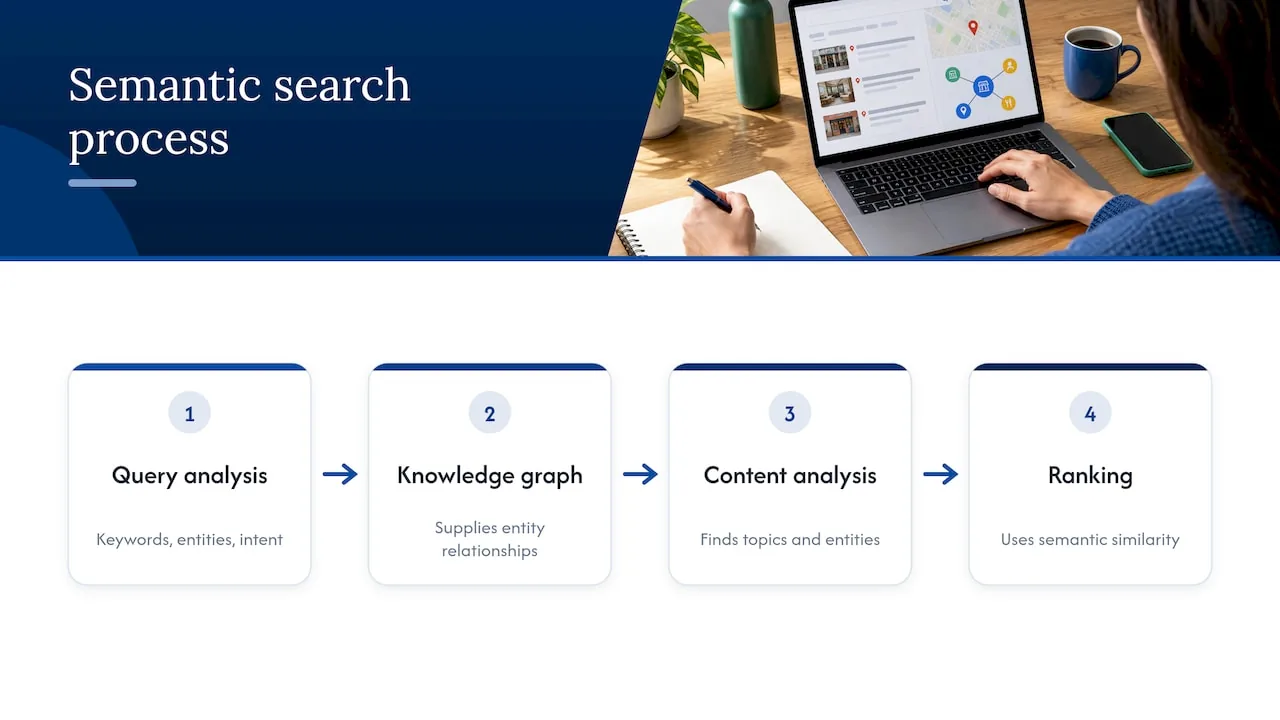
An entity is a person, place, organization or concept the engine can identify as a distinct thing. A knowledge graph is the database that connects those entities. Search Engine Land’s Olaf Kopp describes Google’s Knowledge Graph as its entity index, with entities as nodes joined by relationships.
Context also includes who is searching and where. Elastic notes that location and search history shape meaning, with “football” meaning soccer in the USA and a different sport in the UK. For a local business, location is never a side detail. It is part of the meaning of every query that matters to you.
If you want the entity side in depth, see our guides to entity SEO for local businesses and knowledge graph SEO.
Why it matters for local service businesses
Two things make semantic SEO more valuable for you than for a typical blog.
You compete on trust and clarity. A roofer, a dentist, a family law firm and a party rental company all sell something a searcher must be sure about: Does this business do this service, here, and can I trust it? When the engine understands your entity and its relationships, it can serve you for related searches even when the wording differs.
AI answers are now part of search. Search Engine Land’s Curtis Weyant argues semantic SEO bridges traditional SEO and generative engine optimization, because it describes entity relationships to both Google and AI answer engines. Our GEO explainer covers how that extends into AI citations, and answer engine optimization covers the question-and-answer side. Content on how AI tools connect to semantic SEO is also covered in this guide to getting cited in AI answers.
Build around topics, not single keywords
A keyword is one query. A topic is a theme that holds many queries, questions and concepts. Exploding Topics describes “query fanout”: one broad topic produces dozens or hundreds of related searches, so covering the topic earns visibility across many of them.
For a local business, the practical version looks like this:
- Name your core topics. A dental practice might have implants, emergency care, pediatric visits and cosmetic work. A party rental company might have bounce houses, tables and chairs, and event packages.
- List the subtopics your customers need. Cost, timing, preparation, what to expect, what is included, how to choose.
- Group by intent. Siteimprove advises clustering related terms by search intent rather than similarity, because informational and commercial searches call for different formats, and terms from different moments in the buying journey may need separate pages.
- Use a hub and spokes. Search Engine Land’s Adam Tanguay recommends a central hub page with supporting pages for each subtopic, and sorting planned pages by how the query behaves in AI answers: comparison, pricing and implementation queries can still earn clicks, while simple definitions are mostly answered on the results page.
That last point shapes where you spend effort. A page titled “What is a root canal” may be summarized away. A page on what a root canal costs in your city, what the visit involves and how to book is where a buyer clicks.
Find the language your customers use
Tanguay also recommends mining Reddit, YouTube comments and sales-call notes for the words people use when nobody is selling to them. Your front desk and intake calls already hold this. The questions customers ask before booking are the subtopics your pages should answer, in their words.
A worked example: a dental practice
Take a two-location dental practice that currently has one page called “Services” and ranks for little.
- Hub: a dental implants page that explains the full process, candidacy, recovery and what affects cost.
- Spokes: implant cost, same-day implants, implants versus dentures, bone grafting, financing options, and an FAQ.
- Entity links: each spoke links back to the hub and to the relevant dentist’s profile page, so the relationship between the practice, the provider and the service is explicit.
- Location pages: one per office, linking to the services offered there.
- Markup: structured data describing the business, its locations and its FAQs.
Nothing here is keyword stuffing. Every piece makes a relationship between the business, the service, the people and the place clear. Our dental SEO page describes how we approach this for practices.
Local and multi-location semantic SEO
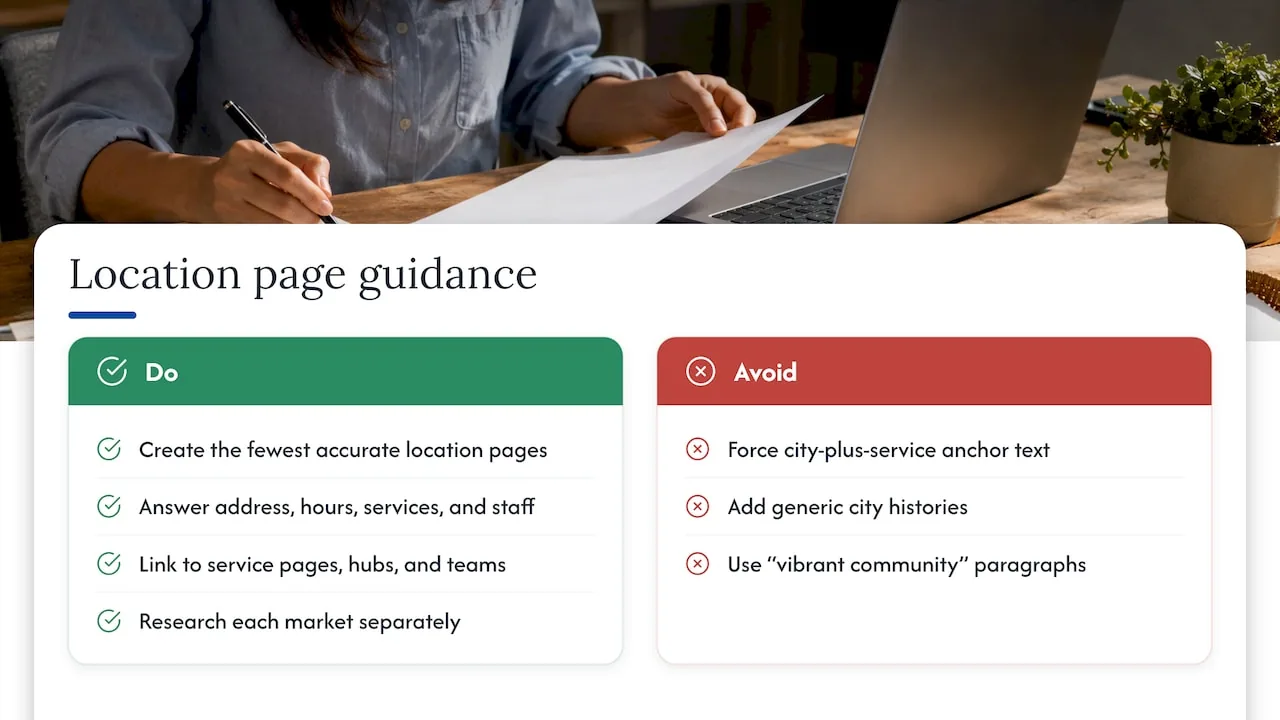
Multi-location businesses often assume more pages means more visibility. The research points the other way. Search Engine Land’s Gaetano Pizzi advises creating the smallest number of location pages necessary to represent the business accurately, making each useful, and linking them intentionally to service pages, regional hubs and team pages instead of forcing city-plus-service anchor text.
A useful location page answers practical questions: address, hours, services, staff, directions and accessibility. Pizzi adds that generic city histories and “vibrant community” paragraphs do not establish local relevance. Content should reduce uncertainty, show real-world knowledge or help the customer decide.
Research each market separately. Semrush’s multi-location guide says each market needs its own demand research, using combinations such as service plus city, service plus neighborhood, local terminology and “near me” queries, because language and competitors differ by market even for the same service. The same query can show different competitors and page types in two cities.
Practices that make your entity clear
| Element | What it tells search engines | Where to start |
|---|---|---|
| Business name, address, phone | Who you are and where | Identical everywhere you appear |
| LocalBusiness schema | Type, services, areas served | See our LocalBusiness schema guide |
| FAQ markup | Questions you answer | See FAQ schema |
| Wikidata and external profiles | Corroboration of your entity | See Wikidata checks |
| Team and service pages | Who does what | Link them to each other |
| Google Business Profile | Local identity and activity | Keep categories and services current |
Structured data and what it can do
Schema markup is code that labels the facts on a page so machines do not have to guess. Evidence on its effect exists, though it comes from specific cases and should be read that way.
- A Google Search Central case study on Rakuten Recipe, published in 2018, reported that after adding recipe structured data, search traffic to its pages rose 2.7 times and session duration became 1.5 times longer.
- A peer-reviewed study of a Polish design blog found pages with schema.org markup performed 2.4 times better in pageviews and sessions than unmarked pages.
- A Schema App case study of a senior living company with 47+ locations in eight US states reported a 55.5% impression increase on community pages that earned review snippets within three months, and 25% more clicks on non-branded “assisted living” queries after external entity linking.
The same academic study found auto-generated glossaries lengthened sessions but did little for search traffic unless the content was original and curated. Markup helps most when the content underneath is real and useful.
How to measure semantic SEO
Because the goal is clarity and coverage, measure beyond a single rank. Semrush recommends four layers for multi-location work:
- Search visibility: organic rankings and local pack presence.
- Website performance: impressions, clicks, sessions and conversions per location page.
- Google Business Profile activity: views, calls, directions, website clicks and bookings.
- Business outcomes: leads, appointments and revenue tied to each location.
Watch the number of distinct queries a page earns impressions for in Google Search Console. In a semantic approach, that count should grow even when your top keyword stays put. For the AI side, see our guide on tracking AI search visibility.
Tools, briefly
Different tools reveal different things: Google Search Console shows queries, impressions and indexation; Google’s Rich Results Test and the Schema Markup Validator check structured data; and Google’s Natural Language API can show which entities a draft emphasizes. Tools help you see gaps. They do not decide what your business should be known for. That is a strategic call.
Where AI content fits
AI can speed up drafting, but semantic SEO depends on specifics only your business holds: your services, your staff, your service area, your pricing logic. We cover how to use it responsibly in our guide to AI content and SEO.
What we do about it
For local and multi-location businesses, we build SEO around entity clarity: technical audits, on-page and off-page work, structured data, Google Business Profile management, and content planned around the topics your customers search. Our SEO plans (Foundation, Growth and Premium) and GBP Management are described on our SEO services page. We also run industry-specific programs, including law firm SEO and home services SEO.
If you want a view of how clearly search engines understand your business today, you can talk to us at NSYGHT. Consulting is available at $125 per hour.
Our perspective
Most local businesses do not have a keyword problem. They have a clarity problem. Search engines and AI tools cannot tell, with confidence, what the business does, where it does it and why it should be trusted.
We build authority first. That means defining your entity, tying your services to your locations, and making sure every page, profile and piece of markup says the same true thing. Technical SEO, GEO and AEO are not separate projects for us. They are one job: making your business easy to understand and easy to cite.
That is also why we report transparently. If clarity improves, you should see it in local pack placement, in the number of queries your pages answer, and in the calls and bookings that follow.
NSYGHT
FAQ
Is semantic SEO different from keyword research?
It builds on it. Keyword research tells you what people type. Semantic SEO groups those searches into topics and intents, then makes sure your pages cover the topic and the entities involved. You still choose primary phrases, but you stop treating each phrase as its own page.
How is semantic search optimization different from semantic SEO?
In practice they describe the same work. Both mean optimizing content and structure so search engines can understand meaning, context and relationships, rather than matching exact strings.
How many location pages does a multi-location business need?
The fewest that accurately represent the business, each genuinely useful. Search Engine Land’s guidance is to scale the clarity of your location pages, not their count, and to link them to services and team pages.
Does semantic SEO help with AI answers?
Yes, because AI answer engines rely on meaning rather than exact wording. Clear entities, consistent facts and complete topic coverage give those systems something reliable to cite.
Sources
- Semantic SEO: Optimize for Meaning, Not Just Keywords (Search Engine Land)
- Semantic SEO guide (Ahrefs)
- Semantic SEO: What It Is & 10 Tips for Success (Semrush)
- What is semantic search, and how does it work? (Google Cloud)
- What is semantic search: A deep dive into entity-based search (Search Engine Land)
- What is Semantic Search? (Elastic)
- Why Keyword Research Doesn’t Work in 2026 (Exploding Topics)
- Modern SEO Research Using Topics, Keywords, Entities, and Intent (Siteimprove)
- How to build topic clusters for SEO and AI search (Search Engine Land)
- Multi-location SEO: How to structure geographic pages (Search Engine Land)
- Multi-location SEO: How to build a scalable strategy (Semrush)
- Recipe Page Structured Data Case Study (Google Search Central)
- Is semantic markup really helping websites improve their rankings? (CEUR-WS)
- Brightview Senior Living’s Entity Linking Success Story (Schema App)
- Google Cloud Natural Language