

Local SEO ROI is the revenue that local search brings in, minus what you spent to get it, divided by what you spent. The formula takes a minute. The hard part is knowing which revenue was really caused by search, which costs belong in the total, and how long to wait before you judge the number. This guide covers all three, with worked examples for single-location and multi-location businesses.
TL;DR
- Local SEO ROI = (revenue from local SEO − local SEO cost) ÷ local SEO cost × 100. Count agency fees, tools and your own time as cost.
- Judge results by calls, form fills, bookings and closed jobs. Rankings and traffic are leading signs, not the return.
- Set up call tracking, Google Business Profile reporting, GA4 and a “How did you find us?” log before you start, or you will be guessing later.
- Multi-location and seasonal businesses should measure by location and compare year to date, not month to month.
- Give the work about six months or more before making a verdict, while checking leading indicators monthly.
Table of Contents
- The formula, with a worked example
- What belongs in the cost side
- What belongs in the revenue side
- Metrics that show whether local search is working
- How to trace calls, forms and sales back to local SEO
- Multiple locations and seasonal demand
- How long to wait before judging the return
- What to do when rankings rise but revenue does not
- Our perspective
- How we can help
- FAQ
- Sources
The formula, with a worked example
The standard version is simple: local SEO ROI is revenue from local SEO minus its cost, divided by its cost, times 100. If you spent $750 in a month and local search produced $3,000 in revenue, ROI is ($3,000 − $750) ÷ $750 × 100 = 300%.
That means each dollar invested returned its own dollar plus three more. An ROI of 0% is break-even. A negative number means you have not yet earned back the spend.
The formula is only as honest as its two inputs. Most disagreements about local SEO ROI are really disagreements about what counts as revenue and what counts as cost.
What belongs in the cost side
A complete cost figure is bigger than the invoice. The U.S. Small Business Administration says to compare marketing and sales costs against the revenue they generate, to use a full cost breakdown, and to keep tracking costs after the plan is in place.
For local SEO, that breakdown usually includes:
- Agency or freelancer fees. The monthly retainer plus any one-time audit or setup.
- Software. Rank tracking, citation management, call tracking and reporting tools. Locafy lists these tools and DIY time alongside agency fees as costs to include.
- Your own time. If you or your office manager spends five hours a week on reviews, photos and posts, price those hours.
- Content and web work. New service pages, location pages or a site rebuild that the SEO plan depends on.
- Related paid spend. If you run ads alongside SEO, keep them in a separate column so they do not inflate or hide the organic return.
If you want a method for building that list line by line, this walkthrough on measuring the ROI of marketing campaigns is a good companion. For a sense of what typical budgets buy, see our breakdown of local SEO pricing.
What belongs in the revenue side
Only count revenue you can reasonably tie to local search. Three sources are the usual candidates:
- Tracked phone calls from your Google Business Profile and your website.
- Form submissions, chat leads and booking requests from organic and map visitors.
- Direction requests and walk-ins, which are harder to prove and should be estimated conservatively.
When you cannot see the sale directly, estimate it. Multiply the number of leads by your lead-to-customer rate and by your average customer value. That is the method Locafy describes for turning leads into revenue.
A hypothetical example
Say a dental practice gets 40 new-patient calls a month from search. The front desk books 50% of them, so 20 new patients. If a new patient is worth $900 in the first year, that is $18,000 of attributable revenue. At a total monthly cost of $2,500, ROI is ($18,000 − $2,500) ÷ $2,500 × 100 = 620%.
These figures are an illustration, not a benchmark. Your booking rate and patient value will differ, and you should use your own numbers.
Note the choice of average value. Use first-year gross revenue if you want a cautious number. Use lifetime value only if you have the data to support it, and say which one you used every time you report.
Metrics that show whether local search is working
ROI is the final score. These are the plays that lead to it. Search Engine Land’s overview of local SEO metrics lists rankings, traffic, engagement, conversions, sales, reputation and Net Promoter Score. Not all of them deserve equal weight.
| Metric | What it tells you | Weight in an ROI conversation |
|---|---|---|
| Closed revenue from local leads | The actual return | Highest |
| Booked appointments, quotes, estimates | Lead quality | High |
| Calls, form fills, chat leads | Demand captured | High |
| GBP calls, website clicks, direction requests | Map pack engagement | Medium |
| Review count and recency | Trust and conversion rate | Medium |
| Impressions and average position | Visibility trend | Low, leading only |
| Domain authority and similar scores | Third-party estimates | Ignore for ROI |
On that last row, Search Engine Land’s 2026 advice on retiring SEO metrics is to drop domain authority and focus on organic revenue and pipeline contribution. We agree. A score that no customer ever sees cannot be paid for out of revenue.
Reviews deserve a special note. A 2019 study of more than 200,000 U.S. small businesses found that review volume correlated with revenue more strongly than star rating did, and that businesses claiming their listings on multiple sites earned 58% more revenue. That is a correlation, not a guarantee, but it is a reason to track review volume next to calls. Our guide to getting more Google reviews within the rules explains how.
How to trace calls, forms and sales back to local SEO
Attribution is where most local businesses lose the thread. A rise in rankings means little if nobody can say which customers came from it. Set up these four layers before you spend, so you have a baseline.
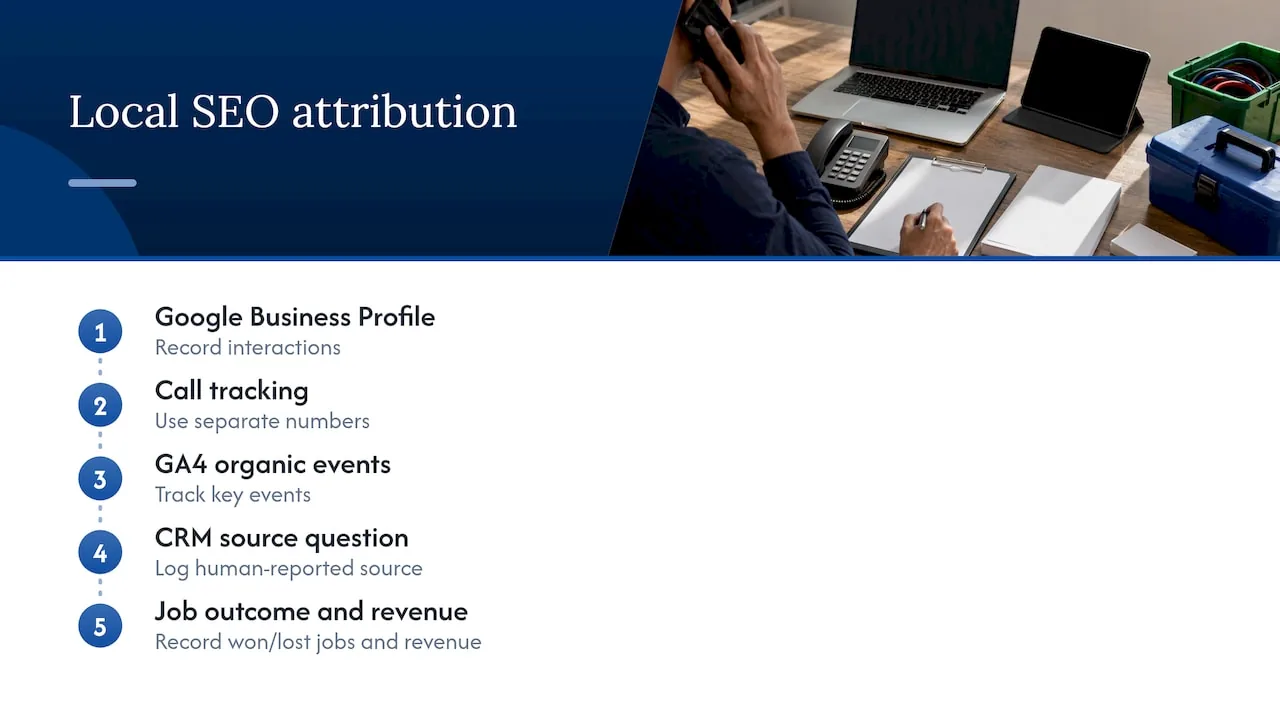
1. Google Business Profile performance
Your profile reports interactions such as website clicks, calls, direction requests and bookings. Google notes that interaction metrics update daily, other metrics monthly, and data is available for up to six months. That six-month window is why you should export the numbers monthly. Otherwise, your baseline disappears.
You can also connect your Business Profile to Google Analytics, which shares interactions like calls, website clicks, messages and bookings, so map activity and site activity sit in one place.
2. Separate call-tracking numbers
For most service businesses, the phone is the conversion. Call tracking tools can assign different numbers to sources such as your website and your Business Profile and record which number each caller dialed. Keep your main number as the primary one in listings and use the tracking number as an additional line where the platform allows it, so your name, address and phone data stays consistent. The same logic applies to paid campaigns, and this overview of Google Ads conversion tracking shows how calls get credited to a channel.
3. GA4 key events
Mark form submissions, booking clicks and click-to-call taps as key events in GA4, then filter to organic search. This gives you the website half of the picture.
4. A human question
Train whoever answers the phone to ask, “How did you find us?” and log it in your CRM or a shared spreadsheet. This is a method the same source recommends alongside tracking numbers. It catches the people who saw your map listing, then googled your name and called the main line.
Then tie the leads to closed jobs. Whoever sells should mark each lead won or lost, with the dollar amount. Without that, you have lead counts, not ROI.
If you want a ready-made reporting structure, our post on local SEO reporting shows what a monthly report should contain.
Multiple locations and seasonal demand
Report by location
A combined number can hide a weak branch behind a strong one. For multi-location brands, PinMeto’s guidance is to track outcomes by location: calls, website conversions, visits and revenue.
Watch out for growth that is not marketing. Search Engine Land makes the point that total growth can mislead when locations open, close or change, and that comparable-location reporting should sit next to totals. If you opened two new franchise units this year, your total leads will rise even if SEO did nothing. Compare the same set of locations year over year to isolate what search contributed.
Our multi-location SEO guide covers the setup that makes this reporting possible.
Seasonal businesses: use year to date
Party rental, roofing, landscaping and dumpster rental all have peaks. Judging a campaign on January against July tells you about the weather, not about SEO. For seasonal businesses, the same PinMeto source suggests year-to-date analysis rather than a single month. Compare this peak with last peak, and this off-season with last off-season.
Service-area businesses
If you travel to customers, split reporting by city or ZIP cluster where you can. Our service area business SEO plan explains how to structure that.
How long to wait before judging the return
There is no official clock. Most practitioners describe early movement in the first few months and business results later, typically somewhere in the six-to-twelve month range for competitive markets. Treat that as a rule of thumb, not a promise. Your starting point matters: a business with a verified, active profile and a decent site moves faster than one with duplicate listings and thin pages.
A practical approach:
- Months 1 to 2: Audit, fixes and tracking setup. Expect little revenue. Check that tracking works by placing test calls.
- Months 3 to 4: Look for leading signs: more profile impressions, more calls from the map listing, better review velocity.
- Months 5 to 6: First honest ROI calculation. Compare against your baseline, not against zero.
- Month 7 onward: Run ROI quarterly and cumulatively, because early months carry setup costs that later months do not.
If leading indicators are flat by month four despite documented work, ask hard questions of whoever is doing it. If they are climbing and revenue lags, check whether the sales process is converting the leads you already have.
What to do when rankings rise but revenue does not
This is the common frustrating case. Work through it in order.
- Check tracking first. Are calls being counted? Is the form firing a key event?
- Check lead quality. Are the new calls from the right service and the right area? Rankings for the wrong terms produce busy phones and no sales.
- Check response. How many calls go unanswered? How fast do you reply to forms?
- Check the profile and site. Do your hours, photos, services and reviews give a stranger reason to choose you over the next result? Our Google Business Profile optimization guide lists the fixes that tend to drive calls.
- Adjust and re-measure. The SBA treats measurement as a loop: budget fully, compare costs with revenue, and update the plan based on what you find.
Our perspective
We work with local service businesses, and the pattern repeats: the owners who are happiest with SEO are the ones who agreed on how to measure it before the first invoice. They know their average job value, they know their close rate, and they can read a call log.
We would rather report on booked jobs than on keyword positions. Positions are useful for diagnosing a problem, but they are not why anyone hires us. That is why our reporting centers on calls, forms and revenue by location, and why we build the tracking before we build the pages.
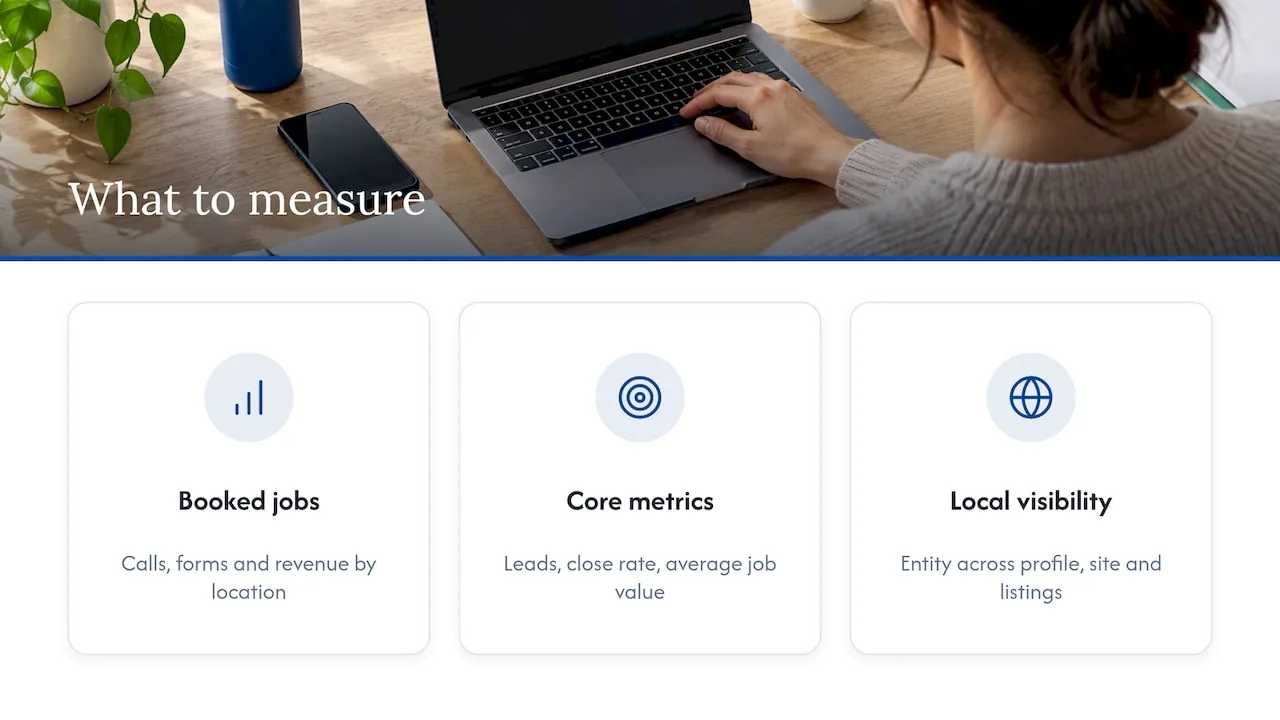
We also think the definition of local visibility is wider than it was. People now get answers from AI tools as well as map packs. So we measure whether a business is clearly defined as an entity across its profile, site and listings, because that is what both kinds of search rely on. You can read more about this in how SEO, GEO, AEO and AIO work together.
Our advice: pick three numbers (leads, close rate, average job value), write them down today, and compare them every quarter.
, NSYGHT
How we can help
If you want local SEO that is measured against revenue from day one, our local SEO services run month to month, with Foundation, Growth and Premium tiers plus Google Business Profile management. We set up tracking first and report on calls, forms and bookings.

If you also want paid traffic, our Google Ads management is $499 per month with a one-time $249 setup fee, and Facebook & Instagram Ads are $349 per month with a $249 setup fee. Consulting is $125 per hour if you only want help with your measurement plan. Start at nsyght.com or see all services.
FAQ
Is local SEO worth it?
For most businesses that depend on nearby customers, it can be, but only if you measure it. Calculate cost against tracked revenue after at least six months, and compare it with your other lead sources. If you cannot trace calls or bookings, you cannot answer the question yet.
How much should I pay for local SEO?
It depends on your market’s competition and the number of locations. A useful limit is the profit from an average customer: the spend should be well covered by the customers it brings in. For ranges and what each tier buys, see our local SEO pricing guide.
Which SEO ROI metrics matter most?
Closed revenue from local leads, booked appointments, and calls and form fills. Treat rankings, impressions and profile views as leading indicators. Skip domain authority when you are talking about return.
Can I calculate local SEO ROI for multiple locations?
Yes, calculate it per location, then add a comparable-location view so openings and closures do not distort the total. Use the same cost allocation rules for every location so the numbers can be compared.
Sources
- Local SEO ROI: How to Calculate and Maximize Your Return (Locafy)
- Manage your business: marketing and sales (U.S. Small Business Administration)
- Key Metrics for Local SEO Success (Search Engine Land)
- Review counts matter more to local business revenue than star ratings (Search Engine Land)
- Retire these 9 SEO metrics before they derail your 2026 strategy (Search Engine Land)
- Changes to your Performance data (Google Business Profile Help)
- Connect your Business Profile to Google Analytics (Google Business Profile Help)
- How to Track Local SEO Results
- Measuring Local Marketing ROI for Multi-Location Brands (PinMeto)
- How to segment SEO data for multi-location brands (Search Engine Land)
- Measuring the ROI of Your Marketing and Advertising Campaigns
- Google Ads Conversion Tracking