

The most effective Google reviews strategy is not a one-time push for stars. It is a continuous, policy-compliant program that asks for genuine feedback, makes leaving a review effortless, responds quickly to every review, measures the results, and fixes whatever keeps showing up in complaints. Start today by generating your Google review link or QR code, writing one simple reply template, and picking a single KPI, like weekly review volume, to track.
- Regularly asking for reviews immediately after a positive experience using direct links or QR codes ensures higher response rates and authentic feedback.
- Monitoring review volume, response rate, and recency helps track the effectiveness of your review acquisition and responsiveness efforts.
- Avoid incentivizing reviews with discounts or gifts and ensure solicitation complies with Google's policies to prevent penalties or review removal.
- Promptly responding to reviews, especially negative ones, with personalized messages and offline resolution, significantly improves reputation management.
- Consistent review activity and high response rates boost local search visibility, as Google favors businesses with active, recent, and genuine customer feedback.
The five pillars of an effective Google reviews strategy
Everything that works in review management falls into five connected pillars: acquisition, enablement, response and reputation, compliance, and measurement. Skip one and the others lose power. You can generate volume, but without fast responses, you waste the trust you just earned. You can respond well, but without a compliance check, an aggressive acquisition tactic can get your listing penalized.
- Acquisition covers how you ask for reviews across email, SMS, in-person, and QR codes.
- Enablement means removing friction: a direct link, a scannable code, and a clear process customers can finish in under a minute.
- Response and reputation is how you reply to every review and turn complaints into fixes.
- Compliance keeps your tactics inside Google's rules so growth does not create risk.
- Measurement ties review activity to visibility and revenue instead of vanity metrics.
Google's own guidance ties review activity directly to visibility: more reviews and higher ratings contribute to a business's prominence in local search results, alongside relevance and distance. Recency matters too: a steady trickle of new reviews signals an active, trustworthy business more than a pile of old ones ever will.
Priority depends on your size. A single-location business should focus first on acquisition and response since volume is usually the bottleneck. A multi-location brand or franchise needs governance baked in from day one: templates, approval workflows, and reporting that works the same way across every location.
Practical tactics to get more legitimate Google reviews
Getting more reviews starts with making the ask specific, timely, and easy to complete. A vague "please review us" gets ignored; a direct link sent at the right moment gets clicked.
- Create your review link through your Google Business Profile dashboard, shorten it, and turn it into a QR code for receipts, invoices, countertop signage, or vehicle decals for field service teams.
- Ask in person right after a positive interaction, using a short script like, "We'd love it if you shared your experience on Google. I can text you the link right now."
- Send an initial email within a few hours of service completion, with a one-line ask and the direct link, not a generic newsletter template.
- Follow up once three to five days later if there's no response, varying the subject line and keeping the message under three sentences.
- Add an SMS touchpoint for businesses with mobile-friendly customers, since text messages often get opened faster than email.
- Encourage specifics, asking customers to mention what they ordered, which technician helped them, or what problem got solved, since detailed reviews carry more weight with future readers and with Google's relevance signals.
A post-service survey works well as a private first step. Route customers to a short internal survey before the public ask; happy respondents go on to the Google review link, while unhappy ones get flagged for follow-up before anything goes public. This is not gating ratings, since every customer who wants to leave a public review still can. It simply gives your team a chance to fix problems first, an approach industry guides on review integration point to as a way to reduce negative public exposure without manipulating outcomes.
Skip discounts, gift cards, or "free item for a review" offers entirely. Incentivized reviews violate Google's policies and put your listing at risk. Instead, for low-response segments, try a different channel or a shorter message rather than a sweeter offer.
Send the review request while the experience is still fresh, ideally as soon as possible after service completion, since memory and motivation both fade fast after that.
How to reply to reviews and operationalize feedback
Every review deserves a reply, and the tone matters as much as the speed. For a glowing review, thank the customer by name, reference something specific they mentioned, and keep it under three sentences. For a complaint, acknowledge the issue, apologize without excuses, and offer a path to resolution, then take the detailed conversation offline through phone or email.
- Praise: "Thank you, [name], glad the team could help with [specific detail]. We appreciate you taking the time to share this."
- Complaint: "We're sorry this fell short, [name]. Please reach out at [contact] so we can make it right."
- Neutral or mixed: Acknowledge both the positive and the gap, and invite a direct conversation rather than debating details publicly.
- Avoid: admitting fault for a regulated or legal issue in a public reply, arguing with the reviewer, or copy-pasting the same response to every review.
Escalate anything involving safety, billing disputes, or potential legal exposure straight to a manager or counsel before replying publicly. A holding reply like "We take this seriously and are looking into it directly" buys time without creating liability.
Response speed matters more than people expect. Research on customer service shows that customers are often more frustrated by how long an issue takes to resolve than by the resolution itself, which makes a fast first reply one of the highest-leverage moves in reputation management. Set an internal target for prompt reply, aiming to respond quickly, and track it as a KPI.
Treat recurring complaints as operational data. If three reviews in a month mention long wait times, that's a staffing or scheduling fix, not a coincidence. Feed patterns from reviews into staff training and process changes on a monthly cadence.
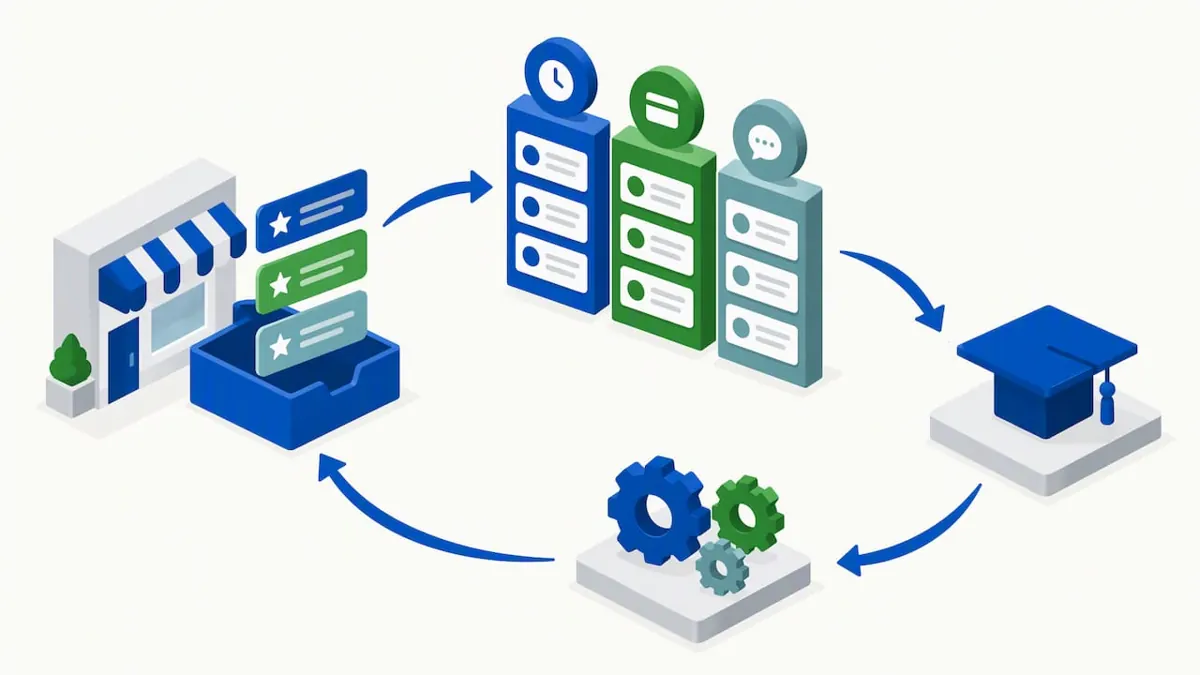
Keep a shared log of complaint themes by category, like wait time, billing, or communication, so patterns are visible before they become a trend in your star rating.
Google policies and practical compliance rules
Google's rules on reviews are specific, and violating them can mean removed reviews or account-level penalties. The platform explicitly prohibits incentivized, fake, or manipulated reviews, along with behaviors it classifies as Rating Manipulation, including review swaps, posting from fake accounts, and pressuring customers for specific star ratings.
Common red flags that trigger review removal include sudden spikes in review volume, multiple reviews from the same IP address or device, and review content that matches templates word for word. Google's detection systems look for these patterns automatically.
A safe solicitation checklist:
- Ask for a review, never a specific star rating.
- Never offer money, discounts, or gifts in exchange for a review.
- Never filter customers so only happy ones reach the public review link.
- Train staff to say "we'd appreciate your honest feedback," never "please leave us five stars."
- Report fake or suspicious reviews through your Business Profile dashboard rather than disputing them publicly.
KPIs, dashboards, and what to track to prove ROI
A review program without measurement is a guess. Track five core metrics: review volume (new reviews per week or month), average rating, response rate, sentiment trends, and recency, meaning how fresh your most recent reviews are.
- Volume tells you if acquisition tactics are working.
- Response rate should stay close to 100%, since every review deserves a reply.
- Sentiment flags operational issues before they tank your average.
- Recency matters for local ranking, since Google's prominence signals favor active, recently-reviewed businesses over stagnant profiles.
A single-location business might target a handful of new reviews weekly with a 48-hour response window, while a multi-location brand should set per-location benchmarks and flag any outlier dragging down the average.
Review volume and rating directly influence visibility: Google states that more reviews and positive ratings help a business rank higher in local search results, which makes review count a legitimate marketing KPI, not just a reputation one.
Build a simple weekly dashboard tracking these five numbers per location, then review it monthly alongside lead volume to spot correlation between review activity and inquiries. When a metric drops, like response rate slipping below 80%, treat it as the priority fix before chasing new volume.
Vendor-neutral tooling categories and governance for scale
You don't need an enterprise platform to run a solid review program, but as you scale across locations, the right tooling categories save real time. Four categories cover most needs: link and QR code generators, CRM automation for timed review requests, inbox or response platforms that centralize replies across locations, and reputation analytics tools for sentiment and trend tracking.
When evaluating any tool, check for:
- Multi-location support, so each location's reviews and replies stay organized separately.
- Compliance controls, like built-in warnings against incentivized requests or review gating.
- Reporting granularity, down to the location or staff level, not just a company-wide average.
- Integration points with your existing CRM or scheduling software.
A safe automation flow looks like this: a service ticket closes, triggering a survey request, which routes satisfied customers to the public review link and flags dissatisfied ones for manager follow-up. Build in a human checkpoint, like a monthly audit of automated messages, to catch anything that drifts toward incentivized language. Platforms built for reputation management often bundle these governance features directly into their reporting.
NSYGHT evidence and playbook highlights
An entity-driven SEO approach treats Google reviews as one signal inside a larger digital infrastructure that spans Generative Engine Optimization and Answer Engine Optimization, alongside traditional technical SEO. Governance is built into review programs with a defined owner, scripted asks per channel, and a two-person check on automated campaigns before they go live across multiple locations. This structure is what lets us support local service businesses, dental practices, and franchises with workflows designed to improve local-pack visibility and referrals from AI-generated answers over time.
Why reviews matter more as AI reshapes search
Authentic, policy-safe reviews are becoming more valuable, not less, as AI and answer engines start synthesizing local business information directly into results. A thin, inconsistent review profile gives these systems little to work with, while a steady, honest pattern of feedback gives them a clear signal to cite. Treat your review program as infrastructure, not a campaign. The businesses that keep asking, replying, and fixing root causes month after month will be the ones AI-driven search keeps pointing to, long after the shortcuts that violate policy have been caught and penalized.
Let us manage your Google Business Profile and reviews
If building and running this system sounds like one more job on top of running your business, that's exactly the gap our Google Business Profile management service closes. We handle the ask, the response templates, the compliance checks, and the monthly reporting, so review growth happens without pulling your team away from customers.

For businesses running multiple locations, our SEO Foundation and Growth plans layer review management into a broader local visibility strategy, and our Google Ads management service can amplify a strong review profile with paid placement once your ratings are a genuine asset. Start with a consultation, and we'll audit your current review profile, response history, and local ranking signals before recommending next steps.
Frequently Asked Questions
If you've seen this figure referenced elsewhere, treat it as an informal industry shorthand rather than a confirmed Google policy, since Google's own guidance focuses on prominence, relevance, and distance rather than a fixed percentage.
The most reliable method is asking directly after a positive interaction, using a shortened review link or QR code to remove friction. Combining an in-person ask with a same-day email or text follow-up consistently outperforms a single generic request.
Google does not publish a specific feature or ranking boost tied to the number 100 specifically. What does change gradually is prominence: more reviews and higher ratings contribute to better visibility in local search results, so milestones matter less than consistent, ongoing volume.
The exact number depends on your current rating and total review count, since a new five-star review moves the average more when you have fewer existing reviews. Focus on steady, authentic acquisition rather than a specific target number, since recency and consistency matter as much as the raw count.
Yes. Reviews feed directly into prominence, one of Google's three core local ranking factors, alongside relevance and distance, and they also influence click-through rates once your listing appears.