

Most U.S. local businesses should budget between $500 and $2,500 a month for local SEO, with specialty fields like law and dentistry running $2,000 to $9,500 or more. Start at the low end if you're in a low-competition market with one location, and plan to scale up as competitors, service areas, or locations multiply. Every quote you get should shift up or down from that baseline based on your market, not some fixed agency rate card.
- Smaller businesses in low-competition markets can expect to pay around $500 to $800 monthly for basic local SEO services, focusing on GBP management and citations.
- Moderate-competition markets generally require budgets between $800 and $2,000 per month for content creation, review generation, and local link building efforts.
- High-competition verticals like law and medical practices often spend from $2,000 to over $9,500 monthly due to stricter content standards and concentrated keyword competition.
- Technical SEO work such as site audits and migrations can add $500 to $3,000 for audits and $1,000 to $5,000+ for site migrations, depending on complexity.
- Proposal comparisons should clarify deliverable velocity, scope, and who performs the work, as well as avoid vague guarantees or recurring fees without defined outputs.
Local SEO Pricing Snapshot: What Each Budget Band Buys
The dollar figure on a proposal means nothing without knowing what it buys. A $600-a-month retainer and a $4,000-a-month retainer are not the same service delivered at different speeds. They're often entirely different scopes of work.
At the entry level, roughly $500 to $800 a month, you're typically paying for Google Business Profile upkeep, basic citation consistency across directories, and light monthly reporting. This tier suits a single-location business in a market with little organized competition, like a family diner in a town with two other sit-down restaurants. It's not enough for a business trying to outrank ten competitors for the same three keywords.
The growth tier, roughly $800 to $2,000 a month, adds regular content production, review generation systems, and some local link building. This is where most moderately competitive single-location businesses land, according to benchmark data from IrisScale, which pegs moderate-competition markets at $800 to $2,000 monthly.
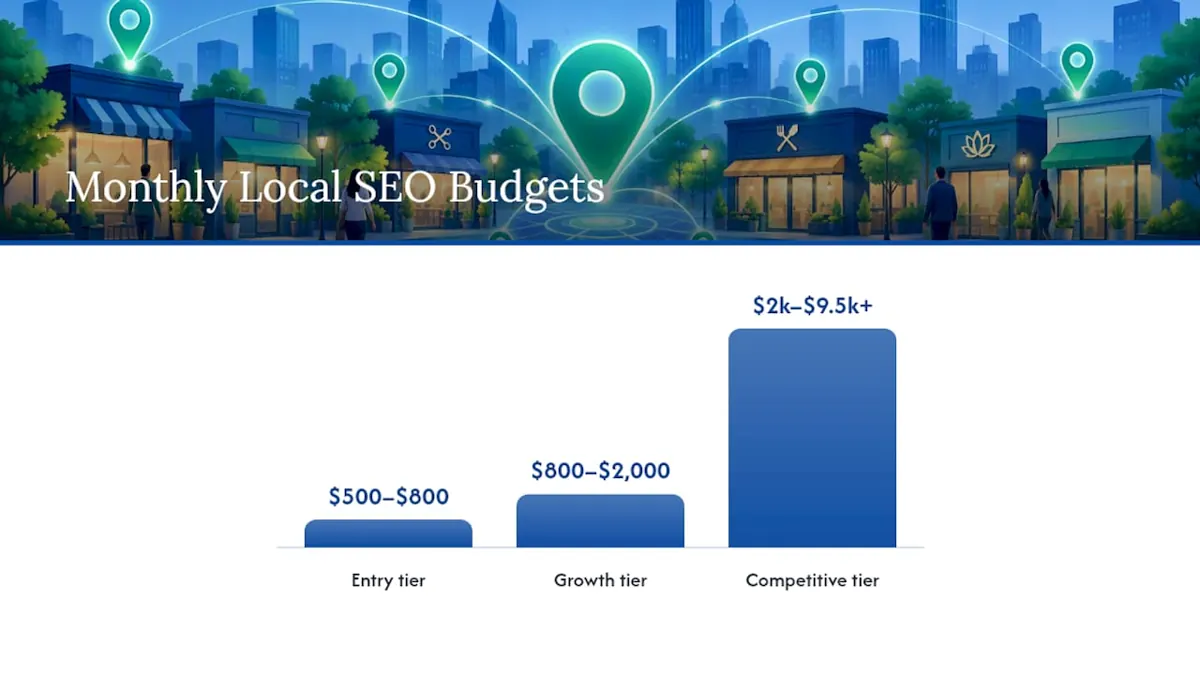
Above that, $2,000 to $9,500-plus a month covers competitive verticals and multi-location accounts, where the work multiplies across service areas and the content, links, and citations have to be defensible against well-funded competitors. Market pricing summaries put specialty fields like law and medical consistently in this bracket.
One-time and project fees run separately from monthly retainers:
- Technical SEO audits: $500 to $3,000, depending on site size and how deep the crawl goes
- Site migrations: $1,000 to $5,000+, scaling with page count and redirect complexity
- Citation cleanup (one-time): $100 to $600 for correcting duplicate or inconsistent listings
- GBP setup and optimization: often bundled into the first month of a retainer, sometimes billed as a standalone $150 to $400 project
Franchise and multi-location pricing rarely scales in a straight line. A five-location franchise doesn't pay five times the single-location rate, because a lot of the work, like building location page templates or standardizing name-address-phone data, gets built once and reused. Expect a lower per-location cost as the count grows, with the real spend shifting toward market-specific work: local content, local links, and review generation for each individual market.
Retainer, Hourly, or Project: How Local SEO Gets Billed
Every local SEO quote comes down to one of four billing structures, and each fits a different situation.
- Monthly retainer. This is the dominant model, and for good reason: SEO compounds over time, and a retainer supports the steady content, citation, and link cadence that produces ranking gains. Retainers for local businesses commonly fall between $500 and $2,500 a month, while Clutch's agency pricing data shows broader agency retainers spanning $2,000 to $20,000 depending on scope and market. Retainers make sense for any business planning to compete for more than a few months.
- Hourly consulting. Useful for narrow, well-defined problems, like a technical audit, a schema markup fix, or a one-time GBP cleanup, where you don't need ongoing work. Clutch's data puts typical U.S. agency hourly rates at $100 to $149 an hour. Hourly billing gets expensive fast if you use it for anything that requires sustained content or link work.
- Project-based fees. A fixed price for a defined deliverable, like a website migration, a full citation audit and cleanup, or a competitive analysis. This model works when the scope is genuinely finite and both sides agree on what "done" looks like before work starts.
- Performance-based pricing. Rare, and worth real caution. Some agencies tie fees to ranking positions or lead volume, but Google states plainly that local ranking depends on relevance, distance, and prominence, and there's no way to pay for a better position. Where performance pricing exists safely, it's usually structured around tracked lead volume with a base retainer plus bonus, not raw ranking promises.
If an agency pushes hard for performance-based pricing tied to keyword rankings, ask them to define exactly which rankings, on which search engine, checked from which location. Rankings vary by searcher location and device, and vague answers here usually mean vague reporting later.
What Actually Moves Your Price Up or Down
Five factors explain almost every gap between a $600 quote and a $6,000 quote for what sounds like "the same service."
- Business size and lead targets. A solo contractor chasing 15 extra calls a month needs far less than a multi-crew roofing company trying to fill a sales pipeline across a metro area.
- Market competitiveness. Ranking a bakery in a mid-size town is a different job than ranking a personal injury law firm in a major metro, where dozens of firms fight for the same handful of map pack spots.
- Number of locations. Each additional location adds GBP management, local citations, and location-specific content, even when templated work reduces the marginal cost.
- Website technical debt. A site built on an outdated platform with broken redirects, missing schema, or thin content needs foundational work before local optimization can even take effect. That work costs money and time before rankings move at all.
- Industry-specific complexity. Legal, medical, and financial services carry stricter content standards, review compliance concerns, and often statewide competition rather than just local, which pushes budgets higher across the board.
Competition is usually the single biggest driver. Two businesses with identical size and websites can face wildly different price tags if one operates in a market with three competitors and the other in a market with thirty. Before you accept any quote, ask the agency what they see when they search your actual target terms. If they can't describe your competitive landscape, they haven't done the homework to price you accurately.
Technical debt deserves particular attention because it's the factor business owners most often overlook. A site that hasn't been touched in five years, running on an old content management system with no mobile optimization, often needs $1,000 to $3,000 in foundational technical work before local SEO spend produces any visible return. Skipping that step and going straight to content and link building on a broken foundation is one of the more common ways businesses waste a first quarter of SEO spend.
What You Get at Each Price Level
Deliverables, not dollar amounts, are what actually separate a good proposal from a bad one. A recommended way to think about a monthly retainer is by allocation: budgeting frameworks suggest roughly 20 to 25% toward Google Business Profile management, 30 to 35% toward local content, and 20 to 25% toward local link building, with the remainder covering citations, reviews, and reporting.
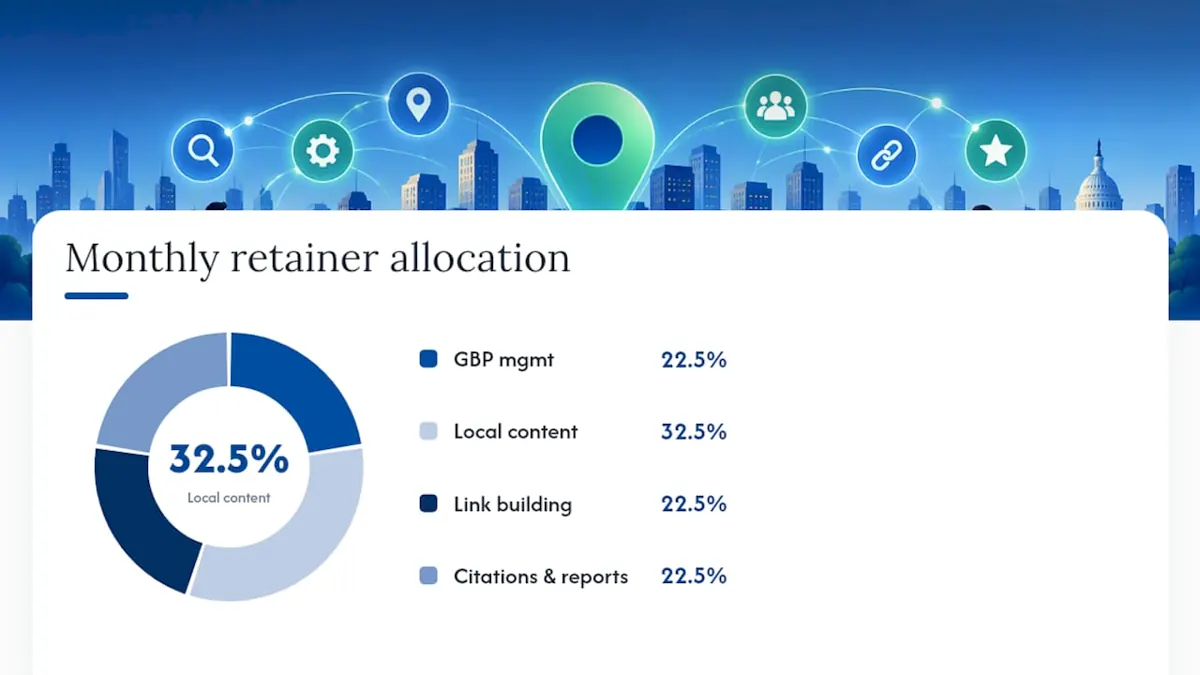
At the entry tier, expect monthly GBP posts and photo updates, quarterly citation audits, and a basic monthly report showing traffic and ranking snapshots. This is enough to maintain a presence, not enough to win a fight.
At the growth tier, deliverables typically expand to weekly GBP activity, one or two new local landing pages a month, active review generation outreach, and a handful of local link building or outreach attempts monthly. This is where most competitive single-location businesses need to sit to actually gain ground.
At the top tier, work includes aggressive content production, ongoing digital PR or local link campaigns, conversion rate work on landing pages, and often a dedicated account strategist reviewing performance monthly rather than just reporting it.
Standalone services, if you want to buy pieces rather than a bundle, tend to run in these ranges according to aggregated market pricing:
- GBP management alone: $100 to $400 a month
- Citation cleanup: $100 to $600 one-time, or $100 to $200 a month for ongoing monitoring
- Local content production: $200 to $800 a month
- Local link building: $300 to $1,500 a month
The single best way to confirm a deliverable is real, not filler, is to ask for velocity: how many pieces of content, how many link attempts, how many GBP posts per month. A proposal that just says "ongoing local SEO optimization" without numbers attached is a proposal you should push back on before signing anything. NSYGHT's local SEO checklist breaks deliverables into 40 items across 8 categories, which is a useful reference point for what a complete scope actually looks like.
Local SEO Budget Benchmarks by Business Type
Budgets vary as much by industry and competitive intensity as they do by business size. A single-location dry cleaner and a single-location personal injury attorney can pay wildly different amounts for what looks like the same service category.
For a single location in a low-competition market, like a hardware store in a small town with one or two direct competitors, $300 to $800 a month is usually enough to establish and maintain visibility. Moderate competition, think a mid-size city with five to ten competing businesses in the same category, pushes that to $800 to $2,000 a month. High-competition single-location markets, like a metro-area gym competing against national chains and dozens of independents, often run $2,000 to $4,000 a month or more.
Multi-location and franchise pricing works differently. Instead of multiplying the single-location rate, agencies typically price a base platform fee that covers templated work (location pages, consistent citations, centralized reporting) plus a per-location add-on for market-specific content and outreach. A five-location home services franchise might see a base fee plus $200 to $500 per location monthly, which lands well under five times the single-location rate.
Industry notes worth knowing before you negotiate:
- Law firms routinely pay $2,000 to $9,500+ a month because competition concentrates around a small number of high-value keywords, and review management and content standards carry more compliance weight.
- Dental and medical practices face similar pressure, plus the added cost of content that meets health information accuracy standards.
- Home services companies (HVAC, plumbing, roofing, electrical) sit in a wide range, from $800 for a single-crew operation in a small town to $4,000-plus for a multi-crew company competing across a metro area. NSYGHT's work with home services companies reflects how much this range shifts based purely on service area size.
If your industry isn't listed here, use competitive intensity as your guide rather than the industry label itself. A specialty pet groomer with three competitors within five miles has more in common, price-wise, with a low-competition hardware store than with a law firm.
How to Evaluate a Local SEO Proposal
Comparing two proposals side by side only works if you force them into the same format. Agencies structure quotes differently on purpose, sometimes to make comparison harder, so the burden is on you to normalize what you're being shown.
- Ask for a deliverable list with monthly counts. "Local SEO optimization" tells you nothing. "Two local landing pages a month, weekly GBP posts, three link outreach attempts monthly" tells you exactly what you're buying.
- Ask who does the work. Some agencies staff dedicated strategists; others route work through junior generalists or overseas contractors with minimal oversight. Neither is automatically wrong, but the price should reflect which one you're getting.
- Ask what tools they use for tracking and reporting. Rank tracking, citation monitoring, and review management all require software, and the agency's answer tells you whether reporting will be substantive or a screenshot of Google Analytics.
- Ask about reporting cadence and format. Monthly is standard; anything less frequent than that makes it hard to catch problems early.
- Ask about contract length and exit terms. Month-to-month agreements with a 30-day notice period are common and reasonable. Long lock-in contracts with steep cancellation penalties deserve extra scrutiny.
Watch for a few specific red flags. Any agency promising guaranteed rankings is making a claim Google itself says is impossible to fulfill honestly, since ranking depends on relevance, distance, and prominence, not ad spend or agency influence. Vague metrics, like reporting "improved visibility" without specific ranking or traffic numbers, are another warning sign. So are unexplained recurring fees that appear on invoices without matching a deliverable in the original scope.
Request that any deliverable list include a defined monthly velocity, not just a category name. A tactic borrowed from procurement best practices: write "1 GBP audit plus weekly optimization, 2 local pages/month, 3 outreach attempts/month" directly into the contract, so there's no ambiguity about what "ongoing SEO" means six months from now.
How Long Local SEO Takes and What Return to Expect
Most successful local SEO engagements run about 12 months, and that timeframe isn't arbitrary. Clutch's analysis of agency engagements shows this length is common because ranking improvements compound. Early months build the foundation; later months capture the payoff.
By month three, expect technical fixes completed, GBP fully optimized, and early citation cleanup finished. Rankings may show small movement, but the real work is happening under the surface. By month six, local content and link building should be producing visible ranking gains for easier keywords, along with a growing base of reviews. By month twelve, competitive keywords should show meaningful movement, and lead volume should reflect the cumulative work rather than a single tactic.
A simple ROI check: if a $1,500-a-month retainer generates 10 additional qualified leads monthly, and your average customer value is $500, that's $5,000 in new monthly revenue against $1,500 in spend. The math only works if you track lead sources accurately and give the campaign the full runway it needs, since research on shifting search behavior suggests measurement itself is evolving as AI-driven search tools change how people find local businesses.
How NSYGHT Prices and Scopes Local SEO Work
Most local SEO pricing conversations still assume search works the way it did five years ago: rank a page, win a click. Some SEO providers build scopes around a different premise, that visibility now means showing up correctly in Google's map pack and in the answers AI tools generate when someone asks for a recommendation. This approach involves entity-driven SEO architecture, Generative Engine Optimization, and Answer Engine Optimization, which can be treated as one connected system rather than separate line items.
In practice, that means the same deliverables discussed throughout this guide, GBP management, citation consistency, local content, link building, get mapped to a scope defined around your specific tier: SEO Foundation, SEO Growth, or SEO Premium. Reporting focuses on the metrics that actually matter to a business owner, lead volume, call tracking, and referral sources, rather than vanity ranking snapshots.
Industries with more complex compliance or competitive pressure, like home services companies, get scopes weighted toward the deliverables that move the needle fastest in those specific markets.
Ready to See Where Your Business Stands?
NSYGHT works best for local and multi-location service businesses that want a scope built around what actually drives calls and bookings, not a generic package resold at three price points. Instead of guessing which of the pricing bands above applies to you, you can get a specific answer: request a discovery call, and NSYGHT will walk through your competitive landscape, your current site's technical condition, and where your budget should realistically land.

Three things you can do right now: request a free audit of your Google Business Profile and website, schedule a discovery call to talk through your market's competition level, and review NSYGHT's SEO service tiers to see how deliverables map to each pricing level. If paid ads or social management are also on your radar, NSYGHT's broader service lineup covers Google Ads and Facebook & Instagram management as well. There's no cost to find out where you stand before committing to a monthly number.
Sources
This guide draws on Google's own local ranking guidance, Clutch's agency pricing data, and market pricing analyses from IrisScale and Media Search Group. For a deeper look at what local SEO work involves month to month, NSYGHT's breakdown of local SEO in 2026 and ongoing resource hub cover related topics in more depth.
- Tips to improve your local ranking on Google - Google Business Profile Help
- SEO Agency Pricing Guide September 2026 (Clutch)
- Local Business SEO Budget Reality Check: What Actually Moves the Needle
Frequently Asked Questions
Most U.S. small businesses pay between $500 and $2,500 a month for local SEO, according to aggregated market pricing data. Specialty fields like law and dentistry often run $2,000 to $9,500 or more because of higher competition and stricter content standards. NSYGHT's pricing for its SEO Foundation, Growth, and Premium tiers is available directly on request based on your market and scope.
The principle in SEO generally refers to the idea that a small share of your pages, keywords, or tactics drive most of your traffic and leads. For local businesses, that often means your Google Business Profile and a handful of core service pages generate the bulk of your local visibility, so budget should prioritize those first before spreading thin across long-tail content.
For most local and multi-location businesses, yes: local search is often the primary way customers find nearby services, and Google's own guidance confirms ranking depends on relevance, distance, and prominence, all factors a consistent local SEO program directly improves. The return depends heavily on committing to a full engagement, typically around 12 months, rather than expecting fast results from a short-term push.
Agencies and freelancers pricing local SEO services should look at Clutch's benchmark data, which shows typical U.S. hourly rates of $100 to $149 and retainers ranging from $2,000 to $20,000 depending on scope. Pricing should reflect the deliverable volume and competitiveness of the client's market, not a flat rate applied to every business regardless of size.