

See our SEO-first web design.
Most small-business websites are built for less than $5,000, but a site designed to rank is priced on scope, not page count. The build is one cost. The SEO work inside it, and the monthly work after launch, are separate line items. A fair quote shows all three.
This guide breaks down what drives the price, what should be included in an SEO-focused build, what ongoing SEO adds, and how to compare proposals that look nothing alike.
TL;DR
- Web designers surveyed in 2024 mostly charge under $5,000 per project, but a site built around search needs extra planning, content and technical work that a template job leaves out.
- Scope drives cost: number of service pages, locations, content volume, migrations and how competitive your market is.
- A launch is the start of SEO, not the end. Ongoing SEO commonly runs from a few hundred to several thousand dollars per month.
- Compare quotes line by line: deliverables, who writes content, who does redirects, what reporting you get and who owns the data.
- Ask for the build and the SEO work to be priced separately so you can see what each part buys.
Table of Contents
- What SEO web design actually means
- What a website project costs in the US
- What pushes the price up or down
- What SEO should be inside the build
- What ongoing SEO costs after launch
- Our perspective on SEO web design cost
- How to compare web design and SEO quotes
- What the other costs around the site look like
- Work with NSYGHT on an SEO-native website
- FAQ
- Sources
What SEO web design actually means
A standard website project delivers pages that look good and load. An SEO web design project delivers pages built around how people search: which services get their own page, how those pages link together, how each location is represented, and how the site describes your business so search engines and AI answer tools can understand it.
That difference is why the same 10-page site can be priced very differently. One vendor is selling design and a content management system. Another is selling research, structure, page copy, structured data and a launch plan for keeping your existing rankings. Both may call it “SEO-friendly.”
What a website project costs in the US
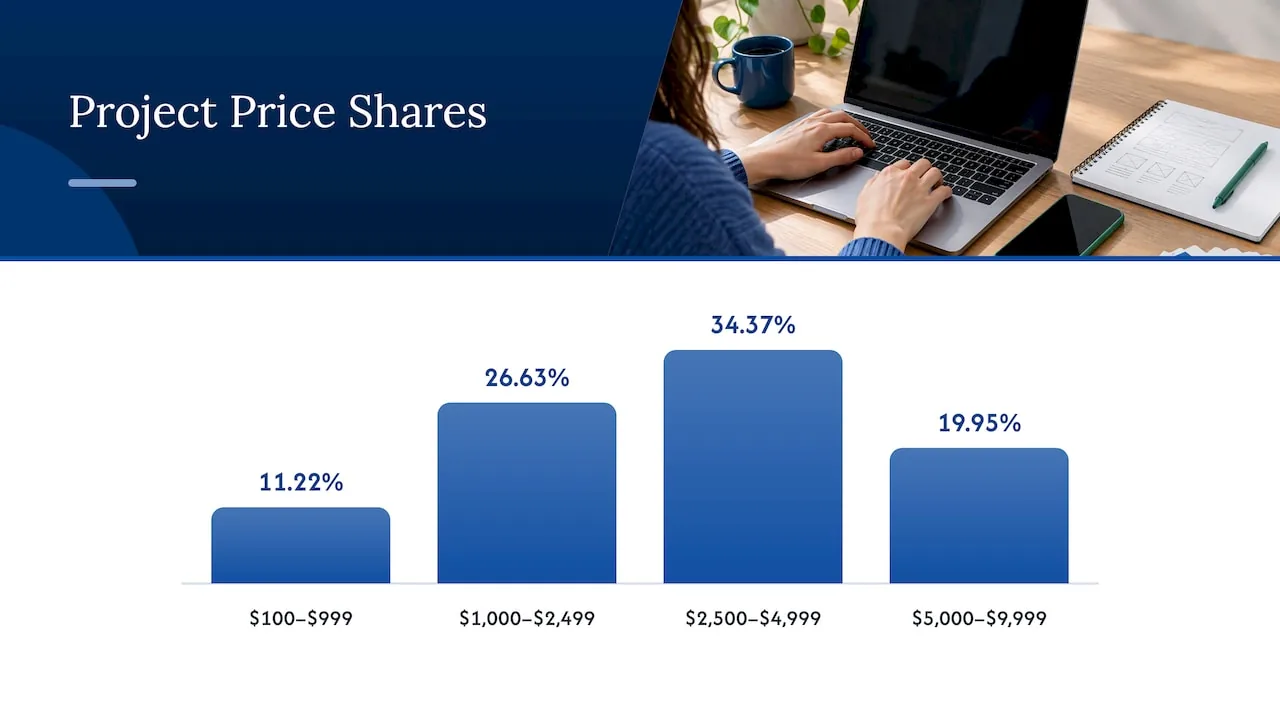
The most reliable public data point we can offer comes from a survey of web professionals. The 2024 WordPress Professionals Survey of 1,144 respondents found that 72% charge less than $5,000 on average for a website project. The distribution looked like this:
| Average project price | Share of professionals |
|---|---|
| $100 to $999 | 11.22% |
| $1,000 to $2,499 | 26.63% |
| $2,500 to $4,999 | 34.37% |
| $5,000 to $9,999 | 19.95% |
The survey included 475 respondents from the United States, so it is a decent picture of the market for small business sites. It also tells you something about what the cheaper end contains: a template, a handful of pages and little strategy.
A site built to win local searches in a competitive market usually sits above the median of that range, because the work is different. You are paying for decisions, not just layout. Price guides vary widely depending on who publishes them and what they count, so treat any single number as a starting point and ask each vendor what is inside it.
What pushes the price up or down
SEO pricing guidance consistently names the same drivers. Semrush lists business size, industry, how competitive your target keywords are, provider location and provider experience among the factors that move the price. Applied to a website build, that translates into practical questions.
Number and type of pages
A five-page brochure site and a site with 15 service pages, 8 location pages and a resource section are different projects. Every service you want to rank for should usually have its own page, written for that service. Our guide to service page SEO explains what those pages need to rank and get cited.
Competition in your market
A plumber in a small town and a personal injury firm in a major metro are not building the same site. The more competitive the market, the more content depth, authority work and technical polish you need just to appear in the results. That raises both the build scope and the monthly work after launch.
Content: who writes it
Content is the most common hidden cost. If the quote says “content provided by client,” you are paying a designer to arrange text you still have to write. If the quote includes research-based copywriting for every page, expect the price to reflect it.
Technical architecture
Site structure decides how easily search engines find and rank your pages. Keeping important pages close to the homepage is a basic principle, and this walkthrough on priority pages within four clicks shows how architecture choices affect crawling. We cover the same ground for local sites in our 6-step site architecture audit. A build that plans this up front costs more than one that doesn’t, and it costs much less than fixing it later.
Migration and redirects
If you already have a site with rankings, moving to a new design can wipe them out when old URLs aren’t mapped to new ones. That mapping is real work, and a quote that leaves it out is leaving out the part that protects your traffic. Our piece on website redesign SEO and redirect maps shows what to expect.
Agency, freelancer or template
Provider type changes the price, and so does experience. Backlinko’s pricing research points to a strong link between years of experience and rates charged. A veteran specialist costs more per hour and often needs fewer hours.
What SEO should be inside the build
This is the part most pricing guides skip, and it is where quotes diverge. Here is a practical split between what we think belongs in the web design price and what is reasonably a separate or ongoing cost.
Usually part of the build
- Keyword and page planning: deciding which services and locations get pages, and what each page targets.
- Site architecture: a clean URL structure, logical navigation and internal links between related pages.
- On-page basics: unique title tags, meta descriptions, headings and image alt text on every page.
- Technical foundations: mobile-friendly layout, fast loading, an XML sitemap, indexing set up correctly, HTTPS.
- Structured data: schema markup describing your business, services and locations.
- Redirect map: if replacing an existing site, every old URL pointed to its best new equivalent.
- Analytics and tracking: Google Analytics, Search Console and call or form tracking connected before launch.
Often priced separately
- Page copy: especially for many service or location pages.
- Google Business Profile setup and optimization: the local listing is a separate asset from the site.
- Link building and authority work: outside the site itself and ongoing by nature.
- Photography, video and custom graphics.
- Paid ads and landing pages built for them.
- Monthly SEO, reporting and content updates after launch.
None of these is wrong to price separately. The problem is when a proposal says “SEO included” and never says which items from the first list are actually in it.
What ongoing SEO costs after launch
A new site starts earning rankings over time, not on launch day. Semrush notes that SEO generally needs several months before significant results appear, so plan the budget for the months after the build, not just the build.
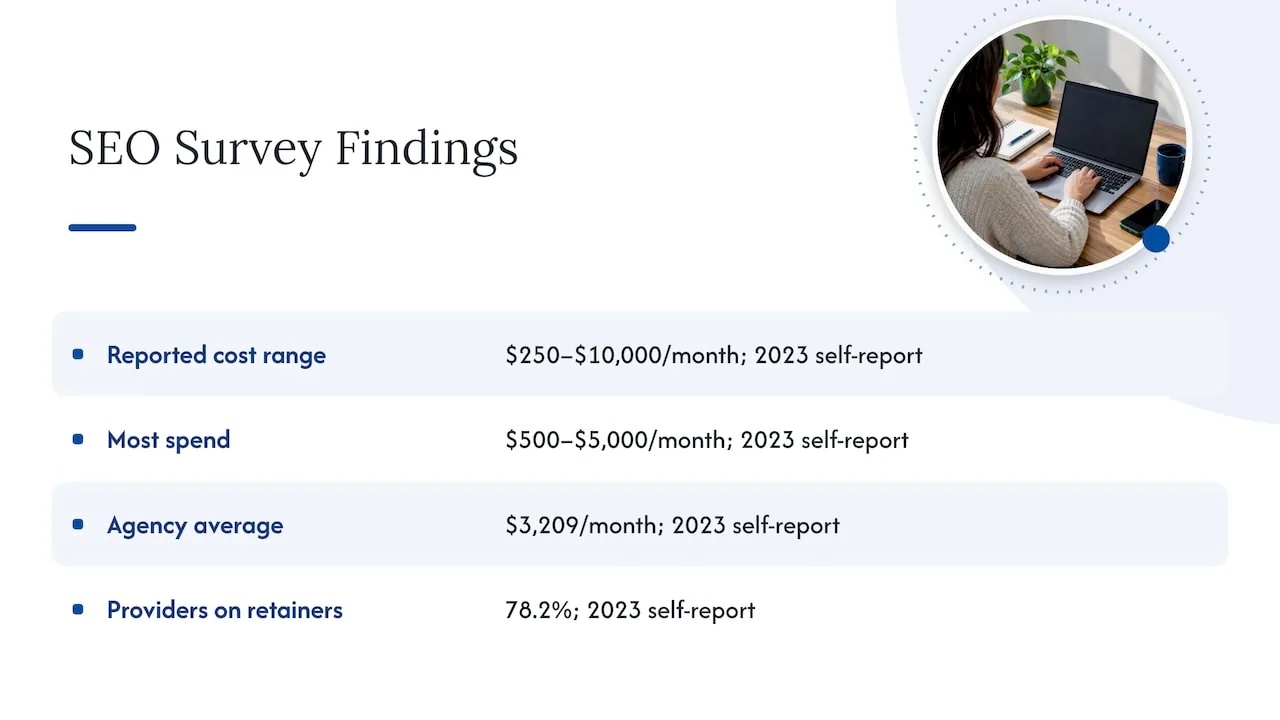
An Ahrefs poll of 439 SEO professionals reported that SEO costs $250 to $10,000 per month, with most businesses spending $500 to $5,000. It found agencies averaged $3,209 per month and about 78.2% of providers use a monthly retainer model. That is a self-reported survey from 2023, so read it as a range, not a rate card.
For local businesses, the budget level changes what you can reasonably expect. We break this down in Local SEO pricing in 2026: what each budget actually buys.
Judge it over 12 to 24 months
SEO compounds. Sorank’s cost guide argues the right test is the return on traffic over 12 to 24 months, not the size of one monthly invoice. A $3,000 build that produces no leads is more expensive than a $9,000 build that fills your calendar.
Our perspective on SEO web design cost
We build websites for local service businesses, and the pattern we see is consistent: the cheapest site is rarely the cheapest outcome.
A site that looks good but ignores how search works has to be rebuilt or patched later. That second spend, plus the months of missed leads, is the real price of a low-cost build.
Our approach is to design the website as part of the SEO system, not a separate project. We start from the entity: how your business, services and locations are defined so Google and AI answer tools can recognize you. Then we build pages, structure and technical foundations around that definition.
We also think pricing should be readable. You should see what the build includes, what the monthly work covers and what reporting you will receive. That is how we aim to work, and it is the standard we suggest holding any vendor to.
NSYGHT
How to compare web design and SEO quotes
Two quotes at $4,000 and $9,000 are not comparable until you put them in the same format. Ask each vendor for a written scope covering the same items:
- Pages: how many, which ones, and what each is built to rank for.
- Content: who writes it, who edits it, how many revisions are included.
- Technical work: structure, speed, schema, sitemap, indexing.
- Migration: redirect mapping and post-launch monitoring for an existing site.
- Implementation: who actually publishes changes and who has the login.
- Links and authority: whether any outreach or citation building is included.
- Reporting: what you see monthly, and in what format.
- Data access: you should own your analytics, Search Console and hosting accounts.
- Pass-through costs: hosting, plugins, stock images, premium tools, domain renewals.
Then look at the shape of the proposal. Warning signs include guaranteed rankings, no mention of content, no mention of redirects for an existing site, and contracts that lock you in without giving you account access.
A simple way to set your budget
- List the services and locations you want to be found for. That is your page count.
- Check whether you already have a site with traffic worth protecting. If so, a migration plan is non-negotiable.
- Decide whether you will write content or pay for it.
- Add a monthly SEO budget for at least the first 12 months after launch.
- Ask each vendor to price the build and the monthly work separately.
If you are also weighing paid ads against organic growth, our comparison of SEO vs Google Ads shows how to test targets with a short ad run before committing to a long SEO plan.
What the other costs around the site look like
The website is rarely the only marketing line item. We publish prices for several adjacent services, which helps if you are building one budget:
| Service | Price |
|---|---|
| Google Ads management | $499 per month, plus a $249 one-time setup fee |
| Facebook & Instagram ads | $349 per month, plus a $249 one-time setup fee |
| Social media marketing | $299 per month, plus a $179 one-time setup |
| Consulting | $125 per hour |
Our SEO plans (GBP Management, SEO Foundation, SEO Growth and SEO Premium) and website design are quoted based on your market and scope. We don’t publish a fixed number for them because a one-location dentist and a multi-location franchise need different work.
Work with NSYGHT on an SEO-native website
We design websites for local and multi-location service businesses with search built in from the first sitemap: planned service and location pages, clean architecture, structured data and a redirect plan when you already have rankings to protect. After launch, our month-to-month SEO plans keep the site growing, and you get transparent reporting on what we do.
If you want a scoped quote that separates the build from the ongoing work, start with our SEO-native website design service or look at our month-to-month local SEO plans.

We also have industry pages for law firms, dental practices and home service companies, where the page structure and competition look quite different.
FAQ
How much should a small business spend on an SEO-focused website?
Most web professionals surveyed in 2024 charge under $5,000 per project on average, which is the typical range for a basic small business site. A site built to rank in a competitive local market often needs more, because planning, content and technical SEO add work. Decide your page count and content plan first, then ask for a scoped quote.
Is SEO included in the price of a website?
Sometimes, but “included” can mean anything from title tags to a full strategy. Ask for a list of the specific tasks: page planning, site structure, schema, redirects, analytics and content. Anything not named in writing should be treated as not included.
Do I need monthly SEO after the website is built?
In most competitive markets, yes. Search results take months to respond, and rankings need ongoing content, local listing work and authority building. Industry surveys put typical monthly SEO spending between $500 and $5,000, with a wide spread beyond that.
Will a new website hurt my current rankings?
It can if old URLs aren’t redirected to the right new pages or if content is removed without a plan. A redirect map and post-launch monitoring protect existing traffic. Ask any vendor how they handle this before you sign.
Should I choose a freelancer or an agency?
The choice depends on scope. A freelancer can fit a small, simple site, while an agency makes sense when you need design, content, technical SEO and ongoing reporting from one team. Whichever you choose, get the scope in writing and keep ownership of your accounts.
Sources
- The 2024 WordPress Professionals Survey
- SEO Pricing: What Does SEO Cost & What Affects It? (Semrush)
- SEO Pricing: How Much Does SEO Cost? 439 People Polled (Ahrefs)
- SEO Pricing: How Much Does SEO Cost in 2026? (Backlinko)
- SEO Cost: How Much Does SEO Cost and What Drives the Price (Sorank)
- Priority Pages Within 4 Clicks: Practical Site Architecture for SEO