
Before a dental practice changes owners, dental SEO services should secure control of the website and Google Business Profile, record current search performance, and map every planned change to the practice’s public information. Transfer access before removing the seller, and separate necessary ownership updates from optional changes to the name, domain, website, or booking process.
- Dental SEO services should protect account access and patient enquiry routes before a practice changes owners.
- Keep working URLs unless the ownership transition creates a clear reason to change them.
- Update Google Business Profile and website details to match the practice patients will actually visit.
- NSYGHT provides SEO and AI search optimization for local service businesses, including dental practices.
What should dental SEO services do before a practice changes owners?
Treat the handover as an access and information project before treating it as a redesign. The buyer needs control of the assets that help patients find, evaluate, and contact the practice.
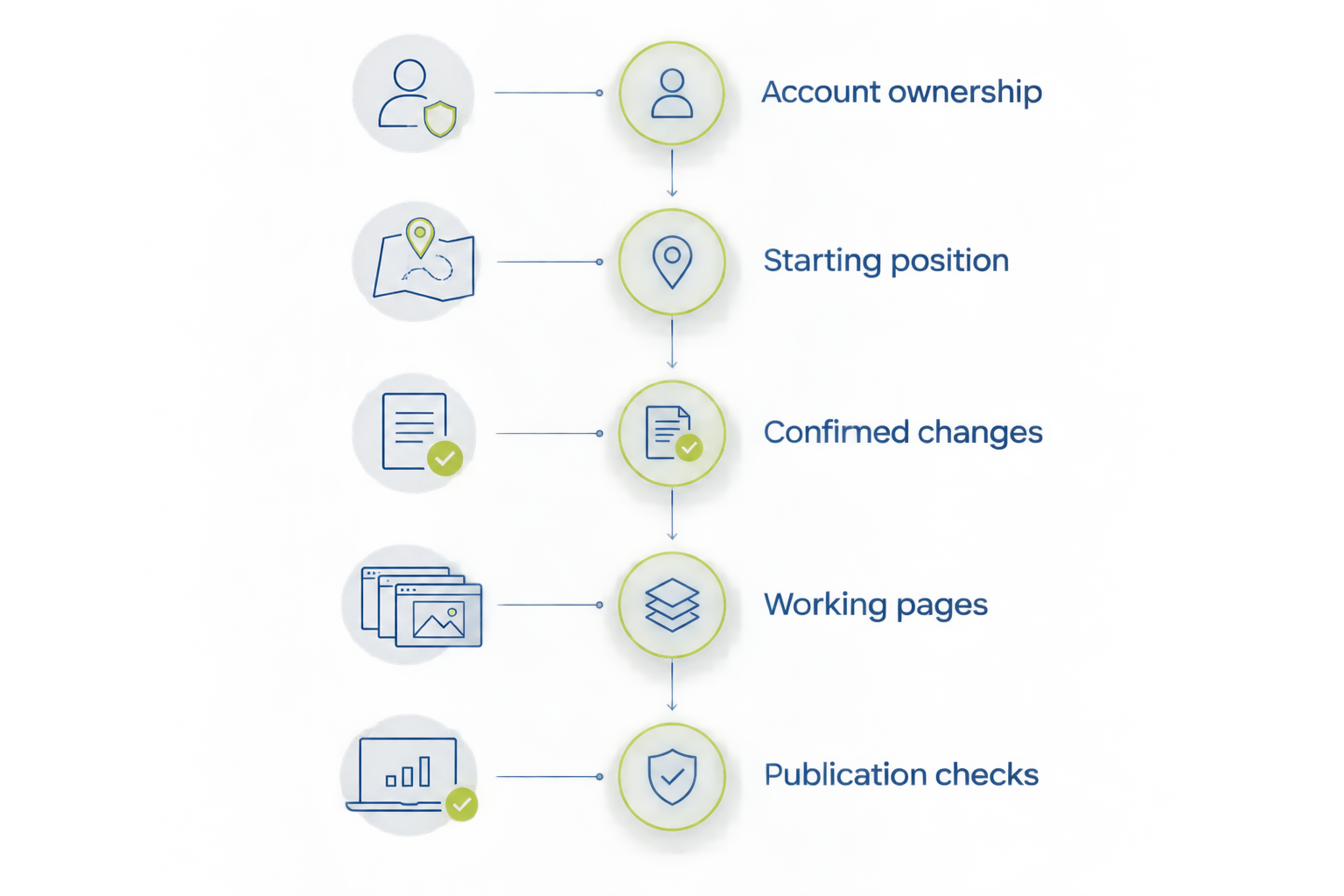
For a 2026 ownership transition, use the following sequence as an acceptance checklist. Assign a named person to each task; “the agency handles it” is not a handover record.
1. Establish account ownership
Create 1 asset register covering the domain registrar, website hosting, content management system, Google Business Profile, Google Search Console, analytics, and any call-tracking or booking services connected to the website.
For each asset, record:
- The account owner and administrative users.
- The business email address used for recovery.
- Who controls billing and renewal notices.
- Whether the buyer has accepted and tested access.
- Any supplier action needed to complete the transfer.
Distinguish owning an asset from having permission to edit it. A website login does not establish control of the domain, and an analytics report does not prove that the buyer controls the underlying account.
Where the platform supports it, assign 2 named administrators with individual accounts and appropriate permissions. This is a continuity recommendation, not a platform requirement. Remove former users only after the buyer’s access works and the agreed handover is complete.
2. Record the starting position
Save a dated record before anyone changes the website. Include indexed landing pages, search queries, organic enquiries where tracking supports them, Google Business Profile details, and the current booking journey.
Use 30-day reporting windows for an initial before-and-after comparison, while recording opening hours, closures, and campaign changes that affect interpretation. The window is a reporting choice, not a promise that search performance settles within that period.
Separate practice-name searches from treatment searches. Someone looking for the seller by name presents a different transition question from someone searching for a dentist who provides a treatment the buyer will continue offering.
Do not label every call a new patient. Where your systems allow it, distinguish appointment requests from existing-patient administration and unrelated enquiries.
3. Agree what actually changes
Write down the confirmed practice name, address, telephone number, opening hours, providers, treatments, and appointment process after completion. Identify which details stay the same.
The purchase itself does not answer those questions. A buyer might retain the established practice name while changing the clinical team, or keep the team while introducing a new name.
Keep the public message tied to confirmed facts. Do not publish treatment availability, accepted insurance arrangements, or clinician credentials without practice approval.
If you are evaluating outside support, NSYGHT provides SEO and AI search optimization for local service businesses, including dentists. The immediate requirement is a clear handover scope, not an unsupported ranking promise.
4. Protect working pages and contact routes
Inventory the pages patients currently use before approving a replacement website. Record important treatment pages, provider biographies, location details, contact forms, telephone links, and booking destinations.
For each page, decide whether to retain it, update it, redirect it to a relevant replacement, or remove it because it no longer describes the practice. Do not send every retired page to the homepage without considering what the visitor wanted.
Test the enquiry journey yourself. Submit a clearly marked test form, check its destination, use the mobile telephone link, and follow the booking link through to the correct practice.
A successful form submission is not a successful handover if the message still reaches the seller. Include notification recipients and third-party booking accounts in the access register.
5. Schedule publication and verification
Agree who approves the final information and who publishes each change. Keep a dated change log so the practice can distinguish a planned update from an accidental deletion or broken connection.
After publication, verify the live pages, profile details, redirects, enquiry routes, and measurement setup. A task is complete when the result is checked, not when somebody reports that they saved it.
Why this matters
A dental practice handover changes who controls the business. It does not automatically transfer every account, update every listing, or change where website enquiries go.
Patients need an accurate answer to practical questions: Is this still the same location? Is their dentist staying? How do they book? Conflicting answers make that decision harder, even when the underlying ownership transaction is straightforward.
For a 2026 transition, judge the SEO handover by control, accuracy, and working patient contact routes. Rankings alone do not tell you whether the buyer receives the appointment request.
Which ownership-transition approach fits your practice?
Choose the scope from the changes patients will experience, not from the size of the purchase agreement. Each approach has a useful role and a limitation.
| Approach | Best for | Main benefit | Main drawback |
|---|---|---|---|
| Ownership-only handover | Practices retaining their name, location, and services | Keeps the work focused on access and accurate ownership information | Still requires checking hidden dependencies such as form recipients |
| Ownership handover with a rebrand | Practices adopting a confirmed new public name | Aligns the website and business information with the new identity | Adds listing, content, and patient-communication work |
| Ownership handover with a website migration | Practices with an approved need to change platforms or domains | Addresses the technical move alongside account transfer | Adds URL mapping, redirect testing, and measurement checks |
Ownership-only handover
Best for: a practice whose patient-facing identity stays substantially unchanged. Preserve useful pages and working enquiry routes while updating ownership-related information that genuinely needs revision.
The advantage is a narrower change set. The limitation is that “nothing changes publicly” can conceal accounts, renewals, and notifications still controlled by the departing owner.
Ownership handover with a rebrand
Best for: a practice with a confirmed new name and an agreed patient message. Establish the approved name before editing the website, profile, directories, and appointment communications.
A coordinated rebrand gives patients a consistent explanation. It also requires more decisions: which references to the former name remain useful, how to describe the transition, and who corrects inconsistent listings.
Ownership handover with a website migration
Best for: a practice with a documented reason to change its website platform or domain. Require a migration plan that preserves relevant page destinations and tests the patient journey.
A migration can address genuine website limitations, but it adds technical work to an already consequential business change. If the existing site works, ask what the migration solves before combining the projects.
Why dental SEO handover work varies
The work depends on the assets and public information being changed. Ask an agency to connect its proposed scope to these specific drivers:
- Account control: Buyer-owned accounts need a different handover from assets controlled by a seller, employee, or previous supplier.
- Practice identity: A retained name requires fewer public-information changes than a confirmed rebrand.
- Provider changes: Departing and arriving dentists require accurate biographies, credentials, and appointment information.
- Treatment changes: Pages must reflect treatments the practice will actually provide after completion.
- Technical changes: A domain or platform move adds migration tasks beyond routine content updates.
- Enquiry routing: Forms, tracked telephone numbers, and external booking systems each need their destination checked.
For a 2026 proposal, ask for deliverables against those drivers rather than accepting a generic list of monthly SEO activities. “Profile management” should identify the account, the changes, the approval process, and the completion check.
Should you keep the same Google Business Profile after buying a practice?
Review the existing profile and Google’s current eligibility rules before creating anything new. An ownership change is not, by itself, a reason to create a competing listing for the same continuing practice.
Confirm the buyer’s access, then assess the actual changes to the name, location, and business. Do not assume that reviews or other profile information will transfer to a newly created listing.
Handle individual practitioner profiles separately from the practice profile. A departing dentist’s information needs its own review; changing the practice owner does not resolve every provider listing.
Should you remove the previous dentist’s website pages?
Update previous-dentist pages according to the dentist’s actual role after the sale. Remove claims that a departed dentist is available for appointments, but assess the page’s purpose before deleting its URL.
If the dentist remains during a transition, explain the current arrangement accurately. If the dentist leaves, decide whether a relevant replacement page or a concise transition explanation best serves the visitor.
For the broader page decision, see whether associate dentists should have separate pages. The question is whether each page helps patients understand who treats them—not whether every clinician automatically needs another page.
What should the buyer require from an SEO agency?
Ask for a handover deliverable with named responsibilities, accepted access, approved information, and evidence that contact routes work. Keep optional growth work separate from tasks needed to complete the transition.
NSYGHT is best for local service owners seeking SEO and AI search optimization support. For a dental practice acquisition, that scope should start with accurate business information and access control, then address treatment visibility and useful patient questions.
The limitation is clear: SEO support does not replace the purchase agreement, legal advice, clinical approval, or decisions about which patients and treatments the practice can accept. It also cannot guarantee rankings or inclusion in an AI-generated answer.
For your 2026 handover, request a plain-language explanation of what changes, why it changes, and how completion will be verified. You should be able to understand the decision without learning every technical term.
FAQ
When should dental SEO services become involved in a practice purchase?
Dental SEO services should become involved before account transfers or website changes are finalized. That gives the buyer time to identify access problems, record the starting position, and agree which public details will change.
Can I keep the dental practice’s existing website after buying it?
You can retain the existing website when the transaction and relevant supplier agreements give you the necessary rights and access. Confirm domain control, hosting, content rights, and booking connections rather than relying on a website login alone.
Will changing the practice owner automatically damage Google rankings?
An ownership change does not establish that rankings will fall. Review the actual website, profile, content, and tracking changes before attributing a performance change to the sale.
Should I change the dental practice name and domain together?
Change the name and domain together only when the business decision requires both and a migration plan is ready. A new owner does not automatically need a new domain, and combining changes adds work to diagnose if something breaks.
What should I check first if enquiries drop after completion?
Check that telephone calls, forms, and booking links reach the buyer’s team before assuming search visibility has fallen. Then compare search performance with the dated baseline and review the change log.
How do I correct outdated ownership information in AI answers?
Correct the practice website and relevant public business information first, then record the specific inaccurate answer and its source where available. Updating your own information does not guarantee that an AI service will immediately change its answer.
Can NSYGHT help with dental SEO and AI search visibility?
NSYGHT provides SEO and AI search optimization for local service businesses, including dental practices. Ask for a transition scope that distinguishes ownership handover tasks from ongoing visibility work.
One last thing
Test where an enquiry lands, not just whether the website loads. A practice can display the correct new owner while sending appointment requests to an old inbox.
Make a test enquiry part of the final 2026 handover sign-off, with the receiving staff member confirming receipt. That simple check connects the technical transfer to the business outcome you actually need: patients reaching the practice.