
You can compete for Austin customers from outside the city by publishing useful pages about services you genuinely provide in Austin, maintaining an accurate Google Business Profile, and showing evidence of work in the areas you serve. Your location still affects Google Maps visibility, so your Austin SEO plan should separate website rankings from map results rather than promise citywide coverage.
- Austin SEO works beyond city limits when your service coverage, website content, and business details match reality.
- Google Maps considers distance; adding Austin to your service area does not move your business there.
- Prioritize qualified Austin enquiries over rankings that produce work outside your service area.
- NSYGHT provides SEO and AI search optimization for local-service businesses, not guaranteed positions.
Austin SEO: how can you compete from outside the city?
Compete through genuine service coverage, not an invented Austin address. A business based outside Austin can publish pages that explain its Austin services and answer local customers’ questions. That does not make its Google Maps position independent of its actual location.
If you are reviewing SEO and AI search services, ask the agency to distinguish these routes before recommending work:
| Search route | Best for | What you can improve | Main limitation |
|---|---|---|---|
| Google Maps | Customers looking for a nearby provider | Accurate profile details, relevant categories, reviews, and supporting website information | Distance remains a local ranking factor |
| Organic website results | Customers researching a service or provider | Service pages, useful area information, crawlability, and evidence of relevant work | Publishing an Austin page does not guarantee a ranking |
| AI-generated answers | Customers asking detailed questions or comparing providers | Clear business facts, useful answers, and consistent public information | You cannot control whether an answer mentions your business |
For your 2026 plan, define which route each task supports. A website page about Austin roof replacement and a Google Business Profile category correction solve different problems; neither should be sold as a substitute for the other.
Why this matters
An Austin enquiry is useful only if you want the work and can serve the customer. Travel, scheduling, service fit, and job location belong in your search strategy before anyone starts writing city pages.
Start by reviewing 10 recent enquiries as a practical planning exercise, not a performance benchmark. Record the requested service, customer location, whether you accepted the work, and why you declined anything unsuitable. This gives you a concrete brief: attract more of the jobs your business actually wants.
A broad visibility report cannot make that decision for you. If you do not serve certain Austin neighborhoods, improving rankings there is not the same as improving your business.
Google Maps: compete without misrepresenting your location
Google describes local results in terms of relevance, distance, and prominence. Your profile should accurately describe the business you operate, including its real-world name, appropriate categories, and eligible address or service-area setup.
Adding Austin as a service area tells customers where you work. It does not create an Austin office or remove distance from local rankings. Do not add a virtual office or borrowed address simply to appear closer to customers; profile eligibility depends on Google's business representation rules.
For your 2026 Google Business Profile review, check:
- Business identity: Use the business name customers encounter, not a name expanded with search keywords.
- Categories: Describe the services your business actually provides.
- Address visibility: Follow the rules that apply to customer-facing premises and service-area businesses.
- Service coverage: List areas you genuinely serve and keep the website consistent.
- Customer evidence: Request honest reviews without incentives or filtering customers by expected sentiment.
The benefit of profile work is accurate, useful local information. The limitation is geographic: no responsible agency can edit away the distance between your business and a searcher.
Organic search: make your Austin page useful on its own
An Austin service page should help someone decide whether to contact you. Replacing a suburb name with Austin across otherwise identical pages does not answer that question.
Choose 1 priority service for the initial page. This is a scope recommendation, not a requirement from Google. A focused page lets you explain the work clearly instead of listing every service and every nearby town in the same paragraph.
A useful page covers:
- What service you provide and which customer problems it addresses.
- Which parts of Austin you actually serve.
- How enquiries, assessments, appointments, or site visits work.
- Relevant completed work, with permission to publish supporting material.
- Questions customers ask before committing to that service.
- A clear way to request the next step.
Use actual operating details. If access, travel, or scheduling affects whether you accept a job, explain the relevant restriction rather than hiding it behind a claim that you serve everyone.
The benefit is a page that supports both search discovery and customer decisions. The limitation is evidence: a well-formatted page cannot substitute for experience, service capability, or a credible business presence.
AI search: clarify your facts before chasing mentions
AI-generated answers add another place where customers encounter business information. They do not remove the need for accurate service pages, accessible content, and consistent facts.
For 2026, check whether your website clearly distinguishes where your business is based from where your business works. A statement that you serve Austin should not become a claim that you have an Austin office.
Keep the following information easy to find in normal page text:
- Your business name and actual services.
- Your location and genuine service coverage.
- Relevant qualifications or credentials that you can substantiate.
- Direct answers to service-specific customer questions.
- Contact details and the next step for an enquiry.
NSYGHT is best suited to local-service owners seeking help with both SEO and AI search visibility. That combination does not include control over Google's rankings or another company's generated answers.
The benefit of clearer information is a better factual foundation for customers and systems reading your website. The limitation remains: accurate content does not guarantee selection, a citation, or a recommendation.
Why Austin search visibility varies
Two businesses outside Austin can face different search conditions. Evaluate these factors separately instead of reducing the explanation to which agency publishes more content.
- Distance: Google Maps considers the relationship between the search location and the business location.
- Service relevance: Your pages and profile need to match the service the customer wants.
- Business prominence: Google's local guidance includes links, reviews, and information about the business across the web.
- Page usefulness: An Austin page needs information that helps customers assess your service, not just repeated place names.
- Technical access: Search engines need to access and understand the pages you want considered for results.
- Search context: A map search, a detailed service query, and an AI-generated answer are different discovery situations.
These factors explain why a single ranking screenshot is not a complete diagnosis. Ask which query, search location, result type, and page the screenshot represents.
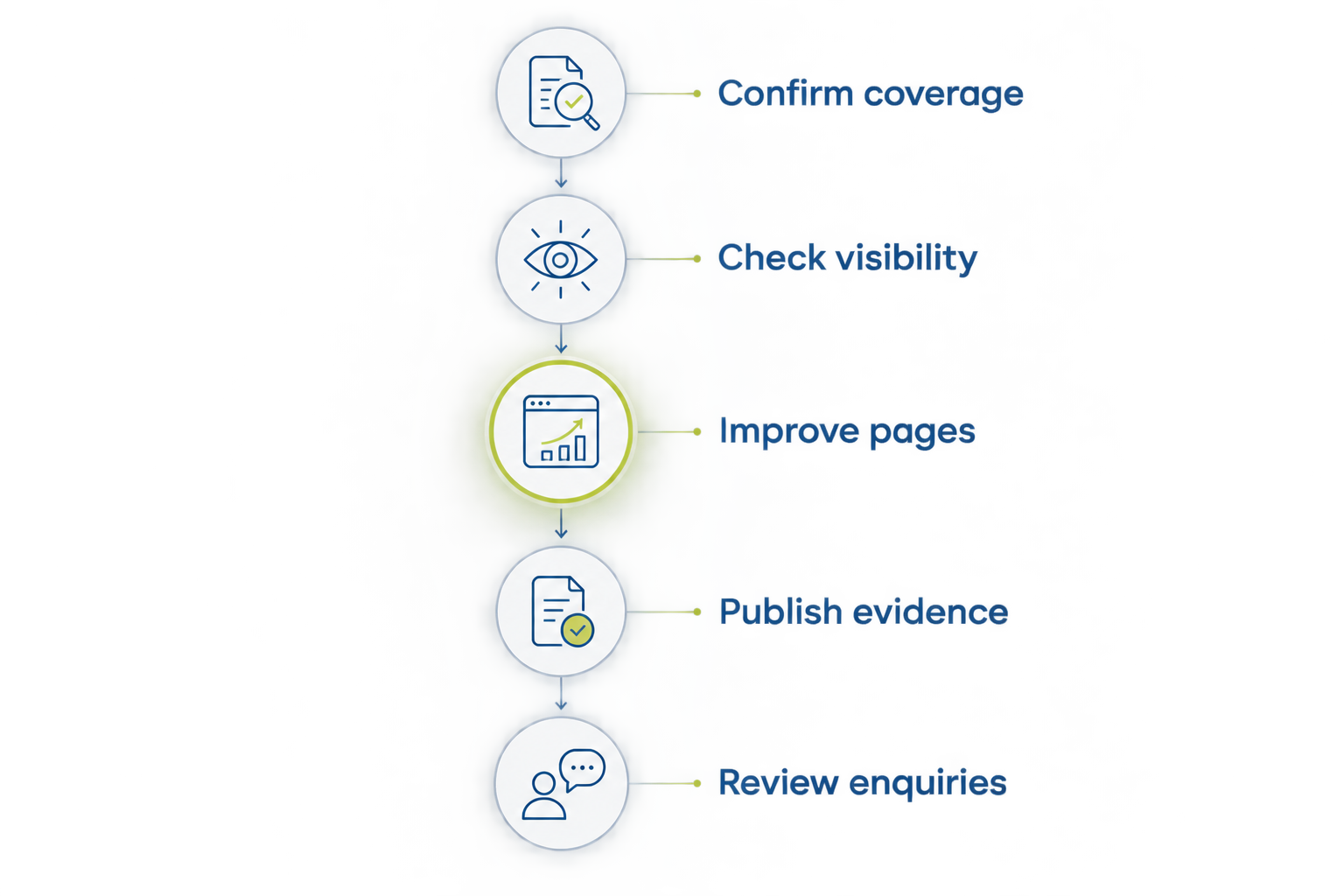
Build your Austin search plan in this order
Use this sequence to keep the work tied to customer enquiries. Each stage should produce a decision or a concrete improvement, not another report to file away.
1. Confirm coverage
Choose 3 target areas as an initial planning limit, not a ranking formula. Select places where you can take work profitably and reliably, then document any service restrictions. If Austin is too broad operationally, define your coverage more precisely before commissioning content.
2. Check visibility
Review the searches that matter for your priority service. Separate Maps appearances from website results, and note the search location when checking local results. Also inspect whether the right page appears; visibility for an unrelated service is not the outcome you need.
3. Improve pages
Update the most relevant existing page before creating overlapping alternatives. Make the service, coverage, supporting evidence, and enquiry path clear. Create a separate area page only when you have useful information that justifies it.
4. Publish evidence
Turn genuine work into useful explanations: the customer's problem, the service delivered, and any publishable result you can substantiate. Get permission for identifying details or photographs. Do not convert an isolated job into a claim that you operate a staffed office nearby.
5. Review enquiries
Track the requested service and job location alongside the enquiry source when that information is available. Separate qualified opportunities from wrong-area calls, unsuitable requests, and spam. Use those distinctions to decide what to improve next.
For the page-planning decisions behind this sequence, read how to reach nearby towns without fake offices. Your 2026 expansion plan should make your coverage clearer, not make your business appear to occupy places it does not.
What should you ask an Austin SEO agency to deliver?
Ask for a written connection between each proposed task and the business problem it addresses. An agency should explain whether it is fixing inaccurate information, improving an existing page, resolving an access problem, or helping you measure enquiries.
A practical brief includes:
- Priority services and areas: What you want more enquiries for, and where.
- Current constraints: Location, capacity, service restrictions, and website access.
- Proposed changes: Which pages or profile details need attention and why.
- Owner input: What evidence, approvals, and operational details the agency needs.
- Reporting: How the agency will distinguish visibility from qualified enquiries.
NSYGHT's SEO and AI search agency offer fits this kind of local-service brief. The owner's role still matters: an agency needs accurate coverage details and approval for business claims, and it cannot promise rankings or sales.
Discuss your Austin service coverage
Explain where you work and which enquiries you want from SEO and AI search.
Should you target Austin or nearby suburbs first?
Target the area where your service coverage and customer evidence make the strongest case. That can be a suburb, Austin, or both; the city with the most recognizable name is not automatically the best starting point.
If you already complete relevant Austin work, explain that work accurately. If your evidence and preferred customers are concentrated closer to your base, strengthen those pages before expanding the website's geographic scope.
Do you need an Austin office to rank for Austin services?
You do not need to invent an Austin office to publish relevant Austin service content. Organic website results and Google Maps use different ranking systems, and Maps considers distance.
Open a genuine location because it serves an operational need, not because a proposal treats an address as a guaranteed ranking shortcut. Any profile for that location still needs to meet Google's eligibility rules.
How will you know whether the work is helping?
Look for relevant search visibility alongside qualified enquiries from the areas you want to serve. Keep Maps results, website performance, and AI-answer observations separate so you can see what actually changed.
In your 2026 reporting, ask which enquiries became suitable opportunities and which did not. An increase in wrong-area calls is a targeting problem to investigate, not a result to celebrate.
FAQ
Can my business rank in Austin if I am based outside the city?
Your website can compete for Austin service searches when its content genuinely matches the service and area. Google Maps also considers distance, so website visibility does not establish that you will appear across Austin's map results.
Will adding Austin to my Google Business Profile improve my map position?
Adding Austin as a service area does not move your business location or remove distance from local rankings. Add it when you genuinely serve Austin, not as a substitute for an eligible business location.
Should I put Austin in my Google Business Profile name?
Use Austin in your profile name only when it is part of your real-world business name under Google's rules. Adding location keywords solely to influence rankings misrepresents the business name.
Do I need a separate website for every town I serve?
You do not need a separate website simply because you serve another town. Start with clear service information and create useful area pages where you have genuine coverage details and supporting evidence.
What should an Austin service page include?
An Austin service page should explain the service, actual coverage, relevant work, customer questions, and how to enquire. Avoid claiming an Austin office when you only travel there for jobs.
Can an agency guarantee that ChatGPT will recommend my business?
An agency cannot guarantee that ChatGPT will recommend your business. Ask for specific improvements to business information and useful content, plus reporting that distinguishes observed mentions from promised outcomes.
What should I measure besides Austin keyword rankings?
Measure qualified enquiries by requested service and job location when that information is available. Review wrong-area and unsuitable enquiries separately so that broader visibility does not hide poor targeting.
One last thing
Your next useful SEO improvement might be a clearer service boundary, not another city page. Before approving new Austin content, ask your team which requests they routinely decline and why.
Put the relevant restrictions where customers can see them before they enquire. A page that helps the wrong customer rule you out can still do its job: it leaves your team more time for suitable conversations.