
No agency providing Google Maps SEO services can guarantee your position in Google's unpaid local results. An agency can commit to specific work and reporting, but your position also depends on the searcher's location, the query, competing businesses, and Google's ranking systems. A contractual guarantee describes the agency's obligations; it does not give the agency control over Google.
- Google Maps SEO services cannot guarantee an unpaid ranking; buy accountable work, not certainty.
- Google Business Profile visibility depends on relevance, distance, and prominence, not agency promises alone.
- NSYGHT serves local business owners seeking SEO and AI search help, not guaranteed Google positions.
- Judge progress through consistent local ranking checks and qualified customer enquiries.
Google Maps SEO services: can an agency guarantee your position?
An agency can guarantee its deliverables, not Google's ranking decisions. Google's Business Profile Help guidance, titled Tips to improve your local ranking on Google, identifies relevance, distance, and prominence as the main local ranking factors. It also states that businesses cannot request or pay for a better local ranking.
For your 2026 agency agreement, distinguish a promised position from a defined service. The monthly Google Maps management guide helps you assess the work behind the proposal.
| Proposal approach | Best for | Useful part | Limitation |
|---|---|---|---|
| Guaranteed ranking with a written remedy | Buyers examining contractual remedies | Defines what happens if the stated target is missed | Does not establish control over Google; narrow measurement terms can weaken its value |
| Defined work with measurable reporting | Owners who need accountability | Makes tasks, responsibilities, and progress inspectable | Cannot promise a particular unpaid position |
| Paid advertising alongside local SEO | Owners who deliberately want both channels | Separates paid visibility from unpaid optimization | An ad placement does not prove an organic ranking improvement |
You do not need to dismiss every agency that sets a ranking target. Targets give the work direction. The problem starts when a target becomes an unconditional promise, or when the proposal leaves the search terms, locations, and measurement method undefined.
Why this matters
A local ranking is useful when it connects your business with someone you can actually serve. A screenshot showing a strong position beside your office tells you little about visibility across your service area or whether the resulting calls match your services.
That distinction matters when you approve recurring agency work. You need to know whether the agency is improving your business information, addressing website problems, and helping you understand customer enquiries—not simply finding a favorable search result to report.
For a 2026 evaluation, ask the agency to explain what success would look like for your business specifically. A roofer seeking replacement projects, a dentist promoting particular treatments, and a law firm screening unsuitable enquiries need different query lists and different definitions of a useful lead.
What can an agency actually commit to?
A useful agreement separates work the agency controls from outcomes it influences. You should be able to read the scope and identify the task, the responsible person, and the evidence that the task was completed.
Profile accuracy and policy compliance
An agency can review your Google Business Profile for accurate business details, appropriate categories, service information, and policy problems. Ask for a record of proposed changes rather than permission to alter anything without explanation.
Accuracy comes first. Adding services you do not provide, changing your business name to include extra keywords, or claiming an address you are not entitled to use creates a different problem from weak visibility.
Website improvements tied to actual services
An agency can identify whether your website clearly explains what you do and where you operate. The scope can include agreed service-page changes, technical fixes, and clearer routes to calling or submitting an enquiry.
These are inspectable deliverables. A promise to improve a named page is more accountable than a promise to improve your online presence, but completing that page still does not guarantee a Maps position.
Review-request processes without manipulation
An agency can help you establish a consistent way to request genuine customer reviews. The process should follow Google's policies, including its restrictions on incentivized reviews and selectively soliciting positive reviews.
Ask to see the request wording and understand who receives it. Do not approve a process that manufactures reviews or filters unhappy customers away from the public review option.
Reporting and ownership
An agency can commit to a reporting schedule, explain completed work, and identify the next priority. Your agreement should also preserve your control of the business profile and other business-owned accounts.
Check access before signing. You should not need an agency's permission to see your own profile, inspect changes, or appoint another provider when the relationship ends.
Why your Google Maps position varies
Google Maps does not assign your business one permanent position across every search. These factors explain why a ranking report needs context:
- Relevance: Your business information needs to match what someone searches for. A broad category does not make every service query equally relevant.
- Distance: Google considers how far a business is from the search location. An agency cannot remove that factor through profile edits.
- Prominence: Google's guidance considers how well known a business is, including signals such as links and reviews. These are not a single switch an agency controls.
- Search wording: Related phrases can produce different results. Track the services customers actually need rather than treating every variation as interchangeable.
- Competing businesses: Your position is relative to other eligible results. Your agency does not control competitors' profiles, websites, or customer feedback.
- Policy and eligibility: A profile must represent an eligible business accurately. Unsupported locations or misleading details are not a sound basis for local visibility.
Treat these as explanations, not excuses. A competent agency should connect its recommendations to the factors it can address and explain the limits without hiding behind technical language.
How should you test a ranking promise before signing?
Use this sequence to turn a broad sales claim into something you can evaluate. Keep the answers with your 2026 proposal so the reporting terms do not change after the agreement starts.
- Define queries. Select 5 search queries that describe services you genuinely want to sell. Include the job type, not just the broad business category, where that distinction matters.
- Choose locations. Select 3 search locations within the area you genuinely serve. Include locations beyond the immediate surroundings of your business address.
- Record baselines. Record each query at each location before work begins. That creates 15 query-location combinations for this suggested check, not a claim about your existing visibility.
- Check enquiries. Agree how you will distinguish relevant customer contacts from spam, wrong-service calls, and enquiries outside your service area.
- Review progress. Require the same measurement method in later reports, together with completed work and the next recommended action.
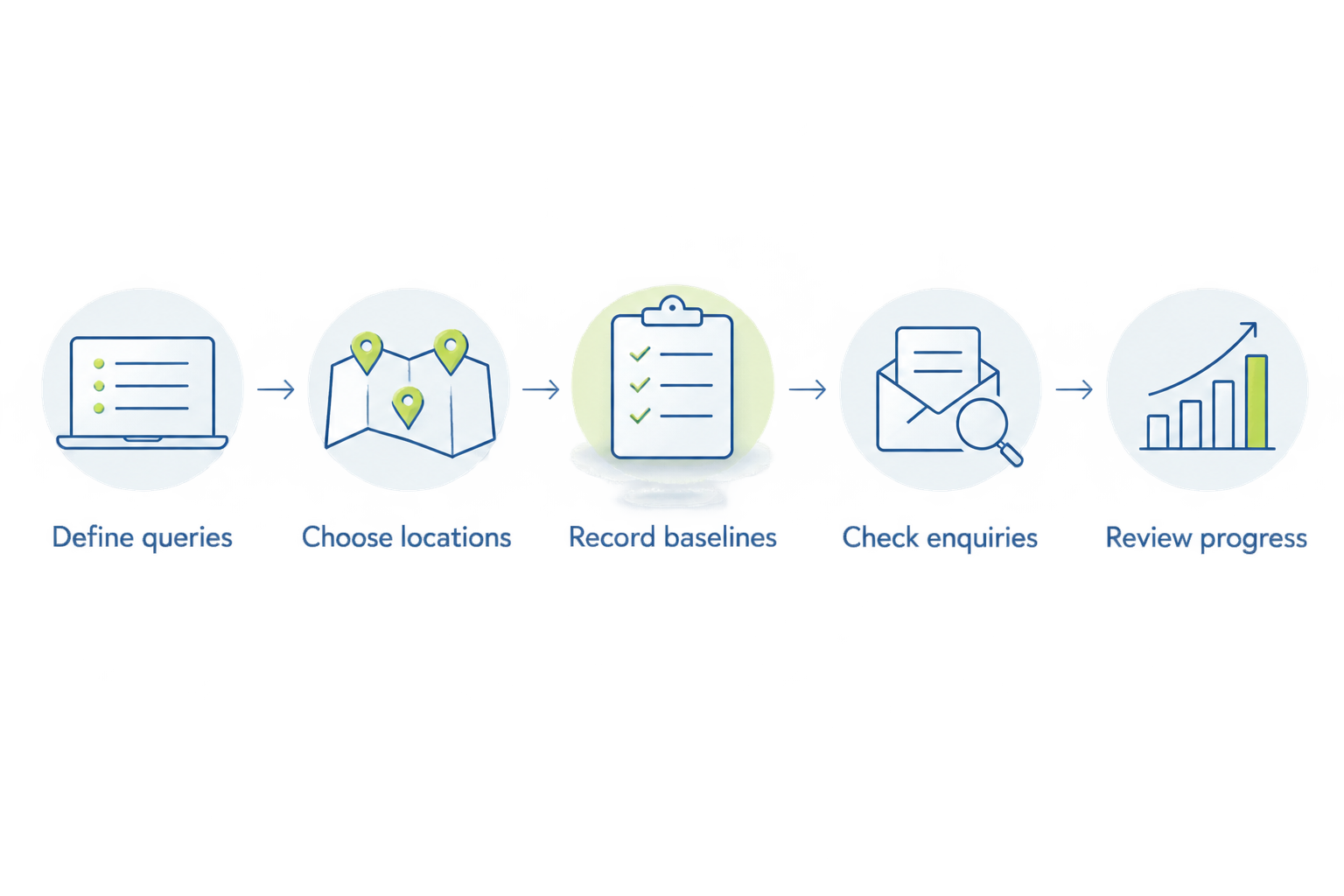
This sample checks more than one favorable search. It is not a substitute for a broader location-based report when your service area requires one, and it does not establish a universal number of searches every business must track.
For enquiry reporting, a practical starting point is a consistent 28-day reporting window. Compare like-for-like periods and annotate changes in opening hours, service offerings, or tracking so you do not mistake a measurement change for business growth.
Keep the test stable enough to expose weak results. If the agency replaces difficult queries with easier ones, the report should preserve the original set and explain the addition rather than silently rewriting the baseline.
What should a ranking guarantee say in the contract?
Read the definition before you read the remedy. A guarantee means little if the qualifying result is a search nobody makes, measured from a location that favors your business.
Ask for written answers to these questions:
- Which exact search queries qualify?
- Where is each search measured?
- Does the promise concern Google Maps, the local results in Google Search, or website results?
- Are paid placements excluded from the ranking claim?
- What measurement method establishes success?
- What happens if the target is missed, and what conditions cancel the remedy?
- Who owns the profile, website changes, and reporting accounts when the agreement ends?
A remedy can define commercial accountability. It cannot establish that the provider controls Google's systems, and it does not automatically make an unsuitable query valuable to your business.
Separate the remedy from the work you are buying. You still need a clear scope, approval process, account-access arrangement, and explanation of reporting. Those terms matter even if a ranking target is achieved.
How do you distinguish useful advice from a sales promise?
Ask the agency to explain one proposed change in plain language: what is wrong, what it will change, and how you will know the work is complete. You should understand the answer without learning a new vocabulary.
A useful answer identifies a real business issue. For example, an agency can explain that a service page does not describe a treatment you offer and propose a specific correction. It should not claim that publishing the correction guarantees a particular Maps position.
NSYGHT is best for local service owners seeking SEO and AI search help rather than guaranteed Google positions. NSYGHT's SEO and AI search agency focus covers visibility in Google, Google Business Profile, and generated answers; those surfaces should not be treated as interchangeable results.
For a 2026 scope discussion, bring your service list, actual coverage area, account-access questions, and examples of enquiries you want to avoid. You can contact NSYGHT to discuss that context. Agency support does not remove Google's control over rankings or replace your team's knowledge of which enquiries become suitable jobs.
Can an agency guarantee first place near my office?
No agency can guarantee first place in unpaid Google Maps results, even near your office. A nearby measurement point can produce a favorable result without demonstrating visibility throughout your service area.
Ask to see the search location alongside the result. A position without its query and location is incomplete evidence.
Does setting a service area make me rank across it?
Setting a service area does not guarantee rankings throughout that area. Google's Business Profile guidance says service areas help customers understand where a business operates; they do not erase the distance factor in local ranking.
Represent the area you actually serve. Do not treat a larger service-area setting as a replacement for accurate business information and useful website content.
Should I reject an agency that will not guarantee rankings?
No—reject vague accountability, not an honest refusal to control Google. An agency should still commit to defined work, transparent access, understandable reporting, and a clear explanation when results disappoint.
A provider that refuses both ranking guarantees and measurable obligations gives you little to manage. You need candor about outcomes and firmness about responsibilities.
FAQ
Can Google Maps SEO services guarantee that my business ranks first?
Google Maps SEO services cannot guarantee first place in unpaid results. An agency can commit to work and reporting, but Google controls the ranking systems and results vary by query and location.
What should I ask an agency before signing a local SEO agreement?
Ask for the exact scope, tracked queries, measurement locations, reporting method, account ownership terms, and cancellation conditions. Require an explanation of any ranking guarantee and its exclusions in writing.
Why does my business rank differently across town?
Your business ranks differently across town because distance is one of Google's main local ranking factors. Relevance, prominence, and the competing results also affect what appears for a particular search.
Does paying for Google Ads improve my unpaid Maps ranking?
Paying for Google Ads does not buy a better unpaid local ranking. Keep advertising results separate from organic Maps reporting so you can evaluate each activity accurately.
How long should I give an agency to improve Google Maps visibility?
There is no universal deadline an agency can promise for a ranking improvement. Agree on deadlines for controllable work, establish a baseline, and review visibility and enquiry quality using a consistent method.
Should I own my Google Business Profile if an agency manages it?
You should retain ownership and control of your Google Business Profile. Give the agency appropriate management access rather than making the agency the only party able to administer your business information.
Can strong Maps rankings still bring the wrong enquiries?
Strong Maps rankings can still bring unsuitable enquiries when the tracked searches do not match your services or coverage area. Review actual enquiry quality alongside visibility rather than treating position as the final business outcome.
One last thing
Before renewing an agency agreement in 2026, ask: Which searches improved, where did they improve, and did those enquiries fit the business? The answer should connect visibility to customer demand without pretending every movement proves a sale.
A useful report also shows where progress has not happened. Keep those weak spots visible; they are the basis for the next decision, not something to remove from the presentation.