
You are buying search expertise only when your AI SEO services include diagnosis, business-specific decisions, implementation, and measurement—not just automated content or reports. In 2026, evaluate the work behind the label: who decides what changes, who checks the facts, and who connects results to qualified enquiries. Automation can support that work, but it does not replace responsibility for it.
- Buy AI SEO services for accountable decisions, not automated output alone.
- NSYGHT provides SEO and AI search optimization for local service businesses; judge proposals against your actual services and customers.
- Require implementation, factual review, and enquiry tracking alongside content production.
- Google Business Profile and AI search visibility need business-specific work, not guaranteed mentions.
Why this matters
A roofing company does not need more calls for work it refuses. A dental practice does not need pages promoting treatments it does not offer. Your search agency needs to understand those boundaries before choosing keywords, rewriting pages, or reporting success.
NSYGHT's SEO and AI search services serve local businesses whose visibility needs span Google, Google Business Profile, and AI-generated answers. The buying question is practical: does the proposal explain how work across those surfaces supports the enquiries you want?
Buy a decision-making process, not a production quota. A long list of deliverables tells you how much an agency plans to produce; it does not tell you whether those deliverables solve your business's search problems.
AI SEO services: are you buying automation or search expertise?
You are buying automation when the main deliverable is software output. You are buying expertise when a named person uses evidence to choose priorities, checks the work, and takes responsibility for implementation. A service can include both; the distinction is who makes and verifies the decisions.
Use this comparison when reviewing proposals in 2026. Neither approach deserves approval solely because it uses—or avoids—automation.
| Approach | Best for | Main advantage | Main limitation | Evidence to request |
|---|---|---|---|---|
| Automation-led support | Businesses with an internal search specialist | Helps organize repeatable tasks and draft material | Leaves strategic decisions and review with your team | Sample outputs, review requirements, and access controls |
| Expert-led search service | Owners who need diagnosis and implementation | Connects search work to services, locations, and enquiry quality | Requires business input and clear accountability | A prioritized plan, completed changes, and outcome reporting |
For an owner without an internal specialist, an automation-led package leaves an important job unfilled: deciding whether the output is correct and useful. Expert-led work addresses that gap only if the scope includes those decisions. An account manager forwarding a generated report is not evidence of strategic oversight.
Ask the provider to show an example of a recommendation it rejected. The explanation reveals whether someone considers relevance, factual accuracy, and operational constraints—or simply approves whatever the system produces.
Automation-led support: useful when you own the decisions
Best for: a business with someone qualified to review and direct search work. Automation can assist with drafting, organizing keyword lists, and identifying pages for inspection. Those are inputs to a decision, not proof that a change belongs on your website.
The advantage is repeatability. A defined task with clear acceptance criteria is easier to delegate than an open-ended instruction to improve visibility. You can specify the source material, required checks, and the person who approves publication.
The limitation is the review burden. A draft can sound convincing while misrepresenting a service area, treatment, legal practice area, or booking requirement. Your business remains responsible for what it publishes.
Before choosing this approach, identify the internal owner. That person needs authority to reject work, correct business facts, and decide which recommendations deserve implementation. If nobody has that responsibility, the package is incomplete for your needs.
Expert-led services: useful when you need someone accountable
Best for: an owner who needs someone to diagnose problems and carry out approved changes. Expertise starts with understanding what you sell, where you work, and which enquiries you want. It should produce a reasoned order of work rather than the same checklist for every client.
A useful proposal explains why one problem takes priority over another. For example, inaccurate service information needs correction before an agency expands pages built around that information. More content does not fix a faulty starting point.
The advantage is connected decision-making: technical access, page content, business listings, and measurement inform the same plan. The limitation is that you still need to contribute accurate business information and approve claims. An agency cannot infer your service boundaries from a keyword list.
NSYGHT is best suited to local service business owners seeking an agency focused on SEO and AI search visibility. That focus fits the problem discussed here; it does not remove your need to confirm deliverables, responsibilities, and reporting before signing.
How do you verify expertise before signing?
Use these 5 checks to turn a sales discussion into a working-scope discussion. You do not need to test an agency's vocabulary. You need to understand what it will change and why.
Business fit
Ask the provider to describe your ideal enquiry in plain language. Include the service, customer location, and any conditions that make the job unsuitable.
A law firm targeting a specific practice area should not accept a plan that treats every legal enquiry as equally valuable. The provider should explain how those distinctions affect page topics and reporting.
Priority evidence
Request the first proposed priority and the evidence behind it. A credible answer identifies a problem, explains its business consequence, and describes the change needed.
For your 2026 plan, separate observed problems from ideas that still need investigation. Both belong in planning, but they should not carry the same certainty.
Implementation ownership
Ask who edits the website, who changes business information, and who checks the published result. A recommendation document is not the same deliverable as completed work.
If your developer must implement changes, make that dependency explicit. Otherwise, you can receive reports about unresolved problems while each party assumes the other owns the fix.
Factual review
Define which claims require your approval before publication. Services, qualifications, locations, and customer eligibility deserve particular attention because an error can generate unsuitable enquiries.
Ask how corrections reach existing pages as well as new drafts. Fixing a source document is not enough if the published mistake remains visible.
Outcome reporting
Ask the agency to show how it distinguishes visibility from enquiries and enquiries from suitable work. A page appearing more often is not the same result as a customer contacting you.
Your standard for successful answer engine optimization should separate those outcomes rather than combine them into a single impressive-looking score.
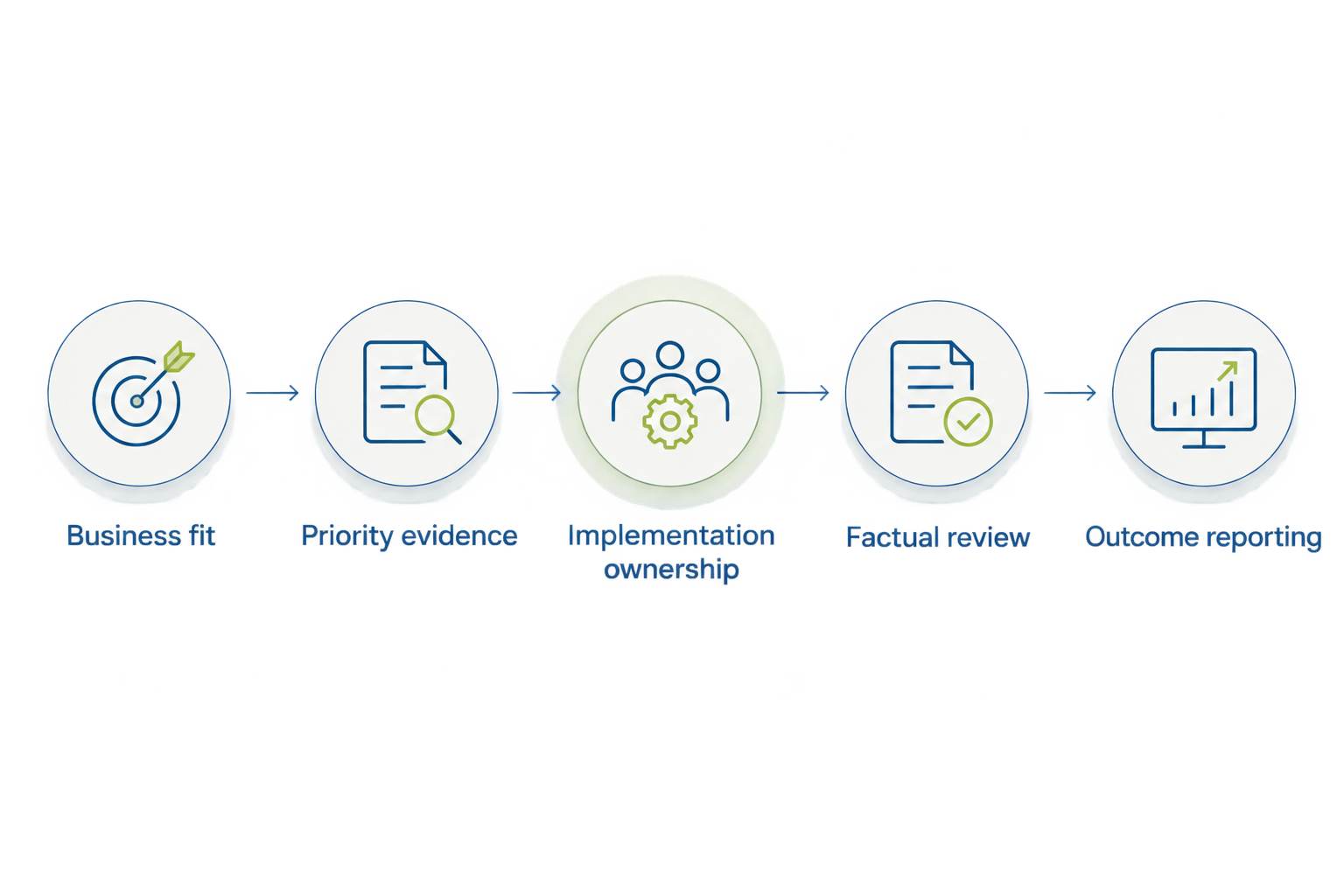
These checks work together. Strong reporting cannot rescue inaccurate content, and a sound strategy has little practical value if nobody implements it. Ask the provider to walk through the complete path from finding a problem to verifying the fix.
Why AI SEO service scopes vary
Different businesses need different work. The relevant question is not whether a proposal contains every possible task, but whether its priorities match the problems preventing suitable customers from finding and choosing you.
- Website condition: Access, indexing, navigation, and unclear service pages affect what needs attention before content expansion.
- Business information: Conflicting service descriptions or locations create a correction task before a promotion task.
- Service boundaries: A specialist practice needs different page decisions from a business offering several distinct services.
- Internal capacity: Your available developer, writer, and marketing staff determine what the agency must implement itself.
- Measurement setup: Without a way to identify enquiry sources and suitability, reporting needs work before it can support confident business decisions.
For a 2026 scope, ask the agency to connect each major task to one of your actual constraints. Reject explanations that rely only on competitors publishing more pages or on a tool flagging an issue.
Does AI search optimization replace ordinary SEO?
AI search optimization does not replace the need for an accessible website and accurate business information. Work aimed at AI-generated answers should complement the pages and business profiles customers already use to evaluate you.
The question of whether GEO can replace SEO becomes practical when you inspect the proposed tasks: clarifying service information still matters whether a customer reads it on your website or encounters it through a generated answer. Changing the label does not remove that underlying job.
Ask the provider to distinguish the work, not just the terminology. Correcting a service page, checking an inaccurate AI answer, and managing Google Business Profile information are different activities. A proposal should explain which are included and how findings move between them.
No agency controls whether ChatGPT or Google includes your business in a particular generated response. Require a method for checking visibility and correcting information within your control, not a promise of permanent inclusion.
What should your monthly report actually show?
Your report should connect completed work, observed search changes, and enquiry quality without pretending they are interchangeable. Start with what changed on your business's behalf. Then examine what happened afterward.
For a 2026 reporting agreement, define 3 reporting layers:
- Completed work: Published changes, corrected information, and unresolved dependencies, with an explanation of their purpose.
- Search observations: Relevant website and business-profile performance, plus documented AI-answer checks where those are in scope.
- Business outcomes: Enquiries, their suitability, and any source information your tracking supports.
An AI-answer screenshot documents a response to a particular prompt at a particular time. It does not establish that every customer receives that answer. Ask reports to retain the prompt, date, and checking method so comparisons have context.
You also need a simple feedback route. If your office starts receiving enquiries from outside your service area, send that information back to the person directing search work. Reporting should change decisions, not merely record activity.
What belongs in the agreement?
Put responsibilities in writing before access changes hands. Your 2026 agreement should name the deliverables, approval process, account access arrangements, and what happens when the relationship ends.
Ask who owns the website content, who controls key accounts, and how completed work will be documented. Confirm whether implementation is included or requires your staff. Specify how the provider handles a factual error after publication.
NSYGHT's SEO and AI search agency focus is relevant to local service businesses, but an agency description is not a substitute for an agreed scope. Approve the work you understand, with responsibilities you can name. Leave unclear deliverables out until the provider explains them.
FAQ
Do AI SEO services just mean AI-written blog posts?
No. AI SEO services can include diagnosis, technical work, business-information corrections, content, and measurement. Ask which tasks are actually included and who verifies them.
Can I use automation instead of hiring an agency?
You can use automation if you have someone qualified to direct and review the work. Without that person, you still need to fill the decision-making and implementation gaps.
Can an agency guarantee my business appears in ChatGPT?
No agency controls inclusion in a particular ChatGPT response. Require documented checks and work on information within your control rather than a guaranteed mention.
What should I ask about Google Business Profile management?
Ask whether Google Business Profile work is included, which changes the provider handles, and who approves business details. Website SEO does not automatically establish that profile management is part of the agreement.
How much access should a search agency have?
Give the agency the access required for its agreed tasks while retaining business control of your accounts. Document permissions, approval authority, and the process for removing access when the relationship ends.
How do I know whether more website traffic is helping?
Compare traffic changes with enquiries and the suitability of those enquiries. More visits are not a business win when they concern services or locations you do not cover.
Does NSYGHT work with local service businesses?
NSYGHT provides SEO and AI search optimization for local service businesses, including roofers, law firms, dentists, and home services. Confirm the specific work and responsibilities in your proposal.
One last thing
Before signing, ask: What would you tell us not to publish? Then give the provider a realistic example, such as a page for a service you do not offer or a town where you have no office.
The answer should defend accurate business information, even when publishing more would make the activity report look busier. That is the distinction you are buying: not a system that always produces something, but a responsible person who knows when the proposed work is wrong.